

If you’ve read part 1, part 2, and part 3 in this post series, have done the dry fire work suggested, and have verified progress with the suggested live fire, then you have already invested a good measure of time, which is our most finite and valuable resource, into becoming more proficient with your firearm. That suggests that to some degree getting better is important to you and you are serious about it. As such, I’d argue it’s time to invest in a shot timer because it’s undeniably the most valuable practice tool in the tool box.
From here on out in this series, we are going to be using time to measure improvement and to set goals. The drills by themselves will be of some value initially, but one can only get so much from them without a shot timer.
Shot Timer Options
The most important feature on a shot timer in the context of dry fire practice is the ability to set a par time. A par time is a time limit that is denoted by a second beep following the initial start signal beep. Since most dry fire practice is done alone, the next most important feature is a randomized delayed start signal. There are additional features which are helpful, but they are nice to have and we will cover those here shortly. However, a par time and delayed start are the key features for a shot timer. Without them, the shot timer isn’t much use in this context.
Shot Timer Apps
Don’t worry if you don’t have the cash available right this instant to drop on a shot timer. There are some low cost options available assuming you have an iOS or Android smartphone or tablet. Let’s look at these first:
- Range Buddy is a free app with in app purchases that includes a dry fire tool and tracker. That dry fire tool is a timer that has a randomized delayed start and par time features. You can also connect with me via the instructor market place that is available in the app.
- Dry Practice Drill is currently a $4.99 app that is essentially a timer app with a fixed delayed start (called a reset time in the app) and a par time. Setting it is a bit more involved, but not overly complicated, since it requires creating a drill, naming it, and setting up the par time.


One benefit these two options have over stand alone shot timers is that the start and par time signals can be silent to everyone else around you when using headphones. These apps also come in quite handy while traveling when the physical shot timer is left at home. Last but not least, both of these apps have the concept of reps so you can set it up to repeat a predetermined number of times which can help make planned practice sessions more efficient.
Physical Shot Timers
There are few additional features I find helpful in dry fire. These are in order of what is most important to me:
- Adjustable sensitivity – Turning the sensitivity way up allows a timer to pick up sounds like a dry fire trigger break or a magazine being inserted. With this one can review “split times” between recorded sounds to see what the timing is between different manipulations in a drill to check for consistency or identify areas of improvement.
- Adjustable signal/beep volume – Shot timers are designed to be loud so they can be heard on a shooting range. Loud start signals in the home can be quite annoying to other occupants. While annoying other occupants can be entertaining, doing so on the regular isn’t conducive to maintaining good relations.
- Multiple par times – Multiple par times means having multiple beeps after the signal. This can be helpful to put a time limit on a component of a drill. For example, when working on a drill with a short total par time having a lighting fast draw becomes incredibly important so setting the first par time to be the indicator for when the draw to first hit should be completed can help one learn about the consistency in their fast draw.
Again, all of these additional features are nice to have and not required.

Now, let’s take look at some popular timers.
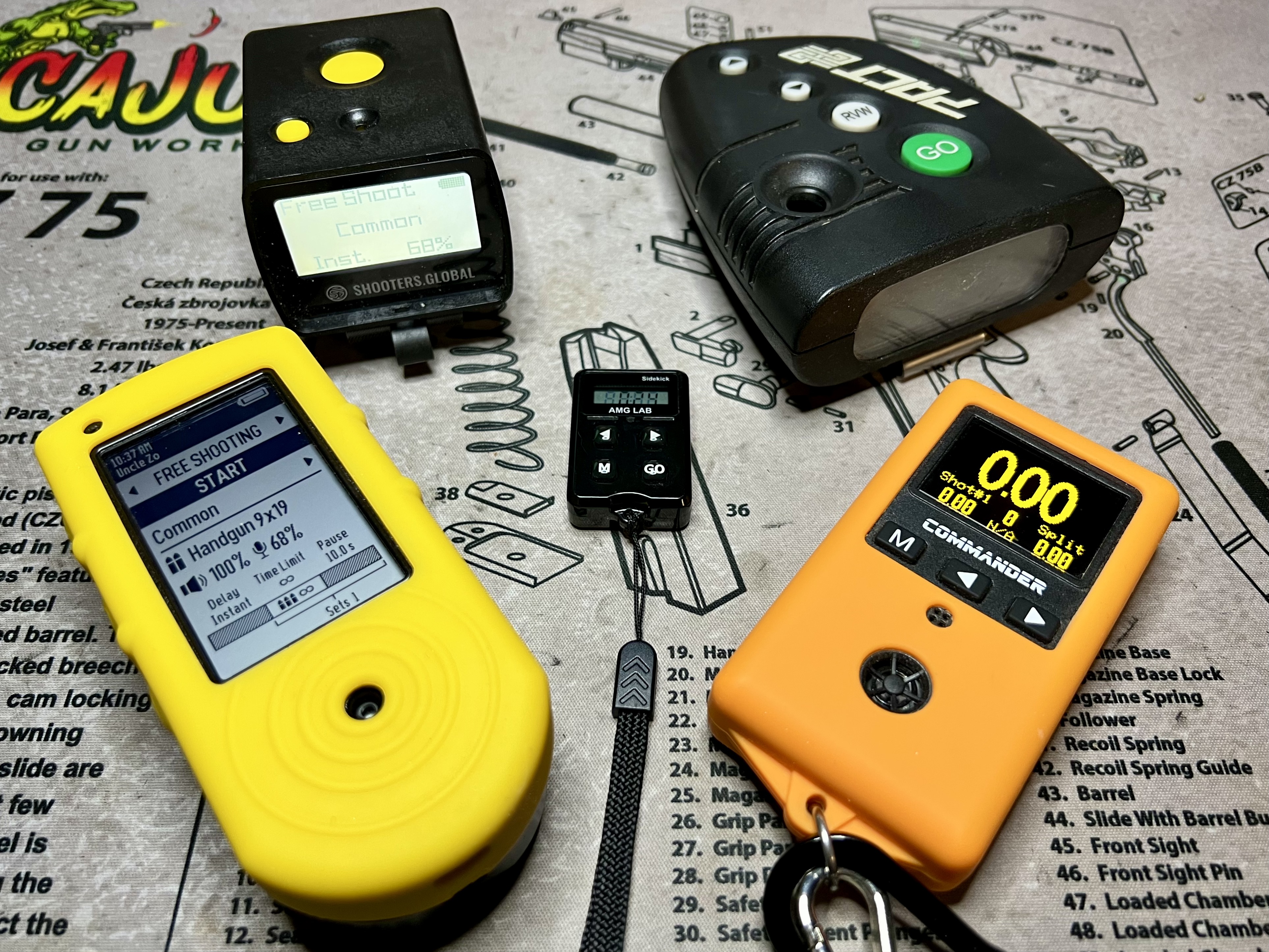
- Competition Electronics Pocket Pro ($150) – This is a staple in the training industry that has been around for a long time. It is Karl Rehn‘s favorite timer. It’s a good unit that is very easy to use. It is particularly friendly at setting and changing a par time quickly which is key for dry fire practice. It also features adjustable sensitivity and randomized delayed start. It doesn’t support multiple par times and doesn’t have an adjustable signal volume. This specific model is becoming harder to find since the introduction of the newer ProTimer and ProTimer BT models to the market which make setting par times a slower, more involved process.
- Kestrel KST1000 Shot Timer ($299) – Compared to other shot timers on the market, this is a relatively new rugged timer with all the bells and whistles which is reflected in the price tag. It is currently Ben Stoeger‘s go to timer which says a lot given how many Pocket Pro timers he’s broken over the years. With all those bells and whistles, you get all the key and nice-to-have features.
- AMG-LAB Commander ($158) – As far as I can tell, this shot timer was popularized by its integration with PractiScore and PractiScore’s app which are respectively used to organize and score hundreds of matches each year. As a side effect, this timer seems to always be on backorder and the lead times are pretty lengthy. For example, it took roughly ten weeks from the time I ordered mine to the time it was delivered. I lead with this because it is my current favorite shot timer that includes all of the key and nice to have features mentioned.
There are several other shot timers as well that will do the job. These are just the ones that I am most familiar with and see most often used.
Draw to First Hit Drill
The drill for this post is: Draw to First Hit.
In a sense, we are revisiting part 1 and part 2 of this post series with this drill. This is because we are combining the draw from part 2 and a trigger press from part 1.
Yet again before we begin with the drill, we have to get our head right and get our Dry Fire Dojo in order for the sake of safety and skill development. The process for this is as follows:
- Find a space that is safe to practice in and free from distraction
- Let other folks in the residence know that you will be practicing for the next several minutes
- Set up a small aiming reference oriented in a safe direction
- Make the environment completely free from ammunition
- Confirm the condition of the gun is unloaded and clear
- Say out loud, “I am now starting dry fire practice”
While any aiming reference will work, I’m going to suggest using a 1/3 scale IDPA target which can be downloaded for free from ConcealedCarry.com. You can also pick up reduced scale cardboard target sets from the Ben Stoeger Pro Shop. Hang up the target in your practice area and stand two to three yards away from it. This will simulate a distance of six to nine yards from a full size target.

Next we will set a par time on the shot timer. The par time used mostly depends on the draw to first hit goal time you have for yourself. It also depends on the type of holster and the position of the holster relative to the body. The following suggestions are based on using a passive retention holster from open carry like one would in a competition setting. Optionally, add 0.25 seconds to the suggestions for active retention and 0.25 seconds for concealment.
| Par Time | Notes |
|---|---|
| 4 | This is an “easy mode” goal that I will suggest for folks who have never practiced with a timer previously. |
| 2 | This is commonly held as a standard that indicates a minimum level of competence for defensive applications at common self defense engagement distances. |
| 1.2 | It takes a significant amount of work to get a draw down to just north of 1 second. Might want to set some incremental goals while working towards it. |
| 0.9 | A sub one second draw to first hit is what will get you all the likes on social media. It’s a difficult and lofty goal. |
With the par time set on the timer, we can begin the drill starting with the pistol holstered. On the signal:
- Draw
- Aim
- Press the trigger
- Reset and repeat as many times as desired
Feel free to adjust the par time as needed. Personally, I like to start with a par time I know I can meet on demand. Then I reduce the par time to push just outside of my comfort zone where I focus on making small improvements to meet it. Then I finish with a few repetitions using a par time somewhere between that initial and the challenging par times where I can get a good draw and hit before moving on to another drill or finishing my dry fire practice session.
Remain Focused on the Process
A common mistake when using a timer is to focus on beating the timer. Focusing on the results, which is exactly what focusing on beating the par time, increases tension which makes beating the par time less likely. It’s also how we begin to introduce errors and bad habits to our techniques. The key here is to remain focused on the process while being mindfully aware of what we are doing.
For this drill, focus on the draw, then the aiming, and then the press. Be aware of tension beyond the forearms. Be aware of the grip pressure. Be especially aware of what the sights are telling you when the trigger breaks. Is the front sight or dot dipping or moving laterally? Those are signs of deficiencies in the grip or the trigger press. Use your process focus to fix those issues in practice.
Need to finish sooner to beat the par time? Focus on your movements to identify extraneous movements that can be eliminated. Can you use a coarser grained visual confirmation for the shot such as a flash sight picture? Not sure, then give it a try and mind the front sight or dot movement when the trigger breaks.
Verify With Live Fire
The shot timer is also a great tool at the range. While not everyone has access to a range that allows them to work from a holster, those that do can go to the range and use the shot timer to verify they draw time with good A-zone hits. This can be done by:
- Setting a full scale target at a distance equivalent to the simulated dry fire distance.
- Disable the par time from the shot timer.
- Use the delayed start on the shot timer to perform a draw to first hit
- Note the time of the shot recorded on the shot timer
- Confirm an A-zone hit on the target.
- Repeat to confirm consistency.
Note that live fire times are usually a little slower than dry fire times. This is normal. If the hits are consistently in the A-zone or there is a large variance in draw to first hit times, then it’s time to go dry practice some more and correct what needs correcting.
Closing Thoughts
A fast draw to first good hit is important in defensive applications and competitive settings. Practicing that using dry fire is the best way to reduce the time and become consistent with getting a good accountable hit. However, practicing that without a shot timer to measure progress and push ourselves to reach new personal records will only get us so far.
It’s not a bad idea to have both an app based shot timer and a physical one. They are both essential tools for practice which is key for skill development.
Remember to avoid getting caught up in the result of beating the time. I get the allure of focusing on the result. It’s fun. Breaking old personal records is rewarding. However, focusing on the result makes improvement slower and risks the introduction of bad habits, some of which can be unsafe. Remaining focused on the process and maintaining mindful awareness are essential to getting the most out of practice.

5 responses to “Dry Fire Part 4: It’s Time to Get a Shot Timer”
[…] Dry Fire Part 4: It’s Time to Get a Shot Timer […]
[…] a shot timer, […]
[…] Dry Fire Part 4: It’s Time to Get a Shot Timer […]
[…] any rate, after publishing part 4 of the dry fire series posts, which basically made the case for a shot timer and provided several options, the owner of AMG Lab, […]
[…] Heads up! You are going to need a shot timer. If you don’t have one yet, then I’m going to recommend the AMG Lab Sidekick cause it’s an awesome dry fire practice shot timer. If that’s not the one for you, then go read this post for other options. […]