
Serendipity is a wonderful thing and that’s exactly what I’d chalk the events that led to this post up to.
Returning readers know that I’ve been writing a good bit about dry fire because it’s the secret sauce to becoming a better marksman and that’s important to me. While I’ve also written about dry fire aids as well, I’ve been adamant about the key ingredients for effective dry fire coming down to a practice plan, being mindfully present during dry fire practice, and having a shot-timer to measure things. That’s it. There is nothing more to it. Everything else is optional.
At any rate, after publishing part 4 of the dry fire series posts, which basically made the case for a shot timer and provided several options, the owner of AMG Lab, which happens to be the manufacturer of my favorite shot timer, the AMG Lab Commander, reached out to me via social media and mentioned that he wanted to gift me a new product because I encourage the dry fire practice in my writing. To be clear I don’t know how much he reads this blog or how he learned about me, but he offered to send me a Sidekick micro shot timer with no strings attached. He didn’t ask for this review. There are no monetary agreements in place. It was a gift. Although, I have a hunch that he figured there was a good chance I would write about it or at least give him feedback on the product.
Regardless, it was fortunate happenstance because I was already eyeballing the Sidekick and considering purchasing one. So having the owner reach out to me out of the blue and offer to send me one was a pleasant surprise. And, as it turned out, the Sidekick is a pretty nifty shot timer that is highly affordable and is primarily designed for dry fire practice.

What is the Sidekick exactly?
It’s a shot-timer. A really small one. But it’s a little different because it’s been designed with dry fire as the primary function.
Designed for dry fire? What’s that mean? This is where things get interesting. At least in my opinion.
As folks get into dry fire, it doesn’t take long to realize that measurement becomes paramount. This is what leads to the realization of needing a tool that can measure time and provide time pressure which is precisely what a shot-timer does. The challenge is that, for most of us, resources are limited. And by resources, I mean funds. And honest to goodness, quality shot timers usually mean an investment of roughly $150 to $300. In the grand scheme of things, that amount of money isn’t insurmountable, but it is roughly about a case of ammo give or take which is enough to give folks who are just getting into dry fire a little pause.
That pause leads to smartphone shot timer apps. These are affordable and provide a pretty good value to cost ratio, at least in my opinion. However, they often fall short. Especially when it comes to live fire. The reality is that apps usually suffer from microphone accuracy and other limitations that eventually result in the realization that a shot timer is a better option. While I agree that shot timers are the way to go, I still feel strongly that shot timer apps are a decent place to start when funds are limited.
Still, $150 to $300 for a shot timer is a hard pill to swallow for a lot of folks. That’s one of the things the Sidekick is intended to address. The Sidekick comes in at $60. That’s less than half of a shot timer priced on the low end of the spectrum and a fifth of a shot timer priced on the high end of the spectrum. This makes the Sidekick, which is a legit shot timer that can be used in live fire practice, a much easier pill to swallow. It’s just not going to break the bank.

Dry Fire First
The Sidekick was designed for dry fire first and foremost. As such, it includes some features that are usually found in smartphone dry fire apps and not in physical timers.
The feature that stands out most to me is the ability to repeat the same “string” for a configured number of times with a static reset delay. The string consists of a configured par time, or time limit, plus a configured start interval. This might seem a little complex, but it’s really not. Let’s say that I’m working on a one second draw to first hit and I want to make twenty attempts at it. The first thing I would do is set a par time of one second. Then I would figure out if I want the start to be immediate or delayed. If I want the start delayed, then I have the option to randomize the start time within a configured range. Next I can set the repeat to specify the number of times I want to repeat the measured string with a configurable delay between the end of the part time and the next randomized start. Basically, I can set up a drill and run it a specific number of times.
Another feature that I find valuable is the ability to set multiple par times which can help one determine if they are making time on specific intermediate steps. For example, let’s say I’m working on a failure to stop drill where I want to hit a one second “draw to first shot”, followed by a 0.2 second split, and a 0.5 transition to the final headshot. Since the Sidekick supports setting up to 10 par times, I can set the first par time to one second (for the first shot), a second to 1.2 seconds (for the second shot), and a final par time of 1.7 seconds (for the final headshot). This gives one the ability to determine where they need to focus their practice in order to meet the par time goals they have set for the drill.
The Sidekick also has a metronome feature which can be helpful for cadence based drills. However, I’m not a huge fan of cadence based drills so it’s not a feature I’ve messed with.

Limitations
While the Sidekick is a legit shot timer, it’s not the best shot timer for live fire scenarios. The most obvious reason as to why this is the case to me is because it’s not a loud timer. Volume is important for live fire practice. Granted, that’s environment dependent.
I can see this timer being helpful for independent live fire training after configuring the sensitivity, but the beep signal, whose volume is not configurable, may not be loud enough for public range practice scenarios. It’s certainly not loud enough for recording times in competitions or for running large firing lines in a class as an instructor.
The timer doesn’t feature any sort of connectivity back to a smartphone or tablet application. I’m fairly certain this is by design to keep costs low. However, if this is a capability that is important to you, then you will want to consider a different shot timer.
Last but not least, I have to mention readability. I’ve already mentioned that it’s a small package. That means the display screen is also pretty small. This means that reviewing shot strings and working the menu options takes a little effort. Working menu options isn’t hard, but it took me a little work to get used to it. That said, it became second nature once I got used to it. Reviewing shot strings still continues to require some effort. However, that’s of little to no consequence when it comes to dry fire since the audible signals do most of the work.

How small is the Sidekick?
It’s freaking tiny. Like, ridiculous tiny.
My initial reaction to first seeing the Sidekick in person is that it was much smaller than imagined it would be. This sentiment has been consistent without fail shared by everyone I have shown the Sidekick to in person.
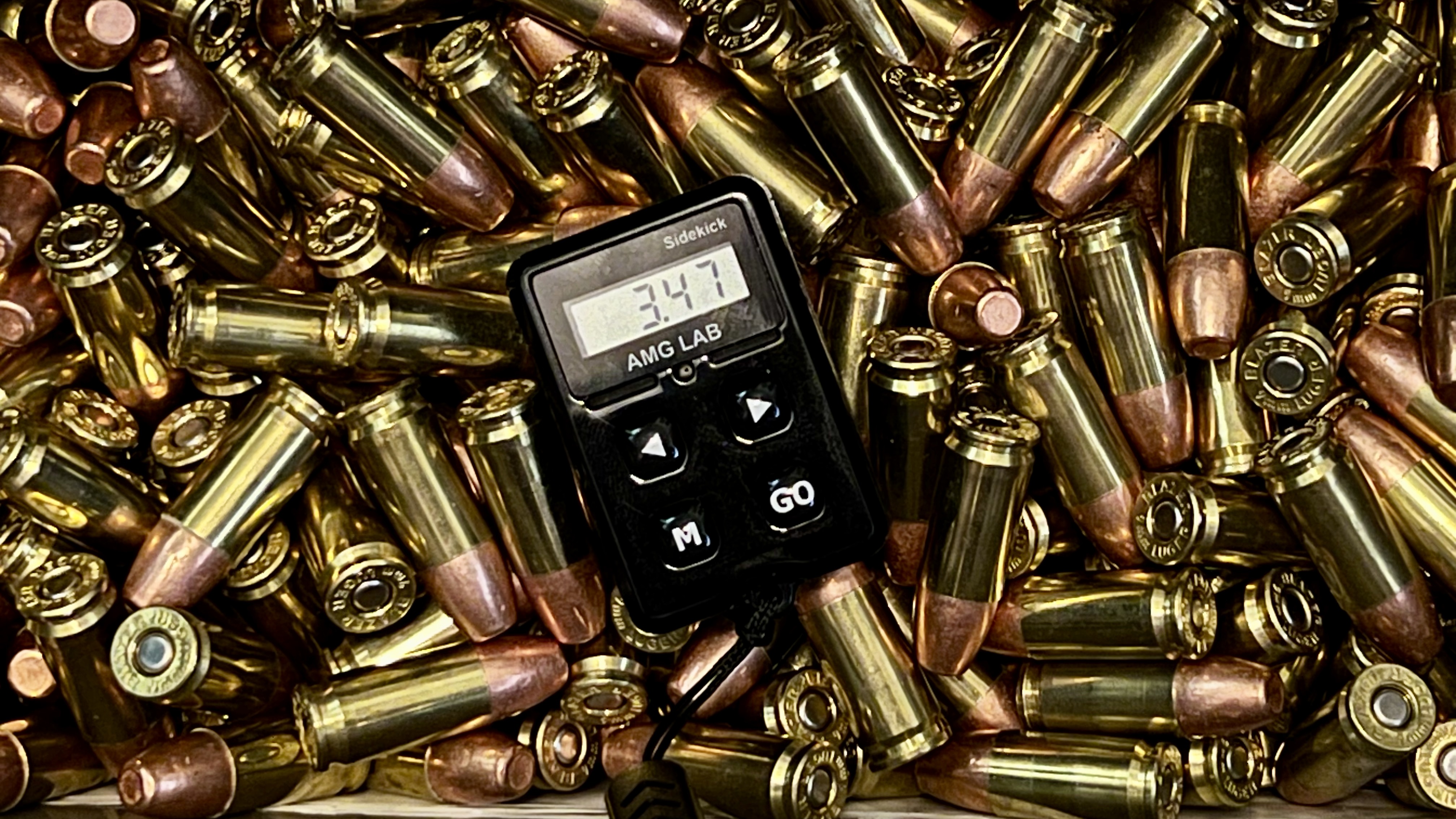
So how big is it? It’s about the size of two 9mm cartridges hanging out side by side.
This also means it’s extremely light.
The combination of size and weight, or rather the lack thereof, make tossing the Sidekick into a range bag, a travel bag or any other bag trivial. It takes up almost no space and weighs next to nothing. This makes making the Sidekick an always available tool trivial. I can’t think of any reasons not to have it available.

Closing Thoughts
The AMG Lab Sidekick is a fantastic and affordable tool for dry fire. The features are ideal for that use case.
Beyond dry fire, the Sidekick has a few live fire uses. However, I find those to be limited in scope. I’m not saying it can’t be used for live fire practice as it most certainly can. I’m just saying that beyond dry fire, there are other tools that are better suited to those tasks and make more sense.
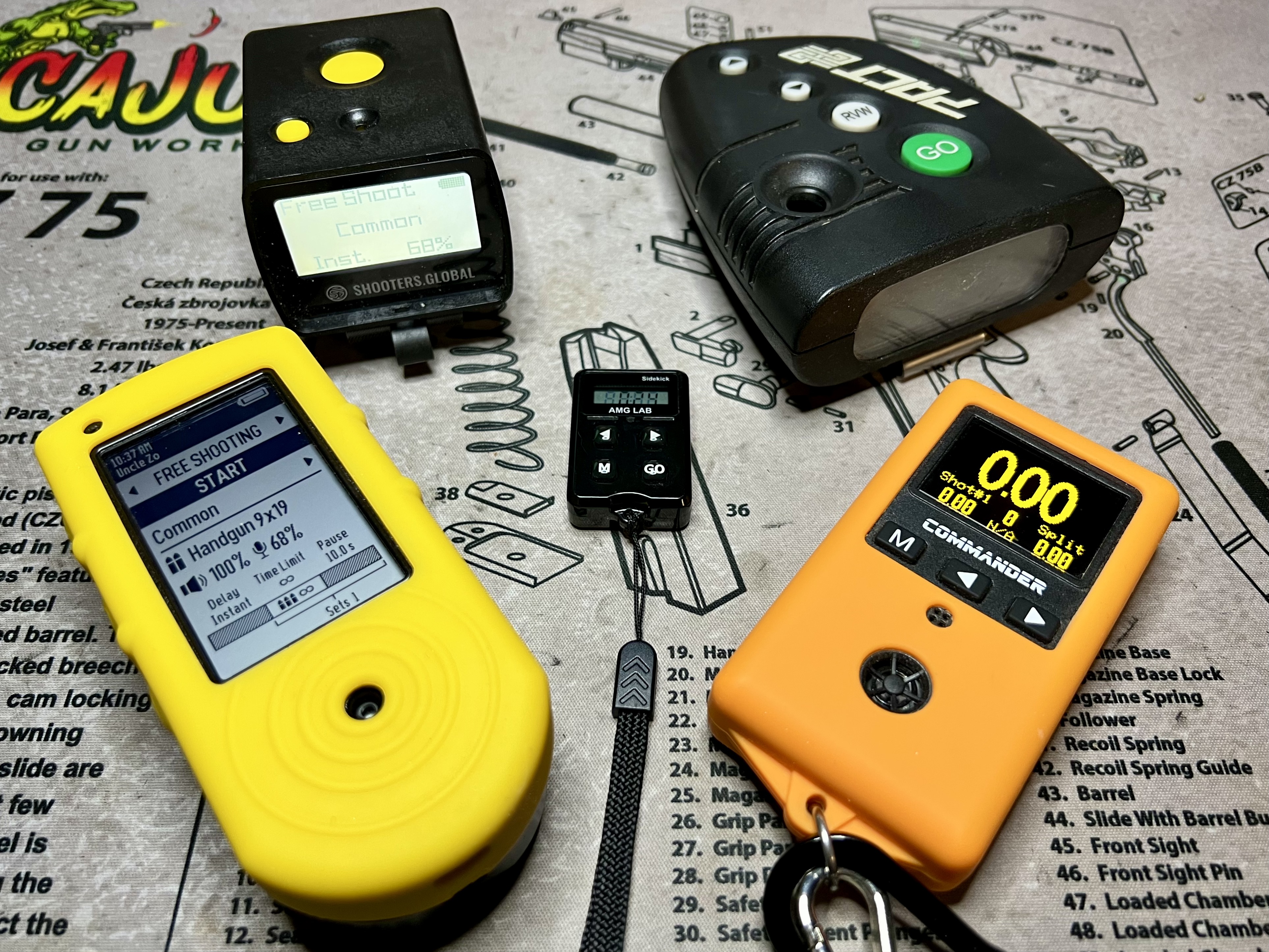
With all that said and in my opinion, the Sidekick is about as perfect as it gets for folks who are looking for a shot-timer to level up their dry fire practice, but are not in a position to pick up one of the popular shot timers. For what it’s worth, I get the most use out of my full size AMG Lab Commander shot timer. However, the Sidekick is getting a fair bit of use and it’s become my go to shot timer for dry fire. It really is a quite capable device and its dry fire first design is making some dry fire activities easier than they are when I use the full size timer.
I suppose what I’m really saying is that if I only had $60 to spend on dry fire practice, then I would spend it on the Sidekick because it really does make a notable difference when it comes to leveling up.

3 responses to “AMG Lab Sidekick: A Shot Timer for Dry Fire Practice”
[…] the training aids aren’t valuable. Rather, I find myself coming back to the basic recipe of a shot timer, a cleared gun, and some reduced sized […]
[…] going to need a shot timer. If you don’t have one yet, then I’m going to recommend the AMG Lab Sidekick cause it’s an awesome dry fire practice shot timer. If that’s not the one for you, then […]
[…] AMG Lab Sidekick (provided free) […]