
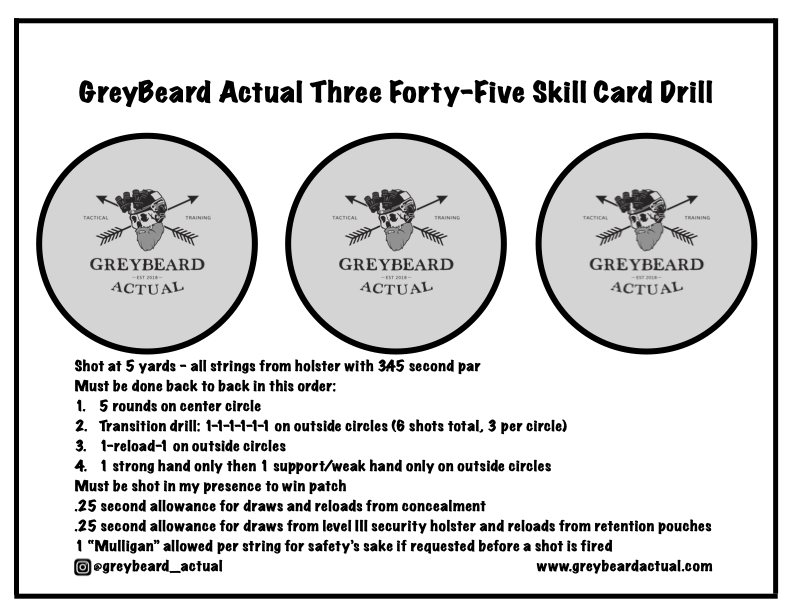
A few weeks back, my friend, Matt Little of Greybeard Actual and author of The Way is in Training, set up a side challenge at a local USPSA classifier match where folks could try their hand at his 3.45 drill and earn a patch by meeting the drill’s standard. Of course, I gave it a shot. And then another. And then yet another. And left without a patch after my fourth attempt. The drill is a real stinker. It was even described as a “swift kick in the nuts” by the drill’s originator. Failure aside, the drill is fantastic for use in practice and the standard, while frustrating, is an achievable challenge that demonstrates a high level of performance with a pistol.
Let’s take a look at it.
The Course of Fire
Target: GreyBeard Actual Three Forty-Five Skill Card Drill which consists of three 3″ circles
Distance: 5 yards
Start Position: Loaded and holstered.
Strings:
- Fire 5 rounds into the center circle
- Fire 6 rounds alternating between the two outer circles (for example: 1 to the right circle, 1 to the left circle, 1 to the right, 1 to the left, 1 right, and 1 left)
- Fire 1 round into an outer circle, reload, fire 1 round into the other outer circle
- Fire 1 round strong hand only into an outer circle, switch hands, fire 1 round weak hand only into the other outer circle
Par Time: 3.45 seconds per string. A 0.25 second bonus is given for drawing from concealment per string. An additional 0.25 second bonus is given for reloading from concealment on string #3.
Scoring: Pass or fail. Each circle should have exactly five hits in them (line breaks count). Anything else is a failure.
My Thoughts on the Drill and Standard
As I’ve already said, the drill is fantastic for practice. The reason I say this is because it covers all of key pistol marksmanship skills: the draw, the grip, trigger control, visual discipline, reloads, transitions, and one handed shooting.
As my friend, Jim Shanahan of Advanced Performance Shooting, says in one of his YouTube videos (embedded below) the drill can be modified and used for practice or for coaching to work on, develop, and improve those key skills.
Heck, this drill can even be modified to be used as a stage in a match using limited or Virginia Count scoring as it was in a match I attended a few weeks prior to attempting the 3.45 drill for a patch as seen in the video below.
Meeting the standards to earn a patch is tough. There is no other way of putting it, the standard is high. Hitting 3″ circles at 5 yards requires a good bit of accuracy. Firing the required number of rounds for each string requires a good bit of speed. Doing both requires accuracy at speed which is only possible with well developed marksmanship fundamentals and requires one to focus on the process. Anything short of that will yield an error will end up sending a round outside of the intended circle which ultimately results in failing to meet the standards. At least, that was my experience.
As I mentioned, I attempted the drill a number of times. Four times to be exact. If I could pick out my best string from each of the attempts and collate them into a final result, then I would have met the standards. But that’s not how it works. It’s all or nothing. Every failed attempt had one thing in common. That is that an error occurred because my mind wandered to a later string. Always the string that I presumed I would struggle with to keep me from meeting the standard and earning a patch. In other words, every failure was due to a momentary lapse where my focus wandered to the results for a split second. The errors were different each time, but the root cause was the same.
In my opinion, the key to meeting this standard is two fold. It requires the mechanical skills and the mental discipline to stay focused on the process for the task at hand. Otherwise, the consistent level of performance needed to meet the standard won’t be there. The operative word there is “consistent”.
Relative Difficulty
I’ve described the standards as high. However, I did so prior to performing a relative difficulty analysis on the drill. We will use the same methodology and data I have been borrowing from Karl Rehn’s book, Strategies and Standards for Defensive Handgun Training, for these drill posts. This methodology will allow us to estimate the speed that a Grand Master (GM) level competitor should be able to complete each string in. Then we can take that GM speed and compare it with the drills par times to estimate what percentage of GM level skill is needed to meet the prescribed time limits, or par times, which is what “relative difficulty” refers to.
The 3″ circles at 5 yards are roughly equivalent to 9″ circles at 15 yards which is a little bit bigger that a typical 8″ A-zone. Given that a 8″ circle has a diameter 12.5% larger than a 9″ circle, we can apply that to the distance and say that 3″ circle is pretty much like an 8″ A-zone at 13.125 yards (or about 13 yards). Unfortunately, I don’t have GM performance data on 8″ circles at that exact distance. However, I do have data at 7 yards. So we can do a little bit of interpolation here.
The difference between 7 and 15 yards is 8 yards. The difference between 7 and 13 yards is 6 yards. The differences between 6 and 8 is two or roughly 25%. While this is by no means an exact science and I might be overlooking something, I think that subtracting 25% of the difference between the 7 and the 15 yard performance time data will get us pretty close to 13 yard GM performance times on a 8″ circle.
So with that interpolation, the GM speed values for tasks on an 8″ circle at 13 yards we will use are as follows:
- Draw: 1.19 seconds = 1.25-((1.25-1.00) x 0.25)
- Draw to strong hand shot: 1.44 seconds (I don’t have good data for this so I’m using the interpolated draw plus an interpolated split time)
- Concealed draw: 1.45 seconds = 1.5-((1.5-1.3) x 0.25)
- Concealed draw to strong hand shot: 1.71 seconds (I don’t have good data for this so I’m using the interpolated concealed draw plus an interpolated split time)
- Split time: 0.24 seconds = 0.25-((0.25-0.2) x 0.25)
- Transition time: 0.33 seconds = 0.35-((0.35-0.25) x 0.25)
- Reload: 1.44 seconds = 1.5-((1.5-1.25) x 0.25)
- Concealed reload: 1.7 (I don’t have good data for this so I’m adding 0.26 since that’s the difference between the draw and concealed draw)
- Switching hands: 1.21 seconds (I don’t have good data for this so I’m treating this like an interpolated shot from ready position plus an interpolated split time)
| # | Par Time | GM Speed | Difficulty |
|---|---|---|---|
| 1 | 3.45 | 2.15 (1.19 + 0.24 x 4) | 62.3% |
| 2 | 3.45 | 2.84 (1.19 + 0.33 x 5) | 82.3% |
| 3 | 3.45 | 2.63 (1.19 + 1.44) | 76.2% |
| 4 | 3.45 | 2.65 (1.44 + 1.21) | 76.8% |
That feels about right for each individual string. Combining the strings, results in an overall relative difficulty of 74.4%.
Now let’s run those numbers again using the concealment bonuses and concealment GM times.
| # | Par Time | GM Speed | Difficulty |
|---|---|---|---|
| 1 | 3.7 | 2.41 (1.45 + 0.24 x 4) | 65.1% |
| 2 | 3.7 | 3.1 (1.45 + 0.33 x 5) | 83.8% |
| 3 | 3.95 | 3.15 (1.45 + 1.7) | 79.7% |
| 4 | 3.7 | 2.92 (1.71 + 1.21) | 78.9% |
The numbers indicate that the difficulty is raised attempting this drill from concealment even when considering the drill’s concealment bonuses. The overall relative difficulty for GreyBeard Actual’s 3.45 drill from concealment works out to 76.9%
The numbers also suggest that earning a patch requires the skills that would be needed for someone to become an A-class competitor in USPSA or a Master class shooter in IDPA.
Using the scale devised in the first post of this series, this drill straddles the border between Hard and Expert level difficulty which also seems about right. Given how easy it is to have momentary lapses in mental focus when chasing the patch, I will comfortably tip the 3.45 drill standards into the Expert level difficulty bucket. As I said, the standard is high and earning that patch will be a challenging achievement.
Closing Thoughts
An interesting thought that crossed my mind is that the calculated relative difficulty of GreyBeard Actual’s drill is only slightly higher than the relative difficulty I calculated for earning a Light Pin from Gabe White, which I’ve done. The difference is that the one can take the best four out of their eight attempts at Gabe White’s technical skill tests instead of only getting one go at each test and meeting the standard for each test. The pass or fail aspect of the 3.45 drill can really get in one’s head and create a good bit of extra pressure when chasing that patch. Perhaps more so that the pressure one puts on oneself when chasing a Gabe White pin.
Regardless, I’m a fan of this drill and the standards. As I’ve mentioned a number of times, it covers the full gamut of key marksmanship skills making it a good drill to practice with. There is no rule that says, “thou shall only run this drill exactly as specified”. If one finds themselves struggling or lacking with a specific skill found in one particular string, the one can practice just that string. Different targets can be used as well. It can also be shot for fun.
Besides, who doesn’t like a “swift kick in the nuts”?
One response to “GreyBeard Actual’s 3.45 Drill”
[…] Need another hard drill? Try the GreyBeard Actual’s 3.45 Drill. […]