
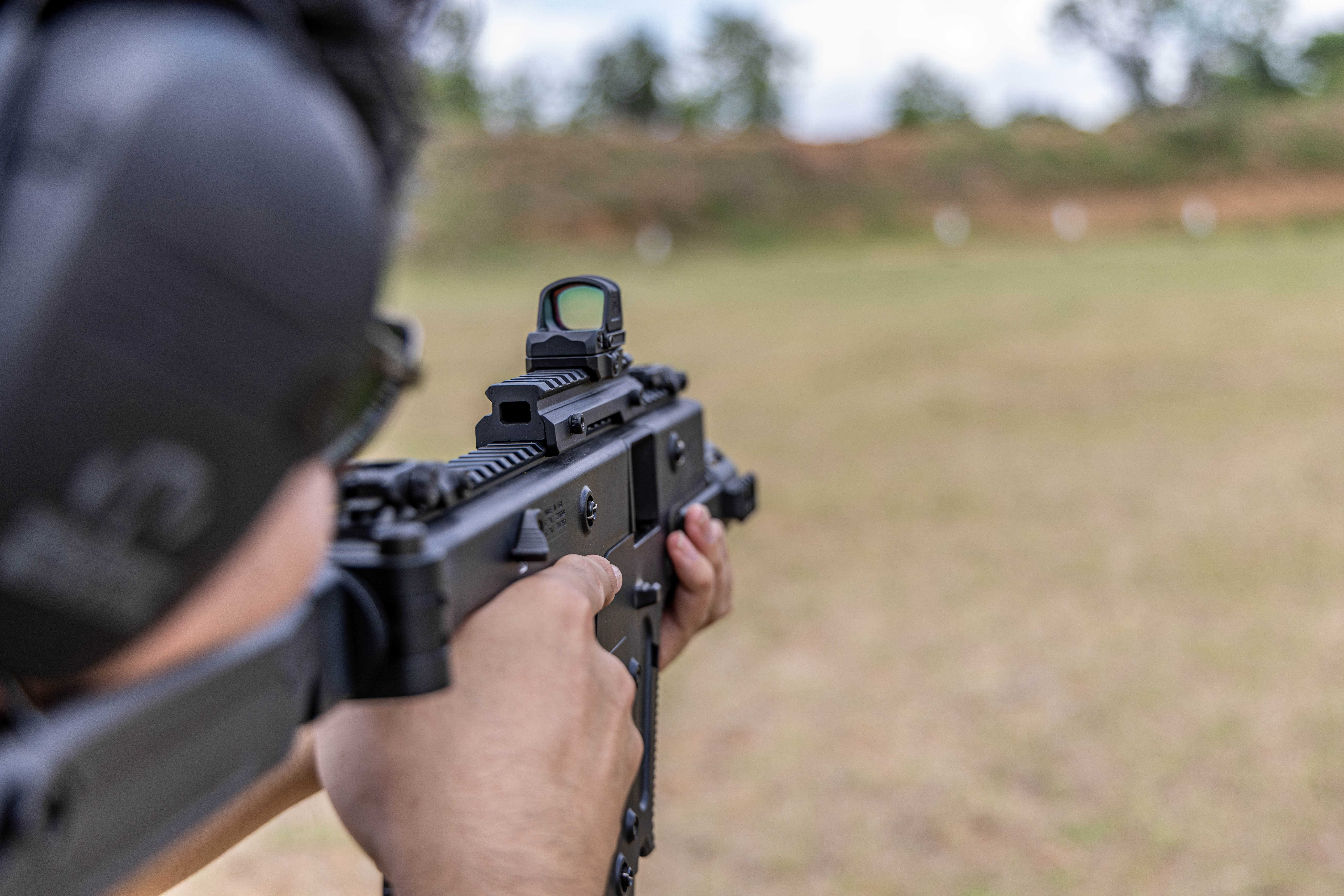
Our friends from Primary Arms back again for a guest post. This time with a deep dive into PCCs, or Pistol Caliber Carbines.
Uncle Zo

Pistol caliber carbines (PCCs) have been gaining a lot of attention lately, and it’s not hard to see why. These handy little rifles (or pistols) combine the stability of a carbine with the light recoil and affordability of pistol cartridges. Plus, unlike handguns, they offer a wider selection of optics, like red dot sights, and a greater variety of accessories. If you already own a handgun, adding a PCC to your collection might be a smart choice.
Whether you’re into home defense, competitive shooting, or just love to plink at the range, it’s not hard to find a great PCC that fits your budget, either. Today, we’ll be looking at some of the main reasons to own a PCC and discussing how to choose the best one for your collection. We will also be providing a few recommendations on current best-sellers, so you know what to look out for when doing your research.
What is a PCC?
Essentially, a PCC is a rifle or pistol that is chambered in a handgun caliber, such as 9mm, .40 S&W, or .45 ACP. This combination results in a firearm that is not only fun to shoot but also highly practical for a variety of applications.
A PCC can come in several forms, but you’ll find that most fall into two categories: rifles and rifle-style pistols. This is a direct result of the NFA and the legal classification of short-barreled rifles, or SBRs.
Even though pistol ammunition is designed for a very short barrel, many PCCs on the market have full-length 16” barrels in order to classify as a rifle. These ‘Rifle’ PCCs eliminate a lot of the legal complexity with the platform, since you can generally adhere to the same rules and regulations as any other semi-auto rifle.

If you want a more compact system, but don’t want to jump into buying a factory SBR, there is an alternative option. Some short-barreled PCCs are sold as pistols, meaning they meet all the legal requirements of a pistol per the ATF. These PCCs are sold without a stock and are subject to more rules and regulations, such as not attaching a vertical grip.
Many PCC-owners will choose to buy a pistol PCC and later file to have it converted to an SBR. This comes with a $200 expense for a tax stamp, plus plenty of paperwork and processing with the ATF, but it does give the best version of the platform: a short, compact carbine that is controllable enough for quick double-taps at short range.
No matter which route you take, though, you can’t go wrong. Whether it’s a rifle, a pistol, or an SBR, PCCs are great fun and can serve reliably in personal defense, competition, or simple recreation.
Benefits of Owning a PCC
Adding a pistol caliber carbine (PCC) to your collection brings a host of advantages. Here are three of the most important benefits:
Greater Performance Compared to Traditional Handguns
PCCs are incredibly easy to shoot and feature user-friendly controls that are perfect for shooters of all skill levels. Unlike traditional handguns, PCCs have much greater stability—especially as an SBR or Rifle, where you have a stock to brace against. This stability translates into faster, cleaner shots, especially for those who might struggle with the recoil and handling of a handgun.
Ultimately, the only real benefit of a handgun over a PCC is concealability and everyday carry. Otherwise, a tuned PCC can outshoot a handgun any day of the week.
Uses Same Ammo as Your Handgun
One of the most appealing aspects of PCCs is their ability to use the same ammunition as your handgun. If you already stockpile 9mm, .40 S&W, or .45 ACP for your pistol, you won’t need to worry about sourcing and storing different types of ammo. This not only simplifies logistics but also can be more cost-effective, allowing you to buy in bulk and save money—especially nowadays with the soaring cost of rifle ammo.
Can Use Same Magazines as Handguns
In addition to using the same ammunition, many PCCs are designed to be compatible with the same magazines as their handgun counterparts. For example, if you have a Glock 17, you can often find a PCC that accepts the same exact magazines.

This interchangeability allows you to easily switch between the two without having to invest in separate magazines. It also simplifies your magazine preparation for range sessions or even personal defense.
PCCs for Home-Defense and Competition
As we’ve mentioned, PCCs are exceptionally versatile firearms, easily tailored to suit a variety of purposes based on their configuration. Whether you’re setting up for home defense or competition shooting, PCCs offer controllability, reduced muzzle flash, and lower penetration compared to traditional rifles, making them an excellent, cost-effective choice for both home-defense and competition.
When it comes to configuring a PCC for home defense, the primary focus is on reliability, ease of use, and maneuverability. A defensive PCC should be lightweight and compact, making it easier to handle in tight spaces like hallways and doorways. Important features to look for include a shorter barrel for better maneuverability and a rock-solid operating system that’s reliable with any ammunition. Other than that, you’ll want to make sure it has rail space for mounting essential accessories like a flashlight and close-quarters optic. If you have interest in adding a suppressor, it’s also important that your PCC has a threaded barrel and can operate reliably with one.
In contrast, a competition PCC is usually configured with a focus on speed, precision, and ergonomics. Competitive shooters might prefer a longer barrel to maximize stability and a lightweight trigger for quicker follow-up shots. These PCCs often feature high-performance muzzle brakes to minimize recoil for faster splits. Generally, red dot sights remain the standard, while flashlights and lasers are removed altogether. Instead, competitive setups might include features like extended magazine releases and oversized charging handles to facilitate faster reloads on longer stages.
Of course, if you can only have one PCC, it’s not hard to find a good middle-ground. A defensive PCC can perform well in competition, even if it isn’t optimal. Just be sure that any defensive carbine is reliable with your self-defense ammunition, which means, in this case, a jacketed hollow-point.

Choosing the Best PCC
Selecting the right pistol caliber carbine (PCC) involves considering several key factors to ensure you get a firearm that meets your specific needs:
Barrel Length
The length of the barrel can significantly impact the performance of your PCC. Shorter barrels, around 5-10 inches, are great for maneuverability in close quarters, making them ideal for home defense. Longer barrels, typically 16 inches, offer better stability and recoil reduction, which can be advantageous for competition shooting.
But as we mentioned, the real importance of barrel length is determining whether the PCC will be classified as a pistol, a rifle, or an SBR. There isn’t a right option, but each has its own tradeoffs, and while you might convert a rifle or pistol to an SBR later, the ease of that process will depend on what you pick up front.
Magazines
One of the great advantages of PCCs is their compatibility with common handgun magazines. For instance, many PCCs are designed to accept Glock, CZ, or SIG magazines, allowing you to use the same mags across different firearms.
If you own a GLOCK already, it makes sense to select a PCC that is compatible with the same magazines.
Caliber
While 9mm is the most popular caliber for PCCs due to its balance of power, recoil, and cost, other calibers like .45 ACP are also available. Choosing a caliber often depends on what you already own and your intended use for the PCC.
Platform
Many of the most popular PCCs on the market are based on the AR-9 platform or are very close in their manual of arms. If you are experienced with the AR-15, these PCCs will feel very familiar. There are a few differences, of course. Most AR-9s are blowback, so they won’t have the same sort of gas system or impulse as an AR-15, but most other controls and ergonomics will be the same.
That said, there’s no reason you have to stick with something familiar. One of the most fun aspects of PCCs is the variety. You can select from a ton of different platforms, which includes everything from classics like MP5 clones to modern marvels like B&T’s APC9.

Popular PCC Brands & Models
With so many options available, what brands should be on your short-list? Ultimately, that answer will depend heavily on your budget, but here are a few top names that have sizable aftermarkets and a solid reputation:
Sig Sauer (MPX)
Known for its reliability and modularity, the Sig MPX PCC is a favorite among both competitive shooters and those looking for a top-tier defensive weapon. Its AR-like controls and robust construction make it a standout choice for those who want a familiar platform that’s been optimized for pistol cartridges.
CZ (Scorpion EVO 3 S1)
This PCC has become a modern icon for subguns. The CZ Scorpion is widely considered a top performer in its class and has remained one of the best-selling PCCs on the market. Even though it looks different from an AR, the controls are easy to learn, and the sizable aftermarket makes it easy to configure. It’s also surprisingly affordable with an MSRP of around $900.
KRISS (Vector Gen II)
Famous for its unique recoil mitigation system, the KRISS Vector offers exceptional control and rapid follow-up shots. Many will favor it for its unique science-fiction look, but it’s also a very practical system too. Plus, it accepts GLOCK-pattern magazines!

CMMG (Banshee Mk9/MkG)
The Banshee series offers models in both 9mm and .45 ACP. It’s a modified AR-9 system that’s well-regarded for its lightweight, compact design and advanced radial delayed blowback system, which reduces recoil and enhances reliability.
Grand Power (Stribog)
A solid choice for those looking for a budget-friendly yet reliable PCC. The Stribog offers good accuracy and versatility with its various magazine and accessory options (including a variant that takes GLOCK-style magazines.)
B&T (APC Series)
Brügger & Thomet is a Swiss company with a long history of making high-performance PCCs and accessories. Being Swiss, their products tend to be on the high end of pricing, but they justify it with impeccable build quality and performance. Their APC series is, in particular, highly regarded as one of the best modern-designed PCCs. In fact, B&T’s APC9K won the first Army contract for a submachine gun in over 50 years.
Heckler & Koch (SP5/SP5k)
No list is complete without the most famous name in submachine guns. Heckler & Koch’s MP5 has been a staple of police and military arsenals for well over 50 years, and while a true fully-automatic MP5 is prohibitively expensive, their semi-auto SP5 and SP5k are satisfying alternatives. Like B&T, Heckler & Koch is a top-quality brand and commands a pretty penny, but if you’re looking for a satisfying PCC with extremely low recoil and bomb-proof operating system, you can’t go wrong with the SP5.

The Custom Option: AR-9 PCC Builds
There are many great factory options for PCCs, but if you have a specific feature list, there is another option: building an AR-9. Building an AR-9 rather than buying a factory-assembled PCC offers several benefits, making it a good option for enthusiasts who have the tools and technical skills to complete it.
The most obvious benefit is the modularity inherent to the AR platform. When you build your AR-9, you have complete control over the choice of parts, from the barrel length and type of handguard to the trigger and receiver style. This level of customization ensures that you get exactly what you want—including compatibility with your preferred magazines. Moreover, many AR-9 components are compatible with AR-15 parts, so if you already have preferences (triggers, handguards, etc.), then you can stick to your favorites.
There is also the benefit of cost-effectiveness. While high-end, factory-assembled PCCs can be quite expensive, building your own can often save money, especially if you shop scrupulously and take advantage of sales. If you can do that, it’s hard to beat the value of a custom-built AR-9 in a dollar-for-dollar comparison.
Lastly, there’s the benefit of familiarity. If you’ve ever built an AR-15, you probably already know this firsthand. By building a gun yourself, you tend to be a lot more attuned to its inner workings. It’ll be easier to clean, service, and maintain a PCC that you built yourself, since you’ll build a deeper understanding of the platform through assembly.
Ultimately, though, the most important question will be: do you want an AR-9?
AR-9s are a very practical option, and there are few boxes they can’t check when it comes to performance. But even so, many people choose a different platform just for the sake of variety—and there’s nothing wrong with that! The PCC market is full of interesting and iconic firearms, and many of them are just as affordable and effective as the comparably ‘normal’ AR-9.
Conclusion
If you own a handgun, a PCC is a great option for getting the most from your ammo (and potentially, your magazines!) While they don’t have the power of a full-power rifle, PCCs are nimble, controllable, and proven effective for personal defense. They also open the door to one of the fastest growing divisions of the sports shooting world—one that’s a great place to start for new competition shooters.
If you’re still debating if a PCC is right for you, don’t hesitate to check out some of the other articles here! This blog has a lot of great content and reviews on some of the most popular PCCs on the market, so you can get a deeper look at PCCs for competition and for self-protection.
2 responses to “Why Every Handgun Owner Should Own a Pistol Caliber Carbine”
PCC’s? After years of wondering “why would I want one of those,” I finally saw the light. As a retired police officer and contract bodyguard, now in retirement, I rely mostly on my sidearm(s) for everyday carry, (LEOSA / HR218) either 9mm or .40. Relying on the common saying that “pistols are for fighting your way to your rifle,” made sense. Looking for a reliable “trunk gun,” I stumbled onto a Kel Tec Sub 2000 (gen-1) at the Cabela’s history vault. That was exactly what I was looking for. Bought it, although used, I got some help from Kel Tec. In .40 caliber, using Beretta magazines, I’m very pleased with the performance of the gun and concealability of carrying it in the folded configuration in a lap top bag in public.
[…] you’re a seasoned competitor or just dipping your toes into the world of action shooting, the 9mm pistol caliber carbine has become a mainstay in the shooting sports […]