
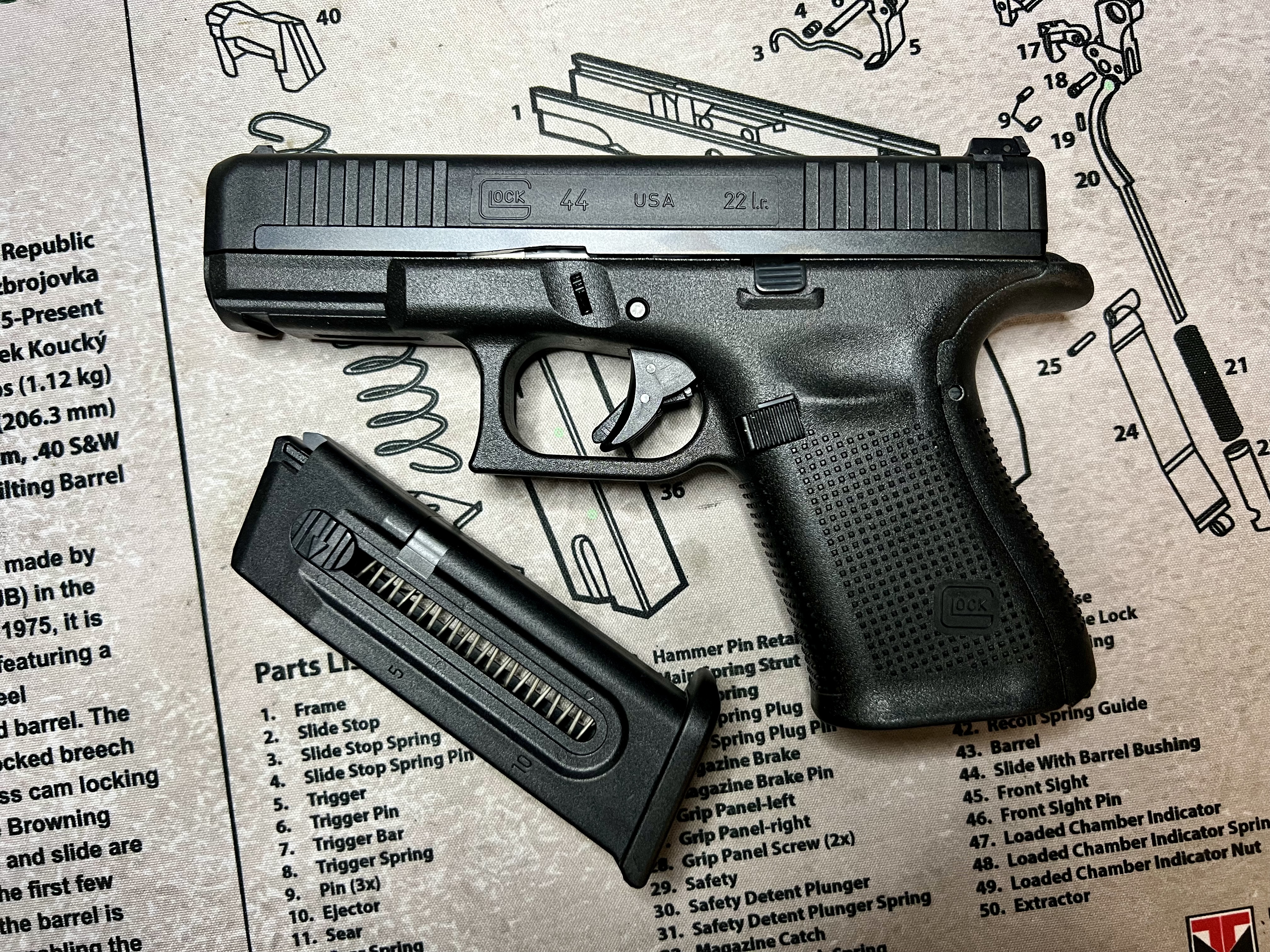
Yeah, I know. Gear reviews have slowed down. I blame the economy. However, I do what I can to keep gear reviews flowing because they drive traffic. That said, I suspect frequent readers are somewhat surprised to find that I’m reviewing a Glock pistol. Why the surprise? That’s a good question. I suspect that is to my relative lack of excitement for Glock pistols that I’ve never tried to hide. Thing is, I’ve never outright expressed a dislike or disdain for Glocks. At the same time, I’ve never expressed genuine long term excitement over a Glock pistol. I’ve given a few Glocks a fair shake, but that’s about where my experience with them and cheerleading stops. Glock makes good reliable pistols. Nevertheless, they haven’t really been my thing, but I don’t dislike them. Furthermore, in some cases, as is the case in this post, sometimes they excite me.
You might be wondering, “Why is Uncle Zo excited about the Glock 44?”
Truth is I’ve found it to be an exceptional instructional tool when working with folks who are brand new to guns and are starting their journey as armed self defenders for a couple of reasons. First off the .22 Long Rifle (22LR) cartridge the Glock 44 is chambered for is a great choice as an introductory cartridge primarily for its almost nonexistent recoil. In addition, the Glock 44 had the exact same physical dimensions and manual of arms as the Glock 19 which I’ve been told is America’s most popular concealed carry handgun since it is a reliable and shootable package that strikes the right balance between size and capacity. As such, it helps dispel the common misconception new armed defenders often have that tiny micro sized carry guns are ideal for concealed carry. Dispelling that misconception is critical because it often results in new self defenders buying a small gun that is very difficult to shoot well and isn’t fun to shoot which often results in leaving that gun at home stuffed in a drawer and never practicing with it.
Beyond the Glock 44’s instructional value, it still is a 22 pistol that owners of Glock 19s will be immediately familiar with. And the fact of the matter is, 22LR is inexpensive and a lot of fun to shoot.
With that said, let us take a look at Glock 44 (G44).

The Glock 44
As of writing, the street price for a Glock 44 is about $380, but can be found for under $360 from time to time. It certainly isn’t the lowest priced striker-fired 22LR handgun in the market, but it certainly has a lower price point than other Glock pistols.
So what does one get for a bit over three fiddy? Well, the package includes:
- A hard-sided foam-padded Glock-branded pistol case,
- a manual,
- a trigger lock,
- a nylon cleaning rod,
- two (2) interchangeable back straps with beaver tails,
- two (2) ten (10) round magazines,
- and the G44 pistol itself.
It’s a pretty complete package. I really wish three magazines was the standard with new pistols as I think it better equips new owners to pursue training without having to procure a third magazine which is a prerequisite for many courses. However, that’s just me gripping about common industry practices that don’t align with the instructional and competition spaces.

At any rate, it is time to walk the 14.64 oz gun that measures 7.28″ in length, 1.26″ in width, and 5.04″ in height starting with the business end which is the muzzle of 4.02″ GMB (Glock Marksman Barrel) chambered for .22 Long Rifle.
The GMB is housed in a polymer slide. Yeah, you heard right. A polymer slide which is a first for me. I suspect that was a design decision primarily to reduce the weight of the slide for reliable cycling. Whatever the reason or reasons, it’s weird, but it works well. The slide is not 100% polymer. It’s a polymer and steel hybrid where steel is used to reinforce the slide to maintain rigidity and durability in places where it is required such as the slide rails and the breech face. A side effect of the design is very little reciprocating weight which yields very little felt recoil transferred to the shooter. It’s pretty neat. Weird, but neat.
The slide features front and rear slide serrations which aid in slide manipulations. However, the manipulation is a little on the stiff side. This is likely the result of the compound guide rod and recoil spring used by the G44. It’s not insurmountable, but it’s worth noting for those with limited grip or hand strength who are looking for an easy to operate and shoot defensive firearm. And before anyone gets all huffy and puffy about using 22 LR chambered pistols for defensive applications, it is a thing that we have discussed before.

The top of the slide is adorned with a set of the infamous polymer Glock sights which are usable, but leave a lot to be desired and are often replaced with aftermarket sights. I wish the G44 was optic ready, but it is not. I’m not too keen on looking into direct mount options either given the polymer material. I’m unaware of available milling options and I’m skeptical as to how durable a direct mount interface would be long term. I might look into options one day, but for now I’m going to leave it as it stands since my plan is to use the G44 as an instructional aid.
Below the slide is the polymer frame which begins in the front with an accessory rail which is quickly followed by the trigger guard. The front of the trigger guard is flat and textured which will be welcomed by folks who hook their support hand index finger on the trigger guard. Above the trigger guard we find the traditional Glock take down tabs of the slide lock which are used to remove the slide for maintenance operations just like any other Glock. On the left hand side of the pistol and behind the undercut trigger guard where it meets the stock is the reversible magazine release button.

With the trigger guard is the trigger which is like every other Glock trigger. It features a trigger safety bar and an untextured curved trigger shoe. The press begins with about a quarter inch of pre-engagement travel before meeting resistance from about an eighth of an inch of mushy creep that stacks before finding the wall. The heavy 6 lbs. break is audible and tactile that reminds me of the separation of two snug fitting Lego pieces. The break is followed by another eighth of an inch or so of over travel. The reset which is also audible and tactile is long. It’s not quite half an inch, but it’s a good bit more than a quarter inch. Overall, it’s functional and nothing to write home about.
The stock is textured like other Gen 5 Glock pistols. The texture is present, but not aggressive. The stock is long enough that most folks will be able to get a full three finger firing grip on it. Those with larger hands will be at risk of pinching their palm with magazine insertions which aren’t very likely given the subtle flare of the beveled magazine well. The optional beaver tailed back straps will be a welcomed feature by folks with meaty hands that are susceptible to slide bite. However, it’s worth noting that both of the back straps increase the trigger reach which can lead to gun fit issues for those with shorter fingers.

The only thing left to mention is the ambidextrous slide release lever that is located where the stock of the frame meets the slide on both sides.
Overall, it’s a functional and reliable pistol. It’s a Glock. A G19 sized Glock to be more precise. As such, there are frills and drills. It’s all work and no play. Really the only things remotely interesting are that this is Glock’s first rimfire cartridge pistol and the unique hybrid steel-polymer slide.
Handling
As I expect from Glock, the pistol runs just fine. It’s cycled every round of CCI Mini-Mag I’ve fed it to date. I don’t expect that to change any time soon as it’s only getting light occasional use. If that changes, then I will write about it.
Applications
There are several use cases for the G44 that I can think of.
The use case I am most excited about is as an instructional aid for teaching those who are new to pistols for personal defense. While it is a little big for little hands that would benefit from a slimline pistol like the G48, it will work for many if not most adults. And by “work” I mean it is a good platform to teach them marksmanship fundamentals with minimal recoil (which reduces the chance they will develop a flinch). At the same time, it helps to dispel notions that usually lead novices to buying hard to shoot tiny guns for defensive applications.
By a similar token, it’s a good starter gun for those who are just getting into defensive carry and want to work their way up to a 9mm. It’s also an option as a defensive tool for those with physical limitations or have high recoil sensitivity. Once again, I will refer those who are staunchly against using 22 LR for defensive applications to this post that explores the topic.
While I think there are better options for competitive and recreational applications, the Glock 44 is still an option that will appeal to Glock aficionados.

Closing Thoughts
I still have a hard time getting excited about Glocks on a personal level. However, it would be intellectually dishonest to write Glocks off due to my personal preferences when they have a track record as viable and capable tools used the world over for duty and defensive applications. Not to mention that many competitors have landed a podium finish while slinging lead with a Glock. Glock makes great pistols.
While I doubt that the Glock 44 will ever reach the same level of popularity or reverence as several of their 9mm offerings have, it’s a good pistol that fits a handful of use cases.
3 responses to “Glock 44: A Functional and Reliable Rimfire Pistol with Unique Features”
Nice article from a non Glock guy! Glock started adding a 3rd mag to the package of all other calibers with Gen 4, and continues this with Gen 5. The slim line models (43, 43x, 48) still only come with 2 mags, but factory mags are frequently on sale for $20-$25. I have owned a model 44 for a long time. Like you said, I find it a great introduction to live fire for new shooters. It’s felt recoil is a little less than a CoolFire trainer. If anyone shoots GSSF matches, the 44 has it’s own ‘Rimfire’ division, which is great for new competitors. Glocks can compete well in the right hands. A friend of mine (Deon Martin) won the IDPA National CDP division 2 years in a row, against all the Wilson Combats and Nighthawk Customs, with a .45 caliber Glock 41, when they first came out.
Dave Sevigny offers sights made specifically for the Glock 44. They work much better for me than the factory sights, for accuracy beyond 7 yards. The 44 does require a little more TLC maintenance than their other models. (Field strip and clean after each use. They need a little more lube than other Glocks). A thousand round trigger job smoothed my trigger nicely. The 44 can be dry fired safely, though I still prefer using snap caps when doing so.
I got my 44 for free. Literally. I selected with a GSSF certificate I won. At first I saw some of the initial complaints people had about reliability, but over time it has become a super-reliable pistol. I can shoot anything in it now and have used mine for steel challenge-type events and GSSF rimfire. I played around with sights and ultimately kept the adjustable rear it came with but replaced the front with a Dawson Precision fiber optic. I’m much happier with this gun than I ever thought I’d be.
I love my G44 and us it to compete in GSSF indoor matches, but as Dave R. points out, it does require a bit more upkeep than my other Glocks. I generally field strip mine after a match (okay, before the next match) wipe it down and scrub the feed ramp with a brass brush. Then I oil it and it is good to go.
It is also a bit finicky with the ammo it likes and may not cycle correctly with underpowered .22 LR ammo. I generally run CCI MiniMag ammo in mine and have not had any failures with the MiniMags (although it is a bit stinky).
Finally, I had my gunsmith mount aftermarket sights on my G44 with a blackout rear and fiber optic front. Note that your gunsmith may warn you that they aren’t liable if the polymer slide gets messed up in the install process. Mine came through fine.
Lee