
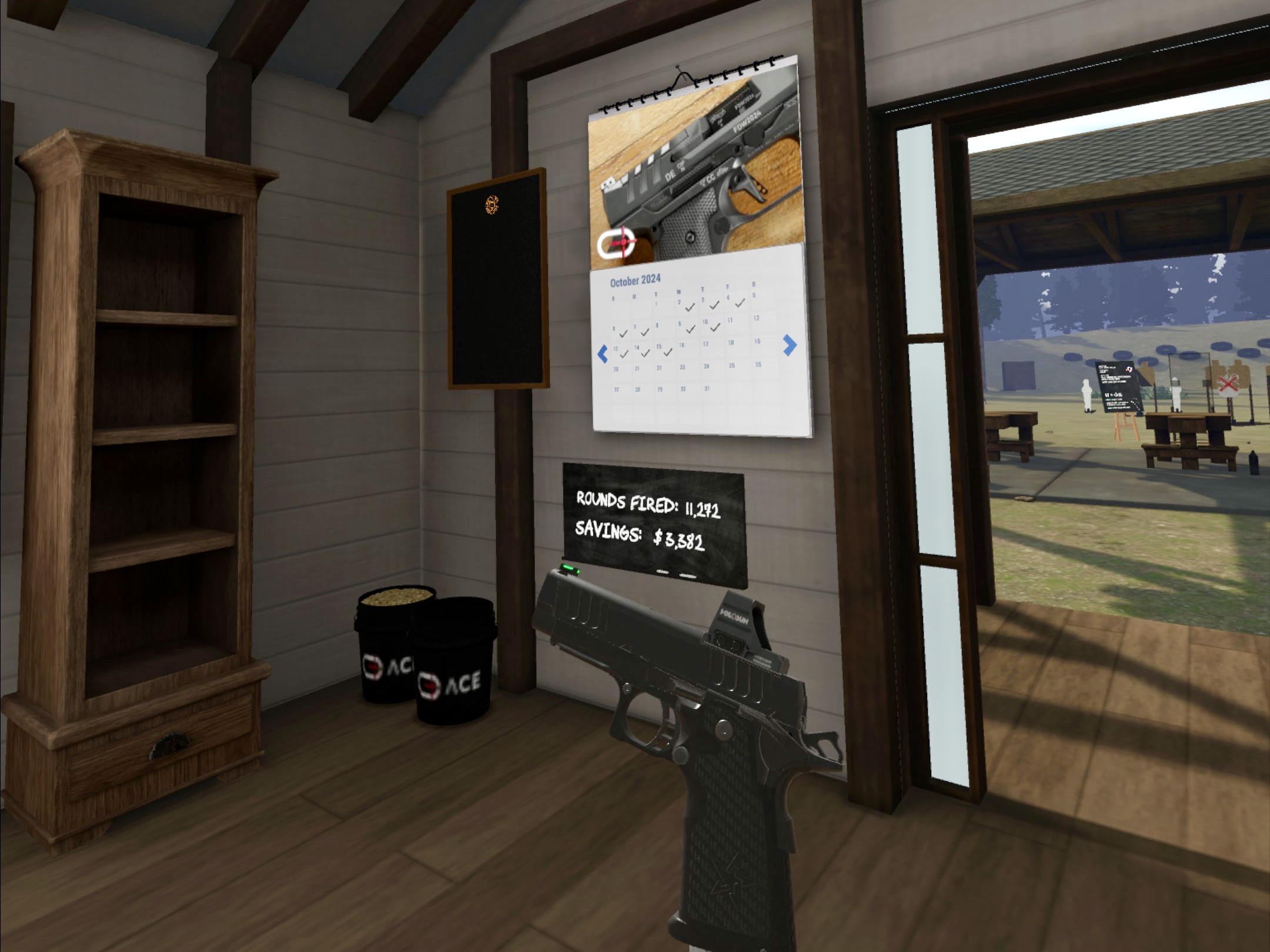
It might seem a little silly that I’m revisiting Ace Virtual Shooting only a few weeks after publishing the first impressions review of the system. However, several things have transpired in a very short time period. First, my friend, Matt Little, whose influence fueled my plunge into virtual reality dry fire, published a blog post diving into how he is using the system as his primary dry fire training modality. When I first read it, I wasn’t sure he had read my post. However, it felt pretty close to a direct response since he got into stages he uses in his practice which is something I was struggling to figure out.
Additionally, I’ve already sent over 10K virtual rounds down range in Ace in less than a month. That’s more trigger presses than most folks put on a single firearm in their entire lifetime. With that level of activity, I’ve made adjustments to how I’m using it to supplement my dry fire training.
Finally after rereading my first impressions review, I realized it can easily be perceived as a negative review which was not my intention. Yes, I was very critical of it. Yes, there are some things that I fear might create some “training scars” like shooting through menu options. However, my many criticisms were a function of my excitement resulting from the great potential I believe it has as a dry fire training aid.
Matt Little’s Tips
Matt’s approach to using Ace for training isn’t very different from mine. At least in principle. While learning about the stages that he uses was helpful, it does underscore one of my criticisms – menu navigation could be better. Why do I say this? Well back to one of my previous points, there isn’t a good search feature. I had to sift through the available stages to find the ones he named in his post.
That said, it is entirely possible to establish a beneficial daily cadence in Ace for skill development. Rather than regurgitating what Matt Little does, which can be read on his post, I’ll share what I’m doing now after having spent some time with Ace and incorporating Matt’s approach into mine.

First things first. Like Matt, I look at the daily drill challenge and give it a go. The cold start gives me a decent idea of where I am and the following two or three attempts help me get warmed up. Full disclosure – I don’t always complete the daily drill challenge. Some of them require more space than I have in my dry fire environment, but more often than not this isn’t the case. My performance on this drill informs what adjustments I might want to make in the training session.


The next stage that Matt called out is the “Accuracy” stage that is found under the “Skills” collection. This stage features a B-8 center target set up on a Roomba looking device that increases the target’s distance from five (5) to forty (40) yards in five (5) yard increments after the target is hit three (3) consecutive times. A miss decreases the distance by five (5) yards. While there is no time limit, this stage is great for learning and improving the use of visual aiming confirmation in order to advance the target to the maximum distance in the shortest time possible. It’s also really good for working grip and trigger fundamentals.
Another stage under the “Skills” collection that Matt calls out is the “Sight Acquisition” stage. At least, that’s what it’s called the version of Ace I am using. I mention that because Matt refers to it as the “Target Acquisition” stage. So that was either a mistake on Matt’s part, a difference between the versions of Ace we are using, or I’m simply wrong and I’m referring to a different stage altogether.


The “Sight Acquisition” stage consists of a single USPSA target at a distance of ten (10) yards and a timer that begins as soon as the pistol is “raised”. The goal is to engage the target with two rounds before the time runs out. Each successful engagement decreases the time giving you less time to acquire the sights and place two hits. At any rate, I haven’t started using this stage in my practice, but I can see how it can be beneficial to improve draw speed from various starting positions, working single handed skills, and improving the reload using the 1-reload-1 drill as Matt does.
Those who read the prior post will recall I took issue with the virtual reloads. After incorporating Matt’s full range of motion virtual reload approach as outlined in his post, I’m warming up to them. Slowly.
Two additional stages that Matt mentions that I’ve started using quite a bit, as I will explain in the next sections in this post, are the “Zeroing Range” and “Core Drills” stages which are found under the “Thrills” collection.
There are several other stages Matt mentions that are found in “Thrills” and “Drills” collections. I’ll encourage readers to go read his post for details on those and more insights into how Matt uses Ace.
Zeroing Range
The “Zeroing Range” stage found in the “Thrills” collection has six USPSA targets with A-zone aiming point references set up with increasing distances in five (5) yard increments from five (5) to (30) yards.
Matt uses this stage to work trigger control at speed drills using freestyle and one handed grips. He also uses it to work doubles drills. These are good drills for this stage, but can also be worked in the “Core Drills” stage, which I’ll cover next. Instead, I like to use this stage to work combinations of targets in a designated target drill fashion which works a combination of marksmanship skills in a way that exposes bad habits or deficiencies when running the drill aggressively. It’s a fantastic diagnostic and self evaluation exercise.


I should point out that I really didn’t see much value in this stage initially since I struggled with the awkward operation of the virtual shot timer. However, I later learned that the timer can be used by simply pressing the A button on the controller after resetting the stage (by pressing and holding the A button for a few seconds) without having to hold the controller in front of “my junk” – I’m blaming this confusion on a case of “instructions were unclear” rather that ID-10-T error. At any rate, being able to use the shot timer to measure time performance on drills, like designated target drills, makes this stage much more valuable for practice in my opinion.
Core Drills
The “Core Drills” stage, which Matt tells me was added to Ace at his suggestion during beta testing, is also found under the “Thrills” collection. In my opinion, this stage is the most valuable stage in Ace for skill development. Especially once one figures out how to use the virtual shot timer.
This stage consists of three USPSA targets with A-zone aiming references spaced about a yard apart which is the recommended “standard practice setup” suggested in Ben Stoeger’s and Joel Park’s book, Practical Shooting Training, which has been a staple in my conventional dry fire practice. By default the targets are set up at a distance of five (5) yards. However, there are two configuration plates off to the left side of the stage that be used to increase or decrease the distance to any of the conventional target distances of five (5), seven (7), ten (10), fifteen (15), twenty (20), twenty five (25) and thirty (30) yards.


This target configuration can be used to perform any of the standard practice drills enumerated in the Stoeger’s and Park’s book which include:
- One Per Target
- Pairs on One Target
- 4 Aces
- Bill Drill
- Bill – Reload – Bill
- Blake Drill
- El Prez
- Criss Cross
- Two Per Target Strong Hand Only
- Two Per Target Weak Hand Only
But that’s only where it starts. For example, I’ve presently been using this stage to work on Gabe White’s Technical Skills Tests. This stage can also be set up to practice individual strings for qualification courses of fire such as the Rangemaster Basic Instructor Qualification. Virtually any drill or string of fire that calls for one to three targets at a single standard distance can be worked on this stage.
The Value of Gamification
The most common reason, or, rather, excuse, I hear that keeps folks from participating in dry fire practice is that they just don’t have time. However, most of us make time for activities that we find entertaining. Gamification, which is the use of gameplay mechanics to non-game applications, makes “boring” tasks fun or entertaining. When employed successfully, folks make time for these activities because they are motivated to participate in them. As I said when I first reviewed the Mantis X, which was the first dry fire training aid I reviewed, the value of gamification is immense because it gets folks who wouldn’t otherwise practice to practice and those who do practice to practice even more.
In the case of Ace, it literally is a game complete with recognition and rewards that is fun to play and by playing it one will improve fundamental marksmanship skills.
Let’s do some quick math to illustrate the impact that gamification can have in practice.
My typical conventional dry fire session lasts about fifteen (15) minutes and it’s something that I do about five (5) or six (6) days per week. In a typical session, I average about fifty (50) draws and roughly 200 trigger presses. To keep the math simple, let’s say that 1,000 trigger presses per week is the average. That translates to about 52,000 trigger presses per year or about 4,300 trigger presses per month.

Now consider that in a little over three weeks, I’ve already pressed the trigger on the Ace handset over 10K rounds. Granted I might still be in the honeymoon phase, but assuming that this rate of use remains consistent it is very conceivable that 3,000 handset trigger presses per week will be done in addition to the conventional practice that continues to take place.
That brings the combined estimated trigger presses to 4,000 per week or 208,000 presses per year. That’s a 300% increase. I don’t know about you, but I would call that a substantial increase. And that’s only one example of the potential value of gamification.
Final Thoughts
I’m still not ready to consider Ace as my primary practice modality, but I sure have been using it a lot. It’s still too early for me to say with confidence that it is a game changer, but I can confidently say that I see the value of Ace as a training aid.
It might be purely coincidental, but I just shot my best IDPA match to date a few days before I finished writing this post. Now that might be a function of me hitting dry fire harder than usual in preparation for my upcoming attempt at earning a turbo pin from Gabe White, but I can’t rule out Ace as a contributor because I’ve also been using it vigorously.
I’m certain a follow up post will follow in the future that revisits Ace Virtual Shooting again. Whether or not it remains a part of my dry fire practice I can’t say. Nor can I say whether or not I will say with confidence that the return on investment has been worth it. All I can really say at this time is that all signs currently point to Ace having an active role in my practice into the foreseeable future and likely being a worthwhile investment. Do what you will with that information.
6 responses to “10K Trigger Presses: My Ace Virtual Shooting Experience”
Ace is incredible. It has taken over 100% of my dryfire and I moved from a low B to an A, who is putting down M classifiers
Also thanks to Ace I cut down my live fire from 30k rounds a year to 10k while still getting better
[…] 10K Trigger Presses Ace Virtual Shooting (Uncle Zo) […]
I realize this is a later response, but I had a discussion regarding the Ace this weekend at a USPSA match I shot. Craig Bellamy, a USPSA master in Carry Optics and the Captain of the Houston Police Department’s pistol team, said it was the most helpful dry fire aid he had ever used and strongly recommended it.
I’ve been a bit leery because of the initial cost, but I’m seriously reconsidering it as it appears it will (1) make me dry fire more, (2) save me a bunch on ammo, and (3) reduce the stress put on my arthritic hands by live fire.
[…] been roughly six months since I last dedicated a full post to Ace Virtual Shooting—though I’ve sprinkled mentions of it across other posts and social […]
[…] I’m not a spring chicken anymore. The other part was wanting to get some dry-fire practice and Ace Virtual Shooting time in before hitting the sack, since my scheduled match time was 8:30 AM the next morning. Yes, […]