
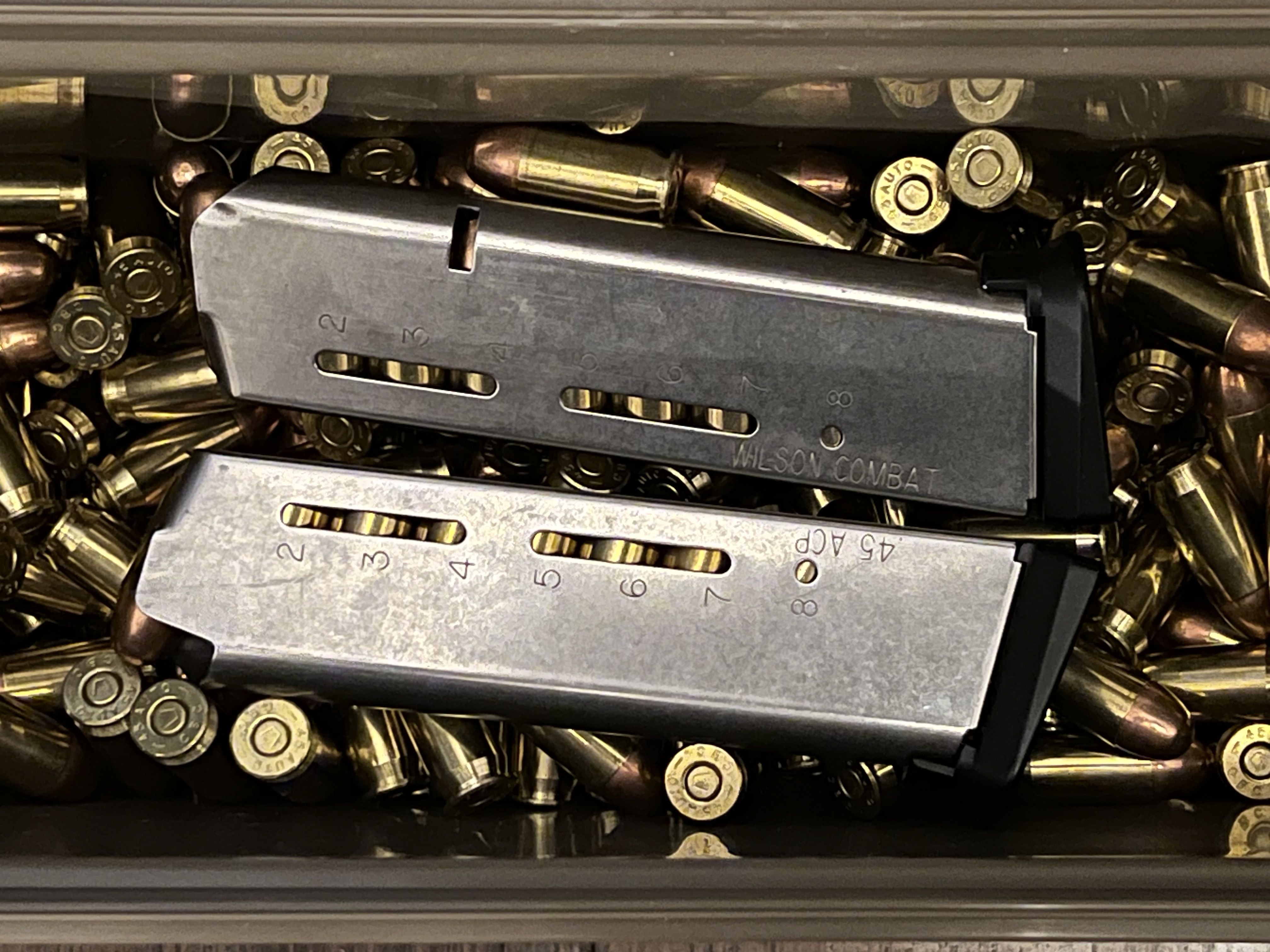
In the month of November 2024, I decided to revisit the skinny gun for an upcoming championship match. And by skinny gun, I mean the 1911. And by 1911, I mean a 1911 in 45 ACP. Why 45 ACP? I could say that it’s because it’s the “Lord’s Caliber”. Or because, that’s what “John Moses Browning intended”. However, the real reason is because the only 1911s I have are in 45 ACP. However, this post isn’t intended to argue the proper 1911 cartridge. Rather, it’s intended to provide a different perspective on the age-old 9mm vs 45 ACP debate that generally boils down to arguing over caliber versus capacity.
For those of you who aren’t aware of the caliber versus capacity debate, it is an ongoing, and arguably never ending, debate between the merits of the 9mm and 45 ACP predominantly in a defensive application context. The 9mm proponents claim that modern powders and bullet construction techniques make the 9mm just as good as the venerable 45 ACP while offering additional capacity in the same form factor. On the other hand, the proponents of 45 ACP suggest the larger diameter increases the chances of fight stopping hits and therefore offers more stopping power. As far as I can tell, both cartridges will get the job done assuming shots are placed in the right vital anatomical structures.
Regardless of what I think, the debate rages on. With neither side willing to concede even an inch.
So why are we even here? Why am I writing this post? Great questions, really. Bottom line? I think the argument is shallow and short sighted.
When it comes to modern ammo, I can’t identify a notable terminal ballistic advantage between either cartridge. Due to that, I’m pretty much 100% committed to team 9mm. I’ll take extra ammo over slightly bigger holes.
All of that said, there is one aspect that I find is almost universally overlooked: the compounding effects of shooting 45 ACP or any other larger caliber in volume for training, practice, or competition.
The first of the compounding effects comes in the form of a lighter wallet. When any other cartridge is compared to 9mm, it is going to be more expensive. The average price of 9mm since AmmoPricesNow.com (which is now a part of SouthernDefense.com) started tracking ammo prices in May of 2020 is 28¢ per round. The average price of 45 ACP over that same time period is 44¢. Look up the price of any other centerfire pistol cartridge and the result will be the same: 9mm is more cost effective. And that price difference adds up fast.
The next compounding effect comes in the form of wear and tear on pistols from the difference in recoil. Generally speaking, larger calibers including 45 ACP generate more recoil which results in more wear and tear from each shot fired. For non-shooters, occasional participants, and even most competent hobbyists, the difference in wear and tear will be negligible. These folks are not shooting enough volume for the compounding effects of recoil to result in broken parts or failing springs. However, those who are putting five to tens of thousands of rounds through their firearms are far more likely to see part failures.
I suspect some folks will argue that with that volume folks are more likely to see failures with their 9mm pistols. While that is true, the failures with heavier recoiling cartridges are likely to be more frequent since more force is at work. More frequent repairs also means more money spent which supports the argument of 9mm being more cost effective.
The final compounding effect is the wear and tear on our hands from the difference in recoil. This was a point I shared on X (formerly Twitter) yesterday. One of the responses pointed out that Ken Hackathorn no longer shoots 45 due to the nerve damage it did to his hands. I’m not certain if that statement is accurate or not, but it’s not the first time I’ve heard it. Regardless, I can tell you that my hands end up more tired and my arthritis is more aggravated after a match where I shoot 45 ACP versus a match where I shoot 9mm. While it’s not as noticeable, this holds true whenever I shoot revolvers in a match or in a class using 38 special or 9mm. The more recoil that is transferred to the hands the faster the hands get tired and it’s not hard to believe that doing that repeatedly over years might result in or accelerate nerve damage or other medical conditions.
Now I’m not telling anyone that they are wrong if they don’t shoot 9mm exclusively. Nor am I telling anyone that they are wrong for preferring 45 ACP over 9mm. All that I’m trying to say is that the caliber debate, while fun to engage in, is silly and shortsighted. It’s silly because there is no tangible ballistic advantage to the 45 ACP. It’s no more of a “man stopper” than modern 9mm is. And it’s shortsighted because 9mm is more cost effective to shoot in volume and puts less wear and tear per shot to the pistol and to our hands.
Furthermore, I’ve arrived at the personal decision that I will switch to 9mm 1911s should I decide to continue pursuing skinny gun activities like the upcoming Texas Single Stack 1911 Championship in December. I’m still going to keep the proper 45ACP 1911, but it’s going to be reserved strictly for low round count recreational activities.

4 responses to “9mm vs 45 (or Any Other Larger Caliber) Debate Revisited”
Good writeup. I’m glad I got into reloading 12 years ago. Factory ammo overall has gone through the roof and I rarely but off the shelf or online anymore except for carry ammo. I reload .45 ACP all the time as well as other conventional rounds, including 9mm.
As for the caliber debate, I like 9mm and modern ammo tech has increased it’s effectiveness but the same can be said of the .45 ACP. Both will work for the street and be fine. But, honestly, if you’re in the woods and face to face with a bear, which would you rather have in hand? A 9mm or a .45 ACP?
For whatever it’s worth: (The late Paul Harrell did a video comparing .45 ACP and 10mm several years ago illustrated that plain .45 230 gr ball ammo is actually very effective in both penetration and damage as it tumbles through flesh and bone deforming).
If you go with a 1911 in 9mm, remember the Stallone movie Cobra and get you a set of Raybans. LOL! (My wife loves that movie)
There are context specific situations where I would prefer 45 ACP over 9mm. But speaking in broad strokes and general terms, 9mm comes out on top for the reasons mentioned in the post. As for bear defense, I’d rather have a rifle handy rather than the 44 mag six shooter I would mostly likely take with me into the woods (which I’m also not going to practice and train with in large volume due to its cost and the wear and tear it will put on my hands).
And now, I suppose I will have to do a little Ray-Ban shopping to go along with that 9mm 1911…
I traded my Glock 21 (.45 ACP) for a Glock 17 (9mm) and I have no regrets. The .45 ACP round in a polymer pistol was just too hard on my hands.
As a gunsmith, I routinely get low to mid-priced 1911s chambered in 9mm with complaints about failure to feed and failure to eject. I don’t see that with the more expensive 1911s….ymmv