
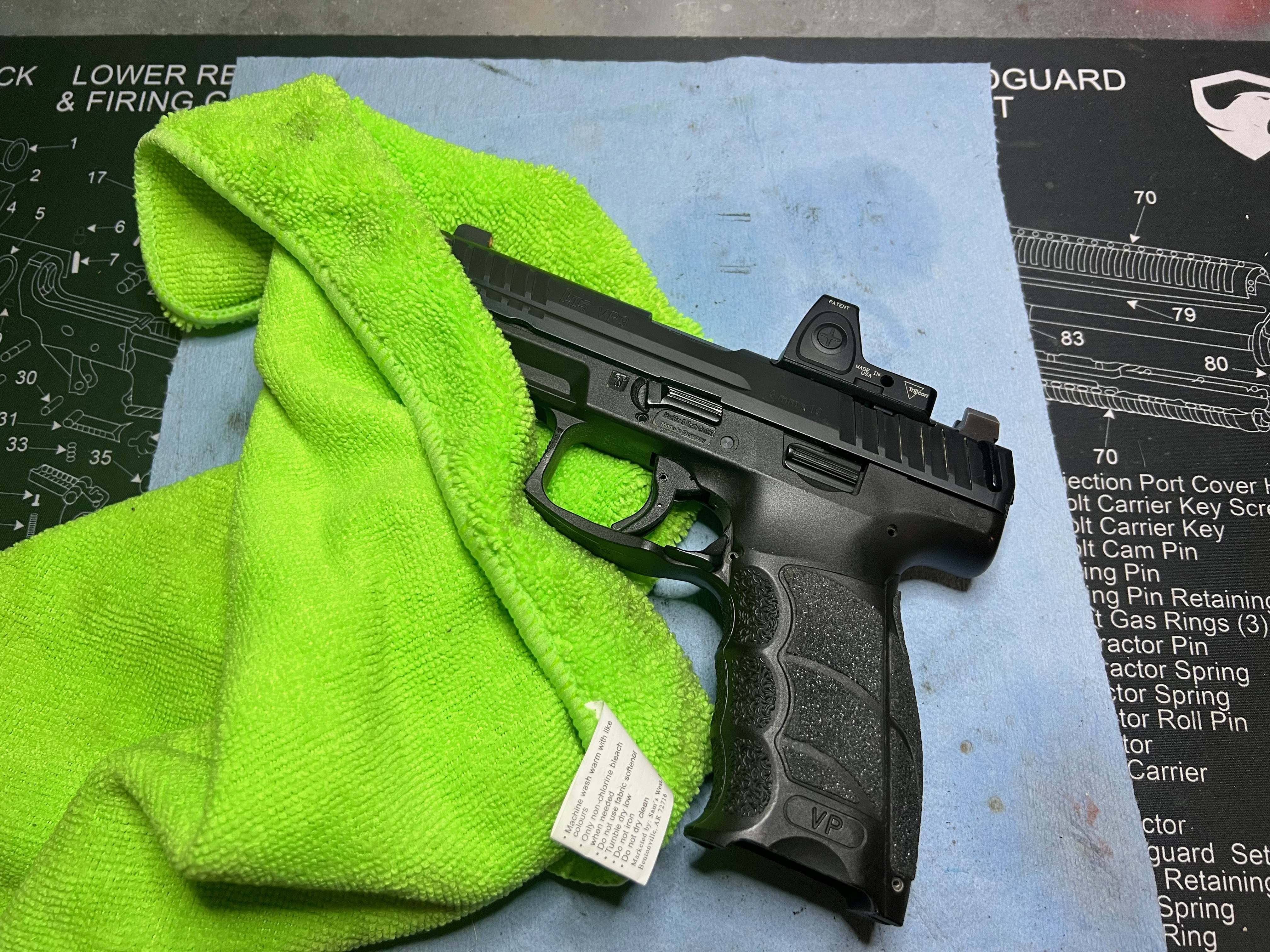
One thing there is never a shortage of in the gun community is opposing opinions. There are good opinions. There are also bad opinions. Then there are a bunch of opinions that have very little bearing on anything or are inconsequential. And if that wasn’t enough, there are those opinions that lead to raging debates over what is most likely the very same opinion simply worded differently. One of those opinions, which I suspect falls into the last group, is over cleaning your firearm.
Seriously. You can’t make this stuff. There is quite literally a camp of folks who swear that cleaning your firearm is a waste of time. Something that only those who lack marksmanship skills do since they don’t actually practice with their firearms. On the opposing side is a camp that swears not immediately cleaning your firearm after every use is blasphemous. It’s such a polarizing topic that I wouldn’t be surprised to have members from both camps who read this get all huffy and puffy before letting me know how right they are before even reading this far into this post.
I suspect that both camps are well meaning and probably have the same opinion without realizing they are all saying the same thing differently using ambiguous terms or approaching it from a different context. Somehow, soon after a heated debate begins, some one starts using car analogies, or more specifically engine analogies, to get their points across. Shortly after that, when it seems that an understanding is about to be reached, someone declares that while the analogy makes sense it is most definitely not what was said given the original choice of words. And then the cycle repeats. It’s truly uncanny. It’s also entertaining and exhausting at the same time.
I’m going to use the same car analogies to, hopefully, illustrate what I believe most folks agree with while attempting to disambiguate the verbiage often used.

Lubrication
Unless one is complete unfamiliar with combustion engines, then one knows that oil must be added when the engine oil is low. Lubrication is critical to reduce friction in order for the engine to operate normally. Lack of lubrication increases wear and tear and increases heat during normal operation that may lead to part breaking prematurely or catastrophic failure. Guns, especially those with reciprocating parts, are similar to engines and benefit from adequate lubrication.
How much and what type of lubrication depends on the firearm and the operating environment. And when lubrication is low then some should be added to the machine. Sounds like an engine, doesn’t it?
The thing is that when one camp says, “one should never clean their guns and it’s a waste of time”, the other camp assumes that means that lubrication is never added. Conversely, when one camp says, “you should always clean your gun after each use”, the opposing camp hears, “you must completely tear down the entire pistol to clean every nook and cranny in order to be ready for a white glove inspection”. Yet both camps probably agree that adequate lubrication is a good idea and probably only differ on when it is most prudent to top off the oil so to speak.

Routine Maintenance
Every single combustion engine has a recommended oil change schedule which can be found in the owner’s manual. Likewise, a firearm has a recommended routine, or preventative, maintenance schedule which can also be found in the owner’s manual. A firearm’s recommended maintenance is the equivalent of a vehicle’s oil change.
I suppose one could argue that it’s not the same because one would never have to remove carbon build up from an engine. However, the systems function differently. An engine is an enclosed system that oil is circulated through. Most of the build up ends up being caught by the oil filter and most of what gets through ends up collected in the oil pan and drained out in an oil change. A firearm is not an enclosed system and lacks a filtration mechanism. So the essence is equivalent, get the nasty stuff out of the machine and put in fresh lubrication.
The two camps do have different points of view of when routine maintenance should be performed. The camp of never cleaning the gun opts for waiting until getting rid of the nasty stuff is necessary which is after a gun starts misbehaving. The other camp takes a preventive approach of getting the gunk out as soon as possible. In my opinion, both approaches are a little extreme and excessive when treated as absolutes and a more practical approach can be found somewhere in the middle.
Think about it. A car is not guaranteed to have a catastrophic failure if driven a mile beyond or the day after the recommended oil change interval. However, the likelihood of a serious failure increases the longer one puts off that oil change. At the same time, changing the oil after every time the car is driven isn’t going to extend the vehicle’s life span necessarily and a catastrophic failure is still possible.
Yeah, I know an engine isn’t a gun and a gun isn’t a car. The systems aren’t identical. The point is routine maintenance isn’t necessary every time the gun is shot, but we also don’t have to wait for it to start misbehaving before performing it. It also doesn’t hurt anything to proactively perform routine maintenance before it’s due.
Personally, I mix and match the approaches along with a maintenance and round count log. The round count log servers as an odometer. If I know I’m approaching the recommended routine maintenance round count or have exceeded it, then I perform the maintenance the next chance I get. I’m not worried if that happens a little before or a little after the recommended interval. If I know there is an important activity coming up that I will be depending on a particular gun such as a major match or a qualification exam, then I will preemptively perform routine maintenance before the activity. Just like one might opt to get an oil change and check the tire pressures before starting a long road trip. I simply want to give the firearm the best chance to perform well without misbehaving.
At the end of the day, it’s up to the individual. If cleaning it after each use is your thing that brings you zen or helps maintain your confidence level in your firearm, then go for it. If you want to wait until there are signs that maintenance is probably a good idea because there are other things you would rather be or need to be doing, then also go for it. If a middle of the road approach like mine strikes your fancy, then… you probably guessed it… go for it. It’s your gun, not mine.

Deep Cleaning (And Major Repairs)
A lot of folks don’t have the necessary knowledge, tools, time, space, or desire to pull their entire engine apart and rebuild it. Similar things can be said about a major repair. Those folks are either going to trade in their car before such a thing is required or hire a mechanic to do it. However, there are some folks who can do all that. And there are some folks that do this sort of stuff for fun and will do that to their cars even when it’s not needed. Yeah, I’m looking at you motor heads.
Guns are similar in this respect. Complete disassembly is rarely required. In many cases, it requires specialized tools and a good bit of knowledge. These tasks are probably better suited for an armorer or gun smith, but there are those of us, like me, who tinker enough to do it and are willing to do so. There are also some that find their zen in doing such things.
In fact, I have a friend who ritualistically breaks down and deep cleans his firearms after every match. I suspect he could benefit from professional help, but then again there are many of us who would benefit from the same. At any rate, I digress. This level of detailed cleaning is well beyond routine maintenance and is rarely needed.
I suspect the “cleaning is a waste of time” camp probably assumes this is the level of cleaning the other camp advocates. The assumption further assumes that the clean after every use camp must not have much time available to run their guns because a detailed cleaning of this magnitude must consume an enormous amount of time.
These assumptions are seldom correct. Having performed this level of cleaning after taking a spill in class that resulted in fine grained sand working its way into the ignition components of a Staccato P, I can tell you that it doesn’t take as much time as one might think in skilled hands that are familiar with the tear down procedure.
Moreover, there are folks, like my aforementioned friend, who are skilled and dedicated shooters who do this level of cleaning and still have plenty of time to run their guns frequently. Conversely, I have met my fair share of “cleaning is a waste” of time camp members who dedicate a lot less time to running their guns and aren’t nearly as skilled. Yes, the former is likely the exception to the rule. At the same time, the latter is seldom the exception.
The point is that the number of folks who do this level of cleaning at all isn’t as big as the “cleaning is a waste of time” folks might think. The number of folks who do this level of cleaning who are also in the camp of “clean after every use” is even less.

Takeaways
You know what they say about opinions? Opinions are like assholes, everyone has one.
In the case of cleaning, ambiguous terms create the illusion that the gun community is vehemently split on the topic. I suspect that is not the case as I rarely find anyone who is versed in firearm operation who truthfully believes that lubrication and routine maintenance is completely unnecessary and must be nothing more than a marketing ploy to sell solvents and lubricants. We might differ on products, methods, and frequency intervals, but not much else.
Keep it adequately lubricated.
Clean or dirty? It doesn’t really matter as much as some folks make it out to seem. As long as isn’t a pig stye that doesn’t perform to expectations, keep it as spic ‘n span as you want or are comfortable with. Me? I’ll air on the side of caution and keep performing the routine maintenance close to the recommended intervals along with the occasional preemptive one prior to an event that is important to me or when I think it needs one. This is what I suggest for those looking for a recommendation, but, at the end of the day, it’s ultimately up to you.
The only thing one can be absolutely certain about is that given the opportunity for a heated debate then a heated debate will predictably ensure. Especially among competitive types who are unwilling to concede. Even after using analogies to find common ground. Bring some popcorn and enjoy the show.
2 responses to “Clean Your F’ing Gun!”
I shoot mostly 1911 style, and as opposed to to the polymer guns which require less lubrication, 1911s need lubrication regularly. So, I clean my 1911s fairly often not so much for the cleaning but for the lube. My polymer guns get cleaned when I am really bored!
[…] Clean Your F’ing Gun! […]