
Why didn’t one of you let me know I’d been dropping the ball on live-fire drill posts? I knew it’d been a while, but three months since the last one? Sheesh! Oh well, nothing to do about it now. Writing that recent after-action report on KR’s Top 10 Drills class was a wake-up call, though. It hit me that I’ve mentioned a bunch of drills before but never gave them their own proper breakdown. No better time than now to get back into the habit.
So, here we are. Let’s take a look at the NRA Basic Pistol qualification.
The Course of Fire
- Target: 4″ circle
- Distance: 5 yards
- Start Position: Aimed at target
- Par Time: None
- Scoring: None
That’s it. Pretty straightforward.
My Thoughts on the Qualification
That’s how I first encountered it, as I described above. Honestly, the target might not have even been a 4″ circle—that’s just how I remember it. Thing is, it’s not an “official” NRA qualification or course of fire, at least not based on what I can find in the current NRA Basics of Pistol Shooting course materials.
Let’s back up a bit. The NRA Basics of Pistol Shooting course is designed to ease new shooters into pistol handling. Safety takes center stage, as it should. After that, it covers the basics—loading, unloading, and marksmanship fundamentals: grip, sights, trigger, stance, and so on. NRA-certified instructors get some general guidelines for the live-fire portion:
- Short, manageable distance (3-5 yards).
- Bullseye-style target (NRA B-8).
- 20-50 rounds, split into multiple strings, 5-shot groups recommended.
- No time limit.
There’s no scoring standard for students. It’s not pass/fail—it’s more of a “you participated” setup, letting newbies safely apply what they’ve learned.
In Karl Rehn’s book, Strategies and Standards for Defensive Handgun Training, it says students in the NRA course start at 10 feet. If they can land 5 shots in a 4″ circle there, they move to 15 feet (5 yards). Hit that? Step back to 20 feet. NRA pistol instructors, though, need to put 16 out of 20 shots into a 6″ circle at 15 yards.
As a drill, this course of fire is a solid way to practice or gauge your fundamentals—from basic competence to real mastery.
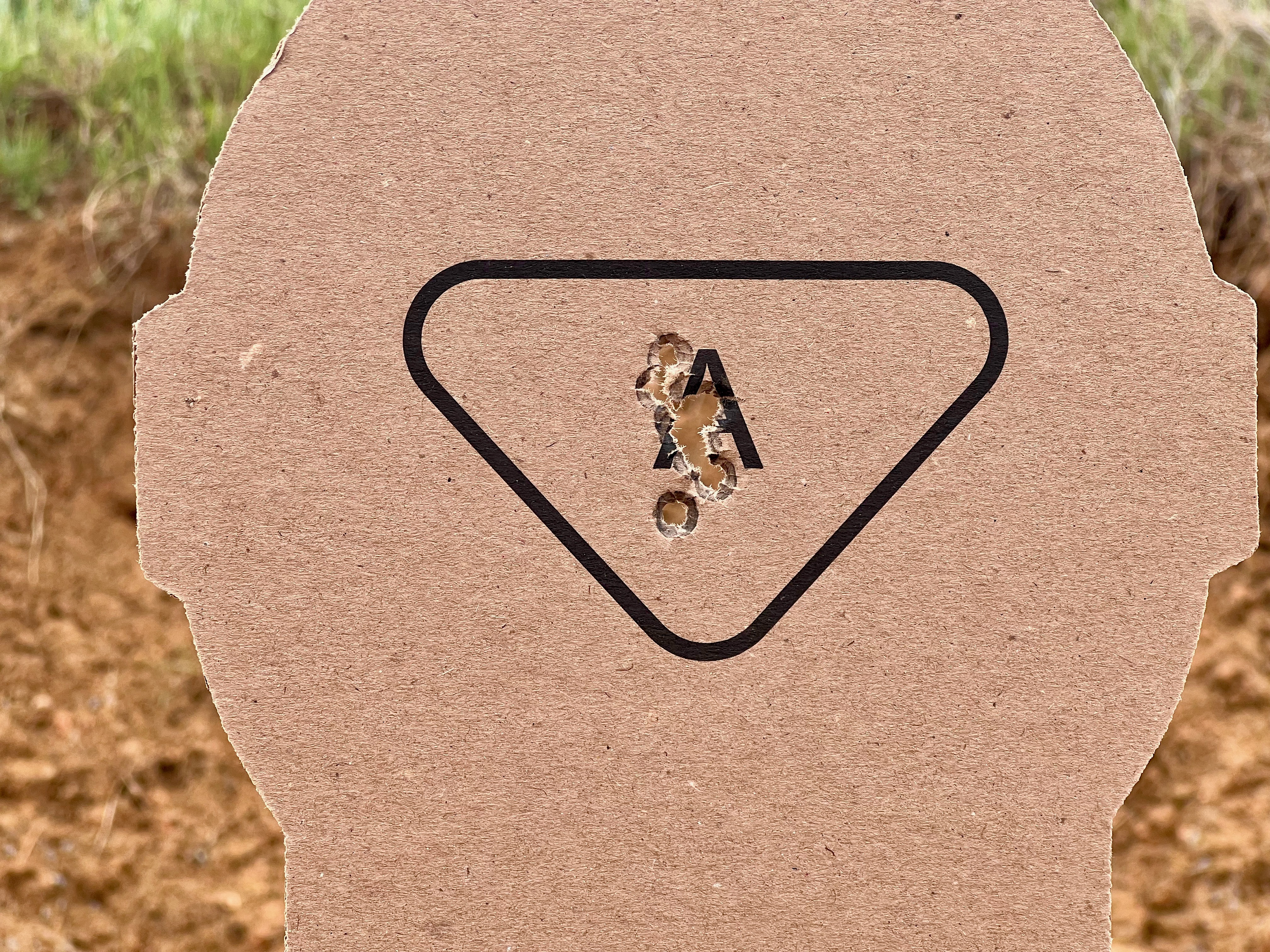
Think about it. Modern pistols have the mechanical precision to shoot 1″ to 6″ groups at 25 yards, depending on build quality and ideal range conditions, minus human error. Ammo and barrel length play a part, but your average full-size pistol in good shape should manage 2″ to 3″ groups at 25 yards with decent ammo. Since 5 yards is one-fifth of 25, the group size shrinks to one-fifth too. A pistol that shoots 2.5″ groups at 25 yards should, in theory, print a 0.5″ group at 5. With a 9mm’s .354″ bullet diameter—common for a lot of folks reading this—that means perfectly executed fundamentals should leave you with one ragged 0.5″ hole after five shots, with the holes overlapping.
On a B-8 target, those five shots should fit nicely in the 1.7″ X-ring. Even a budget pistol that tops out at 6″ groups at 25 yards (1.2″ at 5) still works here.
Relative Difficulty
No time limit means the relative difficulty clocks in at 0%. That’s just how the numbers shake out. Still, at 5 yards, a USPSA Grand Master could likely stack all five shots in a 4″ circle in one second or hit the X-ring in two. Try those group sizes and times if you want a challenge.
Sure, the math says 0% difficulty—firmly in “easy drill” territory—but it still takes a baseline of marksmanship skill to make it happen. Mess up your grip or trigger pull, and shots can stray outside that 4″ circle, even at close range with no clock. Same goes for flinching or anticipating recoil.
Closing Thoughts
The NRA Basic Pistol qualification is one of the least demanding courses of fire I’ve tried. That said, every marksman out there would’ve found it tough when they first started. It doesn’t take much to get comfortable with it, but you can tweak it to up the ante. Landing all your hits in the B-8’s X-ring on demand takes some effort. Getting all the holes to touch? That’s a rewarding challenge that can test your patience.
One thing I appreciate: you can shoot this drill at almost any public range. No movement, starts aimed in, slow-fire (unless you’re pushing GM-level splits). It’s range-friendly and accessible.
If you haven’t tried a drill like this, I’d encourage you to give it a go. Load up and see how it feels.

Leave a Reply