
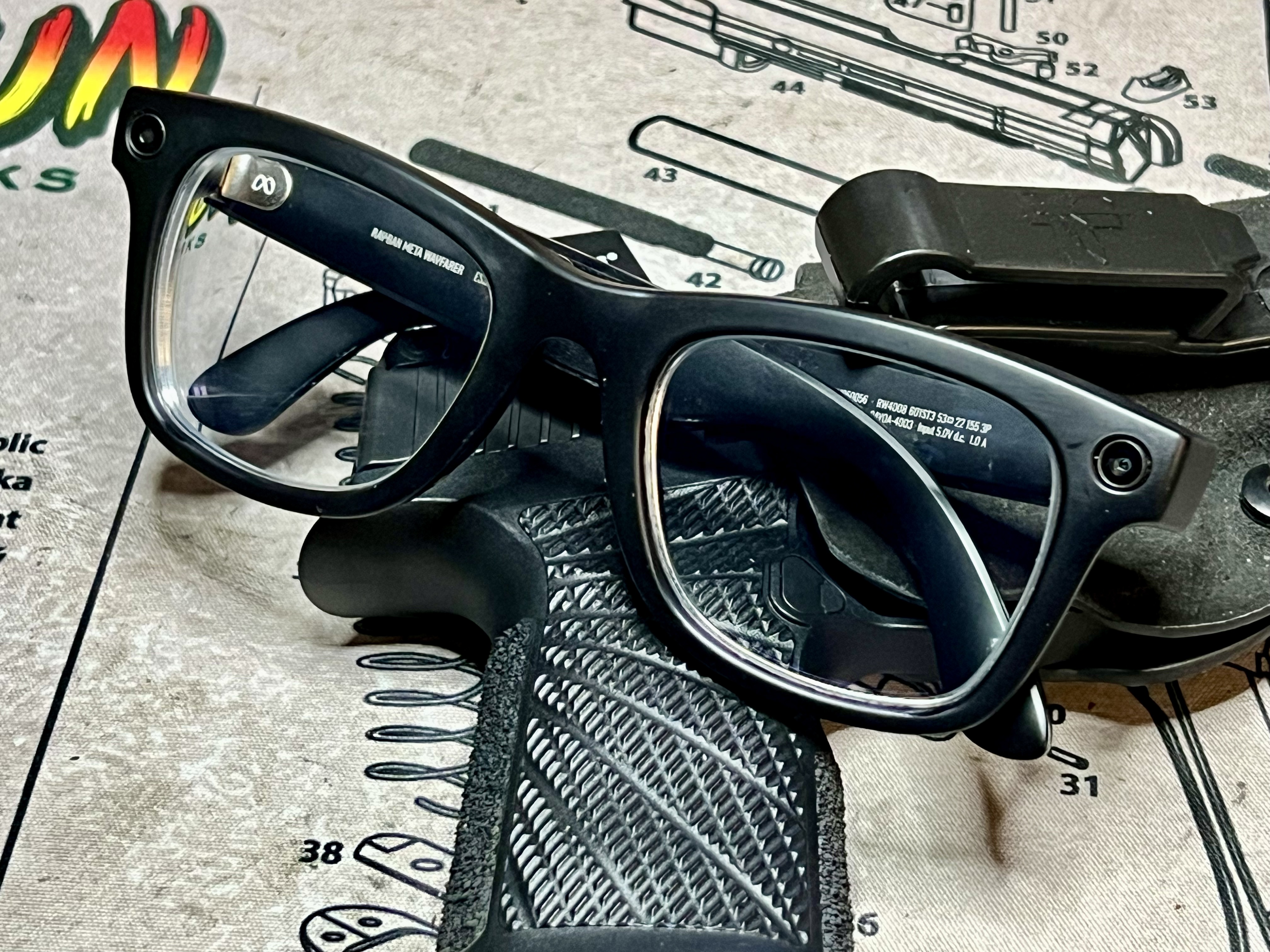
Late in 2024, I noticed a trend among my fellow competitive shooters who record their matches: they were swapping traditional eye protection for Ray-Ban Meta AI glasses. As someone in the same circle, I got curious, did my homework, and jumped on the bandwagon about a month ago. Since then, I’ve fielded plenty of questions about whether these glasses are worth it for shooting. The answer? It’s not a simple yes or no—it’s complicated. So, let’s dive in.
What Are Ray-Ban Meta AI Glasses?
These glasses are a collab between Meta (yep, the Facebook and Instagram overlords) and Ray-Ban. They’re essentially high-tech eyewear that connect to Meta’s AI service via the internet through your Bluetooth paired smartphone. Packed with speakers, a microphone, a camera, a touchpad, a button, and a few LEDs, they’re like the smartphone equivalent of old-school glasses—smart glasses, if you will.
The AI is voice-activated with a “Hey, Meta” command, similar to Siri, Alexa, or Google’s assistant. Honestly, it feels familiar, and I’m not entirely convinced it’s leaps and bounds ahead of those other services, which have likely gotten AI upgrades themselves (just my two cents).
I had two big hesitations before buying in. First was the cost. The glasses retail between $300 and $400, which is actually reasonable compared to a GoPro or Insta360 GO. But as someone needing prescription lenses, I wasn’t thrilled about the added expense of high-quality lenses, especially since these would double as personal protective equipment (PPE) at the range. I waited until my vision insurance kicked in, which brought the cost closer to a regular pair of specs. The catch? These became my all-day, everyday corrective lenses.
My second hang-up was privacy. Remember Google Glass? Privacy concerns tanked it, and Meta’s track record isn’t exactly squeaky clean either. Add their spotty history with firearms-related content censorship, and I was skeptical. But after learning I could disable the AI services, I decided to give them a shot once my insurance was ready.
And so, I got myself a pair. Here’s how it’s been.
All-Day Wear: Cool, But Flawed
Wearing these glasses all day is like having smartphone-connected earbuds in your ears 24/7. Depending on how you set them up via the phone app, they can read incoming messages, announce calls, play music, podcasts, or audiobooks, and even integrate with accessibility features. Plus, you can snap photos or record videos hands-free.
It’s slick—until the battery dies. If you’re using the features heavily, the low-battery warning hits fast. Even with minimal use, you’re lucky to get 10 hours before the alert. The glasses are “on” whenever the legs are open, draining the battery constantly. Charging requires popping them into their case, so you’re lugging that case everywhere. Lose or damage it? You’re out of luck unless you fork over $100 for a replacement. No case, no charge.
For those of us relying on these as corrective lenses, this means carrying a backup pair of glasses or squinting through uncorrected vision while they charge. Both options are a hassle. Because of this, I can’t recommend these as all-day corrective lenses. The battery life is a dealbreaker, and it’s the biggest gripe I hear from others. I’m betting Meta and Ray-Ban are working on a fix, and if the next generation improves battery life, I might consider another pair when my insurance renews. For now, though, I’m not sold on these as a long-term solution.
Shooting Eyewear? Proceed with Caution
Using these as shooting eyewear is where things get tricky.
Good shooting glasses need three things:
- ANSI Z87.1-certified lenses for high-impact resistance.
- Reinforced frames to withstand impacts.
- Wraparound design to block debris from all angles.
Out of the box, the Meta glasses have none of these. Most standard sunglasses don’t either, for that matter.
So why am I using them? Cost. Quality prescription lenses are pricey, and I invest in high-impact Trivex lenses (commonly used in ANSI Z87.1-certified eyewear) with protective coatings. I compromise on the frame and design because these are my everyday glasses. It’s a calculated risk I’m willing to take, but I’m not blind to the shortcomings.
My plan is to eventually grab a dedicated pair of ANSI Z87.1-certified shooting glasses with reinforced frames—something from Oakley or Hunters HD Gold. I’ve done it before, and it’s the smarter move. But footing the bill for both a dedicated pair and everyday prescription glasses every time my prescription changes isn’t always in the budget.
The tradeoff with dedicated shooting glasses is losing the Meta glasses’ POV recording feature. I’m okay with that, and I’ll explain why next. For now, my take is this: don’t use the Meta glasses as shooting eyewear without upgrading to high-impact polycarbonate lenses like Trivex. Even then, the frames and design aren’t ideal. ANSI Z87.1-certified over-glasses safety covers are a solid alternative worth considering.
POV Footage: Underwhelming
I’ll be blunt: the POV footage from these glasses is disappointing.
My biggest issue is the camera’s placement on the left side of the frame, near the hinge. This creates two problems:
- Off-center footage: The pistol is rarely centered in the frame, which I didn’t anticipate when buying.
- Dominant eye mismatch: As a right-eye-dominant shooter, the left-sided camera makes the off-center issue worse. A camera above the dominant eye or closer to the face’s center would be ideal.
Even if the camera placement were better, the audio quality for loud sounds—like gunshots—is poor. Compared to my GoPro (which I reviewed in 2023) or the Insta360 GO, the Meta glasses’ recordings sound flat and distorted.
For those eyeing these glasses solely for POV footage, I’d point you to the Insta360 GO instead. It’s in the same price range (especially on sale) and delivers noticeably better video and audio quality. The minor inconvenience of attaching it to a hat is worth it for the upgrade. The Meta glasses’ footage isn’t awful, but the quality gap is obvious. Smartphone cameras have come a long way, and I expect smart glasses cameras will too. Until then, a dedicated camera is the better bet for quality-conscious shooters.
Verdict: Wait for the Next Round
All things considered, I’d hold off on the Meta glasses. Wait for the next version or see what competitors bring to the table.
The cost of the glasses plus high-impact polycarbonate lenses is roughly equal to (or more than) a pair of quality ANSI Z87.1-certified shooting glasses and an Insta360 GO. The latter combo gives you better protection and superior POV footage.
From a gadget nerd’s perspective, these glasses are fun. Despite their flaws as all-day eyewear, I’ve enjoyed tinkering with them. But I won’t stick with them long-term unless the battery life and camera improve.
That said, I’m not here to tell you not to buy them. If you’re intrigued, go for it. Just know what you’re getting into.

Leave a Reply