
A telltale sign someone’s getting serious about practical marksmanship is when they realize they need a shot timer. Every now and then, folks preparing to cross that proverbial chasm ask me, “Hey, Zo, what shot timer do you recommend?” or “What’s the best shot timer to get?” When choosing among the best shot timers, it’s essential to remember that, as with most things, there’s no silver bullet. Each shot timer has pros and cons tied to how you use it. The best timer fits your specific needs. For some of us pistoleros, that means owning a few, like handguns for different use cases. That’s the bad news. The good news? Most folks can get by with one timer for skill development. Still, the right choice depends on a few factors. Let’s compare the top shot timers available in 2025 and see if we can answer the real question: Which shot timer should you buy?
Setting the Stage
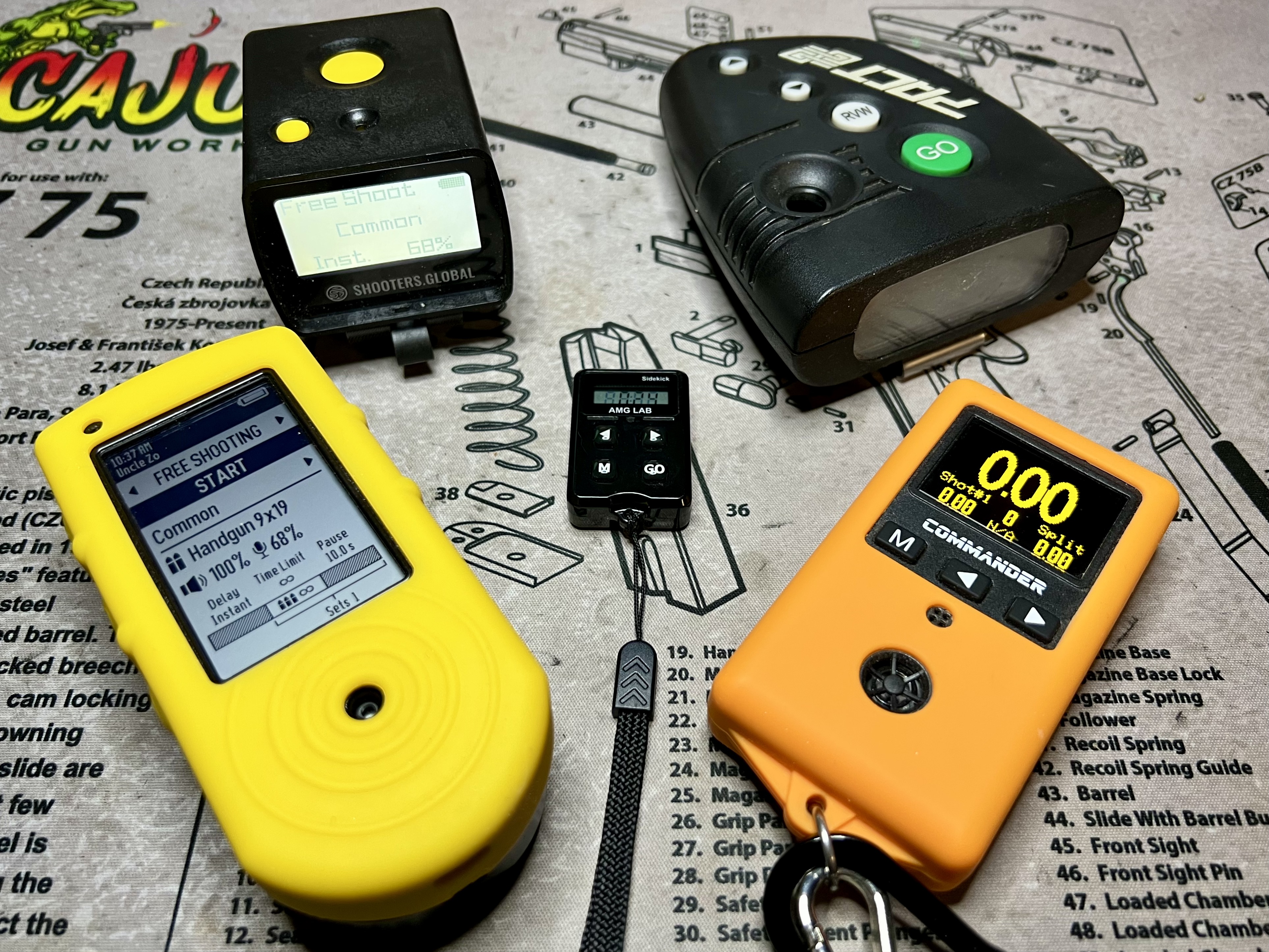
Before we dive into the weeds, let’s level set. I know of ten shot timers used by competitive shooters, coaches, and instructors. There might be more, but I’m sticking to these ten. I own five, three of which were provided free by manufacturers for testing, evaluation, and review—magnificent people in my book. Three of the ten I’ve never used, so I’ll only mention them where it makes sense, with the limited knowledge I have. I also have affiliate relationships with Shooters Global (SG Timer 2 and SG Timer GO) and PACT (Club Timer III, though purchased before this relationship began)—flagged for transparency. My suggestions are based on my experience and analysis, but you might want to factor those affiliations into your take.

The ten timers we’re discussing:
- AMG Lab Commander (purchased)
- AMG Lab Sidekick (provided free)
- Competition Electronics Pocket Pro
- Competition Electronics ProTimer
- Competition Electronics ProTimer BT
- Competitive Edge Dynamics CED7000
- Kestrel Ballistics KST1000
- PACT Club Timer III (purchased before affiliate ties)
- Shooters Global SG Timer 2 (provided free, affiliate)
- Shooters Global SG Timer GO (provided free, affiliate)
One final note: I’ve split this post into use-case sections. Each starts with my top pick for that scenario, followed by considerations that might steer you to another option. If you have multiple use cases, you’ll likely find a timer that works across most of them. No timer covers everything? Pick the one that best fits your top priority—it’ll likely work well enough for other uses, even if not perfectly. Worst case, you end up like me with a few shot timers. Let’s get to it.
Dry Fire
Dry fire practice is the most common reason folks ask me about shot timers, so I’m betting that’s why you’re here. The best news? Any modern shot timer works for dry fire, but my top pick is the AMG Lab Sidekick. It’s the cheapest of the bunch and ticks all the feature boxes a dry fire fiend craves.

For dry fire, you need three things: a randomized delayed start, an audible start signal, and a par time. I’m hard-pressed to think of a modern timer that doesn’t have those, so any will fit the bill. If you’re thinking, “Great! We’re done here,” hold on—not so fast. There’s a bit of nuance that matters.
Consider your dry fire environment. Do you mainly practice at home with others who might get annoyed by loud, incessant beeping day after day? Or in hotel rooms while traveling? If noise control’s a factor, most timers let you adjust the buzzer volume—except the PACT Club Timer III, which, if I’m not mistaken, is the dinosaur of the bunch with no volume control. The Sidekick’s got adjustable volume, digital sensitivity for dry trigger breaks, multiple par times in a session, and configurable session repeat for long drills.
But here’s the catch: the Sidekick’s a dry fire champ but not the best for other use cases. Its full-volume start signal can be tough to hear at a distance or in noisy settings, so it leaves a lot to be desired for competition or instruction. It’ll work for those, but the gap between “it works” and “it works well” is wide. If you’re into matches or coaching, pick something else—the Sidekick’s frugal price won’t save you from needing another timer.
My alternatives start with the Shooters Global SG Timer 2 and SG Timer GO. They currently lack multiple par times in a single string but offer video analysis capabilities—a wet dream for performance diagnostics or posting shot data on the ‘Gram (or your social platform of choice). Any timer can do video with a camera, but it’s way more work. I say “currently” because I wouldn’t be surprised if multiple par times get added via a firmware update. The Timer GO’s more affordable and ideal for personal use; the Timer 2’s better for coaches and instructors.
Other alternatives, in no particular order, include the AMG Lab Commander, Competitive Edge Dynamics CED7000, and Kestrel Ballistics KST1000. They share the Sidekick’s nice-to-have features: adjustable volume, sensitivity, multiple par times, and session repeat.
Live Fire
Live fire means a noisy environment, so my dry fire king, the Sidekick, drops to the bottom—its buzzer’s too quiet. I’d love to give you one top pick, but it’s tough, so I’m going with a twofer: the Shooters Global SG Timer 2 and AMG Lab Commander. They’re both in my range bag for a reason. That said, any other timer on this list works for live fire, but there are nuances to consider.

Indoor ranges are noisier than outdoor ones, with echoes bouncing off walls. All timers except the Competition Electronics models and PACT Club Timer III have echo-filtering to handle those echoes, which can mess with shot time data. Some folks ask if these timers work at busy public ranges, especially for collecting shot times in a bay with multiple shooters. It depends on the crowd. If it’s slow, you can tweak sensitivity and echo-filtering for decent data with a little luck. But if the line’s packed with yahoos sighting in magnum rifles or knuckleheads mag-dumping Desert Eagles into cardboard, you’re pretty much shit out of luck—your timer’s just a start signal and par time tool, indoor or out.
Competition
If your matches use PractiScore for scoring, you’ll want a timer with integration. My top pick is the AMG Lab Commander. It’s my go-to because I’m familiar with its PractiScore setup and comfortable using it. Other PractiScore-compatible timers include the AMG Lab Sidekick, Competition Electronics ProTimer BT, and Kestrel Ballistics KST1000. The Shooters Global SG Timer 2 has PractiScore integration in “Preview,” which could make match video analysis easier (without having to rely on spy mode) if it goes live. I’ll give it a whirl when it’s ready, but for now, I’m sticking with the Commander.
Update: Shooters Global SG Timer 2 and Shooters Global SG Timer GO now have PractiScore integration. Between the two, I think the SG Timer 2 is the better option for competition use due to its larger screen and louder start signal. The comparison table below has been updated to reflect this change.
If your matches don’t use PractiScore, any live fire timer works. Take your pick.

Coaching and Instruction
I’ve got a stinking suspicion I’ll get an “I told you so” from Karl Rehn on this one—my top pick for coaching is the Competition Electronics Pocket Pro. Its feature list is barren, but the efficiency of setting par times or switching between delay and instant start is uncanny. Add a loud buzzer, and it shines for instruction. It’s also on the lower end of the price spectrum.
Some folks can’t vibe with the Pocket Pro—maybe it’s too old-school, or their main use case is elsewhere. In that case, look at timers with loud start signals and multiple presets for quick switches during lessons. The Shooters Global SG Timer 2 lets you preload a boatload of presets—25, if memory serves, assuming newer firmware hasn’t changed that—via its smartphone app, and switching presets is relatively hassle-free. The AMG Lab Commander and Kestrel Ballistics KST1000 support presets too, but they’re limited to 5.
Final Thoughts
If you’ve been paying attention, you’ve noticed the Kestrel Ballistics KST1000 popping up a lot. I wish I had firsthand experience with it because its feature list is on point for most use cases. I keep hearing great things from folks who’ve used it, but I take those with a grain of salt. Is it as good as they say, or is there some cost justification behind the praise? I don’t doubt it’s a solid shot timer, but at over $300, it’s the most expensive of the bunch, and I haven’t heard much negative beyond the price tag.
A less obvious detail is why the Competition Electronics ProTimer isn’t mentioned in the use-case sections. Its features are nearly identical to the Pocket Pro, my coaching pick, but it’s marketed as the “new and improved” model. The main upgrade is a sharper digital display replacing the LCD, but the interface, with fewer buttons, slows down par time setup compared to the Pocket Pro. It’s basically the ProTimer BT without PractiScore integration. The ProTimer’s not trash—if I owned one, I wouldn’t rush to replace it—but it doesn’t stand out for any use case due to its limited features. Heck, it’s not even the most affordable option.
There’s a lot to digest here, but it all boils down to matching features to your priorities. I’m leaving you with a feature comparison table—a cheatsheet you can reference. Some of y’all might wish I’d led with this to save time, but think of it as a reward for reading all the way through.
| Shot Timer | Adjustable Volume | Adjustable Sensitivity | Multiple Par Times in One String | PractiScore Integration | Echo Filtering | Presets | Repeat |
|---|---|---|---|---|---|---|---|
| AMG Lab Commander | Yes | Yes (Digital) | Yes | Yes (Bluetooth) | Yes | 5 | Yes |
| AMG Lab Sidekick | Yes | Yes (Digital) | Yes | Yes (Bluetooth) | Yes | 5 | Yes |
| Competition Electronics Pocket Pro | Yes | Yes | No | No | No | 0 | No |
| Competition Electronics ProTimer | Yes | Yes | No | No | No | 0 | No |
| Competition Electronics ProTimer BT | Yes | Yes | No | Yes (Bluetooth) | No | 0 | No |
| Competitive Edge Dynamics CED7000 | Yes | Yes | Yes | No | Yes | 0 | Yes |
| Kestrel Ballistics KST1000 | Yes | Yes | Yes | Yes (Bluetooth, PractiScore 2 app) | Yes | 5 | Yes |
| PACT Club Timer III | No | Limited (Manual screw) | No | No | No | 0 | No |
| Shooters Global SG Timer GO | Yes | Yes | Likely Yes | Yes | Yes | 25 | Yes |
| Shooters Global SG Timer 2 | Yes | Yes | Likely Yes | Yes | Yes | 25 | Yes |
Still here? Don’t get stuck with analysis paralysis. Hit me up on the socials for help or to let me know which one y’all picked up.

Leave a Reply