
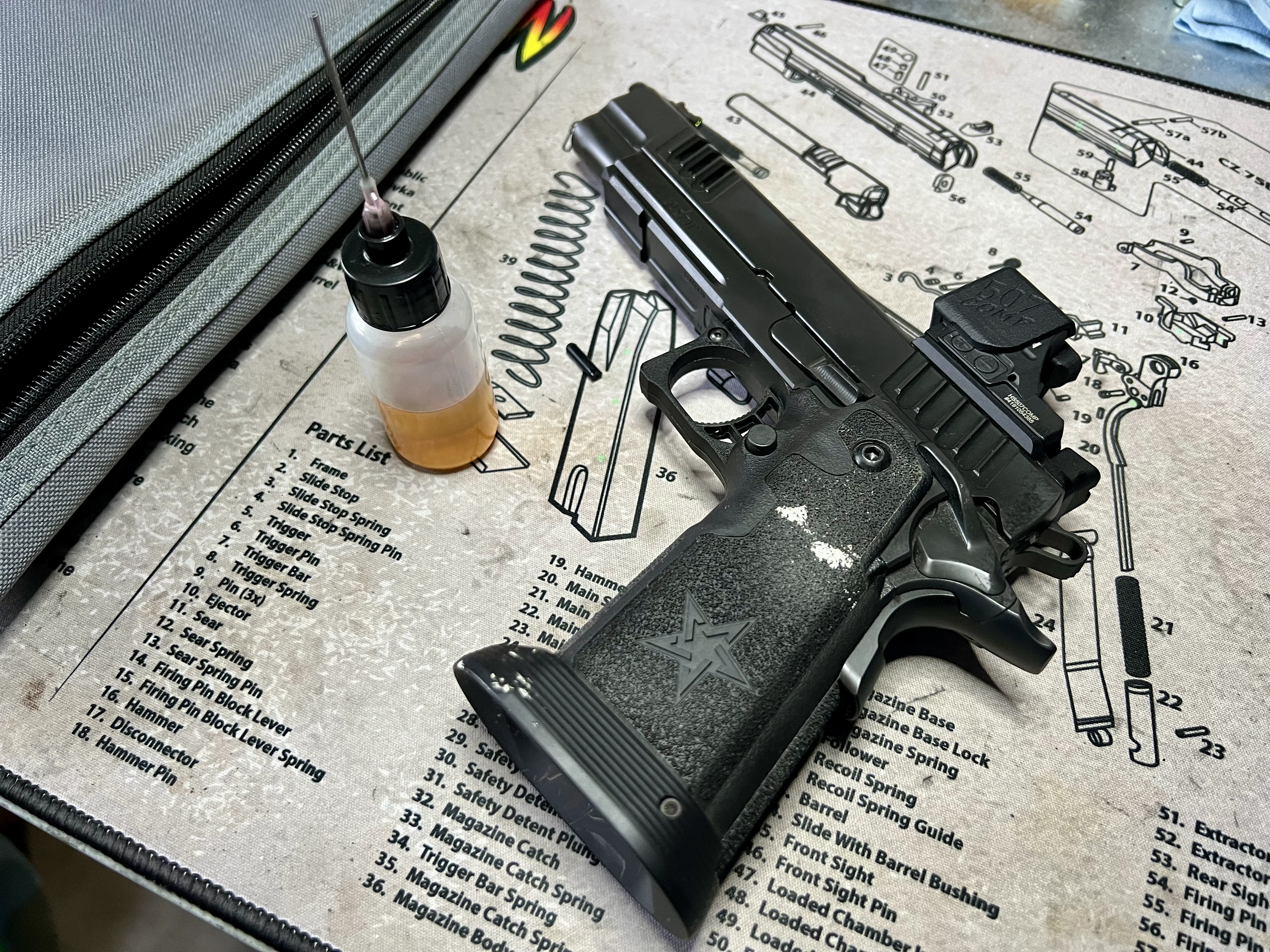
Writing about the Staccato XL again feels a bit like déjà vu. That tracks, since just three weeks ago, I was parked in this same chair, staring at the same computer, also on a Sunday after a Saturday match, typing about the XL hitting the 500-round milestone. But it’s not exactly déjà vu. This time, I’m less thrilled to be writing about it. Part of that’s because I’ve put more rounds downrange, making range days feel less novel. But it’s also because a hiccup just before the 1,000-round milestone has me eyeing the XL with caution.
The 1,000-round milestone is different from the 500. While 500 rounds is a solid sign a pistol is free of manufacturing or workmanship defects, 1,000 rounds is where I gauge its likely longevity in my holster. That’s both how much I’ll use it going forward, based on the subjective fun factor, and its mechanical lifespan, judged by wear patterns observed during routine maintenance.
Thanks to the folks at Ammo To Go, who hooked me up with a case of 150-grain Federal Syntech Action Pistol 9mm, the XL breezed past the 1,000-round mark. So, let’s dive in, starting with mechanical wear.

Visible Wear Patterns
There’s not much to report here—or maybe there is. Honestly, I’m stumped. Confused? Yeah, me too. Let me explain.
Visibly, there’s only slight wear. Compared to the Staccato P, which is well past 5,000 rounds, the wear looks strikingly similar. The P has over five times as many rounds through it, so that’s bad, right? Not necessarily. The P has shown the same wear marks since hitting 1,000 rounds. The difference? The P’s spots, while in the same places and about the same size, are a tad shinier.
So, is this wear pattern good? Maybe. I’m torn. On one hand, the P runs flawlessly, and its wear suggests nothing’s wrong. On the other, I’m not convinced a quality DLC coating, like those on both barrels and slides, should show this much wear this early. It’s not excessive, but it’s noticeable.


I’m still unsure. I’d love to know if other Staccato owners have seen similar wear patterns. I’m probably making a mountain out of a molehill, but I’m curious nonetheless.
When Did We Start “Going Steady”?
These round-count milestones feel like relationship milestones. The first range trip is like a first date—my first impressions review. The 500-round mark is like dating; it’s not serious, but you’re having fun. If you’re truly clicking, the 1,000-round milestone sneaks up. No one says anything, but suddenly you’re “going steady” when your partner springs a surprise invite to meet the parents.
Jokes and shaky analogies aside, that’s where I’m at with the XL. We’ve been having a blast—frequently, almost exclusively. This is exactly what I wanted when I dropped serious cash on this 2011 and its accessories. I’d be pretty bummed if things weren’t working out after that investment.
Ch-ch-ch-changes
Some of you might recall I modded the XL early on with an extended magazine catch/release from Extreme Shooters, topped with a low-profile button from Dawson Precision. That mod was a bust. I dropped magazines post-reload during matches—nearly one per match. I thought it was me until a loaded barrel start proved otherwise. During “make ready,” I was sure the magazine was seated, but it dropped after the first shot. Whatever gains I hoped for weren’t worth the constant magazine drops. I could’ve trained around it, but the juice wasn’t worth the squeeze.

With the extended mag release out, I’m tweaking the recoil system next. A local Master-class competitor, who slays stages with his XL, suggested swapping the conventional 7-pound recoil spring for a 7-pound variable power recoil spring and adding an aluminum shock buffer. He uses this setup to reduce slight muzzle bounce when the slide returns after cycling—something I didn’t notice until he pointed it out. Now I see it with every shot. I’m giving his formula a spin to see how it pans out.
Was that Hammer Follow?
Yes. Yes, it was hammer follow. That’s the hiccup I mentioned earlier, and it’s the most infuriating issue short of a catastrophic failure I can imagine. After sailing past the 500-round mark, I was certain the XL was immune to hammer follow . So, it blindsided me during a stage at the last match. I’m still stuck in denial as I write this.
I keep rewatching the video, hunting for another explanation for why the hammer followed the slide after cycling the next-to-last shot. Despite countless replays and knowing deep down there’s no other answer, I’m still grasping for an alternative theory, hoping I’m wrong. I’m even debating not sending it back to Staccato. I want it to be a fluke. I want it to be anything else. But by the time you read this, the XL is likely on its way to Staccato for repair. It’s the right call, and I’m confident they’ll make it right. Still, what are the odds that two of the three Staccatos have had hammer follow?
The question now is what’ll take the XL’s place while it’s gone. The P is the obvious choice—it’s the designated backup. Then again, this could be a chance to take Ronnie’s old STI Legend for a spin. I’ve got a couple of days to decide, and you’ll know which way I went when I post match footage on social media soon.

No worries, though—the XL will be back in action before long. I’m sure of it. I’ll be back here writing about its 2,000-round milestone, probably before summer break ends and the kids are back in school.

Leave a Reply