Okay. Okay. I’ll admit it. I might be a little crazy.
Why in the world would I, or anyone for that matter, want a single-shot derringer chambered for .45-70? It has no practical application. It’s asinine. And, I’m here for it!
I probably shouldn’t be so harsh. There may be a practical application for this hand cannon, but I can’t think of one. In my eyes, the Bond Arms Cyclops in .45-70 is a meme worthy novelty gun. One that inflicts pain on its user. Punishes wrists and helps one develop a flinch. That said, it’s well built and, for those who aren’t faint of heart, it’s one heck of a hoot.
Let’s back up a smidge and get a little context. The .45-70, which is shorthand for .45-70 Government, is a rifle cartridge that was first adopted by the U.S. Military in 1873 as the official service cartridge over a period of 19 years during which it also became a popular sporting cartridge. Fast forward roughly 125 years to today and we find the .45-70 still with us as a popular short range cartridge capable of dispatching anything from deer to grizzly bears thanks to modern loads that are now charged with generous loads of smokeless powder launch a 300 to 400 grain projectile from a muzzle at velocities hovering around 2,000 fps with somewhere in the neighborhood of 3,000 ft-lbs of energy from modern lever action rifles. It’s more than fair to say that it’s a stout cartridge.
Now consider that the Bond Arms Cyclops is a derringer. That is a small pocket-sized single-shot single-action pistol. Sure, the Cyclops is a hefty derringer when compared to other derringers, but it is still a small pistol. The combination yields, by a large margin, the most punishing recoil that I have ever attempted to manage in my hands. It’s elementary physics. A big boom in an itty bitty gun is very spicy. We will circle back to how the gun shoots and some comparisons later in this post, but for now let’s take a look at the gun itself.

The Cyclops has an MSRP of $699, but can be found for around $460 (as of writing). For that scratch, one gets:
- A cardboard box with bold instructions pleading that the owner’s manual be read prior to use,
- an instruction manual,
- an internal lock key taped to the page in the manual covering the internal lock,
- a small Bond Arms catalog,
- a “join the NRA” advertisement,
- a foam pad,
- and the Cyclops itself.
Reading the manual is usually a good idea. It’s also something that I would guess most folks who own several firearms don’t do. I will point out that there are a few nuances to this derringer pertaining to how it should be gripped and how the trigger is actuated. I can’t say whether or not these nuances may be found in other derringers since this is the only derringer I’ve personally handled. Regardless, I’ll get to those nuances soon enough.
Let’s walk the pistol.

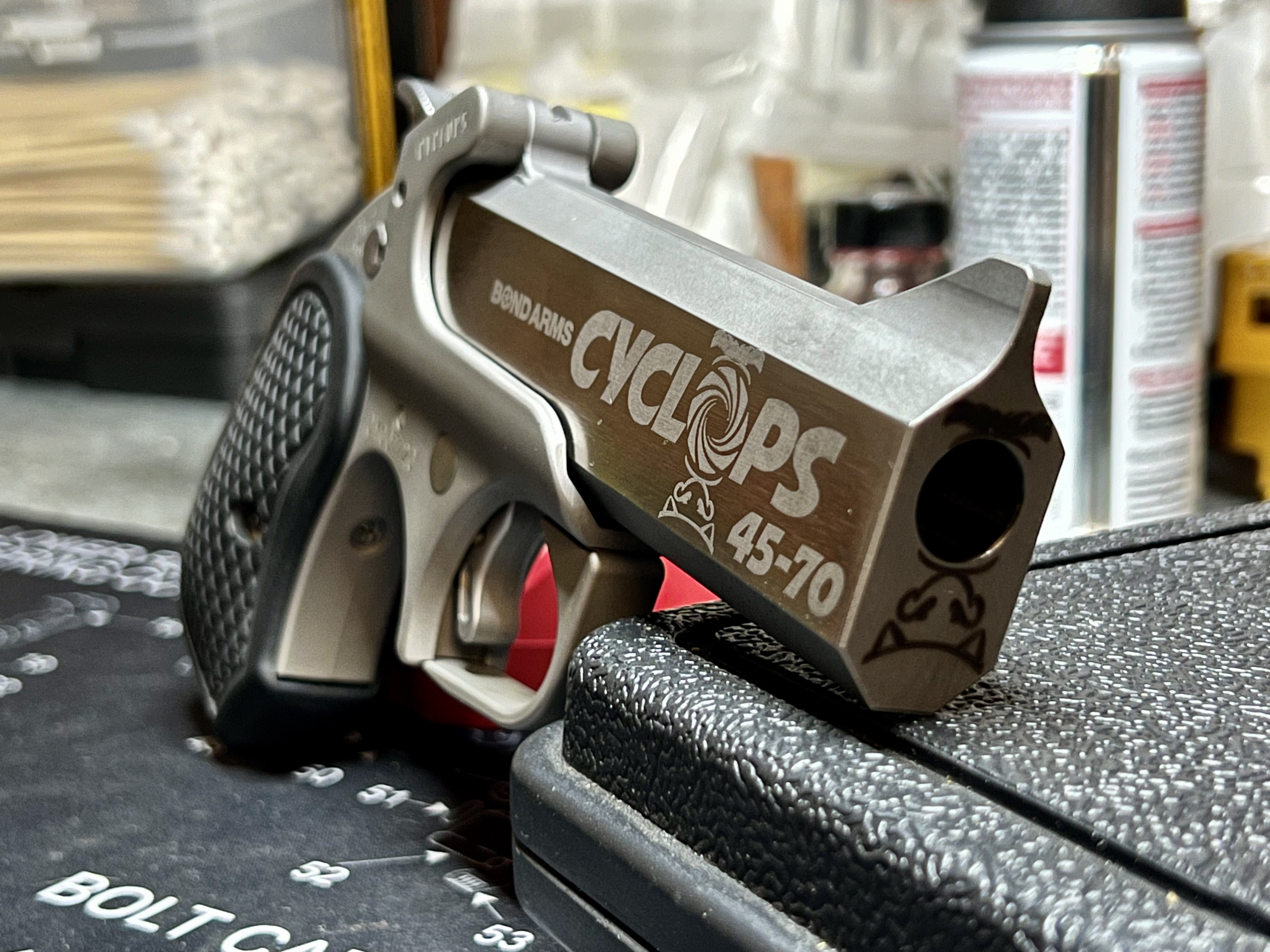
Starting with the business end of the Cyclops we have the muzzle of the 4.25” stainless steel barrel. The muzzle is decorated with an engraving of a cyclops which I found to be quite amusing.
The top of the barrel is adorned with a tall fixed front sight which I didn’t find particularly easy to pick up visually when aiming, but it worked nevertheless.
I will describe the profile of the barrel as the offspring of a one night stand between an octagon and oval which I found pleasing to the eye at first glance. This was partially due to the polished finish on each of two sides. However, I found the light engravings of the brand, make, logo, and chambering on the right side of the barrel to be too large, unnecessary and a bit off putting. The true to size engraving on a .45-70 cartridge on the left side of the barrel did catch my eye as it put how little rifled barrel a fired projectile would travel through before exiting the mule into perspective. Even so, I think the Cyclops could have gone with the engravings along the side altogether. The saving grace is that the engraving is deep and I suspect the engravings could be removed with a little refinishing.

Continuing back along the top of the barrel we find the hinge that connects the barrel to the frame and also serves as a notched rear sight. The notch is shallow and narrow making it particularly difficult to achieve “equal height and equal light” rear and front sight alignment which is, in my opinion, rather important given the sight radius is what I consider to be rather short for a pistol with a 4” barrel. Shorter sight radiuses are generally less forgiving to rear and front sight misalignment than longer sight radiuses. Couple this with recoil anticipation with the aforementioned nuances that I promise we will get to shortly and the result is a pistol that is difficult to shoot precisely.
The frame, which I suspect is also made from stainless steel, is the largest derringer frame that I know of. However, it is still a small frame compared to other pistols. In fact, the overall dimensions of the Cyclops are very similar to snub-nosed J-frame revolvers which are small and difficult guns to shoot well.

At the top of the frame, we find the hammer which must be thumb cocked in order to shoot the Cyclops.
The falling block manual safety can be seen from either side frame right in front of the hammer. When the safety is engaged, the safety protrudes on the left side of the frame. When the safety is disengaged, it protrudes on the right side of the frame and a red colored band is visible indicating the firearm will fire if a round is chambered, the hammer is cocked, and the trigger is pressed. This type of safety doesn’t prevent the hammer from falling when the trigger is pressed. Rather it stops the falling hammer from striking the firing pin.
A B6 resin grip is wrapped around the two sides and the back of the gun’s small stock. I have no idea what B6 resin grip is, but it has a soft rubber feel to and provides a fair amount of friction which helps one to hang on to the pistol during recoil. There is a large undercut between the stock and the trigger guard on the frame that is reminiscent of early production small frame revolvers that created a market from grip adapters from companies Packmayr and Tyler T. I’m not a big fan of this as experienced pistol shooters will intuitively attempt to use the entire undercut to help them get their grip as high up as they can on the pistol as they can. This is a common grip technique that is used to recover from recoil quickly and consistently. Unfortunately, this leads to a couple of problems. First, it leads to an improper grip on the derringer as documented in the manual. Next, it forces an unnatural angle between the trigger finger and trigger which makes it near impossible to actuate the trigger. I’m not kidding. I observed a GM class USPSA shooter who is incredibly fit and has very large hands attempt to shoot the cyclops and fail to actuate the trigger. Lastly, the hammer rests on the web of hand and can lead to hammer bite that will draw blood.
This leads us to the first nuance documented in the manual, the grip. The “proper grip” requires that at least a quarter inch gap remains between the hand and the hammer when the hammer is cocked. This helps correct the trigger finger angle so that the trigger may be actuated and minimizes the risk of a nasty hammer bite. However, it’s also disconcerting because it generally results in a two finger master grip and being unable to utilize pinky pressure to help manage the recoil the shooter knows is coming. Given the angles and grip position, I’m not sure a grip adapter like the aforementioned ones would help folks achieve a better grip. I could be wrong, but it’s not something I can easily test since grip adapters for the Cyclops don’t exist to the best of my knowledge.

Before turning the discussion to the trigger, I want to mention that the locking lever handle is located on the left side of the frame between the trigger and the falling block safety. Pushing the lever down when the hammer is not cocked, unlocks the hinged lever and allows it to swing upwards and away from the frame which allows one to load or unload the chamber of the Cyclops.
Now back to the trigger. It’s heavy. According to Bond Arms, the pull weight is 7 lbs. I had a hard time actuating with the trigger gauge and got some variance but the average worked out to a couple of ounces north of 7 lbs. The trigger is also the source of the second nuance which is also documented in the manual. That nuance is that the trigger requires a downward motion as opposed to the press to the rear motion most handgunners are accustomed to. This motion is required because the pivot point of the hinged trigger isn’t at the top of the trigger as it is in pretty much every other pistol design. And once again, we have yet another feature that increases the difficulty of shooting this gun well.
So in review, we have a small 28-ounce gun chambered for a stout rifle cartridge that is held with a two-finger master-grip while aimed with difficult to use sights as one attempts to apply 7 lbs of pressure on a trigger at an awkward angle. It’s a sketchy and scary ordeal that gets one’s heart racing fast. When it recoils, the muzzle snaps upwards forcefully with a generous amount of recoil that is somewhat painful and may result in a little blood from the potential hammer bite. Nevertheless, it’s exhilarating and puts a smile on your face. It’s completely ridiculous and I love it!

Bottom line is that, at least in my eyes, the Bond Arms Cyclops is a novelty gun. Yeah, I suppose in a pinch it could be used as a last ditch effort defensive tool, but I can’t imagine any sane person picking one up for that purpose. At least, not one chambered for .45-70 Government. I will add that this is not a pistol for novices. The GM class shooter who struggled and ultimately failed to fire Cyclops wasn’t the only skilled handgunner who struggled with it. Everyone struggled with it. That said, I will encourage competent pistoleros to give one of these a try if presented with the opportunity because shooting the Cyclops is a unique and thrilling experience. Nevertheless, I’m going to keep it around and shoot it from time to time since it puts a smile on my face every time I manage to actuate its trigger.