
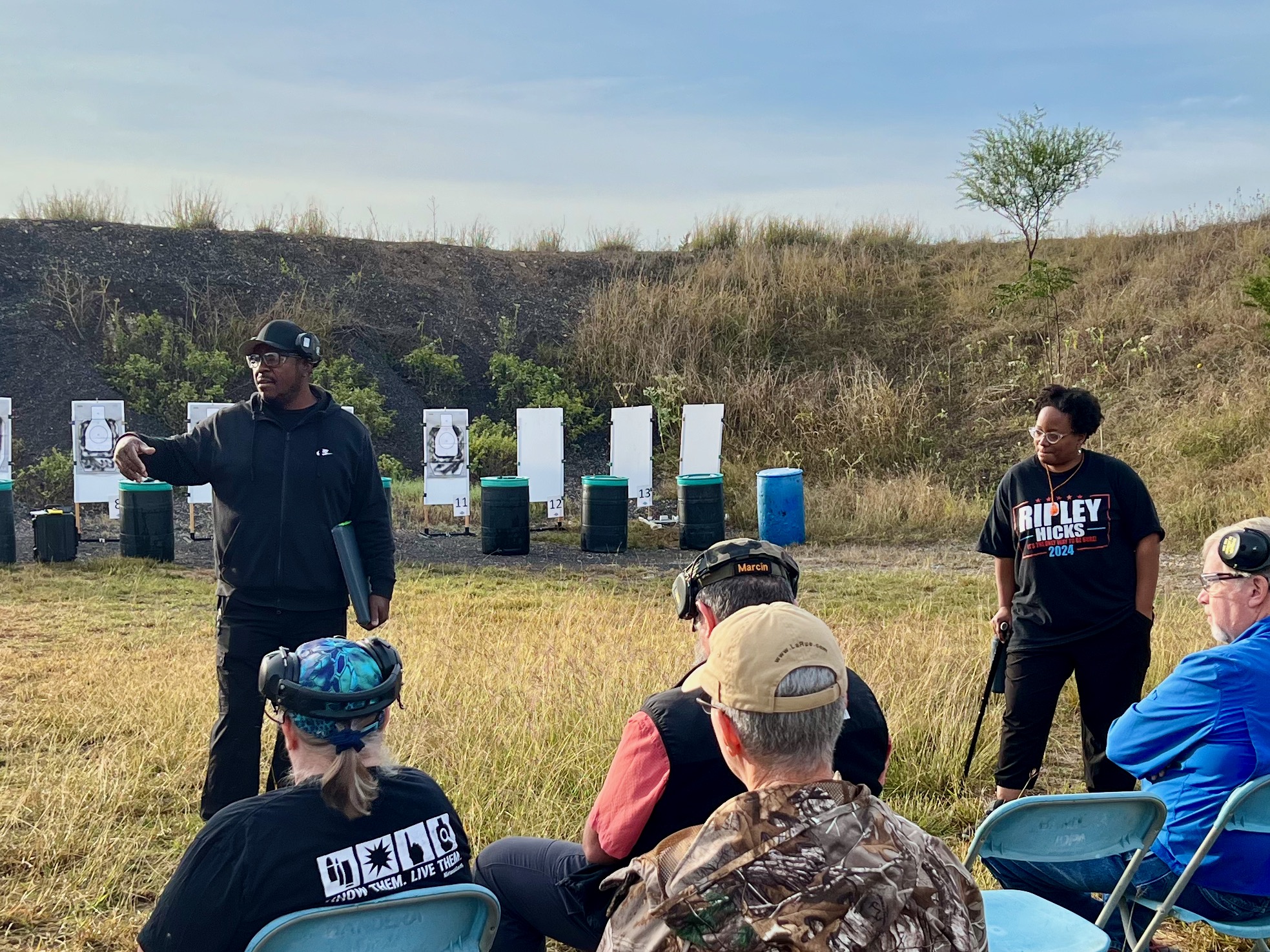
Last month, I spent an entire weekend studying under the tutelage of Tiffany Johnson and Aqil Qadir from Citizens Safety Academy while attending their signature Gateway Instructor Certification Course. I’ve struggled with publishing this particular after action report for several reasons with the primary being that it is unlike any other firearms course or firearms instructor course that I’ve attended which was best summed up by this statement that I stole directly from the class material: “This is not a shooting class. It is a teaching class.” There is a lot to unpack about that statement, but the gist of it is that the class is designed to help firearms instructors improve their ability to develop and deliver curricula for students who are brand spanking new to firearms and shooting them while taking into account growing cultural and demographic diversity of those students in the rapidly expanding number of first time gun owners in today’s market. In other words, the emphasis of class is on instruction in the context of shooting rather than shooting in the context of instruction as is commonly the case in other firearms instructor courses.
Another reason I’ve struggled with this AAR is because I’m still processing and digesting the content and my takeaways. It’s not that the content was foreign. Rather, it’s that the topics are not something I’ve devoted much time to ponder and explore deeply. At least not with the same level of investment or intensity as I have devoted to the principles of marksmanship and self defense. As a result, organizing my thoughts and putting them into words has been awfully challenging to say the least. Frankly, this post wouldn’t be published had I not decided to halt rewriting it and simply put it out there. I have a lot to learn in this space and plenty of room for improvement. So with that, let us take a look into the course.
The class was held in Bandera, Texas and hosted by TDR Training, a fine firearms instruction organization who not only offers a quality instruction, but also hosts a fair number of top tier traveling instructors and their respective courses. In fact, this was the second multi-day class I attended in 2023. I will also be paying them another visit for another multi-day class I will be attending in the first half of 2024.

The first day of instruction was held entirely in the classroom which began with introductions followed by a block on effective communication. Effective communication is critical for all instruction as it is the vehicle in which knowledge and ideas are transported from the teacher to the student. It’s even more important when the knowledge recipients are brand new to the topic as they are blank slates who are highly impressionable. In the context of firearms instructions, brand new students will have some preconceived notions with regards to firearms. They are likely to think firearms are dangerous and maybe unsure if they are capable of learning how to shoot. The student’s first impression will have tremendous psychological effects. Whether those effects are catastrophic or beneficial depends entirely on their first experience which comes down to whether or not the instructors precisely conveyed the processes necessary for students to safely operate the firearm and get hits on the target in a manner that made them comfortable and welcome. It’s a difficult thing to do and a massive responsibility. That discussion set the tone for a review of the course structure, goals, and standards followed next.
It’s worth noting that a certification course is not a “give me” for attending the class. While not insurmountable, there are a set of minimum requirements that must be met in order to earn the certification. These included following the safety rules, attending the course from start to finish, participating in the class exercises, passing a shooting qualification, demonstrating the ability to safely clear revolvers and semi-automatic pistols, leading a firing line through a course of fire, and let’s not forget a written test. Simple? Yes. Easy? I suppose the answer to that question depends on one’s prior experience and excellence in instructing folks who are brand new to guns. For me, it wasn’t easy. With less than a year as an instructor (in an official capacity), I was the least experienced of the students in the class. I had to pay attention. I had to think. I had to learn. That said, I earned my certification and I’m proud of it.
An additional topic we covered early in the course was the importance of knowing your audience which happens to be the students that also happen to be the instructor’s paying customers. When speaking of new gun owners today, we are looking at folks who most likely want, or purchased, a gun for self defense and want to be safe with them. This makes it excruciatingly imperative that the content of the course focus on safety and marksmanship fundamentals. Everything else can come after, the student can safely and confidently hit a target. I can’t recall if this was said or if it was on a slide, but it summed up the goal of the initial class well: “Give them what they need to be safe and set them on the path to competence.”
We then briefly turned our attention to the four cardinal rules of safety because they always matter and they must be conveyed correctly to new folks who will be living with guns in their home. A quote from Chuck Haggard was used in the lecture that summed up the importance of these lifestyle rules succinctly, “If you have an unload gun and you treat it like it’s loaded, do we have a problem? No. If you have a loaded gun and treat it like it’s unloaded, do we have a problem? Yes.” A fantastic little gem was shared by Tim Reedy, owner and lead instructor of TDR Training, to help students learn and remember the four rules: “Let’s Meet For Tacos” which is an easy to remember mnemonic for “Loaded, Muzzle, Finger, Target”.
What I would consider the meat and potatoes of the course followed shortly after. That was discussions regarding the use of training aids, interaction and engagement, assessment design, and range management. None of these topics were completely new to me, but I was more familiar with some than I was with others. However, my experience with these topics and exposure to them via formal instruction or dedicated study is limited at best. I was most familiar with the range management block which touched upon several topics that were also covered in the Assistant Instructor course also offered by Citizens Safety Academy that I attended earlier this year. Even so, it was drinking from the firehose the entire time.
The first day came to a wrap with a homework assignment. We were paired up with another student instructor. The pairing had a couple of purposes that would be part of demonstrating our ability to “run the firing line”. One part of that would involve the pair of students functioning as assistant instructors for the firing line as another pair of student instructors led the line through two simple exercises, one dry and one live, which was the second part. For the second part, one member of the pair would lead the line through the dry fire exercise and the other member would lead the line through the live fire exercise. The homework was to figure out who would lead the dry fire exercise and who would lead the live fire exercise. Once that was decided, then we were to prepare for leading the line through the exercise we were responsible for. Given I had never led a firing line, I opted for the live fire exercise and spent the remainder of the evening after dinner stressing out a little while figuring out how I was actually going to do that.
The second day started at the range with a bit more discussion on how to work new students up to their first live fire shot safely. Part of this was a review of the range management block we ended on the previous day, but it focused on what to do once the firing line and the students are ready to get to work. The process is simple. Start by having the students pick up the firearm and perform a single aimed dry fire trigger press and then return the pistol back to the “bench” with open action safely. Repeat as needed. This would be the exercise a member of the student instructor pairs would do later in the day. Once the students are comfortable with that process, we add loading a single round of ammunition to the same exercise, which is what the other member of the student instructor pair would do later today as well.

Before getting started with the student instructor pair teach-back exercises, the students had the opportunity to try several different handguns, both semi-automatic pistols and revolvers, with different actions. The idea behind that was to expose us to different handguns new students may bring to their first class and we, the instructors, may encounter. To do this efficiently, the collection of different handguns were set up on the barrels at the five yard line on the range in the same manner the firing line would be prepared for new students. The guns included: a Kimber 1911, a Glock 26, a Smith & Wesson 5-shot J-frame snub nose revolver, a very well used Smith & Wesson K-frame (most likely an earlier Model 19), a Smith & Wesson M&P 9, a Beretta PX4 Storm, and a Hi-Point Yeet Cannon (which Mr. Qadir requested that I bring after he read the review I published on it earlier this year). Each of the student instructor pairs each took a turn at dry firing and then fired a single live shot from each handgun and rotated to the next station. After all the pairs had tried each gun, we then were asked to repeat the same process mirror handed.
The handgun buffet was then put safely away and the range was prepared for the student instructors pair to run the lines. Looking back, this exercise was the one that I found most valuable in this class for a number of reasons. It was also the most stressful for me (again due to my lack of experience leading a firing line). I have to mention that Tiffany and Aqil masterfully conducted the exercise. The assignment pairing and ordering were undoubtedly intentional. The most experienced instructors led the line first and those pairs with less experience followed. This allowed those who followed to observe the more experienced student instructors first and listen to the feedback they were given. That provided an opportunity to make micro adjustments to their plan based on what they saw and heard.
On the firing line was Tiffany Johnson who was accompanied by two student instructors who were instructed to perform the instructions they received from the student leading the line literally. Do exactly what was instructed. Nothing more. Nothing less. To make things more interesting, which is code for more challenging, Tiffany changed her role to a different student archetype each time the pair of students leading the line rotated out. I don’t recall the exact order of the archetypes she played, but they included a student who was afraid, one that was overconfident, one that was a know-it-all, and several others. With each role change, student instructors were able to observe and learn from how the assistant instructors picked up on it, communicated with other instructors on the line, and addressed it all without interrupting the firing line or singling out the student who required a little extra help.
I realize I’m being a little long winded about the student-led firing line exercise, but there was an abundance of things that I was learning and seeing. Some of this was familiar to me from my prior experience as an assistant instructor at KR Training and from what I learned when I attended the Assistance Instructor course mentioned earlier. However, the experience is unique because one gets to see several instructors with different styles and experience levels perform the same task in a unique way. Additionally, we get the luxury of immediate feedback from other instructors as the exercise is completed which isn’t something that one can get when functioning in one of the instructor roles when a real class is taking place. That’s not to say the feedback doesn’t happen, but it’s not as immediate or abundant as it was in this exercise since the focus is on the students who are learning. This also helps me appreciate the continued mentorship I have received from the staff at KR Training even more as it highlights the value of apprenticing under an experienced and accomplished instructor. It’s good stuff.
The shooting qualification wasn’t difficult and it’s not intended to be. It makes sense when we consider that the goal of teaching new students is to ““give them what they need to be safe and set them on the path to competence” since it aligns with what we learned in the assessment design block in the class. What the qualification assesses is whether or not the student instructor has sufficient marksmanship skill to set a student on the path to competence. In other words, passing the qualification requires the student instructor to get good hits on target without time pressure. The course of fire for this qualification is as follows:
- 10 shots from 5 yards, no time limit
- 10 shots from 10 yards, no time limit
- 10 shots from 15 yards, no time limit
The strings are shot and scored on a B8 target for a total of 300 possible points. If I recall correctly, 90% was required to pass and a miss (which was hit outside of the 7 ring) resulted in an automatic fail. I was honestly surprised to learn I was awarded the title of top shot based on having the best score on the qualification with a 298 (including 23 x-ring hits). Afterall it wasn’t a particularly difficult course of fire and I was certain there would be a couple of perfect scores and perhaps even one with 30 x-ring hits. However, test pressure is a real thing as is peer pressure.

The qualification concluded the range time and we returned to the classroom for a few additional blocks of instruction that focused on performance tools, diagnostics, and providing feedback.
Overall this was a great class that I personally enjoyed and good a lot out of. Granted I may have gotten more out of this class than others with more experience as instructor may, but given there were a several accomplished and experienced instructors who attended the class and also appeared to get value from the class, I think it’s safe to say that any instructor, regardless of their skill and experience level, who is passionate about firearms instruction should put this class on their continuing education radar. While this class does place an emphasis on teaching students who are brand new to guns and gun culture, the principles covered in the course are applicable to all students of all levels. Sure we may not see an advanced student struggling with getting hits on paper, but they may have a recent injury and advancing ailment that may require an instructor to adapt to or provide some additional attention or assistance to. If nothing else, an instructor may learn that teaching new students isn’t something they want to do or aren’t well suited for. If this class sounds like it’s up your alley, then I will encourage you to check out Citizens Safety Academy’s upcoming Gateway Instructor course offerings.

One response to “Citizens Safety Academy Gateway Instructor Course”
[…] Citizens Safety Academy Gateway Instructor Course […]