
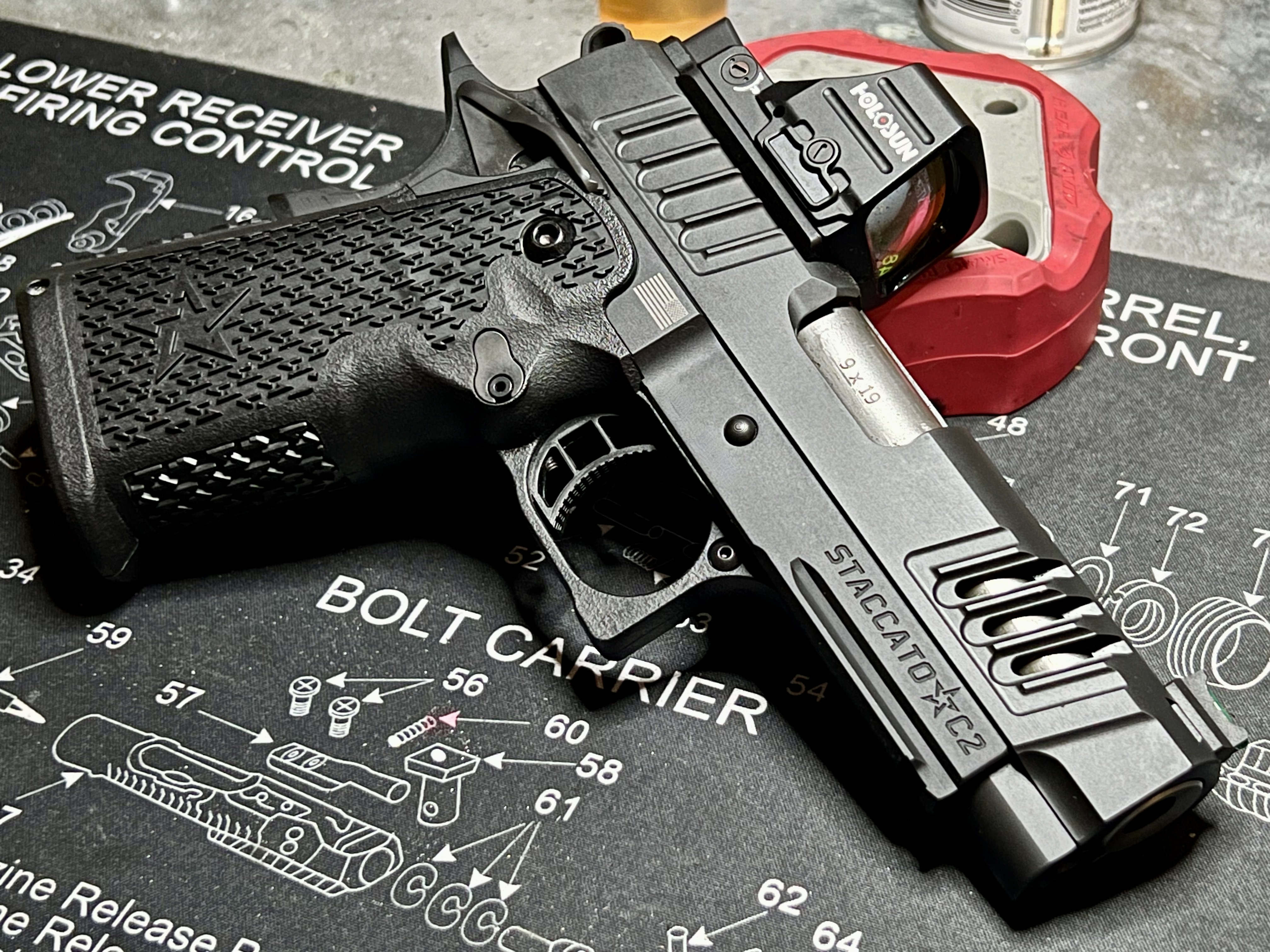
About nine months back, I published a first impressions review on the Staccato P which amazed me. However, I really didn’t get to know it until I decided to start campaigning in the USPSA Limited Optics division early this year. That campaign, which is ongoing, put the P on a steady diet consisting of several hundred 9mm rounds every single week since its inception making hitting the 2K round milestone with it a relatively quick ordeal. An unplanned side effect from that has been developing a deep appreciation for the 2011 platform which fostered a temptation for a 2011 defensive carry option. It was a temptation that I couldn’t resist and resulted in placing an order for the Staccato C2 that this post is about. More specifically, this review is about my first impressions of Staccato’s C2.
The C2 has been around for a bit. There are several reviews on it available on the internet. I’ve seen dozens of them. All of which are positive. Given my experience with the P so far and the C2 reviews I’ve seen, I fully expected my initial review, this one, to fall in line and leave nothing but positive marks. However, statistical anomalies are a thing and I hope that the C2 I got my hands on is just that – an anomaly. I’ll get into this a bit more later in this post. For now, suffice it to say that the C2 is off to a rocky start.
At any rate, let’s start by taking a close look at the Staccato C2 before getting into how it handles and my opinion of potential applications.

The Staccato C2
The Staccato C2 has a lot of very positive things going for it which we will review in this section. It just simply hasn’t been perfect. Perhaps, I was expecting too much. However, I think that expecting too much isn’t unwarranted given the premium price the pistol demands. That last statement should also be put into perspective. As far as capable proven pistols for defensive applications go, the C2 is expensive. In terms of 2011s, the price is on the lower end of the spectrum. That said, a starting MSRP of $2,300 for a standard build is something that I suspect will cause pause for the average person.
What does one get for $2.3K or more? Well at a minimum one gets:
- The pistol with the selected features and personalization,
- a soft pistol case with a Staccato C2 patch,
- a manual,
- a cable lock,
- the tools needed to maintain the pistol,
- and two sixteen (16) round flush fitting magazines.
The 25 oz pistol has an overall length of 7.5”, an overall height of 5.5”, and measures 1.49” at its widest point. That puts the Staccato C2 in the Glock 19 size category which is compact enough to carry and conceal effectively. It’s a few ounces heavier than a Glock 19 or similar polymer-framed pistol. However, it’s well within what would be considered a typical weight for a concealable defensive pistol of this size with similar double stacked magazine capacities.

On the business end of the pistol we find the muzzle of the 3.9” stainless steel bull barrel that’s chambered for 9mm. The barrel is available with an optional DLC coating. One may also opt for a threaded bull barrel as well. Given defensive carry is the application I have in mind for the C2, I opted for the non-threaded barrel to keep the dimensions and weight down. I also opted for the stainless steel as I figured it would provide an aesthetically pleasing contrast where it is visible.
Above the barrel we find the slide which is adorned on the top with traditional notch and post iron sights and a Dawson Precision Optic Reflex System. The front sight is a high-visibility green fiber optic sight. The rear sight is blacked out and serrated. As part of this “custom” C2 build, I added a Holosun 507Comp which was mounted and zeroed by Staccato before it was shipped to my local Federal Firearms Licensed (FFL) dealer. The zero on the optic was spot on. The mounting appears solid and complete with witness marks which should be a step in everyone’s optic mounting procedure. The mounting has held up well so far and I see no signs indicating a mounting failure down the road, but the chance of failure is never zero.

The slide has very functional front and rear serrations that aid with slide manipulations. I opted for the optional “X Series Serrations” which are milled cuts into the front serrations that expose the barrel . These effectively lighten the slide a bit which reduces the overall weight of the pistol a tiny bit and allows the slide to cycle a bit faster. It also makes the front serrations notably more aggressive making slide manipulations with them even easier and faster. The downside to them is that they allow debris to work its way under the slide faster which can lead to faster wear or decreased reliable operation if one isn’t disciplined about performing routine maintenance diligently. Routine maintenance is a must for any 2011 pistol anyway.
Between the slide and the frame, we find the recoil system under the bull barrel. The C2 uses a 3.9″ Recoil Master System. The system doesn’t require any tools for field stripping which is good. However, special attention has to be paid to the system when the slide is removed from the frame during field stripping to ensure it doesn’t go flying since it is under tension. That same care has to be applied when reassembling the slide to the frame. I would have preferred to see the C2 use a Dawson Precision tool-less guide rod, like the P uses, instead, but it’s not a deal breaker. The system works reliably. It’s simple enough to work with. It simply requires a bit more attention than the system used in the P.
Under the slide is the aluminum frame which begins an accessory rail on the dust cover.

As we follow the frame back towards the stock, we first run into the trigger guard on the polymer 2011 grip module that Staccato calls their VIP Carry Grip. The trigger guard is flat, smooth, and straight in the front and returns straight back to the grip with a couple of subtle undercuts. The space available in the trigger guard is amble and should allow large hands to access the trigger even while wearing gloves. The polymer skeletonized trigger is curved and serrated. While Staccato is now offering a flat on some of their pistols, the C2 isn’t one of those. As such, those of you who prefer a flat trigger will have to look at aftermarket options which are plentiful like the Red Dirt USA ST Trigger.
The standard trigger weight on the C2 is 4-4.5 lbs. Optionally, it can be ordered with a 3-3.5 lbs trigger which I opted for. According to the trigger pull gauge, the weight on this particular C2 is coming in at 3 lbs 8.3 oz on average which I will call 3.5 lbs because .3 ounces is well within the range of human error during measurement. The slack, or pre-engagement travel, is short at what I estimate to be about an eighth of an inch and stops at a definitive wall. The break is crisp and reminiscent of a candy cane snapping in two. The post-engagement travel is even shorter than the pre-engagement travel which I estimate to be a little less than an eighth of an inch – perhaps 3/32 of an inch. The trigger is exceptionally good. Especially considering this is a production pistol.
Above the trigger on the left side of the frame is the slide stop pin. Behind the trigger also on the left side is the mag release button which is not reversible.

Texture on the VIP Carry Grip module is comfortable, yet functional and applied virtually around the entirety of the stock. It’s a texture that won’t grab onto clothing or tear up the skin when concealed carrying it. At the same time, it is aggressive enough that it makes it easy to hang on to the pistol when shooting it vigorously with a good firm grip.
The grip has a subtly flared magazine well shaped into it that has been carefully slightly widened to make magazine changes smoother and faster. It’s hard to say how much it helps, but it’s easy to suspect that it does.
Working our way up along the back of the stock we have the polymer mainspring housing which features the same texture as the grip. Then we have the beavertail grip safety that features a memory bump which reduces the chance of not engaging it with a poor grip. Right about the grip safety we have the ambidextrous thumb safety. And finally we have the skeletonized hammer.
The fit and finish on the C2 is excellent. It most definitely exudes a feeling of a quality product that one would expect with the price tag that it carries.
Handling
Staccato, as a brand, has a well earned reputation for performance and reliability.
On the performance side of the reputation, the C2 lives up to the Staccato name. The gun feels really good in hand and makes it very easy to put shots on target assuming it is driven by a capable marksman. Want to put rounds in the exact same hole? As long as one has the skill to do it, the C2 can do it. Want to let it rip and get good hits on target? Once again, the C2 will keep up with whatever skill one can dish out. I’m dead serious about this. The first range trip for the C2 consisted of taking a two-hour 250-round drills class at KR Training where I managed to perform really well with little effort. The C2 simply kept up with me.
Unfortunately, that first range trip was it’s only range trip before I started encountering reliability problems. On two occasions in the class, I found myself with a dead trigger in the middle of a drill. The first time it happened, I suspected I came across a bad round. However, I was a bit confused since I didn’t recall a click following a trigger press. It was a bang followed by a dead trigger when it should have been a bang followed by a click. However, I dismissed it as a bad round of ammunition anyway. Then it happened again. Same thing – bang followed by a dead trigger. I looked at the pistol and noticed the hammer was forward. I then carefully ejected the chambered round which was unfired with a pristine primer.
I began to suspect that the two dead trigger issues were a result of “hammer follow”. Hammer follow is the term used to describe abnormal operation where the hammer fails to cock as the slide cycles and instead follows the slide as it returns and ends up in the half cock position. In some cases, the hammer will follow the slide all the way forward and strike the firing pin which results in a subsequent round being fired. I wasn’t absolutely certain I had experienced hammer follow since it wasn’t something I had experienced first hand previously. However, as most frequent readers are aware, I record matches and classwork on video habitually. As a result of that habit, I caught both instances of the abnormal behavior on camera. Upon reviewing the footage I confirmed that what took place was, in fact, hammer follow.
A good friend provided me with a list of potential hammer follow causes. These are:
- insufficient trigger pre-travel
- excessive trigger post-travel
- trigger bow movement interference
- disconnector not moving freely
- insufficient sear spring tension on center leg
- hammer/sear engagement geometry has changed (either by built up firing residue or possibly due to parts wearing)
Needless to say, this is very disappointing and certainly doesn’t speak to the reliability part of Staccato’s reputation. However, defects in manufacturing and workmanship happen even with excellent quality control processes in place. I will remind readers that this experience is anecdotal and in no way suggests that Staccato products aren’t reliable. It just means this pistol isn’t reliable. It also means that I will now get an opportunity to experience Staccato’s customer service and warranty repair services first hand. I have no reason to believe they won’t take care of this and make it right. I also have no reason to believe that I won’t end up with a reliable C2 that will be suitable for defensive carry.
This experience is also a reminder that practice of verifying a defensive handgun is reliable rather than assuming it is based on its reputation. After all, reliability is arguably the most important quality of a defensive handgun.
Potential Applications
In my opinion, the most obvious potential application for the Staccato C2 is defensive carry which is precisely what the C2 was designed for and is marketed for. As I’ve stated several times in this post, defensive carry is the application I intend to use the C2 for.
Pistols that are suitable for defensive carry are also great candidates to use in IDPA competitions. I will definitely end up using the C2 at local IDPA matches since I most often participate in those using the defensive pistols I carry on a routine basis. Folks who have a C2 and are thinking about trying their hand at USPSA matches or any other pistol match format that allows the use of 9mm 2011 pistols will find that the C2 will work well for getting started in those disciplines. That said, I don’t think the C2 is ideal to purchase specifically for competition as there are better 2011s equipped with lighter triggers and larger magazine wells that will be more competitive in those activities. In terms of the Staccato line up, the XC is the best option for IDPA while the XL is better for the other disciplines where a compensator would automatically put a competitor in an Open race gun division. Again, the C2 will work for competition, but it is less than optimal when intending to compete at the highest levels.

Closing Thoughts
My first impressions of the Staccato C2 were a mixed bag. Quite literally everything about the C2 suggests it is a magnificent pistol, albeit an expensive pistol, suitable for defensive carry. However, the hammer follow I experienced was extremely disappointing and disheartening as it makes carrying the C2 a nonstarter for me. I suspect that Staccato will repair it and I’ll end up with a 2011 that I adore and will end up carrying regularly. I’m hopeful that this will be resolved quickly and it was a statistical fluke.
At this point in time, I won’t tell folks not to pick up a C2 as I believe my experience is an anomaly. However, I’m also going to refrain from recommending it until the C2 I have on hand is one that I would carry confidently to defend my life or the lives of those I love. Of course, only time will tell. And of course, I will provide updates in future reviews.
8 responses to “Staccato C2”
[…] Staccato C2 Review (Uncle Zo) […]
[…] took about a month and a half to get the first thousand rounds through the Staccato C2. It would have taken less, but it had some reliability issues early on and had to take a short two […]
Hello, it’s been a few months since you had posted this issue. Have you worked out the issue with Sticatto customer service? Did they perform the needed repair(s) to your satisfaction? I was very close to buying a C2, but after reading this, I will be holding off and doing more research.
Thanks,
Mike K.
Yes! The customer service experience was rock solid. They addressed the issue quickly and to my satisfaction. I’m fairly confident my issue was an unlucky anomaly. As such, I will encourage you to proceed with your purchase if it’s on your radar and within means. Details on the repair experience are available on this post: https://unclezo.com/2024/05/20/staccato-c2-and-holosun-507comp-1000-rounds-later/
Awesome news. Thanks for the quick reply. Sticatto is now back on my radar. If you don’t mind…. you seem to have considerable experience. What 9mm handguns (hammer fire only, no striker fire)) might come close to the C2? HK P30, Sig 229?
Thanks,
Mike K
That’s a tough question in part because the two other options listed are quite different. But I’ll give it a shot…
Generally speaking, hammer fired pistols come in three actions:
– Single-action (SA) like the Staccatos or a Sig P229 SAO
– Double-action/single-action (DA/SA) like the HK P30 or a Sig P229
– Or a double-action only (DAO) which is more common with revolvers (but there are some semi-autos like the HK P30 LEM that fit into this action type)
So if we want to talk about similar options to the C2, then we have to stay in the realm of SA pistols. Now there is a key difference between C2 and the P229 SAO. That difference is the trigger design. The C2 uses a 1911 style trigger which slides straight back whereas the P229 SAO uses a hinged trigger. This difference is going to feel very different. Additionally, it’s worth noting that 2011s like the C2 are based on the Series 70 1911 and lack some of the safety features of hinged trigger SA pistols like the P229 SAO.
Getting back on track, guns that are similar to the C2 would be other 2011s. Off the top of my head, two similar options are:
– Springfield 1911 DS Prodigy 4.25” AOS
– Atlas Gunworks EOS
The Prodigy is going to run about $700 less than the C2’s starting price. While the EOS is going to run about 3x as much as the C2. The cost difference can be seen in the build quality.
Both the P229 and the P30 are good alternatives, but it’s like comparing apples and oranges. At the end of the day, they are both great pistols. I would encourage you to try to find them at local dealers and get them in your hands to see which one fits better. Better yet, rent them at a local range if you can. It’s worth noting that the P30’s grip has interchangeable backstraps and side panels which allow you to customize the fit. Personally, I found the P229 to be too large for my hands.
Outside of those, it wouldn’t hurt to look at the Berettas.
Great info… thanks for your time.
Mike K.
[…] Staccato C2 […]