
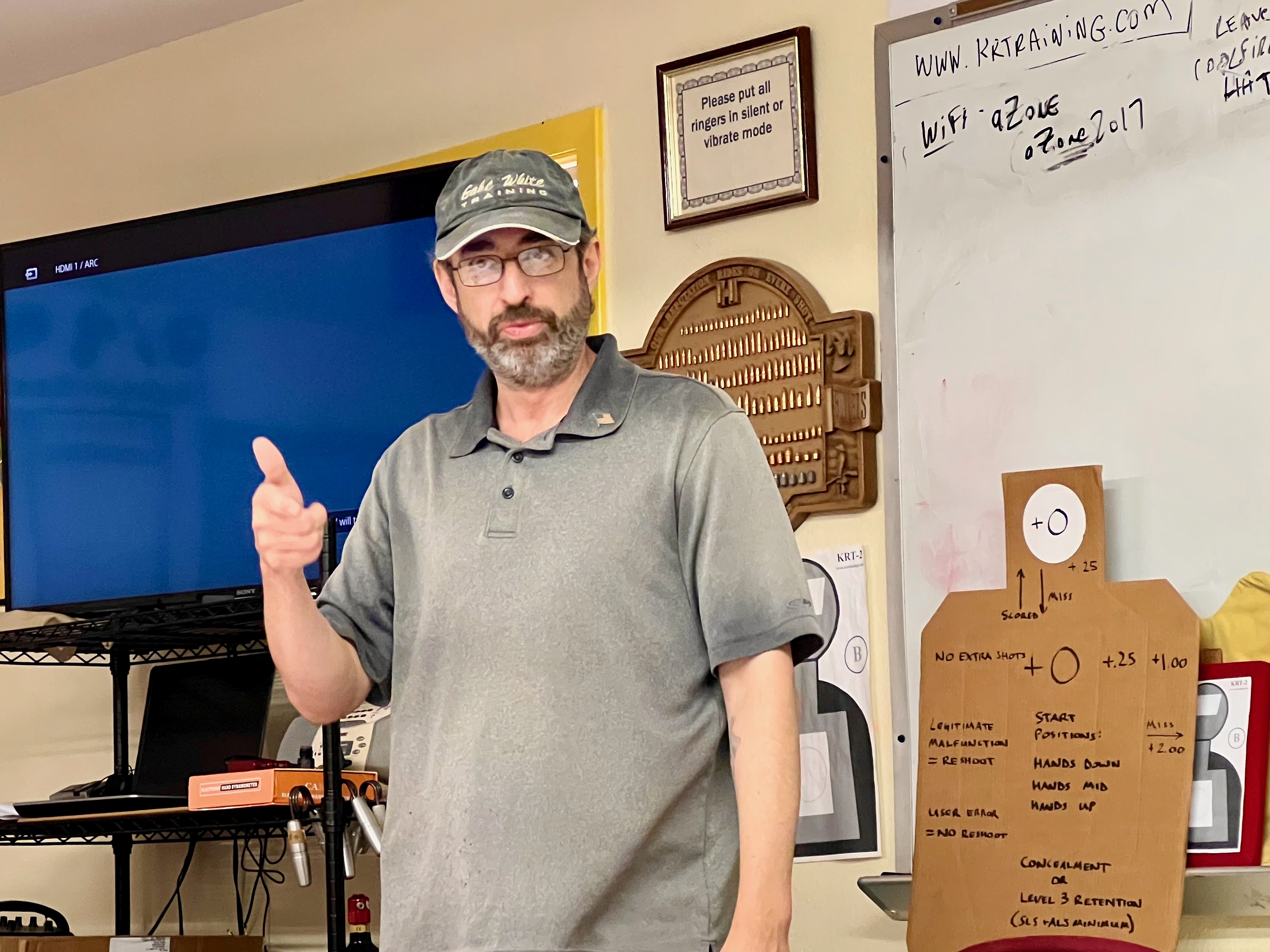
Gabe White’s Technical Skills Tests is a collection of four well known single target drills with three levels of corresponding standards. When those standards are met while attending Gabe White’s Pistol Shooting Solutions, a student is awarded one of the three pins that serves as proof of meeting those standards. The pins, which are well regarded by armed self defense practitioners who are passionate about skill development, represent the attainment of levels of proficiency in core technical skills of drawing and shooting beyond minimum competence.
The Course of Fire
Target: IPDA or IPSC target
| Distance | Start Position | String Procedure | Par Times |
|---|---|---|---|
| 7 Yards | Holstered | 2x Bill Drill: Draw and fire 6 shots to the body | Dark Pin: 3.5 seconds Light Pin: 2.5 seconds Turbo Pin: 2 seconds |
| 7 Yards | Holstered | 2x Failure to Stop Drill: Draw, fire 2 shots to the body, fire 1 shot to the head | Dark Pin: 2.9 seconds Light Pin: 2.25 seconds Turbo Pin: 1.7 seconds |
| 7 Yards | Holstered | 2x Immediate Incapacitation Drill: Draw, fire 2 shots to the head | Dark Pin: 3 seconds Light Pin: 2.5 seconds Turbo Pin: 2 seconds |
| 7 Yards | Holstered | 2x Split Bill Drill: Draw, fire 4 shots to the body, fire 2 shots to the head | Dark Pin: 4.7 seconds Light Pin: 3.5 seconds Turbo Pin: 2.6 seconds |
Scoring is done my taking the raw time and adding the following penalties:
- C-zone impacts: 0.25 seconds
- D-zone impacts: 1 second
- Misses: 2 seconds
A 0.25 second bonus is subtracted from the final score if the test is performed from concealment or using an active retention (SLS+ALS minimum) duty holster.
Earning a pin is accomplished by meeting the corresponding standard four times out of the eight attempts. That means that one can earn a pin after performing well on both attempts of the first two drills even if they fail to meet the standard of the remaining two drills.
My Thoughts on the Test
Like many other avid self defense practitioners, I hold the pins in high regard. They aren’t easy to earn. In fact, they require more than just raw shooting skill. They also require access to that skill under stress that is induced by both test pressure and peer pressure. The shooting skills that are tested include one’s ability to draw the pistol consistently well, establish a good grip on the pistol, trigger control, and appropriate use of the aiming system. Meeting the higher standards will require intimate familiarity with the drills that make up the test in order to perform them at those levels on demand.
A dark pin, while it requires the least amount of skill to earn, isn’t an easy feat. According to Gabe White, it represents a tactical level of proficiency. Getting to and maintaining the level of skill required to earn this pin is going to take some work in the form of live and dry fire practice with occasional regularity. We’ll get into the test’s difficulty in the next section, but suffice it to say that folks who aren’t participating in some form of live fire activity or practice on a monthly basis and dry firing at least on a weekly basis are unlikely to meet this standard. I learned this the first time I took Gabe White’s class.
A light pin, which represents excellence in technical skills, requires a bit more dedication and investment in the form of deliberate practice to do well on the four drills at a minimum.
The turbo pin represents a highly developed level of excellence. I can’t say with certainty what it takes to earn one as it continues to elude me, but I’m working towards changing that at the end of this calendar year when I take Gabe’s class a third time. However, I think I have a pretty good idea of what it will take, which is part of the reason I am writing about the test five months before my next attempt at the test. Let’s just say that a portion of each daily dry fire practice session and weekly live fire practice session is dedicated to at least one of the four drills.
Test Difficulty
In order to figure out the relative difficulty of each pin level standard, we have to establish a Grand Master (GM) par time for each of the four drills.
We don’t have to concern ourselves with GM draw times from concealment or with active retention since the test provides a time bonus for those start positions. With that in mind, the following table summarizes what the available data suggests a GM should be able to do for the different components that make up the drills at a distance of 7 yards:
| Task | Time |
|---|---|
| Draw to first hit on a 8″ target area | 0.9 seconds |
| Draw to first hit on a 4″ target area | 1.4 seconds |
| Splits on a 8″ target area | 0.2 seconds |
| Splits on a 4″ target area | 0.4 seconds |
| Transition to a head box on the same target | 0.4 seconds |
With that data we can now establish GM level par times for each of the four drills which results in the following GM par times:
- Bill Drill: 1.9 seconds (0.9 + 0.2 + 0.2 + 0.2 + 0.2 + 0.2)
- Failure to Stop Drill: 1.5 seconds (0.9 + 0.2 + 0.4)
- Immediate Incapacitation Drill: 1.8 seconds (1.4 + 0.4)
- Split Bill Drill: 2.3 seconds (0.9 + 0.2 + 0.2 + 0.2 + 0.4 + 0.4)
Now we can take each of those GM par times and divide it by the corresponding pin standard par time to get the relative difficulty for each of them. The following table lists the results of those calculations along with the corresponding difficulty using the scale presented in the first post of this series.
| Drill | Dark Pin | Light Pin | Turbo Pin |
|---|---|---|---|
| Bill | 54.3% (Normal) | 76% (Expert) | 95% (Expert) |
| Failure to Stop | 51.7% (Normal) | 66.7% (Hard) | 88.2% (Expert) |
| Immediate Incapacitation | 60% (Normal) | 72% (Hard) | 90% (Expert) |
| Split Bill | 48.9% (Normal) | 65.7% (Hard) | 88.5% (Expert) |
Reviewing the percentages and comparing them against USPSA classifications gives us another perspective of what level of shooting skill is required to meet those standards. The calculations suggest that a strong C-class USPSA competitor who is approaching B-class should be able to earn a dark pin. Using the chart Karl Rehn borrowed from John Hearne that is displayed in the KR Training’s blog post on relative performance measurement, we can deduce that an IDPA Sharpshooter is also a contender for a dark pin. That same chart suggests that the performance requirements for a dark pin suggest some automaticity. Some automaticity isn’t possible without occasional deliberate practice.
The difficulty level of a light pin is unsurprisingly higher than a dark pin. The percentages suggest a USPSA B-class competitor who is on his way to A-class has a good shot at a light pin. An IDPA Expert who is approaching Master class also has a shot at it. The performance requirements for a light pin strongly suggest automaticity which requires frequent deliberate practice.
The turbo pin is a monster. Based on the calculations, it’s going to take a Master class level of performance to lock in. However, a strong A-class competitor might be able to pull it off by doing well on the failure to stop and split Bill drills. Remember any 4 out of the 8 runs is all it takes to earn a pin. The performance requirements for the turbo pin aren’t possible without automaticity which requires frequent deliberate practice over a notable period of time.
Closing Thoughts
While all of Gabe White’s pins are held in high regard amongst the community of self defense practitioners, none is more coveted than the turbo pin. I knew the pin was difficult to earn, but having now done the math it paints in a new light.
Seeing that Master level performance is required to secure might seem daunting, but it’s important to remember that the scope of that performance is limited to drawing and shooting at a target at a distance of seven hards. There are no reloads to contend with. No movement to worry about. No moving or disappearing targets to deal with. It’s stand and shoot. It’s not going to be easy to reach that level of skill and to learn how to get subconscious access to it under stress, but it is an easier feat than earning a USPSA Grand Master card. The practical marksmanship elements that will matter for the achievement are grip, vision, trigger, and, as KR pointed out in the first comment to this post, most importantly a fast and consistent draw.
Another thing that I didn’t realize about how well the test is designed is that it does offer an achievable reward to all students who have made an earnest effort to improve their skills. While it’s not effortless, getting to USPSA C-class or IDPA Sharpshooter doesn’t take much more than making the decision to get better and starting to take structured steps towards getting better. Walking away from Gabe White’s Pistol Shooting Solutions class with any pin, like I did the second time I attended the class, is not only rewarding, but does wonders to motivate a person to keep going and achieve greater levels of skill.
Yeah, a turbo pin is a tall order, but it’s not insurmountable. It is a respectable achievement that should be a goal for the most avid self defense practitioners.
11 responses to “Gabe White’s Technical Skills Tests”
Gabe’s tests are heavily biased to concealment draw speed. Someone that is good at moving and shooting, target acquisition, shooting at distances beyond 7 yards, and/or one handed shooting at the GM level still might not able to earn a Turbo pin purely as a result of not having a 1 sec 7 yard concealment draw. That specific skill is by far the most important indicator of likelihood of earning a Turbo pin or not.
Good call and thanks for pointing that out! I made a small edit to the closing to emphasize the importance of the draw.
Good right up! No disagreement from me! Very nice, thank you!
[…] You shotgun shooters might try My Favorite Shotguns Drills and Skills. Advanced handgun shooters will like Gabe White’s Technical Skills Tests. […]
Wow. Has it been TWO YEARS since I took Gabe’s course at A Zone? Looking forward to repeating in October and shooting for a pin, myself. 🙂
[…] who are subscribed to the newsletter and have been reading it are aware that my third attempt at earning a turbo pin from Gabe White is coming up next month (October 2024). With that fast approaching goal, I figured it would be […]
[…] look at Gabe White and his budding music production career. Furthermore, I’ve performed a relative difficulty analysis of his technical skills tests and even shared my dry fire practice approach to […]
[…] drill is only slightly higher than the relative difficulty I calculated for earning a Light Pin from Gabe White, which I’ve done. The difference is that the one can take the best four out of their eight […]
[…] Split Bill Drill […]
[…] about what I’m doing. I’m simply running the four skills tests, which I’ve written about in detail before, in every dry fire practice session with the equipment I intend to use configured exactly as I will […]
[…] Gabe White’s Technical Skills Tests […]