
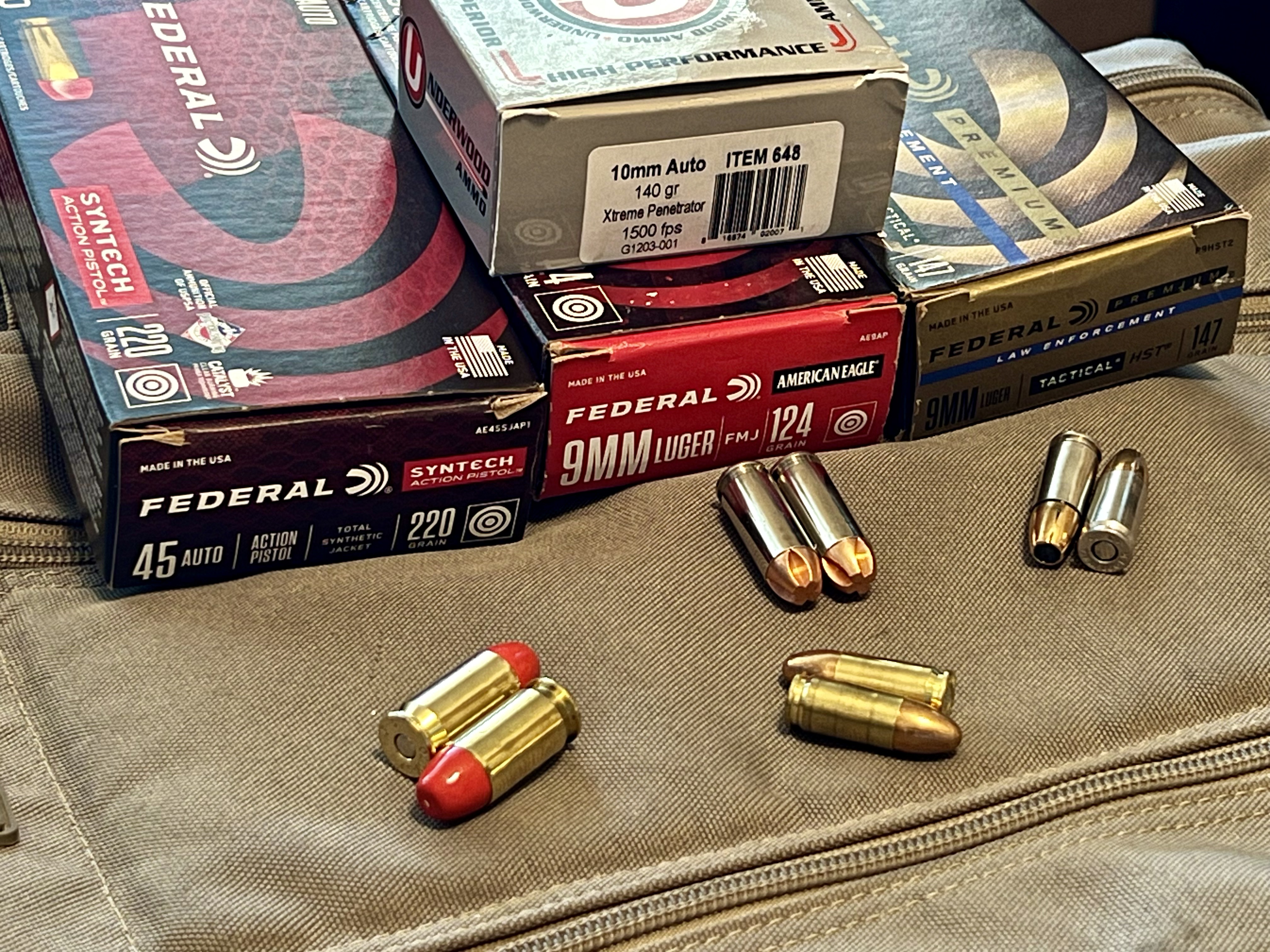
So, prior to last weekend’s events that prompted me to write the ammunition shortage alert post, I was working on another post diving into some nerdy details about pistol ammunition that I hadn’t given much thought priorly. At least not as deeply as I have been recently pondering.
In the early days of this blog, I spent a good bit of effort looking at rifle cartridges and different loads while searching for my ideal hunting cartridge and load. I also spent time looking at projectiles and loads in general for different applications. In the context of pistol cartridges however, I generally lumped loads into either the self defense bucket and the everything else bucket. There were certainly some exceptions to that, but otherwise the two buckets were par for the course when it came to handgun ammo.
So what’s changed?
Over the past two years, I’ve spent a lot of time shooting action pistol style competitions at various levels. At the higher levels where chronographing ammunition is required to ensure I’m meeting minimum ammunition requirements, the “everything else” ammunition I use for practice, training, and competition has come in at power factor levels so high that my usual squadmates pointed out were not doing me any favors. The “everything else” ammunition was noticeably hotter than what other avid competitors were using or loading.
I didn’t pay much heed to that difference until recently. After getting my hands on the Garmin Xero C1 Pro chronograph however, I decided to pick up a case or two of “certified” competition ammo and see what the hoopla was all about. I honestly couldn’t tell the difference between the “everything else” and the “certified competition” ammo without shooting them side by side. However, when I did the differences between them became painstakingly obvious. Now I’m not talking about Earth shattering differences, but the differences were present nevertheless. This got me rethinking about the importance of different ammunition qualities and characteristics in different contexts which is what I intend to share with y’all in this post.
I don’t expect every reader to appreciate the nuanced differences we’re about to dive into. In fact, I suspect most folks who read this probably haven’t considered the differences between “self defense” and “everything else” ammo. Let alone the differences in “certified competition” ammunition. However, I firmly believe that being aware of existing differences matters in of itself even if the characteristic priorities I will present are flawed in some way or biased by interests and experiences.
Let’s get into it.
Reliability – The Universal Primary Characteristic
Without any regard to context, I think that reliability firmly holds the throne as the king of all ammunition characteristics. Ammunition related malfunctions are annoying at best in all contexts and potentially catastrophic in certain contexts.
Even in training and practice contexts where remediating malfunctions is the focus, I want the ammunition I’m using in those contexts to feed, eject, and ignite predictably. Malfunctions can be induced using training tools such as dummy rounds or setup in other manners. Whether we want the malfunction to be predictable or not, it’s better when the training and practice methods dictate that as opposed to unreliable ammunition randomly showing up and saying, “Surprise! What are you gonna do now?”. This is especially true when the training and practice is focused on something other than malfunction remediation.
I mean, honestly, I can’t imagine anyone wants to deal with clearing malfunctions due to unreliable ammunition when working towards learning how to rip a sub two-second Bill drill. Even in a purely recreational plinking context, I wouldn’t classify dealing with excessive malfunctions as fun and I can’t imagine anyone else would.
Yeah, I get it. Sometimes malfunctions show up at the most unfortunate moments and we have to deal with them. However, using reliable ammunition goes a long way at mitigating that risk in every single context. It’s for this reason that I make it a point to purchase a testable quantity of any ammunition I haven’t used previously. The number associated with a testable quantity depends on factors such as cartridge, price per round, intended application context, and purchase source. When I find something that works reliably for that application context, I stick with it. Sometimes there are few different loads that work for a given context and that gives me options to get the most bang for the buck (pun intended).

Practice Ammunition (aka “Everything Else” Ammo)
Next to reliability, the most important characteristic of ammunition use for practice is affordability.
Whether one looks at this bucket of ammunition as “practice” or “everything else” doesn’t change the equation. The more ammo we have on hand, the more one can practice or participate in all shooting activities outside of hunting and self defense. Lower price per round, or cost per round, is what maximizes the number of rounds one can get for their money.
Reliability and price per round are really the only characteristics that truly matter for this category of ammunition.
I will admit that I used to care about other characteristics such as projectile weight, point of impact, and recoil profile. This was because I wanted my “everything else” ammunition to be as similar to my “self defense” ammo as possible. Now that I’ve split up the “everything else” category into multiple ones, the additional characteristics no longer carry any substantial weight when I make purchase decisions for the “practice” category. But even when they did carry much more weight, I found myself compromising on these additional characteristics in favor of lower cost per round especially when market conditions were unfavorable.
There will be times when something other than the “practice” ammunition will be used in practice sessions, but as a general rule of thumb practice ammunition will be what is used for practice, mostly.

Self Defense or Carry Ammunition
Once again, reliability is king. This is the ammunition one may have to use to save their life or the lives of their loved ones. If and when that situation arises, one needs the gun and the ammo to work right then and there. An ammo malfunction here can have catastrophic consequences that are permanent.
Next to reliability, stands what I refer to as durability. There might be a better word for it, but what I’m talking about is that the ammo needs to be durable enough to resist deterioration caused by exposure to the elements. It will travel with each of us from climate controlled environments to the outdoors. It will be exposed to humidity, dust, dirt, lint, and pretty much anything else one can imagine present in the environments they find themselves in. The exposure to the environment is one of the reasons premium self defense ammunition is loaded in nickel-plated brass cases rather than plain old brass.
Equally important is terminal performance. This is where projectile, or bullet, design and construction come into play. The bullet needs to penetrate deep enough to reach vital anatomical structures. At the same time, it needs to transfer most if not all of its kinetic energy into the target in order to minimize its lethal potential in the event the projectile passes completely through the target. There are several variables that come into play here including clothing barriers and angle of entry which changes the amounts of various anatomical tissues the projectile must pass through in order to reach the vital structures that must be damaged in order to incapacitate a lethal threat.
Designing and producing ammunition that meet these requirements while maintaining strict quality control is a tall order which results in noticeably higher prices when compared to ammunition used for other purposes.

Wildlife Defense, Hunting or Varmint Ammunition
The desired characteristics for ammunition used for hunting are virtually identical as the desired characteristics for carry ammunition. It needs to be reliable and durable. However, the specific desired terminal performance isn’t identical to that of carry ammunition and is going to be specific to the type of animal targeted.
Cartridge selection also matters. I’d argue that cartridge selection has a bigger impact on terminal performance in the context of rifle cartridges, but there is an impact even within the context of handgun cartridges. However, that’s a topic beyond the scope of this post. A topic that I’ve written about in the context of rifle cartridges.
Regardless, ammunition design, including projectile design, matters in all contexts even within the context of a single handgun cartridge.
Let’s explore the 9mm Luger for instance, but keep in mind that hunting with 9mm is something I don’t have any experience with. In fact, my handgun hunting experience is limited. However, I believe I have sufficient hunting experience that I can interleave with my knowledge of handguns to offer a well-educated best guess that I would use to select the 9mm ammunition I would use in this context.
While it’s suitable for self-defense when combined with an expanding projectile, that same self-defense round most likely will come to rest prior to reaching the vital anatomical structures of larger dangerous wildlife like a hog or bear. I’m not saying that it won’t work. I’m only saying that it’s less than ideal. However, if we instead opt for a load that for a heavy hard-cast flat-nosed non-expanding projectile backed by higher pressure (+P) powder charge, then we now have something that would be much better suited for hunting or defending against medium or large sized animals. I still wouldn’t suggest going bear hunting with a 9mm pistol, but with the right load one has a much better chance of fighting a bear off with that same pistol.
For dispatching smaller predatory varmints, the terminal performance of that self-defense 9mm load will work just fine.
For really small animals, such as squirrels, that same self-defense 9mm round will probably zip right through and keep on going while still having most of its lethal potential. It would be preferable to have a round that uses a projectile that is designed to dump its energy immediately upon impact like a fragmenting projectile.
Again, I’m not telling anyone to go hunt with their Glock 19. I’m only suggesting that one gives a little thought to the context that they are likely to find themselves in while having that pistol with them. If one is going to go hiking a rarely traveled trail in mountains with large bear populations while only carrying their Glock 19, then having a magazine full of those +P hard-cast non-expanding rounds to swap with the currently loaded magazine filled with ammunition designed for unavoidable social kinetic interactions prior to starting their hike might be a wise move.

Competition Ammunition
Ammunition specifically for competition was the inspiration for this post, but I left it towards the end because, while I might be projecting, I suspect most readers probably lump handgun ammunition into two categories like I used to. As such, I figured placing those topics earlier in the post was prudent to increase the likelihood of readers getting that information before they lost interest in this discussion and bounced.
At any rate, reliability remains king. I can’t tell you how frustrating it is to see the score on a stage at a match that is lower than it should have been because of a malfunction. Especially an ammunition related malfunction.
In the context of action pistol competition, Another important characteristic is the ammunition’s power factor (PF) which is commonly measured as the muzzle velocity multiplied by the projectile weight divided by 1000. Most competitions have minimum PF requirements. Failing to meet the PF requirement can result in invalidating match scores or can have an impact on scoring methods. Generally speaking, competitors want the ammunition’s PF to be as low as possible while meeting the minimum requirements that allow the most generous scoring method.
As implied by the name, PF describes the power of the ammunition. The lower the power, the less the recoil. The less the recoil, the flatter the gun shoots and faster it recovers from recoil which results in less time required between shots. Less time between shots means faster stage times which means higher scores. And higher scores are the name of the game in the context of competition.
While my experience is limited to action pistol competitions, I suspect that in the context of precision focused competition like bullseye shooting PF is not as important, but round to round consistency is. The more consistent ammunition is, the more precise one can be with it because there is very little deviation in external ballistics from one round to the next.
In either case, the production costs for “certified competition” or “match grade” ammunition is generally higher than “practice” ammunition. This is because it is generally produced in lower quantities and higher levels of consistency require more stringent quality control.
Training Ammunition
Folks often use practice and training interchangeably, but there is a difference between them. Practice is a planned and structured activity that we do on our own to improve our shooting ability. Training is an instructor (or coach) led activity that helps one learn how to practice better.
I think in most cases practice ammunition will be used for training. This makes sense to me because using practice ammunition reduces the total cost of training and therefore maximizes the amount of training that one can do within one’s budget. However, there are some training scenarios where using something other than practice ammunition is a better choice.
An example of this is attending an instructor development course that requires passing a qualification in order to earn a certification. In this case, it may be prudent to use competition ammunition in order to perform optimally on the shooting tests. That’s not to say that one must use competition ammunition for the entire course. Mixing it in just for the tests themselves is also helpful and more economical. Regardless of approach, one will want to make sure the pistol one will be using for qualification is sighted in for the ammunition that will be used to qualify with.
Another example might be when one must train with and qualify with their carry weapon and second gun of the same make and model with the same configuration is not available or allowed. One option for this case is to use carried self defense ammunition. However, that will get quite expensive very quickly. Another option is to buy ammunition that shares the same point of impact but has a lower cost per round which may not be the typical practice ammunition one purchases and uses. Not only is this option more affordable, but it also affords one the ability to swap between carry and training ammunition without having to worry about changes in the point of impact on a pistol that is sighted in for the carry ammo.
I’m sure there are other examples where using something other than practice ammunition for training makes sense. The point is that there may be times when other types of ammunition will be used and likely procured for training purposes.

Closing Thoughts
Even those owner’s who are exclusively recreational plinkers can benefit from maximizing their enjoyment by avoiding the absolutely lowest priced ammunition and finding at least one type of low priced “practice” ammunition that works reliably. I could be wrong, but I suspect that the cost per round difference comes out in a wash when looking at it from the lens of cost per reliable bang.
Those who live the armed citizen lifestyle have the most to lose by trading reliability, durability, or terminal performance for a lower cost per round. Even if the ultra frugal ammo functions in the gravest of situations and they fend off their attackers, they run the risk of facing charges for reckless engagement or manslaughter should that non-expanding FMJ bullet keep on traveling and injure a bystander. That’s a negative outcome that is simply not worth the risk in my opinion.
I’m hesitant to suggest that all competitors regardless of skill and participation levels will benefit from investing in “competition” ammunition. Especially since I hold the opinion a good majority of competitors would benefit more from “practice” ammo and getting some training than they would buying and using “competition” ammunition. Which is one of the reasons I held off so long on spending the money on it myself. At some point, specialized ammunition will help increase a competitors competitiveness just like specialized equipment does. I suspect how much it helps make one more competitive is proportional to how skilled and dedicated one is.
The point of all of this is that ammunition selection matters and it’s something that every gun owner should consider based on the activities they participate in and to the extent that they participate in each activity. I’m not expecting everyone to become a ballistic savant. I’m only suggesting that investing a few cognitive cycles on ammunition selection can yield positive benefits and help avoid catastrophic outcomes.

4 responses to “Understanding Handgun Ammunition Selection for Different Activities”
Bullet design makes a big difference in accuracy. For matches above club level, or classes with qualification drills that require shooting past 15 yards, I always bring the most accurate ammo I have on hand. That is evaluated by shooting slow fire groups from benchrest at 25 yards (10 shot groups) and observing group size. In my experience Federal’s Syntech match ammo and Atlanta Arms match grade “elite” ammo produce noticeably smaller groups (as good as 1″ at 25 yards), where Winchester white box and various commercial reloaded ammo varies anywhere from 2″-6″. For handloaders Hornady XTP bullets are hands down the most accurate handgun bullet I’ve ever used. The HAP variant is sold in bulk and is what you’ll find on the Atlanta Arms Elite ammo. Freedom Munitions used to sell some handgun ammo loaded with XTP bullets as well.
Karl: On the Federal Syntech, is there any significant difference between the 124 gr and 130 gr Syntech rounds? Or should I just buy a few boxes of each and test them out?
[…] Handgun Ammo for Different Applications (Uncle Zo) […]
[…] smaller gun takes a little longer to recover from recoil especially when it isn’t loaded with bunny fart competition loads. Draws are slower from concealment than from an open carry race holster. Reloads are also slower […]