
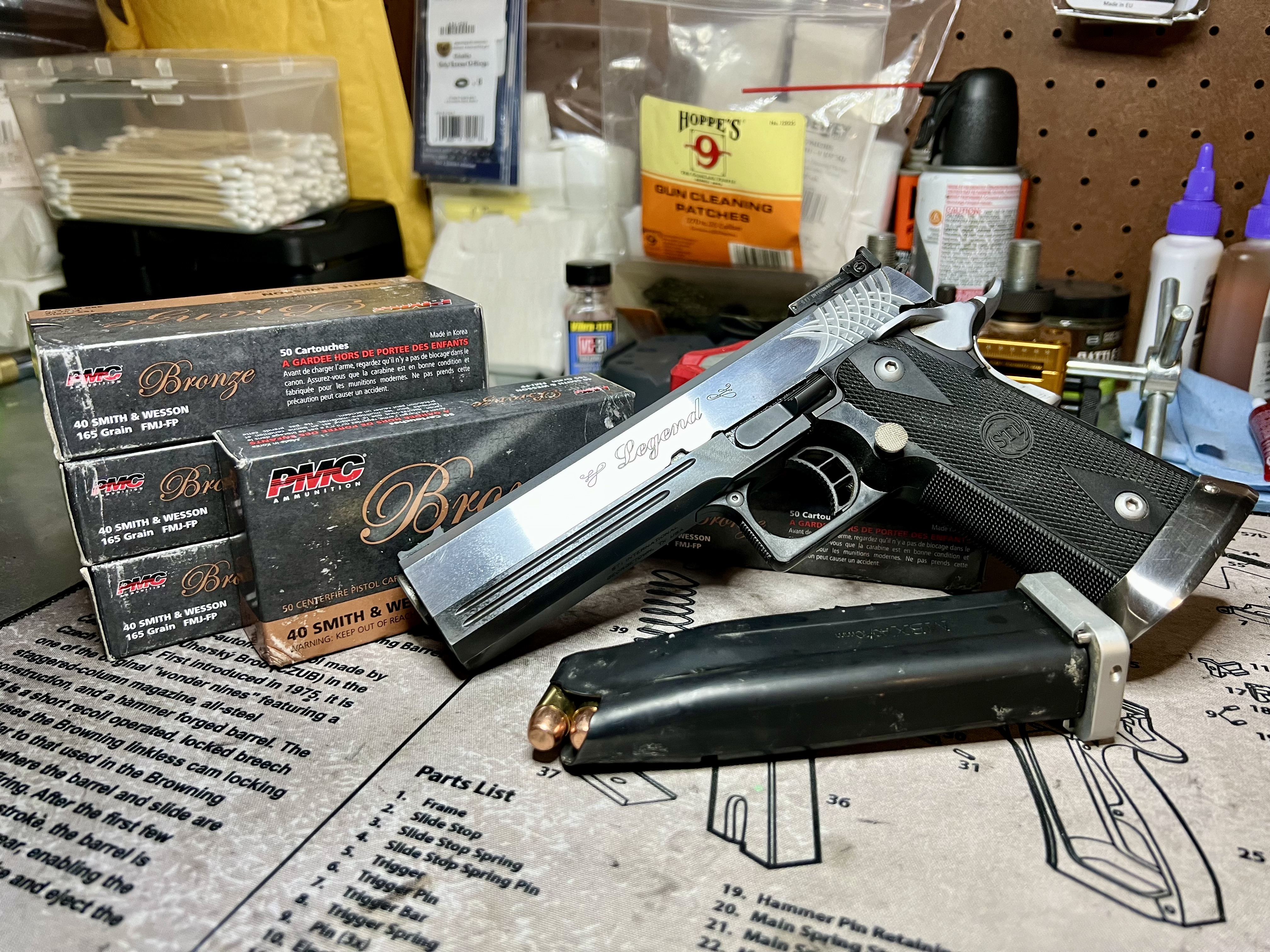
One of the benefits of being involved with firearms instruction and competition is becoming friends with folks in those industries. That also comes with benefits, or hazards depending on your point of view, like opportunities to shoot and, in some cases, own unique firearms. Such an opportunity presented itself early this year (2025), when Karl Rehn, KR Training’s owner and lead instructor, mentioned he had a pistol that I might be interested in. That pistol was a STI Legend 2011 built by the late Ronnie Jones and used by Karl Rehn to earn his Grand Master classifications in USPSA’s Limited and Limited-10 divisions.
Truth be told, I was not in the market for another pistol. Let alone a competition pistol chambered in .40 Smith & Wesson (that I will refer to as .40 S&W or .40 cal from here on out). However, I wouldn’t be telling the truth if I claimed a STI 2011 didn’t make me curious. After all, STI branded 2011 pistols are becoming less common since the rebranding to Staccato. Then, the prospect of a 2011 built by a local competition shooter and gunsmith that I never had the chance to meet was intriguing. On top of that, the idea of owning a pistol used by a mentor and friend to attain a couple of major competition achievements was enticing. It was simply an opportunity that was too good to pass up.
I mentioned what I got my grubby little mitts on to the good folks at Ammo To Go while exchanging emails with them a few days later. They immediately asked if they could sponsor the ammunition for the initial review which they knew was soon to follow. Of course, I graciously accepted the offer. I figured 250 rounds would be enough to function test and to run the STI Legend at a local match which would be sufficient for an initial review. Having never owned a pistol chambered for .40 cal, I requested five 50 round boxes of PMC Bronze .40 S&W 165gr FMJ ammo and Ammo To Go obliged.

While there are other STI Legend pistols out there, this STI Legend (or Legend for short) is a curious creature that is unlike any of the others I’ve come across on the Internet and the only one I’ve come across in person.
It begins with the crowned muzzle of a 5″ stainless steel bull barrel chambered for .40 S&W that protrudes about an 1/8″ in front of the hard chrome finished slide. The muzzle protrusion is a distinctive touch that adds to the Legend’s unique character and not something that I can recall seeing on any other pistol unless it has a threaded barrel.
The “tri-top” stainless steel slide is mostly slick hard chrome save the sabertooth cocking serrations, engravings on either side, and the top slide cuts. On the left side, “Legend” is engraved with a black inlay. On the right side, the Texas STI logo is engraved. At the rear of both sides are the sabertooth cocking serrations that I really like. I find them aesthetically pleasing. At the same time, the texture is hyper aggressive making the serrations exceptionally functional, but may take a bit of skin off when running the slide hard. The top slide cuts are also pleasing to the eye and minimize the sun glare that would otherwise be reflected by the hard chrome on a sunny day.

On the top of the slide we have the STI International branded iron sights which were likely manufactured by Dawson Precision. The high visibility front sight is a thin serrated blade with green fiber optic. The rear sights are adjustable for windage and elevation and are also serrated. The blacked out serrated rear sight combined with a high visibility fiber optic front sight is common on competition pistols and my favorite configuration. The black material of the iron sights contrasts against the hard chrome. That contrast works well with the two tone theme the pistol has going on.
On the inside, sandwiched between the slide and the frame, is a full length Dawson Precision tool-less guide rod.
The blued stainless steel frame features a full length dust cover which is adorned by two grooves on either side. The combination of the full length dust cover and lack of removed material from the front of the slide creates a forward heavy biased weight balance. I suspect the forward heavy bias helps the front sight return to the target consistently and quickly after each shot with almost zero additional input from the shooter.
Behind the frame and the slide is a unique skeletonized hammer that I’ve never seen on a pistol before. It’s also not the same as the hammer on the other Legend pistols I’ve seen on the internet. The shame reminds me of the hammers found on Browning Hi-Power pistols. I’m not sure who made it and if it’s still being manufactured. And my internet searches for it have come up empty. Knowing that Ronnie Jones was a pure gamer, I expect the hammer selection had a purpose, but I can’t imagine what it would be. Regardless, it looks good and functions as intended.

Below the hammer are the ambidextrous thumb safeties and the beaver tail grip safety. There is not much to write home about here as both are pretty standard. As with all other Legends, these parts have a stainless steel finish that contrasts against the blued frame and black grip. However, unlike other Legends, the finish on the slide stop is blue instead of stainless steel.
The grip is a black first generation STI polymer grip module. The sides are checkered much like traditional checkered 1911 grip panels. The front of the grip is also checkered as is the main spring housing. While the checking is aggressive, it’s not as aggressive as some of the popular modern aluminum and steel grip modules are. Meaning the aggressive checkering is unlikely to remove layers of skin. Nevertheless, the 2011 pistol is going to stay put in a firm grip.

At the bottom of the grip module is a massive STI branded stainless steel magazine well as one would expect on a competition pistol. In addition to helping guide magazines during fast reloads, I find that it helps keep my grip locked in place. If nothing else it provides an index reference point when establishing the master firing grip on the pistol during a draw.
The magazine release is from Dawson Precision. While I didn’t measure it to confirm, I suspect it is the extended release that’s drilled and tapped to receive Dawson Precision’s magazine release button finished in stainless steel. This is a nice and welcome upgrade as it almost eliminates my need to rotate the 2011 to reach the magazine release with my firing hand thumb and makes it far easier to hit it consistently when performing reloads. This is something I struggle with a fair bit with stock STI and Staccato magazine releases.

The trigger shoe is a typical run of the mill polymer trigger commonly found on STI and Staccato pistols. That said, it’s been tuned to have almost zero pre and post engagement travel. The break is clean, crisp, and light – measuring right around 2.5 lbs.
The four labeled 19-round magazines with Dawson Precision extended base plates that came with it were functional, but felt gritty indicating they had seen some use and were in need of cleaning. I took this as an opportunity to source four new MBX Extreme 20-round 141.25mm competition magazines to gain an additional round of capacity. This was completely unnecessary, but an extra round is a 5% capacity increase which is something a gamer, like Ronnie Jones, would do.

After a good routine maintenance cleaning, procuring the new MBX magazines, receiving the .40 S&W PMC ammo sponsored by Ammo To Go, and a function test, I reconfigured my Double Alpha Academy Flex Holster and my competition rig and took the STI Legend out for a spin at a local match. While the function test results were flawless, the reliability at the match was less than stellar with repeated failure to feed malfunctions. Initially, I suspected the recoil spring might have been fatigued from Karl’s multiple Grand Master classification related work. However, a chat with Karl revealed that the STI Legend had a relatively low round count of approximately 5,000 rounds. The chat also revealed that Karl’s use was done exclusively with 180 grain .40 S&W ammunition.
While I can’t rule out recoil spring fatigue entirely, the malfunctions might have very well been ammunition related. That’s not to say that the 165 grain PMC .40 S&W ammo isn’t reliable as a whole. Rather it means that the STI Legend doesn’t like that particular ammunition and I will have to try different ammunition. I think it’s unlikely, but the STI Legend may not like the MBX magazines. At any rate, I will try out different ammunition and magazine combinations before I go down the tinkering rabbit hole that starts with recoil spring replacements.

Reliability issues experienced aside, the STI Legend is wicked fun to shoot. The recoil profile is surprisingly tame and flat which is the exact opposite of what .40 S&W is known for. Furthermore, the already mentioned return from recoil is uncanny. All of this makes it seem as though the STI Legend is begging for you to completely open up the throttle and shoot it fast. By that token, I found myself out running my headlights on more than one occasion.
The best way I can think of describing this particular STI Legend is as the embodiment of functional elegance and I’m itching to get it running reliably.
Personally, I think the STI Legend, in general, appeals best to two different kinds of folks. The first kind is collectors given its pedigree, appearance, and the decreasing availability of the pistol – especially in pristine mint condition. The second kind is competitive shooters who are interested in participating in USPSA’s Limited division or IPSC’s Standard division. In my opinion, I think it rather unfortunate that the second kind is a dwindling population because the 2011 is truly meant to be run rather than looking pretty. Although, it does the whole “looking pretty” thing really well.
While I’m not currently looking to focus on USPSA’s Limited division, I’m planning to run Ronnie Jones’ STI Legend in matches from time to time. I’m also extremely likely to tinker with it and squeeze more performance out of it which is something I think Ronnie would have appreciated. I don’t know exactly what kind of tinker I will do, but perhaps I’ll replace the grip module with a modern skin scraping aggressive steel grip module. Whatever the case, I’m going to get it running reliably and run it. That much is certain.
3 responses to “Ronnie Jones’ STI Legend”
[…] Ronnie Jones’ STI Legend – Uncle Zo […]
The feed issues may be OAL related. Factory ammo is typically 1.125″ or so long. However, 2011 magazines were originally designed around .45 ACP and so a longer OAL (possibly as much as 1.160″) may be necessary for reliable feeding.
[…] to hit the mag release on the Staccato P with my firing-hand thumb, but the similar setup on the STI Legend cured […]