

Almost two years. That’s how much time has passed since I took Active Response Training’s Extreme Close Quarters Gunfighting class. This time, I attended the instructor development version. It’s obvious there were differences between the two, but there were also similarities, given they cover the same critical topic: fighting with a gun at contact distance. The context surrounding my decision to take each class also had its share of differences and similarities, making it a fitting place to start this after-action report.
In both cases, I took the class because armed self-defense interests me deeply. There are few learning opportunities that focus strictly on gunfighting at contact distance—an interdisciplinary application combining hand-to-hand and handgun combatives. Such courses exist, but they’re rare compared to self-defense classes that isolate hand-to-hand or handgun skills.
Both times, I was eager to study under Greg Ellifritz, a highly respected trainer I’ve admired for years through his blog. Two years ago, that excitement came from the opportunity to learn from him. This time, it was coupled with urgency, as Greg’s public disclosures about his health suggest his time is limited. As he darkly joked in class during a discussion about market conditions, no marketing gimmick fills seats faster than dying of cancer. If you have any interest in training with Greg, check his upcoming classes and book a seat while they’re available.
Let’s get the gear I used out of the way, since someone’s bound to ask:
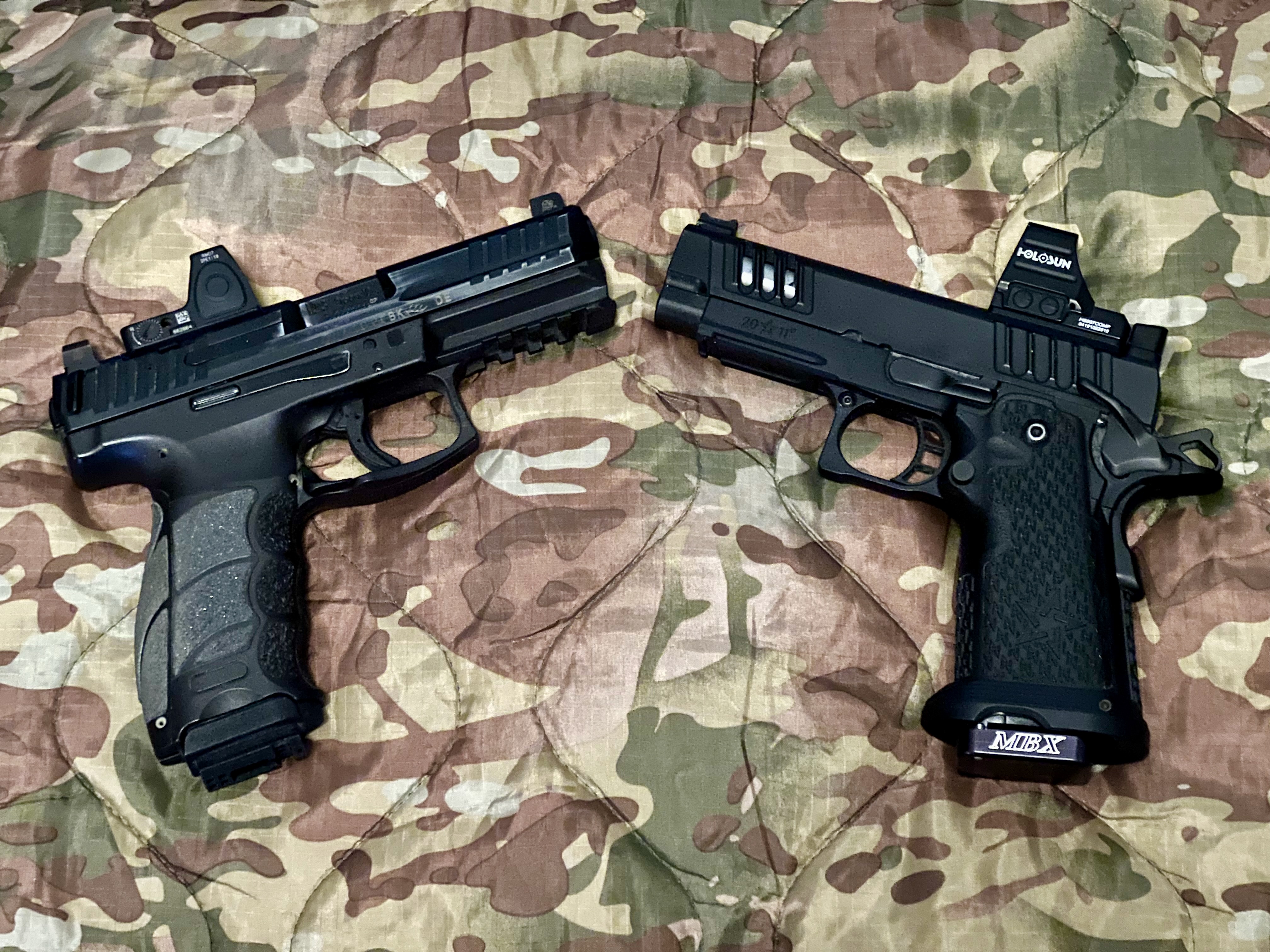
- Gun: Staccato C2 with a Holosun 507COMP
- Holster: JM Custom Kydex IWB 3 holster on my strong side
- Mag pouches: Concealment Solutions Venom Single Magazine Carrier x2
- Belt: Nexbelt Titan EDC Belt
- Ammo: Blazer Brass 9mm 147gr FMJ (round count was just north of 200 rounds)
With gear covered, let’s dive into the course itself.
Some of y’all appreciate the chronological organization of my after-action reports. This time, I’m trying a different approach, focusing on key takeaways and observations, weaving in details of what we did as needed. I’m not sure if this will make the report more or less valuable, but I suspect it’ll help with skimming for key ideas and referencing them later. I think it’s worth trying. Let me know if this format works or if I should revert to the old style.

We spent two days at KR Training, the host range, covering three main topics: gunfighting (the core subject), teaching the material, and teaching in general. The latter two distinguish this as an instructor development course. Greg estimated the first day was about 75% gunfighting and 25% instructor development. The second day felt closer to 60/40 from my perspective. Expect some ebb and flow between these topics as we proceed.
This is Not a Shooting Class
This class is a shooting class, but it isn’t. Gunfighting involves shooting, but at contact distance, it’s maybe 80% fighting and 20% shooting. You’re entangled with an opponent, grappling for control of weapons, avoiding damage, and seeking opportunities to neutralize the threat. There’s no guarantee you’ll stay on your feet—there’s a strong chance you’ll end up on the ground.
Gunfighting requires a range of skills, with shooting being just one slice of the pie. The shooting relies heavily on one-handed operation, as your support hand (and arm) will likely be protecting your head or controlling the opponent’s weapon—often a gun. There’s a good chance both hands will be occupied with controlling their weapon or access to it. This means drawing to a retention position, typically a textbook thumb pectoral index (TPI). However, a textbook TPI may not work for everyone. Equipment or body parts (like large breasts, male or female) can interfere. So can certain handguns—think hot gas or projectile shavings from a revolver’s cylinder gap or hot gasses from a ported or compensated pistol. Alternatives include:
- 45º roll-out: Magazine base pad dug into ribs, for ported/compensated pistols or equipment/body interference.
- Inched forward: Wrist indexed on floating rib, clearing the revolver’s cylinder gap.
One-handed malfunction clearing, like tap-and-rack, is also critical, as malfunctions are likely. You might even end up fighting with the opponent’s gun after a disarm—a risky proposition, as Greg’s law enforcement experience suggests their gun might be broken, unloaded, or loaded with the wrong ammunition. Still, it could be your best option depending on how the fight unfolds.
Shooting at contact distance doesn’t require delicate trigger work or precise aiming. It’s entirely by feel, making a consistent TPI crucial to avoid shooting yourself or your support arm. Hits on the opponent are important, but it’s more about creating space than landing precise, fight-stopping shots.

This boils down to three steps:
- Protect your head with your support hand and arm.
- Draw to a consistent TPI (or variant).
- Press the trigger.
These skills can be taught and learned relatively quickly. Dry fire can refine them. A SIRT pistol or laser accessory can verify projectile trajectory. The real value of live fire is reducing the novelty of discharging a weapon close to your body—it’s louder and more concussive than shooting at full extension.
Gunfighting is for Everyone
Like self-defense, gunfighting is for nearly everyone. Some folks, for their own reasons, will abstain from violence, even to defend themselves or loved ones. But gunfighting isn’t limited to able-bodied men with brown belts in Brazilian Jiu-Jitsu or B-class USPSA shooters. I’d argue a member of a vulnerable population—like a 70-year-old with a heart condition—is more likely to need these skills than a tactical athlete.
We explored this on day two after a comment about timing your draw to minimize the opponent countering it. Greg noted that Craig Douglas’ (Shivworks) ECQC answer—“continue fighting for a dominant position and only go for the gun once a dominant position is established”—is the best and most correct. But it doesn’t work for everyone. It assumes grappling proficiency and physical conditioning, which many lack. It’s especially tough for vulnerable defenders or when facing an opponent with a significant size, strength, or skill advantage. And let’s face it: the average self-defender might invest a weekend in training, if anything, not years on the mats.

Active Response Training’s Extreme Close Quarters Gunfighting class is designed for the average self-defender. It uses simplified principles and easy-to-learn techniques that give everyone a fighting chance, from a retiree with health issues to a novice. Here are a few examples:
- Priorities: Stay on your feet (ground fighting is beyond this class’s scope) and remain conscious. We practiced a fighting/shooting stance: hips and shoulders square to the threat, staggered feet, knees bent to lower your center of gravity, and a forward bias. We also learned a default vertical elbow shield to protect against a likely attack—a big right-handed haymaker—by placing your hand behind your ear, pulling your elbow in, and tucking your chin.
- Weapon control: To dominate a drawn gun, get both hands on it (avoiding the fiery death end commonly known as the muzzle), move it down and to the side, and apply your weight to control it. This same motion can be used to stuff an opponent’s draw.
Once the opponent’s muzzle is controlled, you have three options:
- Shoot them.
- Physically attack them.
- Disarm them.
Your choice depends on the dynamic situation—where your hands end up, which side you’re on, and how the struggle for the gun continues. The opponent has a say in the fight, too.
For physical attacks, we learned two effective techniques: eye gouge or throat rip (trachea dislocation). They’re simple and similar: thumb to the eye or trachea, hook behind, and scoop. These were taught to ensure all students, regardless of prior hand-to-hand skills, have an attack option.
For “shoot them” and “disarm them,” we got straightforward tips. Shooting: maintain control of the opponent’s muzzle, check for clean entry and safe exit, pressing your gun’s muzzle into the opponent (taking it out of battery), then press the trigger. Disarming: assuming one hand landed just right to secure a wrist lock, rotate the muzzle away until the grip gives.
The class kept physical demands manageable. No one was required or encouraged to perform drills at full speed, strength, or intensity. Greg’s tone and pacing set a controlled vibe. Pairs, necessary for drills, could adjust intensity based on skill and comfort. No one got thrown around or ended up on the ground.
It Takes Two to Tango
Every drill required a partner—even shooting drills, where partners acted as safety monitors to ensure the TPI didn’t endanger the support arm or elbow.
Practicing gunfighting skills—like controlling the gun, stuffing a draw, disarms, or physical attacks—requires a partner. For many, including me, this makes practice outside a classroom, dojo, or gym difficult. Most students probably won’t revisit these skills until their next gunfighting class, which is why short, simple principles and techniques that are easy to learn and recall are so important.

Partners in class were invaluable. They allowed hands-on practice, essential for learning, while Greg could observe and adjust your technique. With a willing partner, you could increase intensity just enough to build confidence in your skills. Working with different partners was even better, showing similar successes and occasional failures. Those failures were especially helpful, letting you adapt your technique to work under conditions where it previously failed. That’s experiential learning: constructing knowledge, skill, and confidence from direct experience.
Reducing Novelty
We touched on this earlier, but reducing novelty is a key part of quality self-defense training. The human mind hates novelty in stressful situations. There’s a bunch of brain science behind it, but the gist is: encountering something new in a high-stakes scenario can induce panic, triggering a fight, flight, or freeze response. Stress inoculation and novelty reduction—like in simulation or force-on-force training—help mitigate this.
Live fire from a TPI is one example. The concussive blast close to your body can be startling—some drop their gun the first time. Experiencing it makes it familiar, removing the novelty.
The biggest novelty reducer, which hit me hard two years ago, was having a real (but neutered) gun pointed at you and pointing one at others. This violates at least two safety rules (treating the gun as loaded and pointing it in a safe direction). But guns were made safe with clothesline run through the barrel and magazine well, visible on both ends, and strict safety checks ensured no ammo or working weapons were present, with controlled foot traffic. It’s disconcerting, but that’s the point. This time, it wasn’t as intense. I was still hyper-vigilant about safety protocols, double-checking my gun and my partner’s, but the concept wasn’t foreign. Neither was grabbing and controlling another gun—it was, as they say, not my first time rodeo.

Other drills included firing a live round into the berm while holding the slide (after Greg demonstrated how to avoid injury) or applying pressure to the slide’s back plate. These help you stay calm if a round fires while controlling a gun, reducing the likelihood of novelty induced panic.
Tricks of the Trade
The combination of straightforward principles, simple techniques, and novelty reduction forms the core of this course, but at least half a dozen specific nuggets of knowledge made the class more memorable, engaging, and valuable. Some were additional techniques, while others were anecdotes.
One such technique was countering a stuffed draw—a scenario that can occur if your timing when drawing your pistol is off. If an opponent has their weight on your holstered pistol and both hands on your wrist, drawing is unlikely to succeed, as we learned while practicing stuffing an opponent’s draw. The counter involves dropping your hips to pull the holster away from the pistol, which remains mostly stationary (unlike a typical draw, where the holster stays in place). This creates a brief window to actuate your wrist, orienting the muzzle toward the opponent while their hands control your arm rather than the muzzle.
Another technique addresses a locked-up revolver cylinder caused by an opponent gripping it. This can happen if they attempt to control your handgun and it’s a revolver. Locking the cylinder requires minimal grip pressure and prevents trigger actuation. Like the stuffed draw counter, this technique reverses the operation: if you can’t pull the gun up, drop the holster down; if the cylinder won’t rotate, rotate the frame instead while pressing the trigger.

The anecdotes were engaging and provoked thought, challenging our understanding of conventional techniques. One story, from Greg’s time as a police officer, highlighted unconventional carry methods. He described entering businesses with activated silent alarms in plain clothes, aiming to catch (or shoot) robbers without triggering a hostage situation (a risk when uniformed officers flood a building). In those scenarios, he carried a revolver concealed in a grocery bag, allowing faster access than a conventional concealed carry method. He still uses this technique as a civilian, though it has drawbacks, which he’s documented in a blog post.
While these tricks are specific to gunfighting, many others were shared. Several focused on teaching this material or instructing in general. For example, student introductions weren’t just for building rapport among students (who work in pairs) or getting to know them; they also helped instructors plan firing line assignments and intentional pairings. This heads off known challenges and ensures smoother classes. For instance, identifying left-handed students allows them to be placed on the left side of the firing line, preventing safety monitors from being caught between a right-handed shooter to the left of a left-handed shooter, which could hinder their ability to perform safety duties.
Training Opportunities
There’s a lot to digest here, and I barely touched on the instructor development components—I’ve got a dozen pages of notes on that alone. I’ll save those for future posts, as this covers the key gunfighting insights. I hope it’s enough to spark your interest in gunfighting and maybe push you to take a combatives class.
KR Training has a Close Quarters Pistol course on July 26, 2025. I’m biased as a staff member, but the price point is attractive if you’re near Central Texas. If that date has passed, check the schedule for the next offering.
Greg’s remaining time is uncertain. No one knows how long he’ll be able to teach. If you want to train with him, book a class—or three—now. KR Training is hosting him for at least three more this year: a medical class, a bomb class, and an edged weapons combatives class. He has other classes listed on his schedule, too.
Finally, the Combatives Association Summit is set for October 24–26, 2025, in D’Iberville, Mississippi. It’s a great opportunity to see the state of the art in combatives and learn from experienced instructors. Word is, it’ll be a hoot.
Leave a Reply