
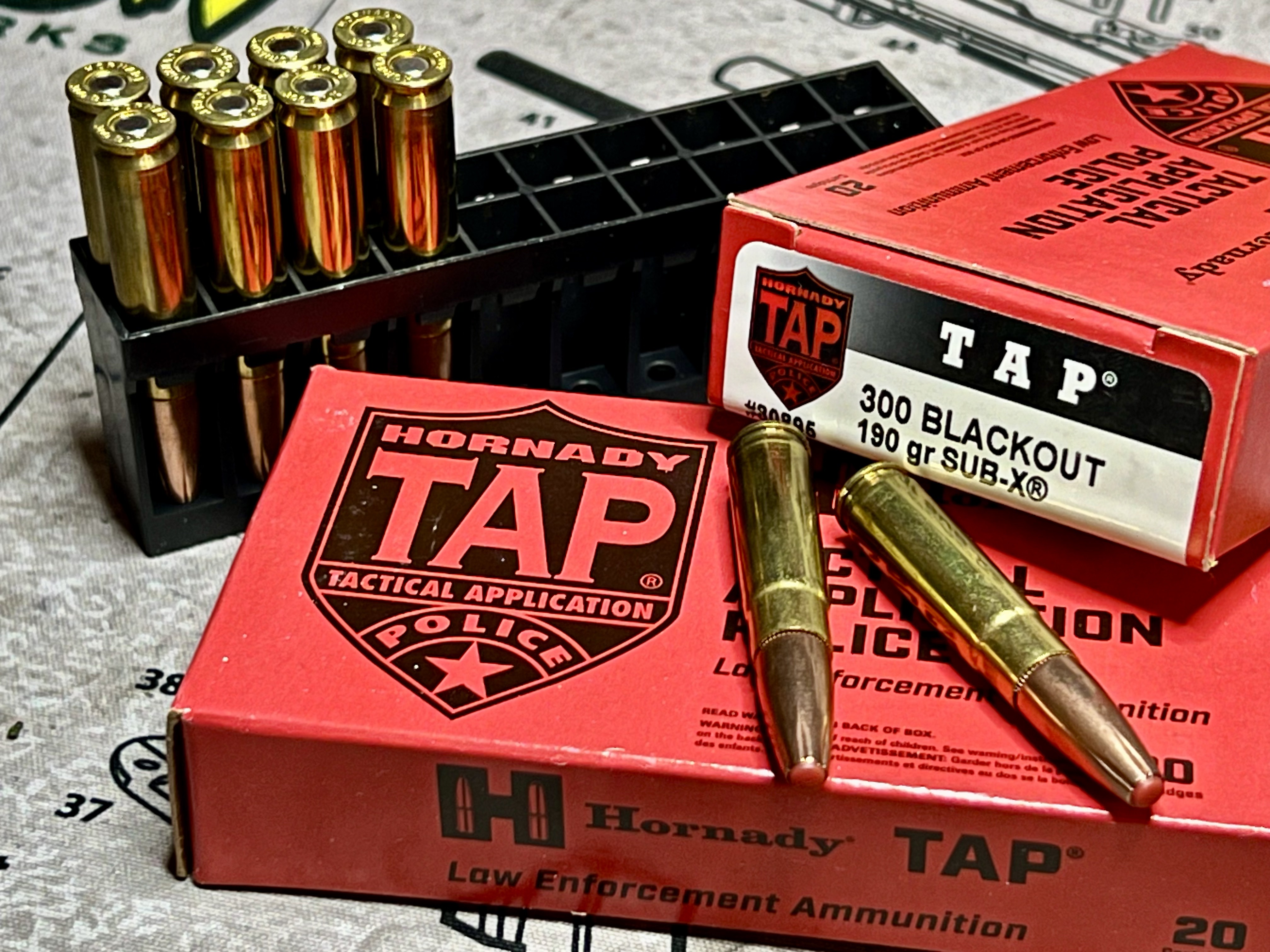
It’s been a while since I last wrote about zeros. Come to think of it, it’s been a while since I’ve given zeros much thought at all. That’s because I’ve spent enough time exploring them to settle on the zero configurations that work for my firearms, cartridges, and their applications. In other words, I’ve got my go-to zeros comfortably dialed in for what I do. So why revisit the topic? A longtime reader asked a question on X: “Regarding .300 Blackout, do I have to re-zero my rifle optic when switching from standard ammo to subsonic rounds?” The answer? “It depends.” Which naturally leads to, “Depends on what?” Let’s dive in.
First, understand that different ammunition loads have different trajectories. This is true even for the same cartridge with the same bullet type and weight from different manufacturers. Small variations in powder—whether in charge or type—result in different trajectories. We could geek out on ballistic nuances to explain why seemingly identical cartridges have different points of impact and group sizes, but the key point is: trajectories won’t be identical. That said, sometimes those trajectories are close enough that you can reuse the same zero without tweaking your optic.
While you might share a zero between two nearly identical loads with similar trajectories, that’s less likely when switching between supersonic and subsonic loads, which have wildly different trajectories. Why? Subsonic loads start with lower muzzle velocity and typically use heavier projectiles with different ballistic coefficients. For example, consider these two .300 Blackout Hornady BLACK loads and their advertised ballistic data:
- Supersonic: 110 gr V-MAX, muzzle velocity of 2375 fps, ballistic coefficient (G1) of .290
- Subsonic: 208 gr A-MAX, muzzle velocity of 1020 fps, ballistic coefficient (G1) of .648
Most folks correctly guess that a heavier, slower projectile will drop more than a lighter, faster one as distance increases. Ballistically, that drop isn’t about weight—it’s about initial velocity and ballistic coefficient—but many mistakenly think heavier objects fall faster, despite gravity affecting all objects equally. The trajectory graph below, assuming a 25-yard zero with a sight height of 2.6” (common for AR platform optics), illustrates this drop.

Interestingly, with a 25-yard zero, both projectiles are still rising from the bore to the optic’s line of sight at 25 yards and will continue rising beyond that. This suggests you can reuse a 25-yard zero for either load at distances up to 25 yards.
The next question is, “How much further can that zero be used?” That’s trickier because it depends on the application and the optic’s reticle. Let’s explore this with the 25-yard zero to highlight the variables at play.
With these two loads’ different trajectories and a 25-yard zero, consider the size of the acceptable impact zone on your target. Let’s assume an 8” circular zone—maybe the A-zone of a target, the high thoracic cavity of a threat, or the vascular zone of a deer. Holding dead center at 25 yards, both cartridges should hit dead center, assuming solid marksmanship. At closer ranges, the impact will be lower because the projectile starts 2.6” below the optic’s line of sight. So, from contact distance to 25 yards, you’ll land acceptable hits.
At 50 yards, the supersonic load impacts about 2” above the point of aim, while the subsonic load is less than half an inch high. Both are still rising, but the subsonic is lower because it’s been exposed to gravity roughly twice as long, given its half-speed muzzle velocity.
By 100 yards, the supersonic projectile is over 5” high, and the subsonic is 5” low—both outside the 8” zone. The supersonic is still climbing, while the subsonic began descending around 50 yards. In this case, a 25-yard zero works up to about 75 yards for the supersonic load and 90 yards for the subsonic without adjusting your hold. Changing holds can extend the zero’s effectiveness, but that requires knowing each load’s trajectory well—a challenge with one load, let alone two.
If 8” zones are your typical targets, you could optimize the zero to maximize one load’s Maximum Point Blank Range (MPBR)—the farthest distance you can hold dead center and still hit within the target area. For the supersonic load, a 30-yard zero yields an MPBR of 259 yards; for the subsonic, a 13-yard zero gives 129 yards. But a 13-yard zero with the supersonic load is only good to about 35 yards, while a 30-yard zero with the subsonic load works to 85 yards. A zero optimized for one load often shortens the other’s effective range.
To find a zero that works for both, you could compromise with a middle-ground zero or choose one that minimizes the range reduction for the other load. I lean toward the latter, but it’s not always the best choice. Using a ballistic calculator with observed (not advertised) ballistic data will help pinpoint the best zero for your loads and use case.
If you can avoid a zero that sends one load’s trajectory into orbit, a reticle with holdover marks might extend the range for one or both loads. Reticle features can even influence the zero distance. For example, consider a bullet drop compensation (BDC) reticle with marks at 2.4 MOA, 5.6 MOA, and 9.5 MOA (common for 5.56 NATO). These marks let you adjust holds to keep impacts on target as distance increases. However, the subsonic load drops fast, so the effort might not always be worth it. Let’s break it down.
With a 30-yard zero and a BDC reticle like the one above, the subsonic load’s point-blank range is about 85 yards, with a drop of 3.31” (3.71 MOA). Using the 2.4 MOA mark raises the impact by about 2”, keeping hits closer to center. This hold keeps you in the 8” zone to about 100 yards, where the drop is 6.05”. The 2.4 MOA mark raises the impact by 2.4”, keeping hits low but within the zone. Switching to the 5.6 MOA mark at 100 yards raises the impact by 5.6”, centering the shot. At 120 yards, the drop is 10.95”, and the 5.6 MOA hold raises it by 6.72”, landing just below the 8” zone by 0.23”. The 9.5 MOA mark raises the impact by 11.4” at 120 yards, putting you an inch high. You’re back in the zone for another 20 yards, where the drop hits 17.3”, and the 9.5 MOA hold keeps impacts just below the 8” area. That’s a lot of hold adjustments over 55 yards, but the reticle extends the 30-yard zero’s usable range for both loads. The catch? You need practice to range targets and apply the right hold, which is easier when distances between hold changes are longer.
I used a 5.56 NATO BDC reticle because they’re common, but .300 Blackout-specific reticles exist, though they’re rarer. For instance, Primary Arms offers ACSS reticles for .300 Blackout and 7.62×39 on a few optics. Regardless of the reticle, verify its subtensions (check the manual or contact the manufacturer) and calculate trajectories using measured ballistic data. Use a chronograph, like the Garmin Xero C1 Pro, to record your rifle’s actual data, especially for .300 Blackout, often fired from shorter barrels than the 16”+ test barrels used for advertised data.
This exploration shows that, in some cases, a single zero can work for both supersonic and subsonic loads with the same rifle and optic. But should it? Is this a case of “just because you can doesn’t mean you should”? It’s context-specific. Let’s weigh the options:
- Re-zero for each load: Prudent but tedious if the rifle switches roles (and loads) often.
- Use two optics on quick-detach mounts: Fast-ish switching, but you’re buying multiple optics.
- Use two dedicated rifles: Ideal but costly and bulky—lugging two rifles is a hassle.
- Share a zero: Frugal and often good enough for most use cases, assuming it doesn’t overly compromise performance.
Other options might be better if they don’t strain resources or functionality. Ultimately, the best choice depends on your needs, gear, and willingness to crunch the numbers.
2 responses to “Zeroing Optics for Supersonic and Subsonic Ammo”
[…] Zeroing Optics for Supersonic and Subsonic Ammo […]
According to my super-sciency calculamentations (and range testing), a 25yd supersonic near zero results in a 50yd subsonic zero (near & far converge like a 100yd 5.56 zero) and a 210-220 yd super far zero.