
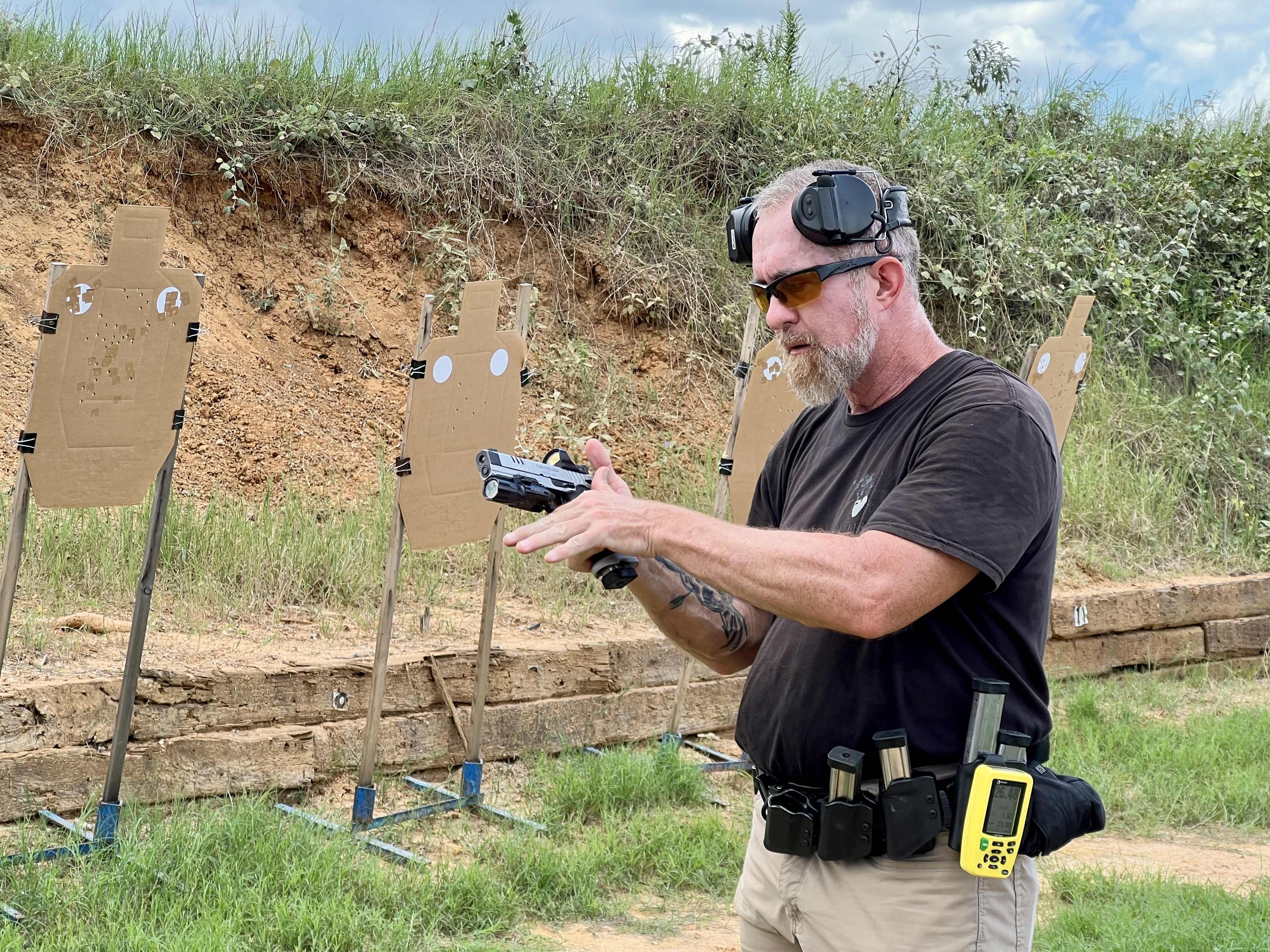
I’ve never been called a training junkie, but I’m sure someone out there suspects it. I don’t know if that’s true, but I do know I love to shoot—a lot. The better I get, the more I want to pull the trigger. That drive to improve is exactly why I take classes. On my training bucket list—having one might just hint at a training obsession—was taking a class from Matt Little, aka Greybeard Actual. I finally checked that one off.
Taking a class from Matt Little was a unique item on my list. Most classes land there through a recommendation from a fellow shooter, classmate, or instructor saying, “Zo, you’ve got to take this class,” followed by a compelling pitch. This one was different. It wasn’t about a specific course but any class taught by Matt Little. How it got on my list has a fun story behind it.
About three years ago, fresh off Ben Stoeger’s Practical Shooting Fundamentals class, I showed up at a local match. While walking the first stage with my squad, I noticed a new face—an intense older guy (older than me, anyway) with a slight but noticeable limp, analyzing the stage with laser focus. His execution wasn’t perfect; mobility limitations clearly held him back, and he wasn’t thrilled about it. Yet, he outperformed me, and that intense focus stuck with me. I asked, “Who’s the new guy?” The answer: “That’s Matt Little. Not new around here, just back after a long recovery from a medical procedure.” New to USPSA at the time, I didn’t know many local regulars. I noted his name and made it a point to squad with him whenever possible.

Over the next couple of years, we shot many local matches and a few majors together. I soaked up his advice and learned about his background: a disabled combat veteran from the US Army Special Forces (20th Group) and a former Chicago SWAT officer. He’s also an instructor with a deep respect for pistolcraft as a martial art. I watched him adapt post-surgery, returning to compete with Master-class shooters. That’s when I decided I had to take a class from him. His real-world gunfighting experience and commitment to continuous improvement could sharpen my training approach. Serendipity struck: my first chance to cross this off my bucket list was his Pistol Skills Development class, designed to teach students how to build pistol skills, hosted at KR Training on July 12-13, 2025.
Gear Setup
Before diving into the after-action report, let’s talk gear. I started with my everyday carry (EDC) setup and practice ammo:
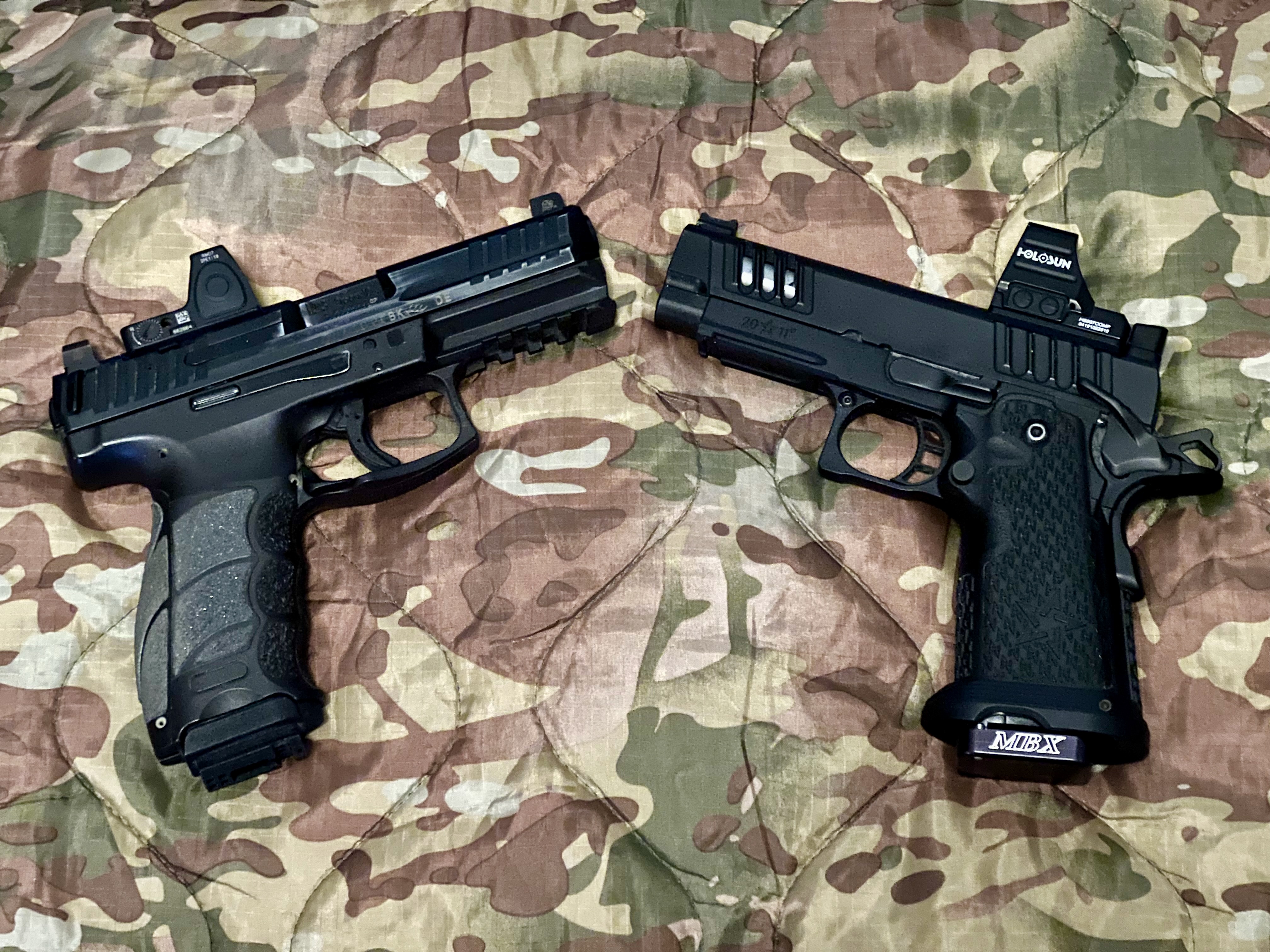
- Gun: Staccato C2 with a Holosun 507COMP
- Holster: JM Custom Kydex IWB 3 holster, strong side
- Mag Pouches: Concealment Solutions Venom Single Magazine Carrier (x2)
- Belt: Nexbelt Titan EDC Belt
- Ammo: Blazer Brass 9mm 147gr FMJ
Realizing the class wasn’t strictly focused on concealed carry skills, I switched to my competition setup:
- Gun: Staccato XL with a Holosun 507COMP
- Holster: Double Alpha Academy (DAA) Flex holster
- Mag Pouches: DAA Aplha-Xi pouches (x3)
- Belt: DAA Lynx belt
- Ammo: Blazer Brass 9mm 147gr FMJ
Round count was just over 900.

One last note: I tried to take detailed notes on drills and key points, but I was also focused on learning, so there are bound to be unintentional omissions. The good news? Matt Little’s book, The Way is in Training, covers the philosophy, drills, and anecdotes in detail. It’s a must-read for any shooting enthusiast.
Day 1 – Fundamentals
The first day kicked off as expected: a safety brief, a medical plan, and introductions. Their presence isn’t a guarantee of quality, but their absence is a red flag in my book.
The initial lecture set the class goal: learning to coach yourself. Matt outlined his training and practice philosophy, emphasizing key points:
- Shooting skill development is an athletic endeavor.
- Practice should be planned and programmed.
- Every drill repetition should be executed mindfully.
These concepts sound simple but aren’t easy to implement. Not everyone has pursued an athletic endeavor, and experience levels vary. Planning practice isn’t intuitive for everyone either. Matt noted that musicians and engineers have an edge—musicians through repetition and refinement, engineers through analysis. Mindfulness is less tangible and somewhat esoteric; saying “be mindful” doesn’t provide specific actions. The drills and discussions throughout the class turned these concepts into practical building blocks for self-coaching.
“Train like you fight” is stupid. You train for the fight.
Matt Little
Matt introduced three drill categories—experimental, isolation, and combination—each with distinct purposes and success criteria. Experimental drills refine techniques by tweaking one variable at a time. Isolation drills hone individual skills by pushing their limits and addressing weaknesses. Combination drills integrate skills to build consistency and reduce errors in complex scenarios. Categorizing drills this way maximizes their skill-development value by ensuring they’re used appropriately.

Range time began with our first experimental drill: Matt Little’s Number of the Beast. The drill involved firing six shots freestyle (two-handed grip), six shots strong-hand only, and six shots weak-hand only at a 3-inch circle 10 yards away with no time limit. From an experimental standpoint, it’s great for refining core marksmanship fundamentals, namely working the sights and trigger. I’d add breathing to the mix for drills like this, as it’s an often-overlooked fundamental that boosts extreme accuracy when time isn’t a factor. That said, the class focus was strictly on aiming and trigger management, which were the main topics of the post-drill discussion.
Matt’s approach to aiming is a contemporary take on visual confirmation of muzzle-target alignment, broken into five levels (least to most confirmation):
- Index Confirmation: Relies on physical reference points with or without the pistol in your field of view. I think of it as shooting by feel.
- Outline Confirmation: Uses the outline of the pistol or optic housing relative to the target, contained well within the acceptable impact area.
- Flash Confirmation: Confirms muzzle alignment the moment the aiming system enters the eye-target line while maintaining visual focus on the target. The shot breaks at that moment, perceived as a “flash” of the front sight or a streak of color (red or green) for an optic.
- Partial Confirmation: Occurs when the front sight appears relatively aligned with the rear sight, or the dot is “squiggling” (Matt’s term, emphasized in class and his book) within the acceptable target area. The gun is still in motion, decelerating into precise alignment but not fully settled.
- Full Confirmation: Happens when the gun settles into alignment with the target, confirmed by “equal height, equal light” with iron sights or a calm, settled dot hovering over the acceptable impact area.

Trigger management was categorized into three levels:
- Slap: The most aggressive and fastest trigger actuation, powering through the trigger’s full travel without awareness of resistance.
- Rolling Break: Trigger actuation with awareness of contact with the trigger shoe, reaching the wall, and breaking through, but without pausing at the wall.
- Prep and Press: Refined actuation, taking out slack, pausing at the wall, and breaking the shot only after the appropriate visual confirmation, with steady pressure until the shot fires.
Aiming and trigger management levels are combined based on three factors: skill level, target difficulty, and target risk. Target difficulty depends on distance and the size of the acceptable impact area. Risk ties to the consequences of a miss—less risk with a cinderblock wall as a backstop, far more with an elementary school playground full of kids.
The next few drills let us experiment with aiming and trigger management at different distances to determine the best combinations for open targets. For brevity—something this post is already lacking—I’ll list the drills and save the details for future posts. Until then, check Matt’s book for full descriptions:
- Trigger Control at Speed: Multiple reps to experiment with the three trigger management levels.
- Progressive Doubles: A great drill to quickly adapt to a new or different gun, per Matt.
- Doubles Drill: The same one popularized by Ben Stoeger.
- Walkback Drill: Exploring aiming and trigger management combinations at increasing distances.
With over half the day done, we shifted to isolation drills, starting with the infamous Bill Drill. I thought I knew this drill, but Matt offered a fresh perspective. I’d seen it as a grip isolation drill to test grip durability, but Matt highlighted its use for isolating sight tracking, guarding against tension, and refining predictive shooting pace.
While working the Bill Drill and its variants, the difference between experimental and isolation drills became clearer. Experimental drills allow us to isolate a single variable, adjust it, and observe results. Positive changes are carried forward into isolation drills; negative ones are discarded. The goal is to refine personalized techniques. Isolation drills focus on repetition and refinement, pushing to find breaking points and improve to overcome them, internalizing skills to execute them subconsciously.
Take the Bill Drill with a grip isolation focus. The goal isn’t to change grip technique but to hone it by burning in indexes and pressure cues for consistent, subconscious application.
Matt’s approach to isolation work starts with an on-demand baseline rep—aggressive but not full throttle, performed correctly without errors. Measure it to know your starting point. Then, push beyond that intensity, mindfully observing errors to correct without reducing intensity. This is where growth happens. Continue until you’re ready to move on, out of ammo, out of time, or too fatigued to maintain performance. Always close with a clean, on-demand rep to leverage recency, ensuring the skill is recalled correctly when needed outside training.
Other isolation drills included:
- Loaded Bill Drill: 3 shots, reload, 3 shots.
- Strict Bill Drill: A Bill Drill with a 3” circle as the acceptable impact area.
- Experimental Transitions: Alternating shots between two 3” circles.
- Blake Drill: 3 targets, 2 shots each.
- Accelerator Drill: 3 targets at different distances, 2 shots each.
- Distance Change Up: Isolates switching between different aiming and trigger combination schemes.
Day one wrapped with Matt’s 3.45 Drill, offering a chance to earn a 3.45 patch (I didn’t make the standard). A second attempt was planned for day two.
Day 2 – Movement
We were warned to rest and stretch for day two’s movement focus. Matt and his wife, Angela, who assisted both days, weren’t kidding—it was physically demanding but a ton of fun, with plenty of learning.
We kicked off with the Shake & Bake drill, an experimental drill to explore mounting and dismounting the pistol at a threshold. The goal was to engage and disengage the support hand grip while maintaining constant contact with the support hand’s index finger on the trigger guard. This allows the pistol to be brought tighter to the chest during dismount and quickly presented during mount, useful for navigating crowded barriers or combining with short and long movement mechanics.

The setup involved two steel targets 3 yards apart, 10 yards from a thin barrier (like a two-barrel stack). The shooter starts behind the barrier, less than an arm’s length away, alternating between engaging each target from its corresponding side with two rounds until the magazine is empty. The focus is on experimenting with dismounting and mounting the gun to optimize transition time between target hits.
Next, we moved to isolation drills for short movements, using a similar setup—two targets 3 yards apart, 10 yards from a wider barrier (like two double-barrel stacks). Matt explained two options for short movements: crossover steps or shuffle steps. Shuffle steps are generally faster, but crossover steps might be better if performing another task, like a reload, or based on your footwork skills. The drill can be used experimentally to refine footwork or in isolation to minimize dead time (non-shooting time) between targets.
Matt noted that short movements, keeping shoulders square to the targets, are fast and scalable but have diminishing returns. Beyond three to five steps, turning and moving becomes faster, depending on footwork, additional tasks, and environmental variables. Exploration helps determine those boundaries.
Shooting on the move followed. Matt’s advice aligned with other skilled shooters: don’t overthink walking or running—it’s natural. A slight bend in hips and knees reduces jarring, but don’t exaggerate it into unnatural movement. Aiming and trigger management remain consistent, though a more refined confirmation may be needed for acceptable hits.
The shooting-on-the-move drill used six equidistant targets along the berm, with barriers (double-barrel stacks or fault lines) between the first and second and the last and next-to-last targets. The shooter starts aligned with the first target, engages it with two rounds, moves to engage the second through next-to-last targets while moving toward the other barrier, and finishes by engaging the last target from the final position.
This drill highlighted the distinction between “training how you fight” and “training for the fight.” The prescribed engagement isn’t optimally efficient for defensive or competitive scenarios, but it isolates and improves a specific skill for use outside training.
Long movements used the same two-position setup with barriers to work on position entry and exit drills. Matt emphasized the upper body’s role in generating explosive movement through arm swinging or pumping, while maintaining muzzle orientation and trigger discipline.
Combination drills followed, integrating multiple skills into a single task. They don’t need to be more complex than isolation drills but can be. The key is to avoid excessive repetitions (three to five max) to prevent grooving with the sequence, focusing on reducing errors and narrowing the performance gap between isolation practice and on-demand performance under stress.
To illustrate this, we played Calvinball (adapted for a class), similar to Horse but with guns. A player chooses a shooting position and engagement sequence, shoots it clean, and sets the time to beat. Others duplicate the course, and the best clean-run time wins, setting the next round’s sequence. Each round adds a shooting position, increasing complexity.
Next was the Fluid V drill (beta testing), with three positions in a V-shape and three targets. The shooter starts at the center rear position, moves to the forward left position to engage the left target (two shots), then to the right position for the right target (two shots), retreats to the center for the center target (two shots), and reverses the sequence for a total of 12 rounds. It works entry, exit, and mixed advancing, retreating, and lateral movements.
The Vice Prez drill followed: draw, fire two shots on three targets, reload, and fire two shots on each again (12 shots total). While this ran, Angela set up targets for another 3.45 Drill attempt, but rain canceled it.
The class ended with a classroom discussion on training and practice planning, returning to the goal of self-coaching. Matt outlined a roadmap: start with your current skill level (origin) and define your next goal (destination), considering the timeline. Gather performance data for your current level and the goal, researching to pinpoint the destination precisely.
The discussion touched on physical training and other combatives, relevant for professionals and self-defense practitioners. Matt briefly mentioned training periodization and cycles—macro versus micro goal setting and practice session design—which went a bit over my head, but I got the gist.
There’s no one-size-fits-all plan, as skills, conditioning, goals, timelines, and resources vary. However, the principles are universal:
- Perform a needs analysis
- Sketch out a plan (long, mid, and short term)
- Execute the current short term plan
- Test, work, retest
- Collect all of the relevant data
- Sketch out the next part of the plan
- Repeat
After the debrief, we got bittersweet news: Greybeard Actual is retiring from open-enrollment classes. Only one more class is scheduled, September 14-15, 2025, in New Home, TX, with seats still available as of this writing.
Closing Thoughts
I’m thrilled I attended this class—not just because it checked off a bucket list item or was fun, but because I got so much out of it. Most of my improvement has been organic, with a vague goal of “getting better.” During introductions, when I shared that goal, Matt called it out as a bad one. I wasn’t surprised; I knew it lacked focus. My goals shift organically based on near-term interests, like earning a Gabe White turbo pin, which I’ve been after for years, but only pursue deliberately when a class nears and I’m free of distractions. That unstructured approach hasn’t served me well. Matt’s framework gives me a deliberate way to plan training, which might even guide how I prioritize my training budget—if I put it into practice.
I also noticed the class’s impact on newer shooters. It’s common for beginners to make notable improvements in multi-day enthusiast classes due to the logarithmic relationship between effort and skill gains—big improvements come with modest effort early on. What stood out was the magnitude of those improvements, likely due to the class’s drill balance: roughly 40% experimental, 50% isolation, and 10% combination. Some drills meant for isolation could be approached experimentally (as I did on day two), skewing the balance toward exploration. Matt noted this proportion suits early skill development, and the results suggest his approach works—evidenced further by his own post-surgery improvements when I first met him.
I was bummed to hear he’s retiring from open-enrollment classes. It’s selfish, but his other courses sounded intriguing. Still, I’m happy for him. He’s supposed to be retired, and this shift should free up time for other passions. Rumor has it he’s working on more books, which I’m excited about.
Leave a Reply