
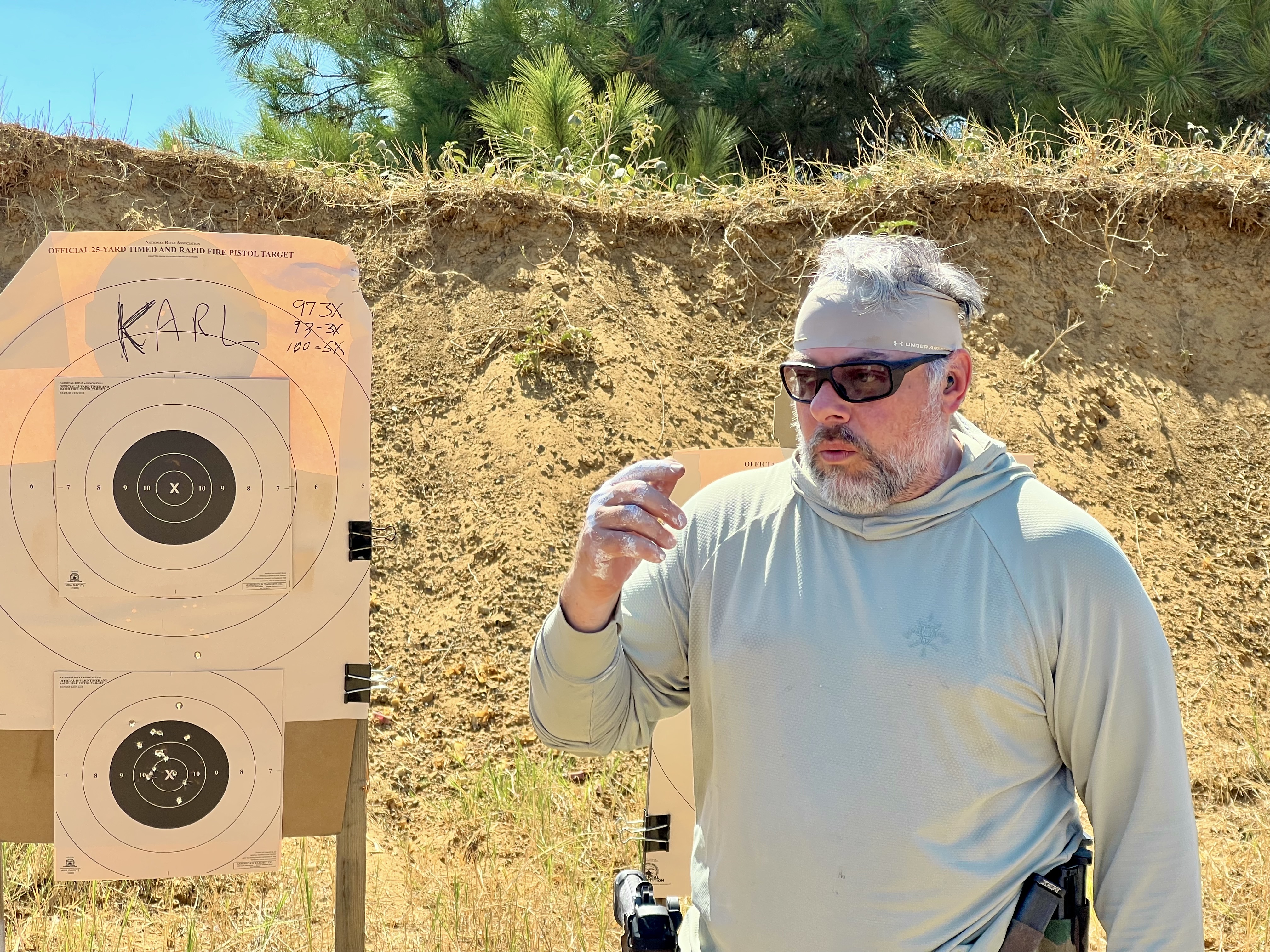
This might seem a little biased given I’m an assistant instructor at KR Training, but KR has a knack for only hosting fantastic flagship classes from highly qualified traveling firearms instructors. So when I saw Chuck Pressburg and his No Fail Pistol class on the KR schedule, I was intrigued. I’d heard of Chuck before but didn’t know much about him or his training company, Presscheck Training and Consulting. Regardless, I figured if it was on the schedule, it would be worthwhile. So I signed up and attended the class about a month ago. Here’s how it went.
Now, before we dive in—and as is customary—let’s get the “what gear did I use” question out of the way:
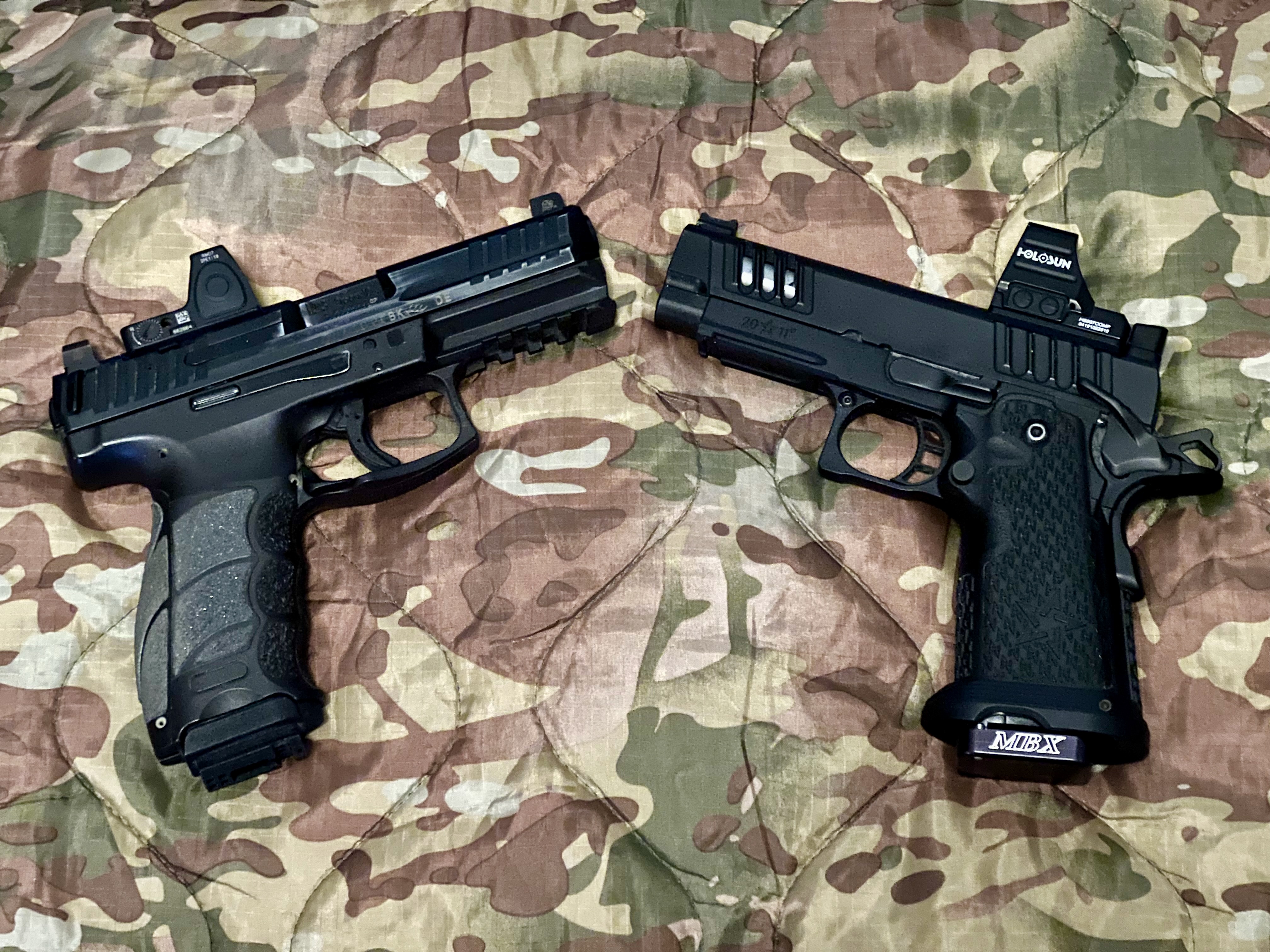
- Gun: Staccato C2 with a Holosun 507COMP
- Holster: JM Custom Kydex IWB 3 holster, strong side
- Mag Pouches: Concealment Solutions Venom Single Magazine Carrier (x2)
- Belt: Nexbelt Titan EDC Belt
- Ammo: Blazer Brass 9mm 147gr FMJ
With that out of the way, let’s dive in.
Who is Chuck Pressburg?
Chuck Pressburg is a retired combat veteran who served over 26 years, mostly in Special Operations and Special Missions Units. I honestly can’t provide much more detail since I don’t know the ins and outs of his service, but I can tell you it’s particularly relevant to this course. And while I could try to get into the details he shared with the class about his background, I wouldn’t do it justice. So I’ll keep it brief and high-level.

His combat experience is abundant. Contrary to what a lot of Hollywood films would have you believe, violence is ugly and brutal. He’s been there, done that, and carried the heavy psychological burden that often leads combat vets down dark paths—paths that have led to the establishment of veteran suicide prevention programs. It’s the reality of violence and the toll it takes that drives his passion for this coursework, with the goal of giving military, law enforcement, and armed citizens the tools they need to do what must be done without making mistakes that can’t be undone.
What is No Fail Pistol?
Admittedly, I misunderstood the course description. What I expected isn’t what I got, but what I got was so much better. Let me explain.
The way I read the course description, I took it to be a performance shooting class with a focus on difficult targets. That interpretation isn’t far off per se. However, filtered through my experience with other performance shooting classes, I expected a different take or variation on common performance pistol topics: marksmanship fundamentals followed by practical application of draw, vision, and other related shooting mechanics. That filtered interpretation was way off.
The class expects students already have fundamentals down and some understanding of performance shooting concepts and mechanics—so they can get the most out of what the class hyper-focuses on: refining and applying the marksmanship fundamentals needed to make the most difficult, highest-risk shots under the worst possible circumstances. It’s the hard stuff that isn’t sexy, which most folks don’t like to practice, but is necessary to be a well-rounded and capable pistol shooter.
The real kick in the nuts comes from understanding the high-risk contexts that call for these skills: hostage rescue and active killer events, among others. In these situations, failure means loss of innocent life. That failure may come from not incapacitating the threat soon enough. But it may also come from a marksmanship error.
Elimination of marksmanship error is precisely what this class is about. It’s a combination of marksmanship skill improvement and shooting maturity development. It’s about having the skills to make the shot and the patience to only take it when the conditions are right.
What Did We Do?
No class would be complete without a proper safety brief and medical response plan. Chuck Pressburg’s No Fail Pistol class was no exception. After those, a lecture established the premise for the class (which I covered above). That lecture set the tone for the range work ahead. As you can probably imagine, the discussion was heavy and serious—but necessary.
The first thing we did at the range was zero our pistols (or confirm it) with three 10-single-shot drills at 25 yards on a B-8 target. It’s important to distinguish: these were 10 single-shot drills, not three 10-shot drills. The idea is to fire each shot as perfectly as possible without introducing fatigue or allowing grip structure breakdown to creep in between shots. Chuck suggests starting every range session this way, ideally using your carry ammunition. This serves a few purposes beyond zeroing the pistol:
- First, it confirms the pistol and accessories are functioning as they should.
- If using carry ammo, it lets you zero against the actual ammunition you might use in a real gunfight—not practice or range ammo, which is likely to have a point-of-impact shift.
- It cycles your carry ammo regularly, as you should.
- It serves as a warmup.
- Finally, it baselines your marksmanship skills at that moment. As skills improve, groups get consistently tighter. The opposite happens as skills diminish.

With zeros adjusted and confirmed, we moved into a progression of drills that built on each other, adding shooting mechanics one at a time. If memory serves, here’s how it went:
- Drill #1: 25 yards—15 single-shot drills from ready (introducing presentation to each shot)
- Drill #2: 25 yards—15 single-shot drills from holster (introducing the draw)
- Drill #3: 20 yards—8 controlled pairs from holster (adding a follow-up shot)
- Drill #4: 20 yards—Incremental shot strings from holster (1 shot, then 2, 3, 4, and 5—building grip durability)
- Drill #5: 3 five-shot “Fensters” from holster (at 20, 15, and 10 yards)
Each drill was done on a B-8 target and scored by rings. Students were encouraged to call their shots by ring. The goal was all X’s, but anything in the black (9-ring or better) was acceptable. For skill development, a 80% accuracy standard allowed experimentation.
For example, Drill #1’s goal is to combine presentation and fire precisely when conditions are perfect—not a moment before or after. This isn’t just aiming granularity; it’s continuously visually monitoring muzzle-to-target alignment while manipulating the trigger—and not letting the shot break if input disturbs alignment. The 80% standard lets you push boundaries safely, minimizing bad habits.
The Fenster progression adds grip technique as a variable for experimentation at varying distances.
After the progression, our first “test”: Three attempts at an individually timed Fenster from 10 yards—100% in the black, fastest wins. No pressure, right? I managed a 4.04.
We then repeated the full progression strong-hand only (SHO), ending with a test from 15 yards. I hit 10.62.

I don’t recall finishing SHO before day one’s end, but day two of No Fail Pistol kicked off with zero confirmation drills again. (Not surprising—Chuck Pressburg is adamant about this.)
Next: the progression and test weak-hand only (WHO). Big difference: no holster draws. Real-world logic—no scenario calls for drawing then immediately transferring, and transfers risk drops. All started from ready. The 10-yard WHO test? Same. I ran a 9.31—beating my SHO time. (The shorter distance made it less surprising.)

Then we put it all together in a head-to-head gauntlet:
- At 25 yards: Draw and fire 5 rounds.
- Move to 15 yards: Mandatory reload, 5 rounds SHO.
- Move to 10 yards: Mandatory reload, 5 rounds WHO.
Time + scoring: Black hits = no penalty; 8-ring = +1s; 7 = +2s; 6 = +3s; 5 = +5s; anything else = +1 min. No idea how, but I nabbed top score: 36 seconds (33 raw + 3s penalties).

Before wrapping day two, we shot steel for the remainder afternoon. One bay: wide transitions on small steel at ~15 yards. The other: modified Bianchi Cup plate rack at 10/15/20/25 yards.
Final classroom debrief. Patches and prizes for top Fenster, gauntlet, and Bianchi scores. Certificates distributed. No Fail Pistol done.
Closing Thoughts
Overall, No Fail Pistol was a great class. Yes, the context is serious and heavy—the consequences of failure in these low-percentage, no-fail scenarios are dire and dark. The skills covered are overlooked because they’re difficult and not as fun or sexy as ripping draws and hosing targets. Yet Chuck Pressburg somehow built a much-needed course that covers them and makes it fun. Imagine that. A real kick in the nuts that leaves you saying: “Thank you, sir! May I have another?”
If this sounds like your jam, check Presscheck’s upcoming schedule for a class near you. (I’d be remiss not to plug KR Training’s schedule for more gold.)
One last thing: Chuck’s passion stems from firsthand experience with violence’s toll. He wants to spare others that burden—but knows some will carry it and need help staying off the dark path. That’s why he’s partnered with Warrior’s Heart, dedicated to addiction/trauma recovery for military and first responders. Want to help? Grab a pair of Presscheck Assault Gloves—30% of proceeds fund treatment scholarships.
Leave a Reply