
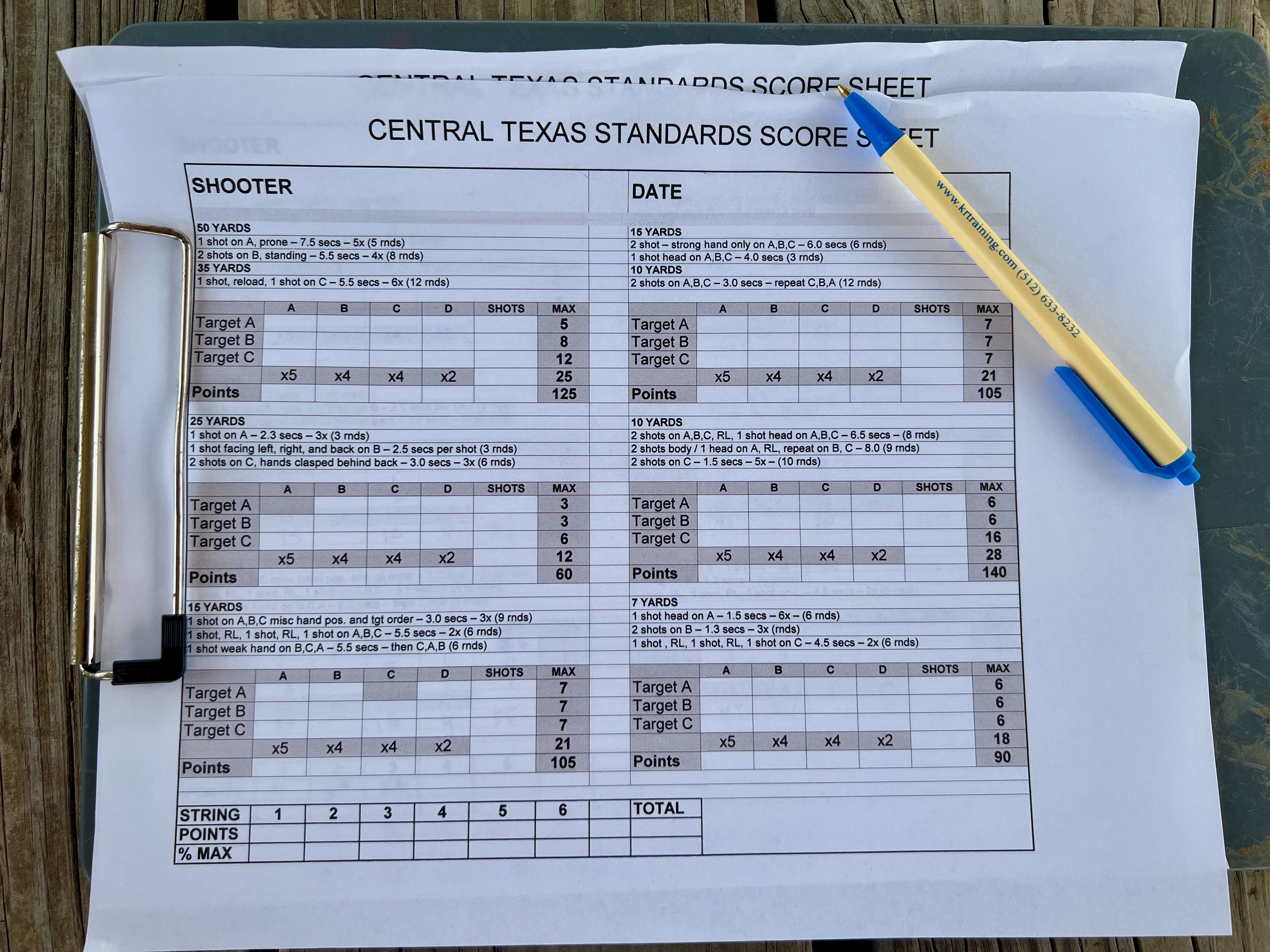
A few months ago I was whining to my friend and mentor Karl Rehn (KR Training) about being stuck on a plateau. I’d occasionally flirt with A-class hit factors on USPSA classifiers, but most of the time I was still parked in upper-B purgatory, and it had been dragging on for almost a year. Karl’s prescription was simple: “Come take a private lesson and I’ll get you moving again.” So I did, and in that one session he introduced me to the Central Texas Standards — a 125-round beast cooked up in the late 1980s by Chip McCormick (the 1911-tuning legend) and Ronin Colman (the guy who invented the PACT timer).
The Central Texas Standards (CTS) is a brutally thorough test of every practical pistol skill that actually matters: accuracy, speed, transitions, recoil management, one-handed shooting, reloads, and draws — all the way out to 50 yards. This isn’t some five-minute warm-up. It’s a 30–45-minute inquisition that will happily point out every weak link in your game, whether it’s sloppy sight tracking, a lazy support-hand thumb, or the fact you still reload like it’s 1998.
Course of Fire
Targets: Three classic IPSC/USPSA cardboard targets (call them A-left, B-center, C-right), spaced 1 meter (~3 ft) apart.
Scoring: A = 5 pts, C = 3 pts, D = 1 pt, miss = 0 pts. Max possible = 625 points.
Start: Holstered, wrists below belt (hands relaxed) unless the string says otherwise.
No time penalties — just no points for shots over par if you’re slow.
| String | Distance | Procedure | Par | Reps |
|---|---|---|---|---|
| 1 | 7 yd | 1 head shot on A | 1.5 s | 6x |
| 2 | 7 yd | 2 shots on B | 1.3 s | 3x |
| 3 | 7 yd | 1 shot on C, reload, 1 shot on C, reload, 1 shot on C | 4.5 s | 2x |
| 4 | 10 yards | 2 shots on each A-B-C, reload, 1 head shot on each A-B-C | 6.5 s | 1x |
| 5 | 10 yards | 2 body shots + 1 head shot on A, reload, 2 body + 1 head on B, reload, 2 body + 1 head on C | 8 s | 1x |
| 6 | 10 yards | 2 shots on C | 1.5 s | 5x |
| 7 | 10 yards | 2 shots on each A-B-C (reverse order next rep) | 3 s | 2x |
| 8 | 15 yards | Strong-hand only: 2 shots on each A-B- C | 6 s | 1x |
| 9 | 15 yards | 1 head shot on each A-B-C | 4 s | 1x |
| 10 | 15 yards | 1 shot on each target (mix hand position & target order every rep) | 3 s | 3x |
| 11 | 15 yards | 1 shot on C, reload, 1 shot on C, reload, 1 shot on C | 5.5 s | 2x |
| 12 | 15 yards | Weak-hand only: 1 shot on each B-C-A (change order to C-B-A next rep) | 5.5 s | 2x |
| 13 | 25 yards | 1 shot on A | 2.3 s | 3x |
| 14 | 25 yards | Facing left: 1 shot on B (face right next rep& face up range last rep) | 2.5 s | 3x |
| 15 | 25 yards | Hands clasped behind back: 2 shots on C | 3 s | 3x |
| 16 | 35 yards | 1 shot on C, reload, 1 shot on C | 5.5 s | 6x |
| 17 | 50 yards | 2 shots on B (standing) | 5.5 s | 4x |
| 18 | 50 yards | 1 shot on A (prone) | 7.5 s | 5x |
That’s a lot of holes. Trying to score all three targets after the full 125 rounds is a fool’s errand, so the smart cadence (whether Chip/Ronin invented it or Karl refined it) is:
- Shoot three strings
- Tally A/C/D per target
- Paste
- Repeat
Score when finished.
You can run the drill 7 yd → 50 yd or 50 yd → 7 yd; either way you only move the target stands once.

My Take
When I first looked at the Central Texas Standard scoresheet my eyes bugged out at the 35- and 50-yard strings. I’ve shot hundreds of USPSA matches and can count on one hand the stages with targets past 25 yards — and only one of those was at a major. I have literally never seen anyone shoot prone with a pistol in competition.
I still haven’t tried the 35- and 50-yard stuff yet. Modern relevance is basically zero, but I’m curious enough that I’ll probably eat the ammo someday just to say I did.
Even stopping at 25 yards, the drill was eye-opening. My final score came out to 74% of possible points — almost exactly the gap between my current B-class classification (~72%) and the A-class line (75%). The grouped scoring also spotlighted my comically slow reloads: either I ran out of time or I rushed the last shot and threw points.
Bonus: Karl spotted a tiny draw hiccup caused by my holster angle, grabbed a hex key, made a small adjustment, and shaved a couple tenths off my draw in about 90 seconds. Private lessons are cheating.
Bottom line — CTS is the most surgical diagnostic drill I’ve ever shot. Yeah, it eats 125 rounds and 45 minutes, but nothing else exposes weaknesses this precisely.
Relative Difficulty (Nerd Section)
We’re going to use the same basic methodology from Karl Rehn and John Daub’s book Strategies and Standards for Defensive Handgun Training to estimate how the Central Texas Standards stacks up against USPSA Grand Master (GM) performance.
A few necessary assumptions because the book doesn’t cover every exact skill/distance combo in CTS:
- Head-box difficulty
The USPSA/IPSC head A-zone is roughly 4×2 in (very roughly an 8 in² rectangle). The body A-zone is 6×11 in (~66 in²). That’s ~8.25× harder by area, but because we’re dealing with angular size and human aiming error, the practical difficulty ratio is closer to 3:1. So a head shot at 7 yd ≈ body A-zone hit at ~21 yd. - One-hand penalties at 15 yd (no direct GM data exists, so educated guesses):
- Strong-hand only draw-to-first = normal freestyle draw + ½ strong-hand split → ~1.50 s
- Weak-hand only draw-to-first = normal draw + full split for transfer → ~1.75 s
- One-hand transitions = ~0.60 s (vs ~0.35 s freestyle)
- Prone penalty (50 yd string 18)
Top GMs (Max, Nils, JJ, etc.) add ~0.45–0.55 s to get into prone on close, easy hits. But what I’m calling the “get into prone” base penalty gets worse the farther out you are, so add an extra ~0.01–0.012 s per yard “settle” time. Total prone adder at 50 yd ≈ 1.1 s. - Non-standard starts
Surrender, turn-and-draw, hands behind back, facing uprange = +0.10 s per Ben Stoeger’s numbers. So +0.10 s per weird start it is.
Now the full break down.
| String | Reps | Par Time | GM Speed | Relative Difficulty |
|---|---|---|---|---|
| 1 | 6 | 1.5 | 1.39 | 92.6% |
| 2 | 3 | 1.3 | 1.2 (1 + 0.2) | 92.3% |
| 3 | 2 | 4.5 | 3.5 (1 + 1.25 x 2) | 77.8% |
| 4 | 1 | 6.5 | 5.71 (1.08 + 0.29 x 2 + 0.23 x 3 + 2.21 + 0.57 x 2) | 87.9% |
| 5 | 1 | 8 | 6.24(1.08 + 0.23 x 3 + 0.57 x 3 + 1.38 x 2) | 78% |
| 6 | 5 | 1.5 | 1.32 (1.08 + 0.23) | 87.8% |
| 7 | 2 | 3 | 2.37 (1.08 + 0.23 x 3 + 0.29 x 2) | 78.9% |
| 8 | 1 | 6 | 4.2 (1.5 + 0.5 x 3 + 0.6 x 2) | 70% |
| 9 | 1 | 4 | 3.61 (2.06 + 0.78 x 2) | 90.3% |
| 10 | 3 | 3 | 2.05 (0.1 + 1.25 + 0.35 x 2) | 68.3% |
| 11 | 2 | 5.5 | 4.25 (1.25 + 1.5 x 2) | 77.3% |
| 12 | 2 | 5.5 | 2.95 (1.75 + 0.6 x 2) | 53.6% |
| 13 | 3 | 2.3 | 1.5 | 65.2% |
| 14 | 3 | 2.5 | 1.6 (0.1 + 1.5) | 64% |
| 15 | 3 | 3 | 2 (0.1 + 1.5 + 0.4) | 66.7% |
| 16 | 6 | 5.5 | 3.97 (1.55 + 2.42) | 72.1% |
| 17 | 4 | 5.5 | 2.87 (2.19 + 0.68) | 52.2% |
| 18 | 5 | 7.5 | 3.29 (2.19 + 1.1) | 43.9% |
Grand totals:
- Total par time (all reps): 206.8 seconds
- Total estimated GM time: 137.6 seconds
- Overall relative difficulty: 137.6 ÷ 206.8 = 66.5%
That 66.5% number says a solid B-class shooter should be able to clean it. But we all know that feels wrong — this thing is brutal.
If we yank the 35- and 50-yard strings (16–18), the math becomes:
- Par time remaining: 114.3 s
- GM time remaining: ~85.9 s
- Relative difficulty: 75.1% → low A-class to clean it cold.
Add Karl’s own ±10% fudge factor from the book, and 75% can easily drift to 85%. That feels a lot closer to reality.
My personal suspicion:
- My weak-hand assumptions were too optimistic (string 12 is probably closer to 65–68%, not 53%)
- Linear extrapolation for 35–50 yd (and all head shots) probably underestimates difficulty
Bottom line: the full CTS is almost certainly an 80–85% GM drill in practice, which puts a clean run solidly in the Master-class neighborhood — exactly where it feels like it belongs when you’re sweating through string 12 weak-hand only.
Final Thoughts
The Central Texas Standards is old-school, brutal, and brilliant. It’s not something you’ll shoot every range trip — set-up and ammo commitment are real — but if you’re serious about finding and fixing the exact things holding you back, there’s nothing better.
I’ll be running it again, and yes, I’m going to shoot the 35- and 50-yard strings just to see how badly I embarrass myself.
If you decide to suffer through it, drop your score in the comments or tag me on social media. Misery loves company.

Leave a Reply