
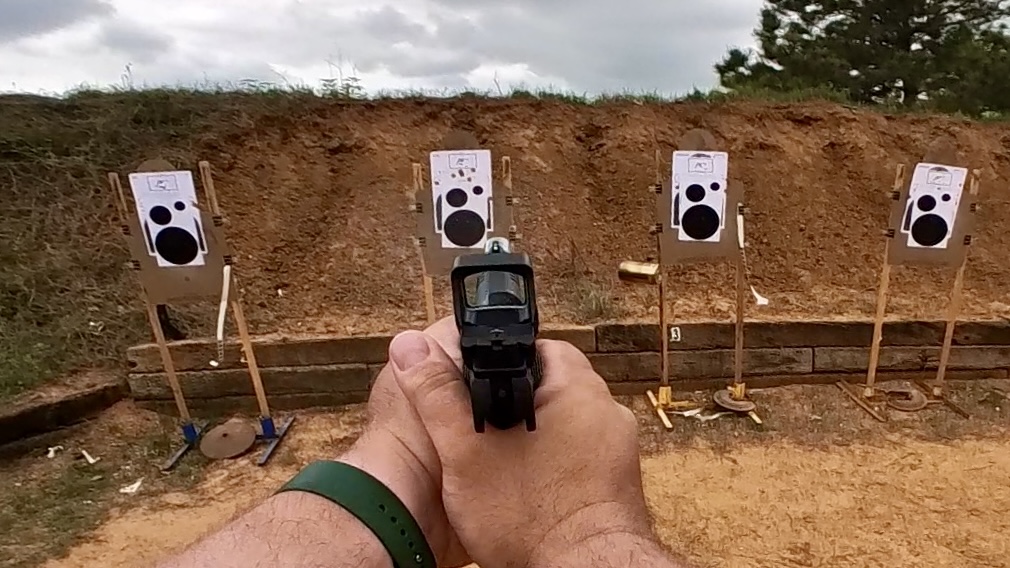
Like I said in the previous KR Training Top 10 Drills after action report, I can’t help myself but sign up when a Top 10 Drills class shows up on the KR Training class schedule. Difference here is that it was the first level 2 variant of the class that I have attended. While the drills performed in this class can be used to objective assessment of one’s proficiency or to diagnose and improve marksmanship problems and skills just like the level 1 variant of this class, the drills in the level 2 class are more difficult.
Half of the drills done in this class were drills that Eric Wise of Cornerstone Performance uses to train police officers with. The other half of drills were recently developed drills Andy Stanford of SureFire uses in his most recent iteration of coach development courses. All of the drills provide some combination of visual confirmation and trigger manipulation modalities that remain consistent or should be adjusted during each drill.
Since somebody will inevitably ask what gear I used for the class, here is what I used:
- Gun: Staccato C2 with a Holosun 507Comp
- Holster: JM Custom Kydex IWB 3 holster
- Mag pouches: Concealment Solutions Venom Single Magazine Carrier x2
- Belt: Nexbelt Titan EDC Belt
- Ammo: CCI Blazer Brass 9mm 147gr FMJ (round count for the course was roughly 200 rounds)
Now, let’s look at the drills.

Eric Wise of Cornerstone Performance Drills
All of the drills taken from Eric Wise were conducted on a three dot target consisting of a large 8″ circle, a medium 4″ circle, and a small 2″ circle.
The first drill we shot was a Live Empty drill that we repeated several times using each of the three different circles. I like this drill a lot as it’s a good fundamentals diagnostic drill which I plan to dedicate an entire post to in the near future. The drill consists of chambering a round and removing the magazine. Then, either from the ready or the holster, on the signal fire “two” shots. This affords one two trigger presses, one live fire trigger press and one dry fire trigger press, in a single string of fire that can be performed . This drill can be used to diagnose and correct grip and trigger issues while also helping to alleviate flinching or anticipation habits.
The next drill we ran was the On Demand Trigger Prep drill and requires a partner. It begins with the pistol loaded and aimed at the target with the slack out of the trigger. Taking turns with your partner, one partner shoots and the other reacts to the fired shot by breaking the trigger. The goal is to react as quickly as possible while keeping the shots on target. We alternated who initiated the on demand reaction about five or six times on each circle starting with the largest one and ending with the smallest one. In theory, one could do this drill alone by using a randomized delay start on a shot timer. However, reacting to a partner allows us to react to a different stimulus than the common shot timer beep.
Next up was the Trigger Prep drill. This is similar to the On Demand Trigger Prep drill in the sense that we start aimed on target with the slack out. On the beep, fire a shot and get the gun back on target with the slack out ready to shoot again on the next beep.
The Tempo drill followed. This drill consisted of firing five rounds into one of the three circles at a defined pace or cadence. This is a powerful learning tool as it helps one to learn how much one is able to see, or visually confirm, and how much more gently one can press the trigger to increase precision with a little more time. Depending on one’s skill the defined pace might be more than is needed for the difficulty of the shot or may not be enough which is evident when hits land outside of intended target area. Regardless, it facilitates learning how much one needs to visually confirm and how gentle they need to be with the trigger relative to target difficulty with their present skill level. We ran this drill in a “Rolling Thunder” fashion where the first shooter on the firing line fired four shots using at the prescribed pace and the next student maintained the pace with their four shots and so on. The cadences we used were one second splits for the small circle, half second splits for the medium circle, and quarter second splits for the large target.
The last drill in this block was a Target Transition drill which consisted of firing two shots at each of the three circles in an order prescribed by the instructor before starting each six shot string. Ideally each student either used the corresponding cadence from the previous drill on each target or applied the level of visual confirmation and trigger manipulation care corresponding to their skill level for each of the three targets. In my opinion, the point here was to work on adjusting to each target as needed in order to get good hits on each target as quickly as possible.
Andy Stanford of SureFire Drills
The first three of the Andy Stanford drills used the SureFire Surgical Speed Skillsheet target pictured below which provides nine (9) individual 1″ circle targets numbered 1 to 6 and labeled A to C, three (3) 3″ circle targets labeled by the A to C 1″ circles, and three (3) 3″x6″ rectangular targets also labeled by the A to C 1″ circles. These drills were all conducted from a distance of three yards.

The first drill was a draw or ready to first hit drill which was performed twice on each of the numbered 1″ circles.
The next drill was a 3×3 on each of the 3″ circles labeled A to C. That is three shots into a three inch circle in three seconds.
We wrapped up working on this target with shooting Bill drills into each of the 3″ circles using a four second time limit. A Bill drill consists of firing six shots into the “A-zone” of a target. In this case, the A-zone was represented by the 3″ circles. This drill is a great drill to test the durability of one’s grip.
For the last two drills in this block, the target was changed to a SureFire Surgical Speed Silhouette which consists of six (6) 1″ circles numbered 1 to 6. As the name implies, it also includes a silhouette with a 2″ circular head box, a 4″ circular A-zone encircled by a 8″ circular C-zone. The remaining drills were run from a distance of five yards.
The first drill on this target was a Distance Changeup drill. It consisted of firing three (3) shots to the body, three (3) shots to the head, and then one (1) shot to each of the 1″ circles numbered 1 through 3. We performed this drill twice. Like the target transitions drill from the previous block, each shooter ideally modulated their rate of fire as needed to get good hits on each target as quickly as possible. I got a little sloppy on a few as is evident in the picture below.

The final drill was another Distance Changeup drill but with the target engagement order reversed. That is, we fired one shot into each of the 1″ circles numbered 4 through 6, then fired three (3) shots to the head, and finished with three (3) shots to the body. We did this twice.
Bonus: Gabe White Technical Skills Test Drills
I’ve covered the details of Gabe White’s technical skills test previously in the after action reports from his Pistol Shooting Solutions class which I’ve attended twice. As such, I’ll refer curious readers to those posts for a deeper dive into the drills and the standards. There are four drills that make up the technical skills test are:
- Bill drill – 6 to the body
- Failure to Stop drill – 2 to the body, 1 to the head
- Immediate Incapacitation drill – 2 to the head
- Split Bill drill – 4 to the body, 2 to the head
We ran all four of the technical skill test drills from a distance of seven yards using the SureFire silhouette target. Which I suppose technically the bonus drills make this class a Top 14 rather than a Top 10 drills class.
Closing Thoughts
I continue to believe that KR Training’s Top 10 Drills classes are a fantastic way to objectively measure how one’s skill stack up against known standards and identify areas for improvement in a couple of hours. Due to the volume of shooting done in a compressed time frame, there is very little instruction and coaching taking place. Don’t get me wrong, some coaching does take place, but it is limited. This class is more of a diagnostic exercise than anything else and there is a lot of value in that which is I continue to sign up and attend these classes when they are added to the KR Training class schedule. Students who are at a point in their skill development where they can self diagnose their marksmanship skills will get the most out of a class like this. I suspect this is why Karl Rehn has this class listed in the Advanced Training Series category of courses.
At any rate, it’s a fun and worthwhile two hours that any student who can safely and competently draw and shoot a pistol will get a lot out of.
2 responses to “KR Training Top 10 Drills Level 2”
[…] Top 10 Drills Level Class AAR (Uncle Zo) […]
[…] Staccato the Monday following the discovery of the issue which occurred while I was attending KR Training’s Top 10 Drills Level 2 class and described the issue. With zero objections, they asked me to send it to them and offered to […]