
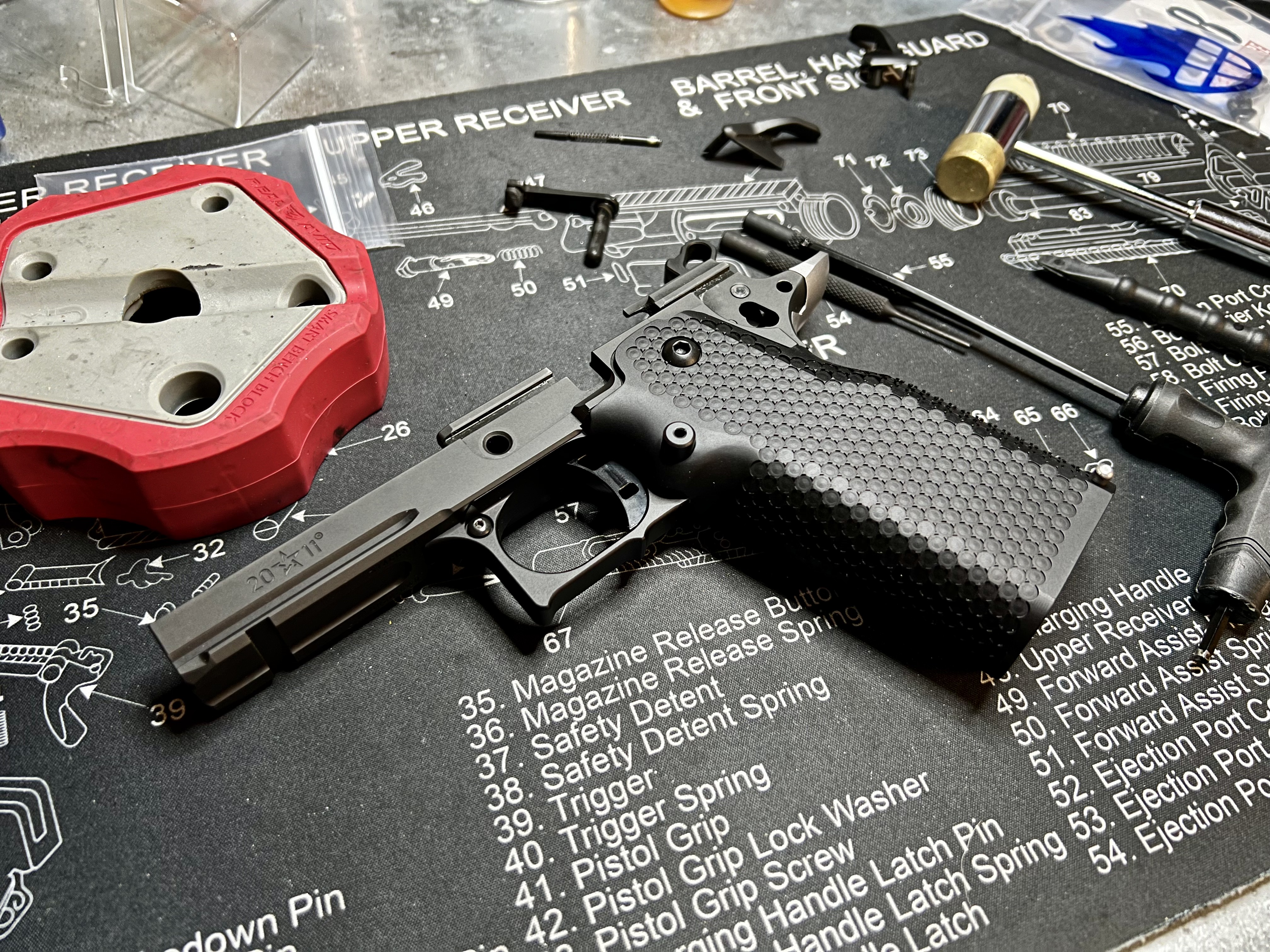
Not long ago, I published a 500 round update review for the CZ Shadow 2 Compact. As I mentioned in that post, I’ve done some tinkering to it. Even some tinkering that goes against my better judgment in the context of a defensive pistol. Yet, a part of me wants to carry it. It’s a struggle. A conversation with a trusted mentor regarding the upgrades I had done got me thinking again about the qualities of a defensive pistol. That, in turn, got me thinking about guidelines those who like to tinker with their pistols, like me, would benefit from following.
Let us back up just a bit. There is well established conventional wisdom about defensive pistols that are common amongst armed defense practitioners that exist for good reasons. Those reasons orbit around general firearm safety, combatives, and legal proceedings that follow self defense incidents. I often tell folks we will be held accountable for every bang and accountable for every hit. Then every little detail about the firearm used for self defense will be scrutinized by the prosecution in the legal proceedings following a self defense incident. That’s reality. Furthermore, it’s a reality that is especially harsh in politically charged environments and situations.
The reason for this post is because I suspect there are folks, like me, who like to tinker with their pistols, including their defensive carry pistol, with the goal to make them better. By “better”, I mean easier to shoot. By that, I mean more effective and efficient at putting projectiles where they need to go. In other words, to improve the function of a tool so that it lends itself towards optimal marksmanship. Better marksmanship reduces risk to others and increases a potential victim’s chance at winning the proverbial fight. While this is conventional knowledge amongst avid armed self defense practitioners, it is a foreign concept to the average person and often to defense attorneys. And that is something that an astute prosecutor will exploit for everything it is worth which makes “tinkering” with a defensive pistol risky business. Arguably, business that should be avoided.
That said, tinkers are going to tinker. I’m guilty of that. This brings us to the point of this post. Or rather the question that needs to be answered. What guidelines should a tinker follow when it comes to their defensive pistol?
Before we dive into the deep end, note that nothing that is in this post should be taken as legal advice. Laws vary by jurisdiction and each jurisdiction has different political priorities that extend beyond the prosecutor’s office to local jury pool. As such, it is important to know your local laws and wouldn’t hurt to seek legal counsel to help inform tinkering decisions. Self defense legal services and insurance programs such as Right to Bear (who happens to be a sponsor of this blog), US Law Shield, CCWSafe, and so forth are something all armed defenders should strongly consider subscribing to for assistance with legal defense and also because they provide access to attorneys who can provide legal counsel for these decisions.
With that out of the way, let’s dive into the deep end so to speak.

Stick with a Stock Pistol
I recognize sticking with a stock pistol is an unlikely thing for a tinkerer to do, but that is what conventional wisdom tells us is ideal.
A stock defensive pistol will absolutely work for most self defense scenarios reliably. A stock pistol is also the least complex scenario for a defense team and makes it hard for an aggressive prosecutor to use it advantageously. Common arguments would include the defender wanting to be or seeing themselves as a law enforcer which is easily defeated with a “what’s good for the goose is good for the gander” defense. Yet, it’s not risk free. If we are being honest, then we can admit that nothing about self defense is risk free. However, defending oneself with a stock pistol that is common use by local law enforcement is arguably the easiest position to defend.
The challenge here is that a stock pistol is essentially an anathema to the tinkerer and an unlikely proposition. I’ll admit that my everyday carry VP9 that frequent readers are familiar with isn’t stock. I’ve put an optic on it. I’ve also upgraded the sights and grip panels. The thing is that I can articulate a valid defensive pistol use reason for each and every single one of those upgrades and modifications.

Avoid “Competition” Upgrades
This is probably easier said than done, but bolting on accessories or swapping out components with accessories and components that are marketed for competition applications are generally not a good idea. While these upgrades have marksmanship merits, they often lack durability and reliability characteristics that one would want for defensive applications. Again, the first priority here is winning and surviving an altercation that justifies and requires the deployment of lethal force. Avoiding these types of modifications on defensive pistols is a good idea.
With that in mind, let us look at some other common enhancements and the articulable reason behind them.

Sights and Optics? Have at it!
Sights and optic upgrades are, in my opinion, the easiest upgrades to defend. Anything we can do to aim better reduces risk to others and makes it easier to put effective hits on an active threat that justifies the use of lethal force. There are plenty of options in the marketplace that are durable and reliable enough for defensive carry applications to keep a tinkerer’s heart content.
A word of caution: it would be wise to follow best practices for installation to minimize the likelihood of mounting failures. This applies to both iron sights and pistol mounted optics. I don’t know who needs to hear this, but contrary to popular belief, iron sights do fail. They fail more often than most folks realize.

Grips? Go Ham!
Upgrading the grips is another thing that should cause any pause.
Stippling? Fair game.
Grip tape? Also fair game.
Grip panels with Punisher skulls? Might want to rethink those. I get it aesthetics are a thing that many of us desire. However, certain insignia and slogans can create an uphill battle for defense teams. That means a larger defense bill and the risk of eliciting an emotional response from a juror that could put the final nail in the acquittal’s coffin. Is that a risk worth taking over aesthetics? That’s a call one will have to make for themselves.
Functional grip surface improvements can improve the fitment of the firearm or make recoil management easier. Both of these attributes aid in the safe control and operation of a firearm especially in environments where substances such as water, mud, or bodily fluids can make maintaining a good positive purchase on a firearm challenging.

Weapon Mounted Lights, Lasers, and Other Accessories Should Be Good To Go
As long as accessories mounted to an accessory rail aren’t of the questionable aesthetic variety and aid in putting justified bullet holes in bad guys, there is also nothing much to worry about.
While I hold the opinion that weapon mounted lights don’t really have much value for armed citizen self defense scenarios, the argument can be made that they can assist with maintaining positive target identification while keeping two hands on the firearm during a fight. Furthermore, the added forward biased weight on a pistol can aid with recoil mitigation and recovery and therefore can aid with safe control and operation of the firearm.
Attached aiming devices, such as lasers, fall under the same purview of iron sight and optics upgrades.

Compensators, Threaded Barrels, and Other Muzzle Devices
Muzzle devices are a little tricky in my opinion.
On one hand, compensators and threaded barrels have increased in popularity with armed self defense practitioners in recent years. So much so that manufacturers have taken note and have started including them as features on new pistol models and new variants of existing models that are marketed towards the self defense market. Even Staccato offers one on their XC model that is marked for duty use. The recoil mitigation offered by compensators aids in getting back on target faster which is a good thing should a threat require more holes to stop it.
On the other hand, they have the potential to create an aesthetic that could result in a “Punisher skull” type problem. For many who aren’t gun owners, which is likely the type of folks that make up a good portion of a jury if not the entire jury, guns are scary things. In my opinion, adding things like compensators or having a thread barrel to the gun can make the already scary thing scarier because it’s likely not something they typically see on a gun. Or even worse, something they saw a villian in a Hollywood production have on their gun. I think this is less likely to be a problem with compensators that are “built” into the gun by the manufacturer like the aforementioned Staccato XC or the Sig P365 X-Macro.
I’m doing a lot of speculating here, but I’m not sure an aftermarket compensator is a good idea. I will also suggest avoiding threaded barrels for defensive use. I’m simply not sold on the juice being worth the squeeze for these upgrades.

Magazines, Mag Wells, Base Pads, and Extended Releases
From our perspective, more ammunition is never a bad thing. Especially given the increased trend of attacks performed by multiple assailants. Of course, this will be something that will be scrutinized but arguments against these modifications can be countered with current crime trends.
That said, using oversized magazines or base pads that increase the capacity significantly beyond what is commonly available from manufacturers are more difficult to explain away. Consequently, it’s probably a good idea to leave those extended 27+ round happy sticks and drum magazines at home and use them strictly for recreational purposes.

The Trigger? There Be Dragons
Every single upgrade we have discussed thus far falls into one of two categories: nothing to worry about or an aesthetic perception concern. Trigger upgrades a different breed at least those that lighten the trigger pull.
Massad Ayoob has written several articles, like this one, highlighting the legal dangers of the “hair trigger” from cases that he has worked as expert witness. The gist of it is that the “hair trigger” problem can come from either an unintended discharge or a false negligent discharge allegation that can be used to convince the jury, who, once again, are likely to be made up of folks who know nothing about guns and probably dislike them, that expiration of the assailant was the result of an unintended shooting which is indefensible in criminal cases and can lead to large problematic judgements in civil ones. As such, Ayoob recommends keeping the trigger pull weight of a striker fired pistol at or above 5.5 pounds and that of a single-action pistol at or above 4 pounds.
Conventional wisdom aligns with Ayoob’s recommendations.
What about drop in “combat triggers” or high-end custom pistols with trigger pull weights below the conventional wisdom’s minimums that are marketed for duty and defensive applications? After all there are several items available in the marketplace that have 4ish and 3ish pound trigger pull weights on striker fired pistols and single-actions respectively. This depends on who you talk to and the political temperature in the jurisdiction. Following the conventional wisdom limits is without a doubt the safest course of action, but something a little lighter might be explained away successfully in court. However the lighter the pull, the harder it will be to explain.
Changing other aspects of the trigger such as trigger reach, reducing over travel, shortening the reset, using a different trigger shoe shouldn’t be problematic, but leave the trigger pull weight alone.

Update (12/30/2024): I’ve received a lot of feedback regarding the “conventional wisdom on modified triggers” most of which suggests this is old “Fuddlore” since no one seems to be able to find any cases in which a modified trigger alone resulted in a conviction after a self defense case. I understand this sentiment and share it myself. My intention with this section was to convey what the “conventional wisdom” is regarding this type of modification which, right or wrong, suggests there is risk associated with it. A deeper discussion, with the Armed Attorneys, is available in the following embedded video:
Disabling Safety Mechanism? Go Straight To Jail, Do Not Pass GO
Just like trigger pull weights, it’s best to leave the safety mechanisms alone. This is another one of those things that can result in a successful argument made that the expiration of the assailant was a result of an unintended shooting.
If the safety mechanisms make running the firearm challenging or inconsistent, then either train until it’s not a problem or replace the pistol with a different one.

Consider Becoming a Certified Armorer
One of the things a prosecutor, especially a politically motivated one, is likely to scrutinize beyond the reasons behind the alterations is whether or not the alterations were made competently. If an argument can be successfully made that the upgrades were made incompetently, the door is open for the unintentional self-defense shooting argument. Proof of training helps build a strong defense against competence arguments and armorer certification fits the bill here.

Bringing It All Together
By definition, any self defense incident that justifies the use of lethal force carries the chance of being seriously injured or killed. There are no guarantees one will make it home unscathed. Even if one survives the life changing event, there are no guarantees of a good outcome from the legal battle that follows. The best bet is to avoid it in its entirety, but that’s not always possible.
While it shouldn’t be this way, a defensive pistol that’s been tinkered with increases the risk of legal defense failure. Whether we like it or not, that’s reality. The prosecution is looking for a conviction. To that end every alteration and upgrade will be scrutinized. This article by Marty Hayes dives deep into the defensibility of various modifications where he illustrates a chain of questions that a prosecutor will ask an examiner for the purpose behind each modification and each answer will potentially build a negative opinion about the defendant in each jury member that sympathizes with the “victim”. That means that every modification is something else that the defendant or an expert witness for the defendant will have to explain assuming it is permitted by the judge presiding over the case. Even if the defense’s testimony is allowed, juries are unpredictable and the testimony may be insufficient to win back the hearts and minds of the jurors.
This is why I contend that a stock defensive pistol is the safest bet. However, tinkerers are going to tinker. Even with their defensive pistols. My hope is that this post serves as food for thought to help tinkerers become aware of the potential legal challenges that might arise from the modifications they perform on their firearms. Remember it’s best to leave those trigger pull weights and safety mechanisms alone. When possible, have a qualified gunsmith or armorer perform the alterations. Last but not least, when in doubt, consult with an attorney, ideally a local one that has a pulse on the political beat.
3 responses to “Tinkering with the Defensive Pistol”
[…] Tinkering with the Defensive Pistol […]
[…] he so often does, ace trainer Greg Ellifretz brought this article to my […]
https://www.backwoodshome.com/blogs/MassadAyoob/let-me-share-some-good-advice/