
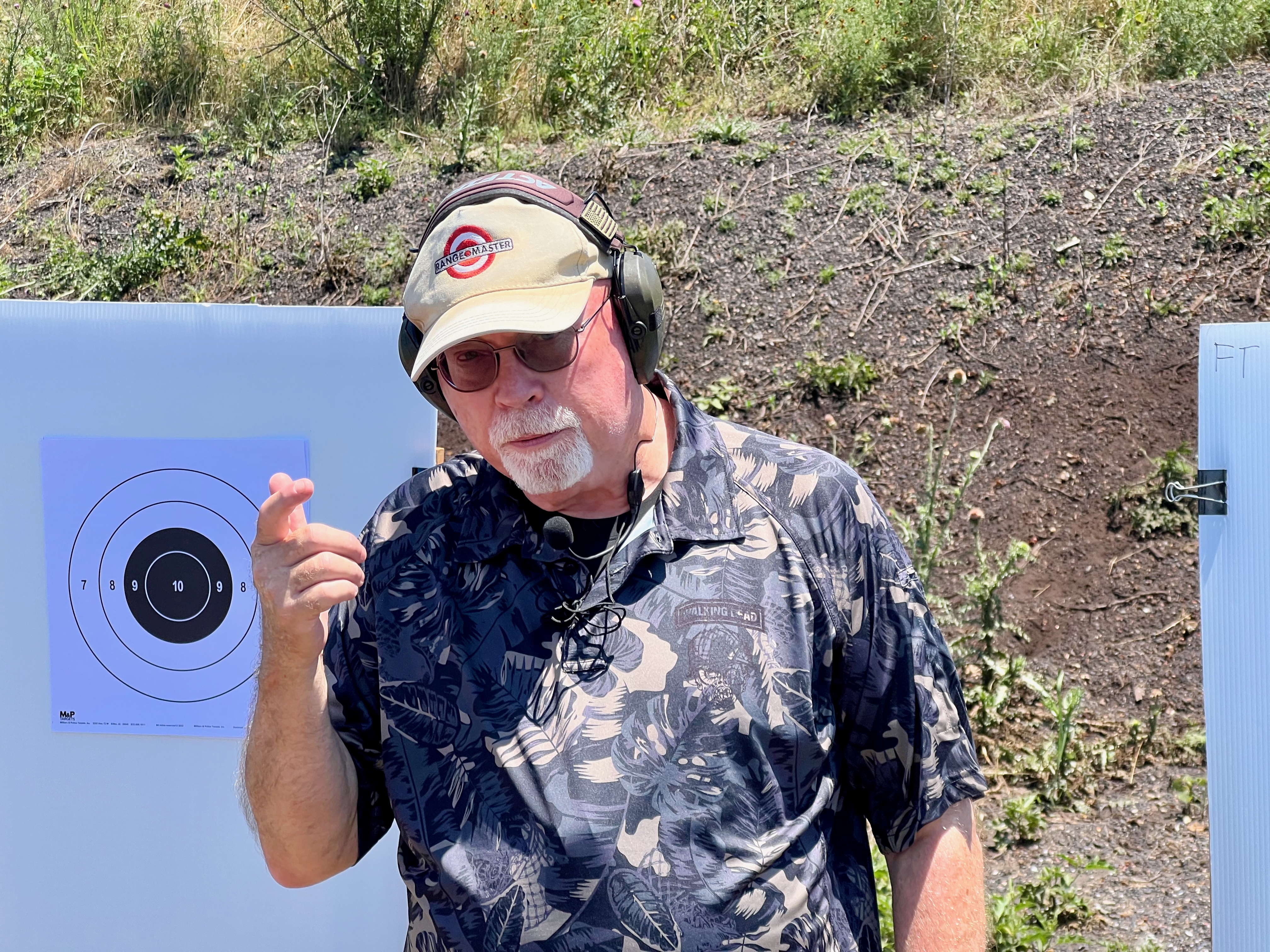
Holy smokes! What have I done?
I began my instructor journey about less than two years ago with the Rangemaster Instructor Development Course. Nine months later, I found myself successfully completing the Rangemaster Master Instructor Development Course. That, in of itself, was surreal. However, it was while I was attending the master level course that I learned Tom Givens, the founder and chief instructor of Rangemaster, had concocted an even more advanced instructor development course open only to those who held a master instructor certification. The course was named “Professional Pistolcraft Instructor Course”. The initial offering was sold out, but the second one, which was just a little over a year away, still had seats available. I did the only thing an overachiever would do and booked a seat. Then, I waited. And then, waited some more. The waiting continued until May 17th, 2024 when the three day course began. And now after having successfully completed the course, I can tell you all about it.
Rather than providing a chronological play-by-play account of the course as I have in the past, I’m going to attempt to group the classroom and range activities into their own chronological sections. After having written several after action reports (AAR) for training courses I’ve attended, I suspect the flow of this organization will make it easier for readers to read, skim, or to use as a reference. Your feedback will confirm or deny my suspicions, but that’s what is going to happen in this post nevertheless.
As per tradition dictates for after action reports on this blog, let’s cover the equipment used before getting into the nitty gritty:
- Gun: Staccato C2 with a Holosun 507COMP
- Holster: JM Custom Kydex IWB 3 holster on my strong side
- Mag pouches: Concealment Solutions Venom Single Magazine Carrier x2
- Belt: Nexbelt Titan EDC Belt
- Ammo: CCI Blazer Brass 9mm Luger 147 Grain FMJ (roughly 600 rounds)

What? Where? When?
The Professional Pistolcraft Instructor Development Course is the most demanding defensive pistol instructor training offered by Rangemaster. Registration is limited to instructors who have successfully completed the Master Instructor Development Course which is limited to those who have successfully completed the Advanced Instructor Development Course which is limited to graduates of the Basic Instructor Development Course. Just like all of the prerequisites, the class requires all students to demonstrate proficiency with a handgun by passing a demanding qualification course of fire in addition to studying and learning about sensitive and serious self defense topics and history.
The academic emphasis is placed on the following topics:
- An in-depth review of the recent defensive pistol training history from 1960 to present
- Developing and teaching situational awareness
- Understanding the characteristics of and developing a defensive strategy for active shooter events and home invasions
- Emergency medical preparedness and response for range casualties
- Tactical anatomy
This training event took place on May 17-19, 2004 and was hosted by TDR Training in Bandera, TX.

And Who?
The class was led by none other than Tom Givens who was assisted by Dr. Troy Miller and Dr. Andy Anderson who delivered the medical and tactical anatomy blocks respectively.
Twenty-four (24) students attended and graduated as Rangemaster Certified Professional Pistolcraft Instructors. Every single student was already a highly skilled marksman and experienced defensive firearm instructors. Those that gave me permission to list them in this report included:
- Dr. Andy Anderson – Pistol Master Award Recipient
- Luis Arias – Pistol Master Award Recipient
- Steven Baine – Pistol Master Award Recipient
- Paul Baumgardner
- Wayne Dobbs – Pistol Master Award Recipient
- Greg Ellifritz – Pistol Master Award Recipient
- James “Maverick” Garner
- Eric Hite – Pistol Master Award Recipient
- John Jones
- Ray Keith
- Dr. Nick M – Pistol Master Award Recipient
- Jose Morales
- Alexandra Nikolov
- John Pearson
- Tim Reedy – Sole Range Pokemon Collector & Pistol Master Award Recipient
- Karl Rehn – Top Shot & Pistol Master Award Recipient
- Jim Shanahan – Pistol Master Award Recipient
- Ken Steadman – Pistol Master Award Recipient
- Quamodi Stevenson

Classwork and Homework
Day 1: History of the Modern Technique and Situational Awareness
The classroom component of the Rangemaster Professional Pistolcraft Instructor Development Course began in the exact same fashion that the classroom component of all the prerequisites began – with student introductions. One would think that I would be comfortable with introducing myself by now, but I haven’t. I’d argue that this was the most uncomfortable introduction for me so far. I’m not entirely certain why that is, but it’s probably because I knew almost everyone in the room and several of them knew me. For some reason, I find it easier to introduce myself to a group of complete strangers rather than familiar faces.
Each student was provided with three books. They were:
- Concealed Carry Class: The ABCs of Self-Defense Tools and Tactics by Tom Givens
- Straight Talk on Armed Defense: What the Experts Want You to Know by Massad Ayoob et al.
- THE OUTDOOR LIFE, COMPLETE BOOK OF SHOOTING : Rifles, Shotguns and Handguns by Jack O’Connor, Roy Dunlap, Alex Kerr, Jeff Cooper
While the first two books weren’t referenced in the lectures, they are jam packed with a lot of information regarding self defense and concealed carry which make magnificent references for both self defense practitioners and instructors. The third book, a 1965 print which includes an entire section on handguns written by Jeff Cooper that was assigned as reading homework, played a key role in the course work as it was discussed during the third day and was directly relevant to the recent historical review of defensive handgun training which was the topic the classroom work began with on day one.
The recent history review starts off with a look at the increasing crime and law enforcement officer (LEO) killed in action (KIA) rates of the 1960s that followed the predominantly peaceful and prosperous times of the 1950s in the United States. We also discussed the state of the art equipment, fighting techniques, and training approaches of that time period which was made up of revolvers, point shooting, and bullseye shooting. This set the stage for the development of the modern technique led by Jeff Cooper which evolved as advancements in weapons and ammunition were made with demand fueled by watershed events and changes in violence trends in the decades that followed including lessons learned from combat during the Global War on Terror. The history in this time period is very rich a few of the many details we got into are:
- The genesis of private range training operations that allowed police, military, and non-sworn citizens to train side by side.
- The creation of competitive pistol leagues including, but not limited to, IPSC, USPSA, and later IDPA which helped fuel adoption of the modern technique.
- The origin of modern jacketed hollow point ammunition
- The adoption of autoloader pistols in favor of revolvers
The lecture was supplemented with a couple of videos. One video was a collection of insights from interviews with prominent figures involved in teaching the modern technique in the early days. Another video was an NBC news profile of Gunsite which included an interview with Jeff Cooper.
You can work your butt off to take 1/10th of a second off your draw stroke, or you can pay attention and start moving three seconds earlier.
Tom Givens on Situational Awareness
The next block dove into situational awareness and teaching it. There is a lot to unpack here as this block had a lot of substance to it in terms of both breadth and depth. Givens defined situational awareness succinctly as “a state of general alertness which allows one to take the element of surprise away from a threat to one’s personal security”. He also went on and pointed out that “it’s not enough to tell someone to be alert or stay safe, you must tell them how to be alert and what to be alert for”. The discussion involved the application of Cooper’s Color Codes and leveraging the progression of conditions to disengage the mental safeties which delay or inhibit an appropriate violent response to a threat. Several exercises were presented that can be used to toughen mental conditioning necessary for better employment of situational awareness. The exercises have the beneficial side effect of creating mental maps that may aid in decreasing the flight, fight or freeze response to novel stimuli.
Day 2: Active Shooters and Home Invasions
The second day of classwork started with a block on active shooters and spree killers. The lecture provided several cases dating back to an incident that took place in Camden, NH on September, 6th 1949 through present day. The most impressive thing to me, which really wasn’t all that surprising given the current politicized state of news media, is the difference between average number of casualties between private citizen aborted events and LEO aborted events which are 2.33 casualties on average versus 14.29 respectively. Those who follow Ed Monk’s work on active shooter response training are probably familiar with the notion that casualty rates are a function of time. The longer the event is allowed to continue, the higher the body count. Factoring in for the delay in reporting the event to emergency services and emergency service response time, the lower rate of citizen aborted events should be an obvious conclusion. However, the difference between the two is an order of magnitude which supports the case for normalizing concealed carry among private citizens that won’t be heard on typical news media channels.
Mass murder wasn’t an easy topic to digest, but at least they are far less common than home invasions which was the second and final topic for the day. Unfortunately, some home invasions can be far more gruesome and horrific than mass murder events since the torture and demise of the individual victims may be prolonged for much longer durations, or at least this was the case in the case study of the murder and rape of the Petit family we looked at. A good portion of the discussion covered tactics and strategies for preventing home invasions and defending against them. This included enhancements to operational and personal security practices as well as methods to improve deterrence, detection, and fortification for the home. This block gave me a lot to think about and is motivating me to revisit the Home Defense 101 blog post series.

Day 3: Medical and Tactical Anatomy
Day number three began with a review of the reading homework from THE OUTDOOR LIFE, COMPLETE BOOK OF SHOOTING : Rifles, Shotguns and Handguns assigned on the first day. The discussion was lively. One of the most intriguing things to me was learning just how little the modern technique has changed since its inception in the late 1960s. While equipment and training has unequivocally advanced, the principles remain largely unchanged: train to a high standard, practice regularly, maintain situational awareness, carry your gun, use a reliable pistol as large as is practical to carry, use the most effective ammunition available, use sighted fire unless at contact distance, put hits in vitally important areas, and so on.
Dr. Troy Miller took over and led the discussion on range response which is a specialized and focused application of emergency medicine. The discussion began with scene safety including the use of personal protective equipment (PPE) followed by assessing the patient. Time was dedicated to the identification of types of bleeding before diving into stopping the bleeding, which is in my opinion the most basic level of medical training every person who practices armed self defense should have, by applying the most appropriate method depending on the location and type of bleeding. Methods reviewed included the application of tourniquets, pressure dressings, and wound packing. The formation of a range response team and composition of medical kits were also discussed. Other injuries covered included:
- Impaled objects
- Penetrating thoracic injuries
- Tension pneumothorax
- Dehydration
- Burns
- Heat related illness
- Shock

Upon the conclusion of the range response block, Dr. Andy Anderson took the reigns for the block on tactical anatomy, which I describe as the study of shot placement. This is important because a threat that isn’t deterred by the thought of being met with opposing lethal force even after being shot multiple times can only be stopped in two ways: flipping the switch (central nervous system disruption) or a hydraulic stop (exsanguination). Those methods require physical damage to very specific and relatively small three-dimensional anatomical structures that are well protected by the skeleton and other tissues. Depending on the situation, or more specifically depending on the threats orientation, hitting those structures is as simple as putting one between the eyes or in the center of chest level with the armpits. Once again, I was reminded that, “sometimes bullets do weird shit when they make contact with tissue”.
The classwork came to a conclusion with a few hands on activities where we:
- Applied tourniquets to ourselves and to other patients.
- Packed different wounds.
- Applied pressure bandages.
- Used a decompression needle.
In my opinion, every block had enough substance to it to be valuable and covered the topic with sufficient breadth and depth to help each student present grow as an instructor. At the same time, there is a lot more in each topic that can be studied and learned should an instructor be inclined to do so.
Range Work
To an extent, the range work was like eating dessert. A really big dessert that took a lot of effort. Why? I really enjoy shooting and getting better at it. We did a fair bit of shooting over the three days and shot several drills. For the sake of brevity, rather than detailing out every single drill, I will provide a summary for each day. However, I will follow up with drill, qualification, and test specific posts as quickly as I can get them published.

Day 1: Tune Up
The range work on the first day felt a lot like Tom Givens was getting us ready for what was to come. Nothing on this day was for score. There were no opportunities to earn a challenge coin or a pin. It was a chance to warm up, knock off any rust that had built up since our last live fire session, and get tuned up. I’m glad this was the case because I needed to get out of my own head as I was somewhat intimidated by the company I was shooting with. In a way, I wanted to prove to myself that I belonged to this peer group. And that got in the way of me being able to shoot to the best of my ability.
The first drill we shot was Justin Dyal’s Double Add One drill. The drill is shot from the ready using a B-8 target with the goal of getting the two shots from each string into the 10 ring within the time limit. The first starting distance is 2.5 yards with a time limit of one second. For each of the following four strings, the distance doubles and one second is added to the time limit, hence the name “double add one”. The maximum possible score is 100 points. I shot a 90.
Next up was the Baseline Assessment drill which I described in the Advanced Instructor Development Course AAR where I was introduced to it. I squeaked out a 184 out of a possible 200. Not bad, but nowhere near my best.
The 2019 FBI Qualification followed. Rangemaster certified instructors are required to pass this qualification with a score of 90% or better in order to earn their initial certification. I shot 94%.

Things finally started coming together for me on the Advanced Bullseye drill where I racked up a solid 291 points out of a possible 300. That’s 97% which I’ll take all day long everyday and twice on Sunday.
We shot the Rangemaster Master Instructor Qualification next. The 94 out of 100 combined with my score on the Baseline Assessment drill would have been enough to earn a Master Instructor certification although both scores were still lower than I would have liked.

We wrapped up the day by shooting several iterations of the 3-2-1 or Quickly-Carefully-Precisely drill using one of the Rangemaster targets. The drill consists of shooting three to the body quickly, two to the head carefully, and one to the parrot precisely from a distance of 5 yards (if I recall correctly). A time of 5-6 seconds is respectable. The entire class was averaging roughly 4.7 seconds.
Day 2: Reality Check
After a little retrospective and debrief with my classmate and friend, Eric Hite, the previous evening. I arrived at the conclusion that I needed to relax and shoot. I already knew this. I don’t know how many times I will have to find a different way (or event) to relearn that lesson, but I managed to do that. I had a simple plan: listen to the instructions for the string, close my eyes and visualize the string, take a breath, and shoot the string. It’s basically what I do before it’s my turn to shoot a stage at a match and it worked well here.
The range work on day number two started with 3×5 Warm Up Drill from Dave Spaulding. It uses an inexpensive 3×5″ adhesive label as a target that one takes three shots at without a time limit. We ran this drill from distances of 3, 5, 7, 10, 15, and 20 yards. I had three misses that were barely out of the 3×5 target area, but they were misses nevertheless. Either way, I has happy with my performance and it was the confirmation that I needed to keep my plan in motion: relax and shoot.

Next up was the Baseline Assessment drill again. This time around I knocked out a 194 out of 200 (or 97%) which is about what I average on this drill and I was happy.
A little interleaving drill followed although I don’t recall if it had a name. It involved shooting two to the body followed by a reload followed by two more shots to the body and then one shot to the head box from the holster and the five yard line. We ran this a few times before Givens informed us that 7 seconds was a good time and under 6 seconds was really good. Then we were each timed individually. The pressure of having Tom watching over your shoulder and running the timer while the rest of the class is watching is a real thing. For the most part, I kept that pressure in check and managed a time of 6.06 seconds. That’s seven hundredths of a second from being real good and I’ll take it.
We then took another stab at the Rangemaster Master Instructor Qualification. I’ve yet to clean this qualification, but I came real close with a 99 out of 100.
Afterwards we faced off against our relay mate in a man versus man challenge consisting of a race down the middle. It was a best two out of three ordeal that required scoring five points on a silhouette target where the A-zones counted as 2 points and the C-zone counted as 1 point before moving on to a second silhouette target to accumulate another five points before knocking down our side of the split steel target. The trick was that you were not allowed to leave each silhouette without collecting all the required points before moving on to the next target. Doing so would give the win to the opponent assuming the opponent collected all their points. The face off with my relay mate was tight. I won the first round, lost the second, and picked up the third.

After a short nutritional break, we resumed with an individually timed Old West Test. Remember how I mentioned the pressure felt by having Tom Givens over your shoulder watching and running the timer while the rest of the class was watching? Yeah, pressure got to me in the Master Instructor Development Course where I came up short by two tenths of a second. Thankfully, I redeemed myself and posted a time of 4.18 seconds.
This is where things got interesting. Tom Givens set up three targets for a traditional El Presidente drill as it was originally designed by Jeff Cooper. Three targets which would be engaged from a distance of 10 yards were set up with a three yard gap between them which differs from the one yard gap used in the USPSA El Presidente classifier (99-11). After the drill was set up, we got a briefing on the origins of the drill and were informed of the 10 second par time for the string of fire that would start facing up range in the surrender position (hands up). On the signal we were to turn, draw, fire two shots on each target, reload, and fire two more shots on each target. Not a single student beat the par time. I also don’t recall a single student shooting it clean. I don’t know how much this played into it, but there were two targets between each of the targets we engaged for this drill which forced us to also apply target discrimination. Regardless, the result was a bit of a reality check suggesting that perhaps our skills weren’t as sharp as we believe they are.
The range work on the second day came to a close with a practice run at the Rangemaster Professional Pistolcraft Instructor Qualification. This is a 50 round course of fire that is scored by adding up points – 2 for every A-zone hit, 1 for every C-zone hit. The first kicker was that we were using a RTFS-Q4 target which has a reduced 7″ body A-zone and a reduced 3.5″-ish A-zone head box. The next kicker was that the strings of fire that were very similar to those of the Master Instructor Qualification were done either from an increased distance or with a decreased time limit. It was like the Master Instructor Qualification on steroids. That’s not at all surprising when one considers the Master Instructor Qualification was like the Advanced Instructor Qualification on steroids, which was like the Instructor Qualification on steroids. Notice a pattern or theme here?

Even though I was a little worried after the El Presidente fiasco, I left the range feeling pretty good on day two since I managed to post a 98 out of 100 which was above the 90 required to graduate and 95 needed to earn a Pistol Master Award.
Day 3: Do or Do Not, There is No Try
My notes for what we did on the range on day number three are really light. I feel like we shot more than what I wrote down, but I suspect that is probably because my focus was on doing what I needed to do to get my points. After all, this was it. It was qualification day. It was the day to collect range pokemon – that is challenge coins and pins that were awarded for best performances on a given drill. Whether I wrote everything down or didn’t doesn’t matter. I wrote enough to mention the important bits. Or at least, that’s my hope.
The first drill we shot on day number three was…. wait for it… the Baseline Assessment drill. I got 194 out of 200. That felt pretty good.
Next up was another pass at the Advanced Bullseye Course. This time it was for the first challenge coin which was collected by Tim Reedy. I posted a 292 out of 300 which was one point better than I did the day before. If memory serves me right, a 90% or better was required to graduate with a Professional Pistolcraft Instructor certification and the 97% I posted was the first score that ended up on my certificate.
There was another coin and pin up for grabs somewhere among the remaining drills. While that’s not in my notes and I can’t recall what they were for exactly, I can tell you that Tim Reedy snatched those up as well.
The Pistol Master Bullseye Course followed. This was like the Advanced Bullseye Course, but on steroids. A score of 95% or better was required to meet the first requirement of the Pistol Master Award. My score was 294 out of 300 or 98%.

My confidence after that was at an all time high for the class after that performance.
And we rolled right in the first of two attempts at the Rangemaster Professional Pistolcraft Instructor Qualification for score. My first run was a duplicate of my practice run the day before with a score of 98%. That met the second requirement for both the Pistol Master Award and the Professional Pistolcraft Instructor certification which were 95% and 90% respectively.
For a brief fleeting moment, I realized that I had what it takes to walk away with the Top Shot award. I didn’t know whether or not that was actually possible as I wasn’t tracking other students’ scores, but that doubt about whether or not I belonged in this peer group was completely gone which was a great feeling. I decided at that moment that I was going to “clean” the Professional Pistolcraft Instructor Qualification in my second attempt. When I was up on the line anticipating the start signal for the first string of fire all I could think to myself was, “Don’t mess up. Don’t mess up.” Of course, I blew the first string and dropped two points. I got in my own head again and I didn’t recover. I posted a 95 out of 100. Guess I haven’t completely learned my lesson about staying out of my own head.
The Top Shop award ended up going to my friend and mentor, Karl Rehn.
Reading Between the Lines
One thing I haven’t mentioned previously in any of the Rangemaster Instructor Development Course AARs is that Tom Givens goes out of his way to offer some clues to things instructors should be paying attention to beyond the classwork and range work at face value. It’s little comments along the lines of “and that’s how you run an efficient line” that he uses to remind instructors to take note how he is running the class and the firing line. He is setting an example. There are details in his organization and execution that those who are paying attention can use to improve how they deliver instruction to their students.

Perhaps the most valuable lesson here is not in just picking up the little details in how Tom runs his classes, but in being aware that these are details an instructor can pick up from all other instructors in classes they attend as students or help out with in the role of assistant instructors. All you have to do is practice those situational awareness skills: notice what the instructor is doing and ask yourself why things are being done that particular way. One can bet that effective experienced instructors do most everything intentionally including making quips that draw attention to subtle details.
Closing Thoughts
The conclusion of this course marks 88 hours of defensive pistol instructor development I’ve completed under the banner of Rangemaster and the tutelage of Tom Givens. Every single qualification and test has been challenging, but I’ve been provided with all the tools necessary to put in the work and rise to the challenge. Every minute of every hour has helped me grow as a practitioner of self defense, a marksman, and an instructor. The benefits of this endeavor go beyond that including things like, connecting me with hundreds of quality instructors, some of whom are now friends and mentors. I’d argue its had a positive effect on the quality of content published on this blog by enabling me to be more discerning about the information I put out.
The Professional Pistolcraft Instructor Development Course is a must for those who already hold a Rangemaster Master Instructor certification and want to continue growing. I will encourage those who hold other Rangemaster Instructor certifications and even those who are considering their first certification to set the completion of this course as one of their goals. Reaching that goal won’t be a cakewalk. Not everyone makes it. Some folks wash out, but if you are serious about empowering folks with the skills and knowledge to successfully defend themselves then you owe it to those folks and to yourself to complete it. If a blogger like me can do it, then you can too and you won’t end up being “that guy”.
I’m not sure what’s next for me in terms of Rangemaster instructor development . Shotgun maybe?
7 responses to “Rangemaster Professional Pistolcraft Instructor Development Course”
Great write up Zo!
Great write up, Zo. Happy for you!
[…] most common inquiry in regards to courses of fire that followed after publishing the Rangemaster Professional Pistolcraft Instructor Development Course after action report was for the details behind the two tests associated with earning the Pistol Master Award. I was […]
[…] so let’s talk about them. One at a time, with the exception of the fourth one from Rangemaster Professional Pistolcraft Instructor Development Course since we’ve already covered it. Across multiple posts. Starting with the first qualification […]
[…] Rangemaster Professional Pistolcraft Instructor Development Course […]
[…] of days prior to me starting work on this post, Karl Rehn published his after action report on the Rangemaster Professional Pistolcraft Instructor Development course. In that post, he mentions that his methodology for calculating par time drill difficulty to […]
[…] Rangemaster Professional Pistolcraft Instructor Development Course […]