
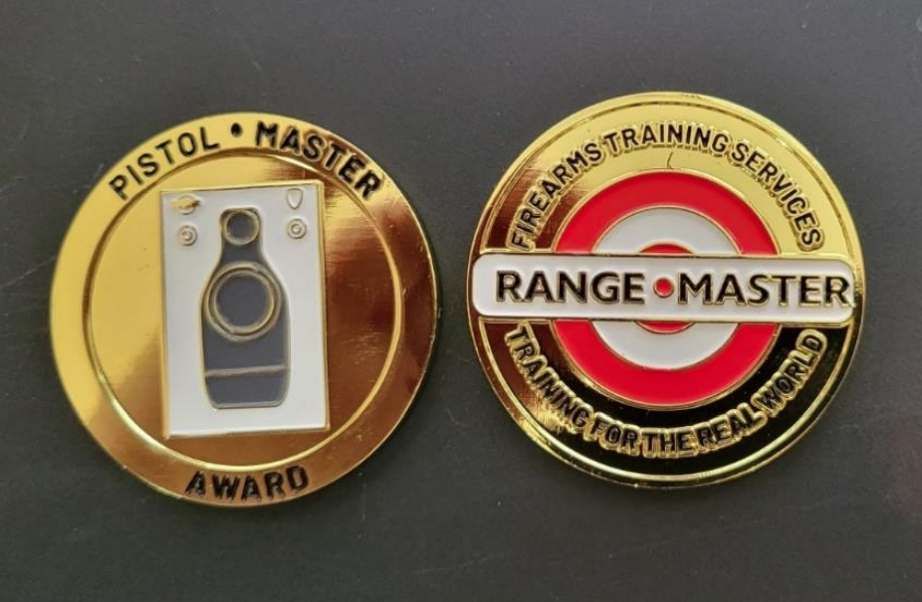
The most common inquiry in regards to courses of fire that followed after publishing the Rangemaster Professional Pistolcraft Instructor Development Course after action report was for the details behind the two tests associated with earning the Pistol Master Award. I was going to save the details and analysis for next month since this month has already seen two live fire drill related posts, but there was sufficient interest in it suggesting that fast tracking this post would be appreciated. And so here we are.
The requirements for earning the Rangemaster Pistol Master Award was originally documented in the December 2023 Rangemaster newsletter [PDF] along with the courses of fire.
The Courses of Fire
Earning a Pistol Master Award from Rangemaster requires completing two consecutive courses of fire with a nearly perfect score of 95% or better. There are no redos. One gets one go at it on a given day. Failure to make the standard on the first course of fire stops the process. Everything is shot from concealed carry using a pistol designed for defensive use.
Pistol Master Test (Part 1)

Target: FBI-IP1 or B8-C
| # | Distance | Start Position | String Procedure | Par Time |
|---|---|---|---|---|
| 1 | 5 Yards | Holstered and concealed | Fire five (5) rounds | 5 seconds |
| 2 | 5 Yards | Ready | Fire four (4) rounds, dominant hand only | 4 seconds |
| 3 | 5 Yards | Ready | Fire three (3) rounds, non-dominant hand only | 3 seconds |
| 4 | 5 Yards | Ready | Fire one (1) round | 1 second |
| 4 | 5 Yards | Ready | Fire one (1) round | 1 second |
| 4 | 5 Yards | Ready | Fire one (1) round | 1 second |
| 5 | 7 Yards | Holstered and concealed | Fire four (4) rounds | 5 seconds |
| 6 | 7 Yards | Ready with only three (3) rounds in pistol | Fire three (3) rounds, reload, fire three (3) additional rounds | 10 seconds |
| 7 | 10 Yards | Holstered and concealed | Fire five (5) rounds | 9 seconds |
Scoring: Add up the impacts to determine the score. Line breaks count. However, the entire line must be broken entirely by the impact. Tears don’t count. Deduct 10 points for every shot not fired or fired after the time limit. A perfect score would be 300. The minimum passing score is 285.
Professional Pistolcraft Instructor Qualification (Part 2)

Target: RFTS-Q4
| # | Distance | Start Position | String Procedure | Par Time |
|---|---|---|---|---|
| 1 | 5 Yards | Holstered and concealed | Fire three (3) rounds with both hands, fire three (3) rounds dominant hand only, fire three (3) rounds non-dominant hand only. | 9 seconds |
| 1 | 5 Yards | Holstered and concealed | Fire three (3) rounds with both hands, fire three (3) rounds dominant hand only, fire three (3) rounds non-dominant hand only. | 9 seconds |
| 2 | 5 Yards | Holstered and concealed | Fire three (3) rounds to the body, fire one (1) round to the head. | 4 seconds |
| 2 | 5 Yards | Holstered and concealed | Fire three (3) rounds to the body, fire one (1) round to the head. | 4 seconds |
| 2 | 5 Yards | Holstered and concealed | Fire three (3) rounds to the body, fire one (1) round to the head. | 4 seconds |
| 2 | 5 Yards | Holstered and concealed | Fire three (3) rounds to the body, fire one (1) round to the head. | 4 seconds |
| 3 | 7 Yards | Ready with only four (4) rounds in pistol | Fire four (4) rounds, reload, fire four (4) rounds | 8 seconds |
| 4 | 15 Yards | Holstered and concealed | Fire two (2) rounds | 5 seconds |
| 5 | 15 Yards | Ready | Fire three (3) rounds | 5 seconds |
| 6 | 25 Yards | Holstered and concealed | Fire three (3) rounds | 8 seconds |
Scoring: Add up the impacts to determine the score, two (2) points for every hit in the 7″ body circle and in the 4″ head box circle, one (1) point for every hit in the silhouette. Line breaks count. However, the entire line must be broken entirely by the impact. Tears don’t count. Deduct two (2) points for every shot not fired or fired after the time limit. A perfect score would be 100. The minimum passing score is 95.
My Thoughts on the Test
In the Rangemaster newsletter [PDF] that introduced the Pistol Master Award, Tom Givens’ wrote, “The combination of a bullseye course and a silhouette based course gives us a good measure of all around consistent performance.” I wholeheartedly agree with that statement.
Both of the courses of fire are challenging. The time allowed for each string in each course of fire doesn’t allow time for one to, as Tom Givens would say, “fiddle f*ck” with the pistol and get their hits. Although, I think the times on the 10 yard string of the Pistol Master Test is on the generous side. Same thing goes for the 15 and 25 yard strings of the Professional Pistolcraft Instructor Qualification. These are just subjective observations though which may be supported or rejected by the relative difficulty analysis that will follow shortly.
One thing about this test is hard to quantify is how test pressure plays into the difficulty. Test pressure isn’t the same for everyone either. However, I will admit that I felt more pressure during the Professional Pistolcraft Instructor Qualification part of the Pistol Master Award because I knew that both the Pistol Master Award and Professional Pistolcraft Instructor certification were on the line.
Relative Difficulty
In order to figure out the relative difficulty of the Pistol Master Award, we have to establish a Grand Master (GM) par time for each string for each of the two courses of fire. This can be done using the methods outlined by Karl Rehn in this book, Strategies and Standards for Defensive Handgun Training.
Pistol Master Test (Part 1)
To get a perfect score on this course of fire all hits have to impact the 10 ring which is a 3.36″ circle at various distances. At 10 yards, which is the longest engagement distance in the course of fire, the 10 ring simulates a 8.4″ at 25 yards which is roughly the size of an IDPA 8″ A-zone. We will use that as the basis for scaling and interpolating GM level speed. That give us the following rough data points:
- 5 yards is roughly equivalent to an 8″ A-zone at 12.5 yards
- 7 yards is roughly equivalent to an 8″ A-zone at 18.75 yards
With that we can roughly approximate the relative difficulty as follows:
| String # | Distance | Reps | Par Time | GM Speed | Difficulty |
|---|---|---|---|---|---|
| 1 | 5 | 1 | 5 | 1.98 (1.1 + 0.22 x 4) | 40% |
| 2 | 5 | 1 | 4 | 2.28 (0.93 + 0.45 x 3) | 57% |
| 3 | 5 | 1 | 3 | 1.83 (0.93 + 0.45 x 2) | 61% |
| 4 | 5 | 3 | 1 | 0.93 | 93% |
| 5 | 7 | 1 | 5 | 2.64 (1.65 + 0.33 x 3) | 53% |
| 6 | 7 | 1 | 10 | 4.6 (1.15 + 0.33 x 2 + 2.13 + 0.33 x 2) | 46% |
| 7 | 10 | 1 | 9 | 3.4 (1.8 + 0.4 x 4) | 38% |
While there are a lot loose factors in this type of analysis, the analysis does appear to support my subjective opinion that the 10 yard string (string #7) had a very generous time since it appears to have the lowest relative difficulty of all the strings.
The most surprising thing I found was the difficulty of string #4 which was the 1 shot in 1 second from the ready at five yards.
Adding up all the times for the strings, including repetitions, we end up with a total par time of 39 seconds for the Pistol Master Test. Doing the same thing with the GM speed we get a total GM speed of 19.52 seconds. The resulting difficulty of this portion of the Pistol Master Award comes to a relative difficulty of 50% which puts it right smack in the middle of the “normal” difficulty bucket of the scale I suggested in the first post of this series.
Professional Pistolcraft Instructor Qualification (Part 2)
The analysis for this qualification is a bit tricky since the target area of the 7″ body circle of the RFTS-Q4 target is about 23% less than that of 8″ IDPA A-zone. The target areas are roughly 38.5 square inches and 50.25 square inches respectively. This means that the difficulty of the body shots in the Professional Pistolcraft Instructor Instructor Qualification are about the same as 8″ IDPA A-zone hits at 23% longer engagement distances. The challenge with this is that we get some odd distances that will require additional interpolation to approximate the GM speed as follows:
- 5 yards is roughly equivalent to an 8″ A-zone at 6.15 yards
- 7 yards is roughly equivalent to an 8″ A-zone at 8.61 yards
- 15 yards is roughly equivalent to an 8″ A-zone at 18.45 yards
- 25 yards is roughly equivalent to an 8″ A-zone at 30.75 yards
At the time of writing, I am unaware of any GM performance data beyond 25 yards. This means that I will either have to make an educated guess by extrapolating approximate performance data using the rate of speed changes from the data up to 25 yards or use the 8″ A-zone data at the respective distances which will result in a definitely lower relative difficulty score. I’ll attempt to do both.
Let’s start the analysis with the 8″ A-zone at the matching string distance which yields the following:
| String # | Distance | Reps | Par Time | GM Speed | Difficulty |
|---|---|---|---|---|---|
| 1 | 5 | 2 | 9 | 4.46 (1.2 + 0.18 x 2 + 0.75 + 0.35 x 2 + 0.75 + 0.35 x 2) | 50% |
| 2 | 5 | 4 | 4 | 1.86 (1.2 + 0.18 * 2 + 0.3) | 47% |
| 3 | 7 | 1 | 8 | 3.8 (0.85 + 0.2 x 3 + 1.75 + 0.2 x 3) | 48% |
| 4 | 15 | 1 | 5 | 1.75 (1.5 + 0.25) | 35% |
| 5 | 15 | 1 | 5 | 1.5 (1 + 0.25 x 2) | 30% |
| 6 | 25 | 1 | 8 | 2.6 (1.8 + 0.4 x 2) | 33% |
The relative difficulty analysis above, which is without a doubt lower than what it should be for the reasons already stated, supports my subjective observation that the time limits for the 15 yard and 25 yards strings was generous as they would fall in the “easy” difficulty bucket.
Let’s run the analysis again with a little more interpolation for the distances that we have performance data for and extrapolating for the 25 yard string:
| String # | Distance | Reps | Par Time | GM Speed | Difficulty |
|---|---|---|---|---|---|
| 1 | 5 | 2 | 9 | 4.53 (1.25 + 0.19 x 2 + 0.75 + 0.35 x 2 + 0.75 + 0.35 x 2) | 50% |
| 2 | 5 | 4 | 4 | 1.88 (1.2 + 0.19 x 2 + 0.3) | 47% |
| 3 | 7 | 1 | 8 | 3.92 (0.85 + 0.22 x 3 + 1.75 + 0.22 x 3) | 49% |
| 4 | 15 | 1 | 5 | 1.9 (1.6 + 0.3) | 38% |
| 5 | 15 | 1 | 5 | 1.7 (1.1 + 0.3 x 2) | 34% |
| 6 | 25 | 1 | 8 | 2.8 (1.9 + 0.45 x 2) | 35% |
The second approach didn’t have much of an impact on the 5 and 7 yard strings individually. However, they did bump up the relative difficulty of the 15 and 25 yards strings which continued to be relatively less difficult that the 5 and 7 yard strings.
Given the differences between the two, I’m going to use the higher numbers from the second set which I think are closer to the actual difficulty of the qualification to estimate the total relative difficulty. Using the total par time of 60 seconds and the total GM speed of 26.9 seconds we get a total relative difficulty of 45%. This also puts this part of the Pistol Master Award in the “normal difficulty” bucket.
Pistol Master Award
Combining the total par time and estimated GM speed of both courses of fire we end up with a combined par time of 99 seconds and a combined GM speed of 46.42. This results in a relative difficulty score of 47% for the Pistol Master Award.
As Karl points out in the aforementioned book, this approach gets us close to the actual difficulty. Done correctly we would end up within 10% of the actual difficulty. Given my experience with the tests for a Pistol Master Award, I would say it’s closer to 55% and maybe even 60%. I have no doubt this approaches the “hard difficulty” bucket and may have one foot in it.

Closing Thoughts
From a raw skills perspective, the two tests do require consistent competent pistol handling. With the exception of the 1 second shots into the 10 ring of the Pistol Master Test, no string in either course of fire requires blazing speed to complete. At the same time, each string is unforgiving to inconsistency in marksmanship fundamentals.
As Greg Ellifritz points out in his post on the Pistol Master Test, the pressure from attempting these for a documented score that determines whether or not one earns the Pistol Master Award while being among classmates and peers can’t be understated. Maintaining consistency under those conditions is essential to pulling it off.
I would say that USPSA C-class or IDPA Sharpshooter skills are what is needed mechanically to pass the courses of fire, but a USPSA B-class or IDPA Expert ability to deal with pressure is also needed to earn the Pistol Master Award.
2 responses to “Earning the Rangemaster Pistol Master Award: Tests and Difficulty”
[…] The curious minds have had some commonly themed inquiries. Next to asking about the details of the Rangemaster Pistol Master Award, the most common inquiries are with regards to the details and difficulty of the instructor […]
[…] also included an 80 round shooting session, where participants had the opportunity to earn the Rangemaster “Pistol Master” award. Zo’s estimate of the difficulty of the shooting tests, using the formulas from our Strategies […]