
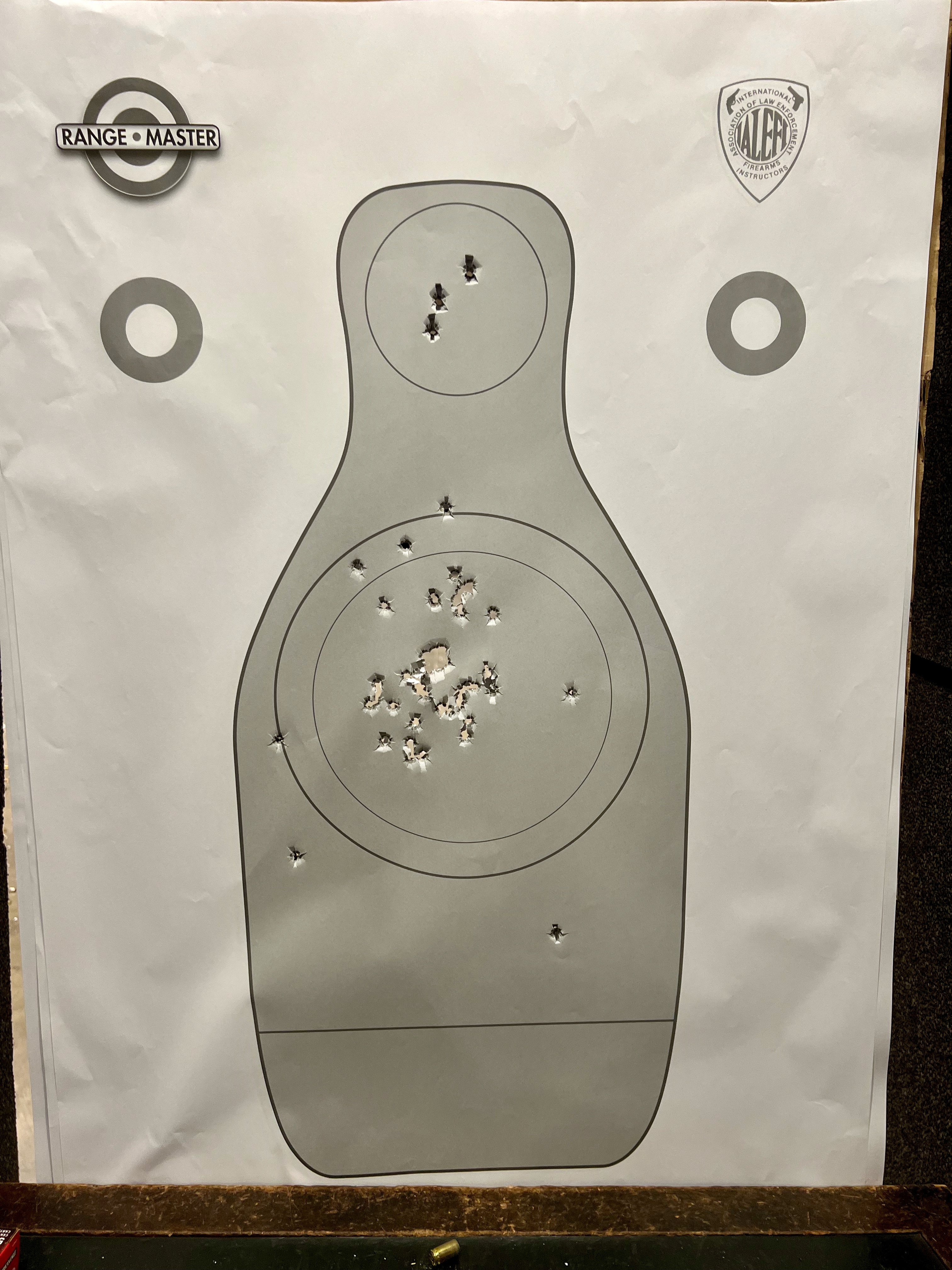
I’ve been writing a good bit on Rangemaster events and courses over the past couple of months mainly because those are things I’ve recently participated in. It naturally follows that readers have recently been asking questions about those writings. The curious minds have had some commonly themed inquiries. Next to asking about the details of the Rangemaster Pistol Master Award, the most common inquiries are with regards to the details and difficulty of the instructor qualification courses of fire.
Okay so let’s talk about them. One at a time, with the exception of the fourth one from Rangemaster Professional Pistolcraft Instructor Development Course since we’ve already covered it. Across multiple posts. Starting with the first qualification required to earn the first Rangemaster Instructor certification.
The Course of Fire
Target: RFTS-Q
| # | Distance | Start Position | String Procedure | Par Time |
|---|---|---|---|---|
| 1 | 3 yards | Holstered | Fire 3 rounds | 3 seconds |
| 2 | 3 yards | Ready in dominant hand | Fire 3 rounds dominant hand only | 3 seconds |
| 3 | 3 yards | Ready in non-dominant hand | Fire 3 rounds non-dominant hand only | 3 seconds |
| 4 | 5 yards | Holstered | Fire 4 rounds | 4 seconds |
| 4 | 5 yards | Holstered | Fire 4 rounds | 4 seconds |
| 5 | 5 yards | Holstered | Fire 3 rounds to the chest, fire 1 round to the head | 5 seconds |
| 5 | 5 yards | Holstered | Fire 3 rounds to the chest, fire 1 round to the head | 5 seconds |
| 5 | 5 yards | Holstered | Fire 3 rounds to the chest, fire 1 round to the head | 5 seconds |
| 6 | 7 yards | Ready with only 4 rounds loaded | Fire 4 rounds, reload, fire 4 rounds | 8 seconds |
| 7 | 7 yards | Ready with an empty chamber | Attempt to fire, remedy malfunction, fire 2 rounds | 5 seconds |
| 8 | 15 yards | Holstered | Fire 3 rounds | 6 seconds |
| 8 | 15 yards | Holstered | Fire 3 rounds | 6 seconds |
| 9 | 25 yards | Holstered | Fire 3 rounds, drop to kneeling position, fire 2 rounds | 15 seconds |
Scoring: Add up all the impacts to determine the score, five (5) points for every hit in the 8″ inner chest circle or in the 4″ head box circle, four (4) points for every hit between the 8″ inner chest circle and the 10″ outer chest circle, and three (3) points for hits in the silhouette but not in any circle. Line breaks count as long as the line is broken entirely by the impact. Tears don’t count. A perfect score is 250 points. The minimum passing score is 225 or 90%.

My Thoughts on the Qualification
This qualification has evolved over time. The version I shot in August 2022 and the one I described here was the 2019 revision which is documented in the student manual that was provided to me when I attended the Rangemaster Instructor Development Course.
John Daub documented an earlier revision from February 2013 in his book Drills, Qualification, Standards, and Tests which has some notable differences. First all of the three and five yards strings that require a draw also require a side step. Additionally, the dominant hand only and non-dominant hand only work was performed at five yards instead of three. There is only one headshot required instead of three headshots required at five yards. The 25 yard string calls for an extra shot from the kneeling position and the time limit is increased by three seconds. It might be interesting to perform a difficulty analysis on this version for comparison. At a glance, I suspect this earlier revision is a bit more difficult but it’s hard to say by how much.
Another revision of this qualification is found in Tom Givens’ book, Concealed Carry Class: The ABCs of Self-Defense Tools and Tactics. The revision found in the copy of the book I have is from 2017. In this revision, the strings are identical to the 2019 revision documented in this post. However, a side step is required in the three and five yard strings that require a draw. Another difference is the 25 yard string has a shorter 14 second time limit. Like the revision document in Daub’s book, I suspect this version is also a bit more difficult, but again, it’s hard to say by how much.
An aspect of this qualification that is hard to quantify is the difficulty that is added in the form of test pressure. After all, a passing score is required to earn the Rangemaster Instructor certification which requires a notable time and monetary investment. I would be lying if I said that wasn’t on my mind when I took the qualification for score even though I had previously shot the qualification with a passing score several times in practice while getting ready for the course. While the effects of test pressure can be mitigated with practice and preparation, it still has a way of negatively affecting performance.
Relative Difficulty
As Karl Rehn prescribes in his book, Strategies and Standards for Defensive Handgun Training, the first step in calculating relative difficulty is establishing a Grand Master (GM) par time for the course of fire.
This analysis should be pretty straight forward using the available data we have GM performance on 8″ A-zone hits at known distances from three to 25 yards. There are two oddities in the course of fire that require a little bit of guesswork. They are:
- Remedying the malfunction in string #7 which I’ll treat as a slide lock reload (1.25 seconds)
- The transition from standing to kneeling on string #9 which I’ll treat as a transition plus a shot from ready position at 25 yards (0.5 + 1.3 = 1.8 seconds)
With that, here is the GM par time analysis:
| String # | Distance | Reps | Par Time | GM Speed | Difficulty |
|---|---|---|---|---|---|
| 1 | 3 | 1 | 3 | 1.4 (1.1 + 0.15 x 2) | 47% |
| 2 | 3 | 1 | 3 | 1.3 (0.7 + 0.3 x 2) | 43% |
| 3 | 3 | 1 | 3 | 1.3 (0.7 + 0.3 x 2) | 43% |
| 4 | 5 | 2 | 4 | 1.74 (1.2 + 0.18 x 3) | 44% |
| 5 | 5 | 3 | 5 | 1.86 (1.2 + 0.18 x 2 + 0.3) | 37% |
| 6 | 7 | 1 | 8 | 3.8 (0.85 + 0.2 x 3 + 1.75 + 0.2×3) | 48% |
| 7 | 7 | 1 | 5 | 2.3 (0.85 + 1.25 + 0.2) | 46% |
| 8 | 15 | 2 | 6 | 2 (1.5 + 0.25 x 2) | 33% |
| 9 | 25 | 1 | 15 | 4.8 (1.8 + 0.4 x 2 + 1.8 + 0.4) | 32% |
The relative difficulty of every string falls in either the easy or normal difficulty buckets I suggested in the first post of this series. Given a total par time of 72 seconds and a total GM speed of 27.96 seconds, this qualification comes in at an overall of 39% which is right at the top edge of easy difficulty. Based on that, I would say that a student who has reached C-class in USPSA or Sharpshooter in IDPA should be able to pass this qualification assuming they can deal with the test pressure. Based on charts provided in KR Training’s Relative Performance Measurement blog post, passing this qualification suggests the student has developed some automaticity which further suggests they have been practicing with some regularity at a minimum.
Based on my experience and discussions I’ve had with others who have passed this qualification, the areas where one is most likely to lose points is strings #2, #3, and #9. Strings #2 and #3 are the dominant and non-dominant hand only strings with most points dropped during the non-dominant hand string. This is because one handed shooting is not something folks like to practice. While string #9, the 25 yard string, is the easiest in terms of relative difficulty, most folks rush and send the shot as soon as they have a stable acceptable sight picture. With few exceptions for students who have very high levels of developed marksmanship skills, most students would benefit from shifting their focus to ensuring a good trigger press after establishing a good sight picture. While this takes more time, there is plenty of time permitted to perform this additional task with each shot.
Closing Thoughts
Passing this qualification requires that the student have consistent competent pistol handling skills. More specifically, a safe and consistent draw, with a decent grip, adequate ability to visually process the information provided by their sighting system, and the ability to press a trigger without disturbing the muzzle and target alignment. All of this is possible with some dedicated intentional practice.
As mentioned, a USPSA C-class or IDPA Sharpshooter shooter has sufficient mechanical skills to pass this qualification. However, they also will have to contend with the test pressure. USPSA B-class or IDPA Expert ability would make quick work of the Rangemaster Firearms Instructor Qualification even with test pressure jitters on board.
4 responses to “Rangemaster Firearms Instructor Qualification Course of Fire”
[…] Compensating for mechanical offset is one of the more difficult skills to get students to remember. When you do this drill and understand what the author is discussing, you should move on to The Tempest Drill. and then the Rangemaster Instructor Qualification. […]
[…] qualification is the one we will dive into in this post as promised in the analysis of the initial Rangemaster Firearms Instructor Qualification course of fire […]
Last night at our 1st and 3rd Tuesday “Outlaw” match at Texas Gun Club in Stafford, I was reminded how perishable shooting skill can be. We had a small turnout so we shot a Bill Drill at the end. My time was okay at 3.09 seconds, but accuracy sucked and I would have failed to get a Dark Pin from Gabe White.
I know this is because, having earned my pin last month, I’ve not been diligent in my dry fire and live training. This reminds me that I need a goal to shoot for (no pun intended) or I lose focus.
So, after that long explanation, I finally get to my point — I’m going to try shooting this drill next time I’m at the range, using an IDPA standard target, the substitution that Hsoi suggests in his Drills, Qualifications, Standards and Tests book. That should give me a good goal to pursue.
[…] Rangemaster Firearms Instructor Qualification Course of Fire […]