

The second Rangemaster firearms instructor qualification course of fire is the Rangemaster Advanced Firearms Instructor Qualification. As the name directly implies, it is encountered in the Rangemaster Advanced Instructor Development Course, and passing it is required to earn the accompanying certification. It also happens to be the qualification we will dive into in this post, as promised in the analysis of the initial Rangemaster Firearms Instructor Qualification course of fire. Likewise, we will walk through the Rangemaster Advanced Instructor Qualification string by string, compare it with the first one, and run the numbers on its relative difficulty.
The Course of Fire
Target: RFTS-Q
| # | Distance | Start position | String | Par | Reps |
|---|---|---|---|---|---|
| 1 | 3 yd | Holstered | Fire 3 rounds | 3.00s | 2 |
| 2 | 3 yd | Ready, gun in the dominant hand | Fire 3 rounds dominant hand only, then switch hands and fire 3 rounds non-dominant hand only | 7.00s | 2 |
| 3 | 5 yd | Holstered | Fire 3 rounds to the chest, then 1 round to the head | 4.00s | 2 |
| 4 | 7 yd | Ready, only 4 rounds loaded | Fire 4 rounds, reload, then fire 4 rounds | 8.00s | 1 |
| 5 | 7 yd | Ready, empty chamber | Attempt to fire, remedy the malfunction, then fire 4 rounds | 6.00s | 1 |
| 6 | 15 yd | Holstered | Fire 3 rounds, drop to kneeling, then fire 3 rounds | 12.00s | 1 |
| 7 | 25 yd | Holstered | Fire 3 rounds | 9.00s | 2 |
Scoring: First, add up all the impacts to determine the score. A hit in the 8-inch inner chest circle or the 4-inch head circle is worth five points. Hits between the 8-inch inner chest circle and the 10-inch outer chest circle are worth four points, and hits in the silhouette outside the circles are worth three. Line breaks count as long as the line is broken entirely by the impact. Tears don’t count. A perfect score is 250 points, so the minimum passing score of 225 is 90%.
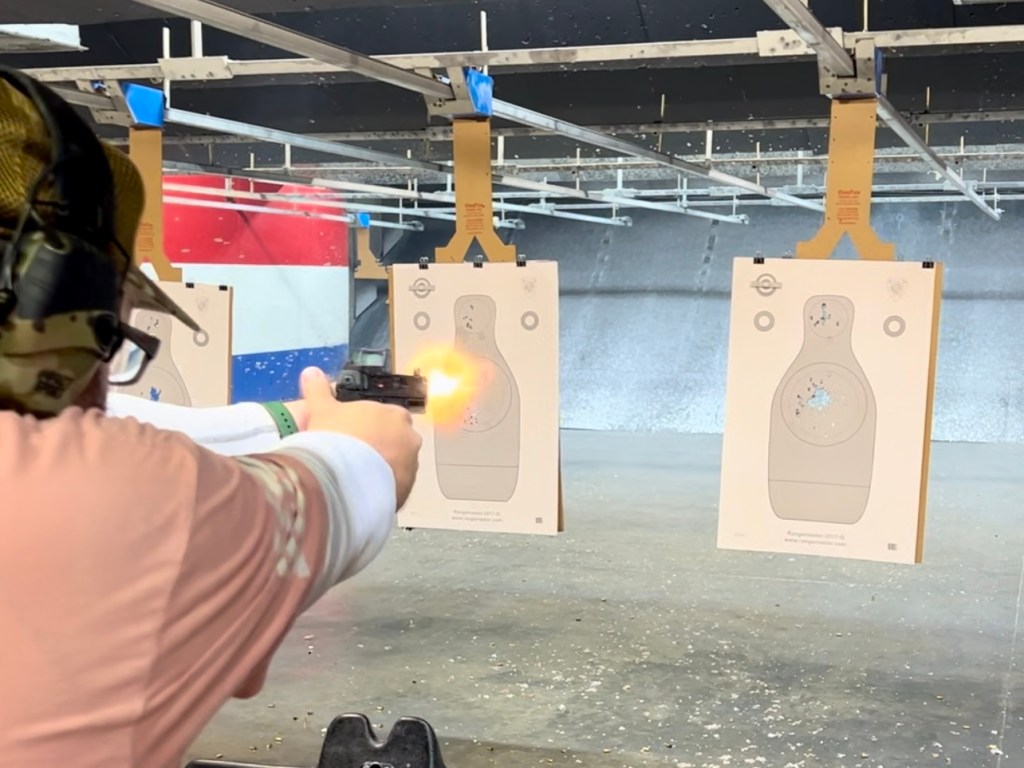
My Thoughts on the Advanced Qualification
Not going to lie, I was concerned about the difference in difficulty between this “advanced” qualification course of fire and the initial instructor qualification. In addition, unlike the first Rangemaster Firearms Instructor Qualification, I was unable to find the advanced qualification documented anywhere before taking the advanced instructor development course, which probably made it worse. After passing the qualification, I still thought it was more difficult, subjectively. However, I hadn’t performed an analysis like this.
On the surface there are some obvious differences. For example, strings of fire are duplicated with tighter time limits, the switch from the dominant to the non-dominant hand happens within a string rather than between strings, and similar strings get a bit more time but additional shots. Digging a little deeper, the number of rounds fired from the 3 yard line doubles in the Rangemaster Advanced Instructor Qualification, while the shooting at the 5 yard line drops by more than half. Additionally, the shooting at the 7 and 25 yard lines increases. These differences are summarized as follows:
| Distance | Instructor Qualification | Advanced Instructor Qualification |
|---|---|---|
| 3 yd | 18% of rounds fired 6 rounds one-handed (hand switch between strings) | 36% of rounds fired 12 rounds one-handed (hand switch in string) |
| 5 yd | 40% of rounds fired 3 head shots | 16% of rounds fired 2 head shots |
| 7 yd | 20% of rounds fired | 24% of rounds fired |
| 15 yd | 12% of rounds fired | 12% of rounds fired Kneeling position |
| 25 yd | 10% of rounds fired Kneeling position | 12% of rounds fired |
Whether or not these differences make the test more difficult is yet to be determined, so let’s do that next.
Relative Difficulty of the Advanced Instructor Qualification
Using Karl Rehn’s method of calculating par time drill difficulty, as outlined in his book Strategies and Standards for Defensive Handgun Training, we can get an idea of this qualification’s relative difficulty as well.
Like the initial instructor qualification, the Grand Master (GM) par time calculation is mostly straightforward, because both qualifications use the same target and the same scoring areas. I will also use similar timings for the malfunction clearance and the transition to kneeling, with adjustments for the changes in distance. Last, but not least, I will treat the switch from the dominant to the non-dominant hand as a target transition plus a shot from ready, as follows:
- Dominant to non-dominant hand switch at 3 yards: 0.9 (0.2 + 0.7) seconds
- Malfunction clearance at 7 yards: 1.25 seconds
- Transition to kneeling position at 15 yards: 1.35 (0.35 + 1) seconds
The Math
Let’s do the math.
| # | Distance | Reps | Par | GM speed | Difficulty |
|---|---|---|---|---|---|
| 1 | 3 yd | 2 | 3.00s | 1.40s (1.1 + 0.15 × 2) | 47% |
| 2 | 3 yd | 2 | 7.00s | 2.80s (0.7 + 0.3 × 2 + 0.9 + 0.3 × 2) | 40% |
| 3 | 5 yd | 2 | 4.00s | 1.86s (1.2 + 0.18 × 2 + 0.3) | 47% |
| 4 | 7 yd | 1 | 8.00s | 3.80s (0.85 + 0.2 × 3 + 1.75 + 0.2 × 3) | 48% |
| 5 | 7 yd | 1 | 6.00s | 2.70s (0.85 + 1.25 + 0.2 × 3) | 45% |
| 6 | 15 yd | 1 | 12.00s | 3.85s (1.5 + 0.25 × 2 + 1.35 + 0.25 × 2) | 32% |
| 7 | 25 yd | 2 | 9.00s | 2.60s (1.8 + 0.4 × 2) | 29% |
Just like the initial instructor qualification course of fire, the relative difficulty of every string falls in either the easy or the normal difficulty bucket I suggested in the first post of this series. The total par time of the Rangemaster Advanced Instructor Qualification is 72 seconds, while the total GM par time (or speed) is 27.67 seconds. As a result, the overall difficulty is 38%, a tiny fraction lower than the initial qualification’s, which puts this qualification near the top of the easy bucket. The difference is so small that I would call the two virtually equivalent in terms of the mechanical skill needed for a passing score. In other words, a USPSA C-class or IDPA Sharpshooter competitor should be able to clean this qualification.
What the Math Misses
While the numbers are what they are, it’s worth noting that this qualification offers more opportunities for a student to commit errors than the previous one, especially if they struggle with test pressure. First, there are twice as many one-handed shots. As noted in the previous post, one-handed shooting is something most folks don’t practice enough. Additionally, switching hands while on the clock offers an opportunity to fumble the non-dominant hand only grip. The uptick in shots fired beyond the 5 yard line also increases the likelihood of rushing the longer shots to beat the clock. That mistake shows up with a frequency inversely proportional to the student’s skill.
Consequently, applying the 10% margin of error Karl Rehn suggests for these types of calculations, I’d put the relative difficulty of this qualification at least 5% higher than what the math says. If I am right, then the Rangemaster Advanced Instructor Qualification is sitting comfortably in the normal difficulty bucket and not the easy one.
Closing Thoughts
I know the math disagrees with me. However, given my subjective recollection of the Rangemaster Advanced Instructor Qualification, plus the nuanced differences in the strings of fire and the shot distribution, I don’t think its difficulty is equivalent to the Rangemaster Firearms Instructor Qualification course of fire. It’s more difficult, but not by much.
Passing the advanced qualification requires the same mechanical skills as the previous qualification. However, patience and consistency are the key elements one needs to exhibit to make it through this one. The best way to make this happen is to get comfortable with running one’s pistol under pressure. Match experience is probably the best and most accessible way to accomplish this. Indeed, it is how I prepared for the advanced instructor course. Combine match experience with regular, intentional practice, and earning a USPSA B-class or IDPA Expert classification becomes a very achievable thing. In fact, that is more difficult than passing this qualification.
Finally, one rung up the ladder, the Rangemaster Master Firearms Instructor Qualification course of fire gets the same treatment.


