
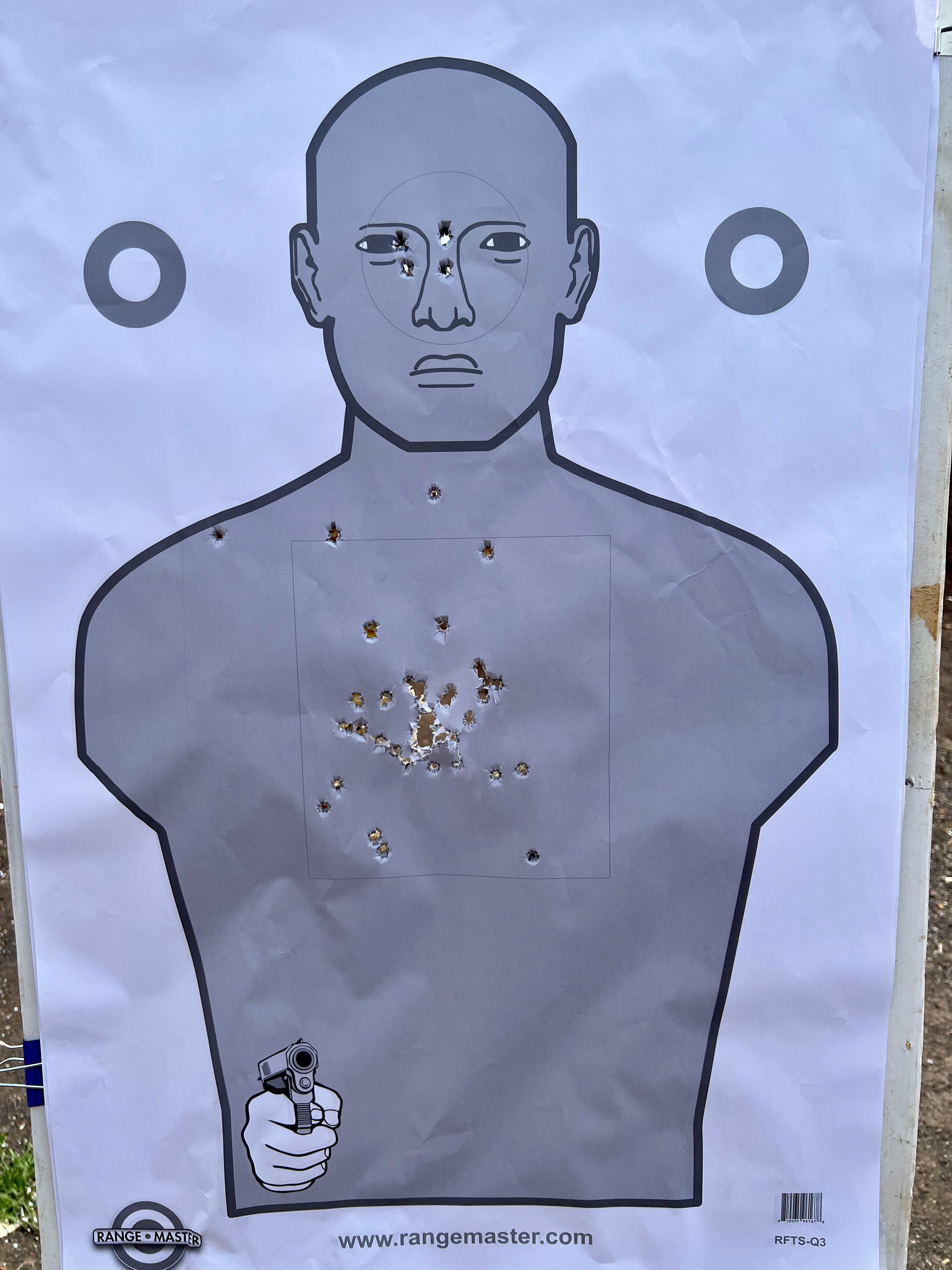
The third Rangemaster firearms instructor qualification course of fire is one of the requirements for earning a certification from the Rangemaster Master Firearms Instructor Development course.
The master qualification shares a lot of similarities with the initial and advanced qualifications. It’s 50 rounds. Strings take place at the 3, 5, 7, 15, and 25 yard lines. It can be shot on a RFTS-Q target using the same 5/4/2 scoring. Passing the qualification requires a score of 90% or better (225 or higher out of 250 on the RFTS-Q target) to pass. However, it can also be shot on a different target which is scored differently. We will cover these differences in the remainder of the post as we work through the details and the analysis of this qualification.
Let’s get into it.
The Course of Fire
Target: RTFS-Q3
| # | Distance | Start Position | String Procedure | Par Time |
|---|---|---|---|---|
| 1 | 3 yards | Holstered | Fire 3 rounds, switch to dominant hand, fire 3 rounds with dominant hand only, switch to non-dominant hand, fire 3 rounds with non-dominant hand only | 7 seconds |
| 2 | 3 yards | Holstered | Fire 4 rounds | 3 seconds |
| 3 | 3 yards | Holstered | Fire 4 rounds with dominant hand only | 3 seconds |
| 4 | 5 yards | Holstered | Fire 3 rounds | 3 seconds |
| 4 | 5 yards | Holstered | Fire 3 rounds | 3 seconds |
| 5 | 5 yards | Holstered | Fire 3 rounds to the chest, fire 1 round to the head | 4 seconds |
| 5 | 5 yards | Holstered | Fire 3 rounds to the chest, fire 1 round to the head | 4 seconds |
| 6 | 5 yards | Ready | Fire 1 round to the head | 1.5 seconds |
| 6 | 5 yards | Ready | Fire 1 round to the head | 1.5 seconds |
| 7 | 7 yards | Ready with only 2 rounds loaded | Fire 2 rounds, reload, fire 2 rounds | 7 seconds |
| 8 | 7 yards | Ready with an empty chamber | Attempt to fire, remedy malfunction, fire 2 rounds | 4 seconds |
| 9 | 15 yards | Holstered | Fire 2 rounds | 5 seconds |
| 10 | 15 yards | Ready | Fire 3 rounds | 5 seconds |
| 11 | 25 yards | Holstered | Fire 3 rounds, drop to kneeling position, fire 3 rounds | 16 seconds |
Scoring: Add up all the impacts to determine the score, two (2) points for every hit in the 8″ inner chest square or in the 4″ head box circle and one (1) point for hits in the silhouette but not in any circle. Line breaks count as long as the line is broken entirely by the impact. Tears don’t count. A perfect score is 100 points. The minimum passing score is 90.

My Thoughts on the Qualification
A couple of days prior to me starting work on this post, Karl Rehn published his after action report on the Rangemaster Professional Pistolcraft Instructor Development course. In that post, he mentions that his methodology for calculating par time drill difficulty to approximate relative difficulty (which I will use in the next section) may need refinement given the findings from recently experimenting with the Professional Pistolcraft Instructor Qualification he converted to a USPSA stage. I’m not certain his similar experience with that qualification feeling more difficult than what the numbers indicate is what prompted that experiment, but reading his post got me thinking back to this qualification and what it felt like.
Not having run the numbers yet, I remember the qualification feeling relatively difficult and thinking this was the hardest qualification I had ever taken. A lot of that is true. While the strings seemed more difficult, the test pressure was some of the heaviest pressure I had felt given I was classmates with several folks I would want to train with and learn from. Additional contributing factors was being outdoors in moderately windy conditions with the Texas heat starting to warm up enough to easily work up a good sweat. I don’t recall struggling with the qualification and at the time I was ranked as an IDPA Sharpshooter and a USPSA C-class competitor. Don’t get me wrong. The qualification was by no means easy. I had to work at it, but shooting it clean was definitely in my wheelhouse.
Comparing the master and advanced instructor qualifications, we see a small decrease in one-handed shooting and rounds fired at the three yard line. However, all of the strings where rounds are fired one-handed start from the holster in the master qualification rather than the ready position in the advanced qualification. The number of rounds fired from the five yard line doubled in the master qualification. Last, but not least, the time pressure on the strings from the seven yard line and beyond was increased.
| Distance | Advanced Instructor Qualification | Master Instructor Qualification |
|---|---|---|
| 3 yards | 36% of rounds fired 12 rounds one-handed (hand switch in string) | 34% of rounds fired 10 rounds one-handed (hand switch in string) |
| 5 yards | 16% of rounds fired 2 head shots | 32% of rounds fired 4 head shots |
| 7 yards | 24% of rounds fired | 12% of rounds fired |
| 15 yards | 12% of rounds fired Kneeling position | 10% or rounds fired |
| 25 yards | 12% of rounds fired | 12% of rounds fired Kneeling position |
Let’s see what these differences mean when it comes to the numbers.
Relative Difficulty
We will use the same methodology we have been using in the previous posts to calculate relative difficulty compared with Grand Master (GM) speed (or GM par time). We will also use similar substitutions for tasks without corresponding GM performance data for like we have been. The new substitution in this course of fire is the switching from two handed to dominant hand only shooting in the first string which I will treat as a shot from the ready.
Here are all the substitutions we will use:
- Two hands to dominant hand only switch at 3 yards: 0.7 seconds
- Dominant to non-dominant hand switch at 3 yards: 0.9 (0.2 + 0.7) seconds
- Malfunction clearance at 7 yards: 1.25 seconds
- Transition to kneeling position at 25 yards: 1.8 (0.5 + 1.3) seconds
The rest of data points will use the available GM performance data on 8″ A-zone hits at known distances from three to 25 yards.
| String # | Distance | Reps | Par Time | GM Speed | Difficulty |
|---|---|---|---|---|---|
| 1 | 3 | 1 | 7 | 4.2 (1.1 + 0.15 x 2 + 0.7 + 0.3 x 2 + 0.9 + 0.3 x 2) | 60% |
| 2 | 3 | 1 | 3 | 1.55 (1.1 + 0.15 x 3) | 52% |
| 3 | 3 | 1 | 3 | 2 (1.1 + 0.3 x 3) | 67% |
| 4 | 5 | 2 | 3 | 1.56 (1.2 + 0.18 x 2) | 52% |
| 5 | 5 | 2 | 4 | 1.86 (1.2 + 0.18 x 2 + 0.3) | 47% |
| 6 | 5 | 2 | 1.5 | 0.9 | 60% |
| 7 | 7 | 1 | 7 | 3 (0.85 + 0.2 + 1.75 + 0.2) | 43% |
| 8 | 7 | 1 | 4 | 2.3 (0.85 + 1.25 + 0.2) | 58% |
| 9 | 15 | 1 | 5 | 1.75 (1.5 + 0.25) | 35% |
| 10 | 15 | 1 | 5 | 1.5 (1 + 0.25 x 2) | 30% |
| 11 | 25 | 1 | 16 | 5.2 (1.8 + 0.4 x 2 + 1.8 + 0.4 x 2) | 33% |
Given a total par time of 67 seconds and a total GM par time of 30.14 seconds, the relative difficulty score of the Rangemaster Master Instructor Qualification is 45% which puts it squarely in the “normal difficulty” bucket based on the buckets suggested in the first post of this series. The numbers certainly support my subjective feeling of this being the most difficult qualification I had taken at the time I passed it.
It is also interesting to see that this qualification’s relative difficulty is essentially the same as that of the Professional Pistolcraft Instructor Qualification which also came in at 45%. Perhaps I’ll entertain a comparison post between these two qualifications in the future if there is interest in it.
Another interesting thing is that 45% lines up pretty well with the USPSA C-class classification I held at the time I took the qualification. For those who are not familiar with the USPSA classification system, a C-class ranking is awarded to USPSA members who are earning scores between 40% to 60% on classifier stages. In other words, earning a C-class classification means the competitor has to demonstrate a skill level that is within 40% to 60% of the skill held by Grand Masters.
It’s worth noting that the most difficult strings are the strings that require one-handed shooting. String #6, which is a head shot from the ready at 5 yards in 1.5 seconds, is pretty spicy as well. The relative difficulty of those strings are 67% and 60% which suggest a level of skill equivalent to a USPSA B-class or IDPA Expert is about what is needed to collect all those points. If memory serves me right, then these are the strings that kept me from shooting a perfect score.
Like the initial instructor qualification and the advanced instructor qualification, the strings from the 15 and 25 yard lines are the easiest in terms of relative difficulty. These are also the strings where students are likely to make the error of rushing shots to beat the time limit. Dropping a few points on the closer strings can increase test pressure since it is easy to assume that strings at longer distances are more difficult because we (or at least I) tend to correlate distance and difficulty proportionally.

I was on the fence about writing a bit about target difficulty and how that might affect qualification difficulty. The RFTS-Q3 target is a more difficult target because the A-zone target areas are aggressively subdued and eventually become impossible to see as the distance increases. The exact distance at which the A-zone becomes impossible to see depends on an individual’s ability to see, but eventually even the very best of human eyes won’t be able to detect them. So rather than looking for a “shoot here” border like the ones on the RFTS-Q target, one has to rely on landmarks along the silhouette to approximate the point of aim needed for an A-zone impact.
However, the difference in scoring for each of the targets makes the impact on overall qualification difficulty a moot point in my opinion. This is because the penalty of a silhouette impact outside of the scoring areas is 50% per shot on the RFTS-Q3 target, which has a larger silhouette, instead of a penalty of 60% on the RFTS-Q target. Additionally, folks who are likely to attend the course that requires this qualification will likely have pretty good familiarity with using silhouette landmarks to determine a point of aim. This is especially true for students who have competition experience.
Closing Thoughts
The Rangemaster Master Firearms Instructor Qualification is among the toughest qualifications I’ve attempted. Numerically speaking, it landed in the “normal difficulty” bucket. Skills wise, it’s passable by folks with skill equivalent to IDPA Sharpshooter and USPSA C-class competitors which is the recurring theme among all of the Rangemaster instructor qualification courses of fire I’ve written about. I think those who’s skill level flirts with or surpasses IDPA Expert or USPSA B-class should have no problem shooting this qualification clean (with a perfect score).
One thing that I haven’t done in any of the posts that detail out these qualifications is to encourage readers to go out and try them. It’s not that I hadn’t thought about it, but I hesitated and decided against it since I assume most readers are in a situation like I am where access to a range where these qualifications can be set up and worked from the holster is nonexistent or limited. However, some of us in that exact situation do have access to a range where we can set up the qualifications, but can’t work from the holster.
There are a couple of approaches we can take to practicing and attempting these qualifications in that case. One option is to work from a table start if the range has a firing line with tables or counters that can be used for a table start. Another option is to work from the ready and reduce the par time on strings that begin from the holster by one second. For situations where dropping to a kneeling position isn’t possible, one can drop to a squat or partial squat depending on what the space allows.
So, there. Go out and try these qualifications. I suspect many readers will find them challenging.
One response to “Rangemaster Master Firearms Instructor Qualification Course of Fire”
[…] A fun shooting drill to try at your next range trip. Want another drill? Try the Rangemaster Master Firearms Instructor Qualification Course of Fire. […]