I had the opportunity to coach a student of the gun this past weekend. Like many students of the gun, he wanted to work on shooting better. That’s a fine goal. A little vague, but fine nevertheless.
Generally speaking, wanting to shoot better often translates into wanting to shoot faster without giving up accuracy. Getting the hits without slowing down is entirely doable, but it presents some challenges. One of those challenges that must be overcome is completely psychological. That particular challenge is the focus of this post.
What do we do with our mind while shooting?
This is a hard question to answer specifically. It’s going to be different from person to person. It’s dependent on skill and activity.
I’ve heard that thinking about nothing and maintaining a quiet mind is ideal. I don’t know how to do that. Heck, I don’t know if that’s possible. Perhaps it’s just me but I’m not very good at meditating in perfect conditions. Trying to think of nothing results in me thinking about thinking about nothing. If I can’t think about nothing while sitting comfortably in a quiet and relaxing environment, then attempting to do that while running around with a device that is containing explosions two to three feet in front of my face is a fool’s errand.
I suspect that many of you share my “thinking about nothing” dilemma. Sure, there is some projection in that suspicion. But I have supporting evidence as well.
What evidence?
You see after I finish a drill or a stage, I take a few moments to reflect on what I observed and felt. This helps me figure out what adjustment I want to make and what thing I want to repeat on the next drill or stage. Sometimes I can only recall what I was thinking. And that happens when my mind was preoccupied with the result I was trying to achieve. Consequently, the result that follows is almost never as good as what I wanted to achieve.
I see the exact same thing from students when I ask them what they observed and felt which comes in the form of, “I don’t know. I was just thinking about going fast.” And I’ve never had someone respond with, “I wasn’t thinking of anything. My mind was perfectly quiet.” I’m not saying it can’t happen. I’m just saying I’ve never seen any evidence of it actually happening.
So if thinking about nothing is a fool’s errand and thinking about the outcome yields poor results, what should we think about?
The best answer I have for that is to focus on the thing that matters most at that exact moment. Whatever that thing is, the focus should be on the process or sub-process that needs to be executed in order to maximize the likelihood of producing the desired result.
Let’s look at a couple of examples from the coaching session that inspired this post.
In the first example, I wanted to demonstrate a Bill drill executed in what Gabe White calls “pushing mode” practice or what Ben Stoeger refers to as “training speed”. Regardless of preferred terminology, I wanted to run a Bill drill at a speed that is faster than what I am comfortable with. While waiting for the start signal from the timer, I focused on reacting to the “b” of the incoming beep. As soon as I heard it, my focus shifted to “getting the gun up”. Once my two hand grip was formed and my vision was locked into a small precise spot centered on the top third of the target’s A-zone, my focus shifted to pressing the trigger the moment I saw a flash of color from the optic and repeating that. The result was almost a sub two second Bill drill with five A-zone hits. I never fired the sixth shot because I didn’t count properly. That’s okay though. I felt the gun staying locked into my hands during recoil. I felt every press of the trigger. I observed the gun return consistently from recoil. Based on that, I would make it a point to focus on counting to six the next time I attempted the drill in that mode of practice.
Later in the session, I demonstrated a split Bill drill in the same mode of practice. However, instead of focusing on the things that mattered at the moment they mattered I focused on finishing in under 2.4 seconds. The result was a time greater than what I wanted with two shots low and left outside of the center A-zone. I can’t tell you what I felt nor what I observed, because I was too busy worrying about the time.
Everyone will need to experiment with the things they need to focus on in different moments of the shooting experience. The points of focus will evolve over time as skills grow and motor programs are refined in practice and training.
While it’s impossible for me to accurately prescribe a sequence of focuses since the combinations are endless, I can offer a method that may help in the discovery of sequences.
Start by identifying a single thing to change or confirm. Pick a drill or activity that lends itself well to working on that single thing. Come up with a sequence of single focuses and triggers for them. Run the sequence. Then check the results.
If the results are adequate, then great. Rinse and repeat as needed to turn that sequence into a motor program that can be recalled and used at a later date and time.
If the results aren’t adequate, then something might need to change. However, I find it best to make changes patiently and gradually. It might be best to repeat the sequence a few more times to confirm that the undesired results weren’t a result of bad execution. This is where reflecting back on what was felt and observed comes in handy. When recollection isn’t happening, chances are we were thinking about the outcome rather than the process we intended to execute. If changes to the sequence are needed, then chances are the sequence could benefit from simplification or focus is better placed elsewhere. Less is more as long as the things that remain are the most important things.
Let’s look at one more example.
Let’s assume we want to get our draw to first shot time on a center A-zone at seven yards down from two seconds to one and a half. The outcome we are looking for is a second and a half draw time. If we focus on that outcome while practicing chances are we are likely to introduce tension that will lead to mistakes that we don’t want to turn into habits like not getting a good grip on the pistol or pressing the trigger before we see enough sights on the target. What we should do instead is focus on the process of drawing the pistol and looking for opportunities to get through each step sooner.
Time to break that down. In my experience, the draw is most commonly taught in four steps that go something along the lines of: grip, pull, join, extend. We can add “press” to the end of that for a good first shot. So our first sequence of focuses and triggers might looks something like this:
- Grip the pistol as soon as we hear the “b” in the beep from the timer
- Pull the pistol as soon as we feel the close the three fingers around the grip
- Wrap the support hand as soon as the pistol is under the dominant eye
- Extend the pistol as soon as the support hand pressure is felt on the dominant hand
- Press the trigger as soon as we see enough “sights” over the A-zone of target
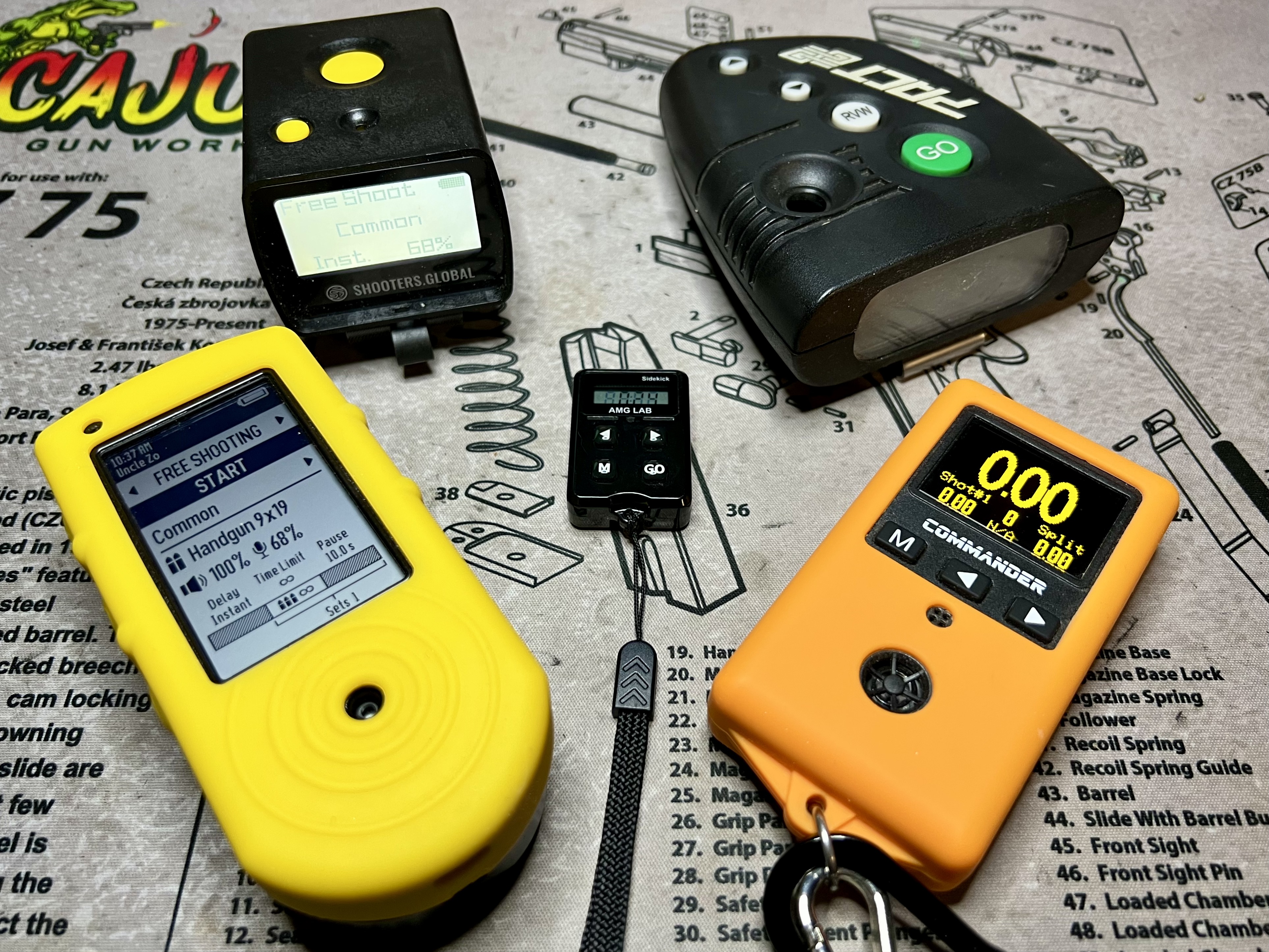
Now we can run that sequence a few times using a shot timer with a randomized delayed start and a par time of 1.9 seconds (that is 0.1 faster than the two second draw we started from). After each attempt, check the result. Did the trigger break before or after the beep? What else did we feel? What did we observe?
Let’s assume we repeated that five times and never beat the timer. Let’s also assume four out of five times we got hung up on the concealment garment. That observation suggests we might need to practice clearing the garment and gripping the pistol.
Perhaps we performed all five steps and nothing obvious slowed us down but we still didn’t beat the timer. Then we might want to try changing or removing a focus or a trigger. For example, remove step 1 in its entirety so that the sequence is becomes:
- Pull the pistol as soon as we hear the “b” in the beep from the timer
- Wrap the support hand as soon as the pistol is under the dominant eye
- Extend the pistol as soon as the support hand pressure is felt on the dominant hand
- Press the trigger as soon as we see enough “sights” over the A-zone of target
Do that a few times and check the results. Maybe we’re still not beating the timer, but we’re getting closer. If that’s the case then we are making progress in the right direction. Maybe we got slower. If that’s the case, then reintroduce the grip focus and try changing something else. Or go back to the original sequence and try to feel for different things that can be eliminated or optimized. Things like shoulder movement, upper body tension, or opportunities to use explosive movement to get to the next step sooner.
Beating the time may not happen in a single practice session. That’s okay too. Try it again in the next session. Eventually the timer will be beat. When that happens we can decrease the time again and repeat the process until we hit the goal time or we are satisfied with the improvement for the time being. When either of those points are reached it’s worth attempting the process a few times with an even simpler focus and trigger such as:
- Draw the pistol as as soon as we hear the “b” in the beep from the timer
- Press the trigger as soon as we see enough “sights” over the A-zone of target
Simpler sequences that yield the desired results indicate that sub-processes are being executed subconsciously. This allows us to start combining sequences to do more complex things like the “sub two second almost Bill drill” I described earlier in this post.
The thing to remember from all of this is that the results are always the outcome of an executed process. If we want good or better results, then our time, energy, and effort is best invested in the process itself. So stop worrying about the results and focus on the process.