
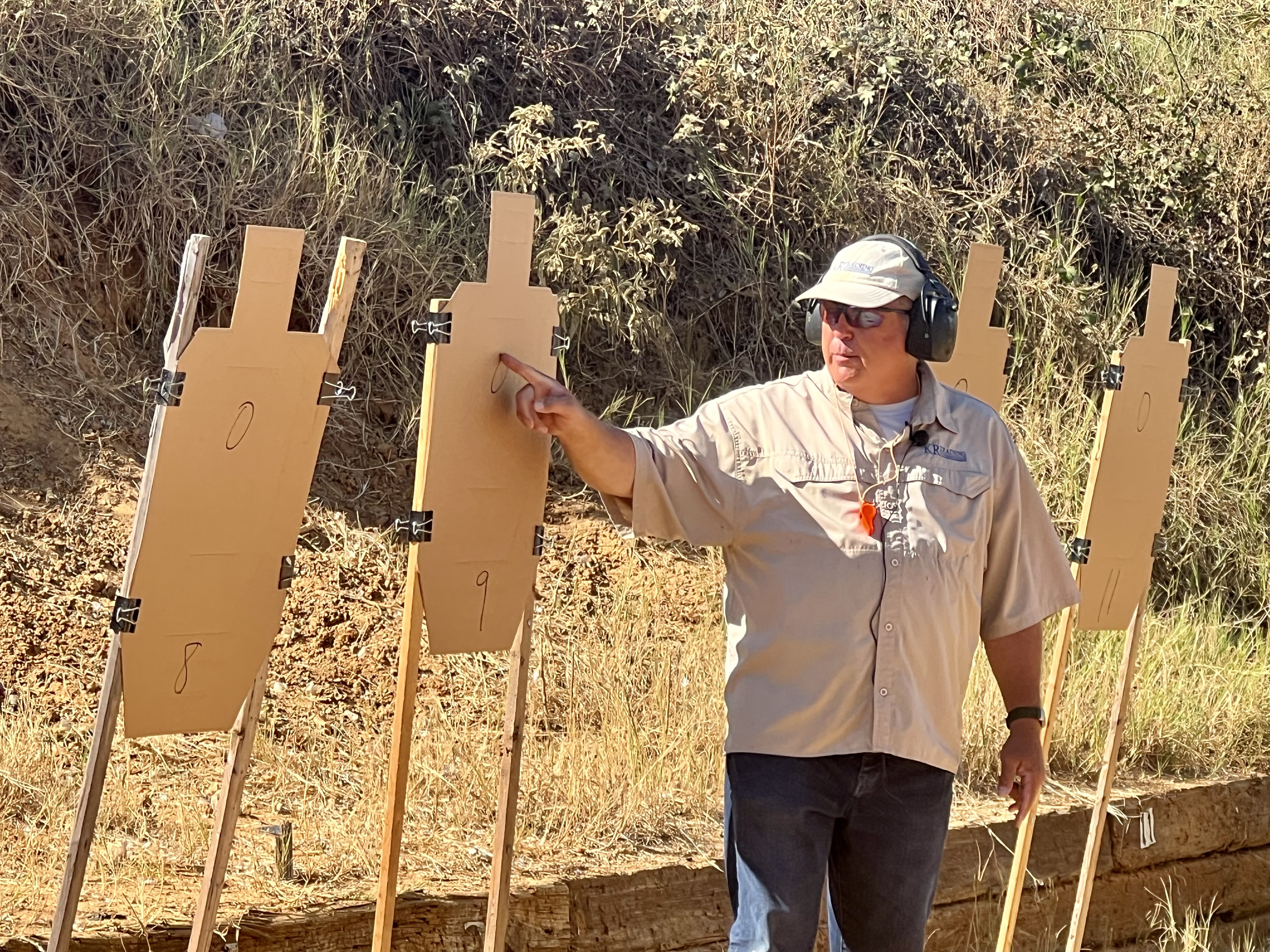
As many of you already know, I’m a big fan of KR Training’s Defensive Pistol Skills Program. From the catalog of courses available in the program, there are a few that I’m determined to attend every time they are offered because they are not only fun, but also a fantastic opportunity to get a tune up and measure progress. One of these is KR Training’s Advanced Handgun course which I recently attended… again.
The class format was similar to the last time I took the class. The 12 student class was led by Karl Rehn with the assistance of David Tschirhart. All of the students present were already competent marksmen and all but one were returning KR Training students. Furthermore, several of the returning students were taking this class again. The makeup of the student body facilitated a smooth running class which is exactly what I’ve come to expect from KR Training.
An interesting side note worth mentioning is that every single student in this class used a pistol with a mounted optic. While pistol mounted optics have continued to become more popular and have become more and more prevalent in classes that I have taken, this is the first class (where pistol mounted optics were not required) that I recall where there were no students using iron sights as their only aiming system on their pistol.
While this class is applicable to competition shooting, I stuck with the concealed carry gear. However, I’ve made several chances over the past two and half years since I last took this class. As such, the gear I used this time around was completely different with the exception of the ammunition I used which was entirely coincidental. Here is what I used:
- Gun: Staccato C2 with a Holosun 507COMP
- Holster: JM Custom Kydex IWB 3 holster on my strong side
- Mag pouches: Concealment Solutions Venom Single Magazine Carrier x2
- Belt: Nexbelt Titan EDC Belt
- Ammo: Fenix Ammunition 9mm 147gr Ammo (round count for the course was roughly 400 rounds)
Class began in the classroom with a safety briefing that included the range medical response plan and a facility overview as per usual.
This was followed by a short discussion on the skill that plagues most shooters who are looking to advance, the reload. The discussion included several tips aimed at helping students develop a consistent reload. Yeah, I felt seen. My reloads suck. I know I need to work on them, but I haven’t made that a priority. As such, I expected reloads to hinder my performance on the drills we would perform later in the day that required them.

The very first thing we did when we got out to range was shoot 25 yard groups to confirm zeros. I decided to use the defensive ammo that I carry to confirm zero with since the Staccato C2 I used in class is currently my defensive carry pistol and it was about time to cycle out the ammo that I had been carrying over the past six months or so. I was pleasantly surprised with my first five shot group which ended up being a centered 3″ group without the assistance of a pistol rest. Since I was already zeroed, I decided to use Fenix ammo I have been using to practice and compete in local matches to see what point of impact shift it had. That group ended up being about a 3″ group with a shift of 2″ down and about 1.5″ right.
With zeros confirmed, we shifted focus on working on the draw stroke next. More specifically, we worked on chunked components of the draw stroke starting with presenting the pistol from position three to four and ending with the trigger prepped with the slack out. Then we worked starting from position two with the support hand oriented with the fingers pointed down to position three and ending with a well formed two handed grip. Next we started from position one with the master grip formed while the pistol was in the holster to position three ending with a well formed grip. Each of these individual sequences was started with no time pressure followed by incrementally increased time pressure.
After tuning up the draw stroke it was time to start with the first drills that would be scored on a score sheet that each student would keep as a record of their measured performance during the class. The first drill was the Bill drill from 7 yards. We did get a few practice runs before being individually scored. This was also the first time I got a chance to compare how much I had improved since I last took the class. While my scored draw had improved by 0.1 seconds, it still isn’t where I want it to be. However, my final time had improved by almost half a second which means my split times have improved a fair bit – from 0.24 seconds to 0.18 seconds on average to be precise.
Karl made a change to the drill sequence since the last time I took the class here. Rather than moving on to one handed versions of the Bill drill from 7 yards, we went to the 15 yard (two-handed) Bill drill. Prior to shooting it for score, we worked on a drill to help improve precision at longer distances. This drill involved starting with the pistol aimed at a precise spot on the target with the slack out of the trigger, firing a shot, and finishing with the pistol aimed at the exact same spot with the slack out of the trigger. The idea is that the trigger can be reset and prepped for the next careful or precise shot while the pistol returns from recoil.

A couple of performance improvements I experienced with the 15 yard Bill drill start with being able to shoot it clean unlike last time I took this class. My draw to first shot was consistent with the draw to first shot time of the 7 yard Bill drill which means I am over confirming my first shot on the 7 yard version of the drill. That said, the draw time improved by 0.71 seconds, the raw time improved by 1.79 seconds, and the total time improved by 2.79 seconds. This tells me that my 15 yard shooting has improved noticeably since the last time I took this class.
Needless to say, the remainder of the drills saw similar improvements – fewer penalties and faster times. As such, I won’t bore y’all with the details of the improvements I saw on the additional drills which included:
- Four Aces
- Farnam
- The Wizard
- Three Seconds or Less
- IDPA 5×5 Classifier
- F.A.S.T.
- 5 yard Round Up
- The Test
However, I will point out another couple of changes that I saw in this class this time around. The first was the second variation of Ken Hackathorn’s drill, The Test (also known as the 10-10-10, where I managed a score of 99/100 (compared to the 63/100 I managed last time). Last time, we moved up to the five yard line and shot 10 rounds in five seconds. A 10-5-5 if you will where I managed a 98/100. Given the class was putting up sporty times throughout the day and did relatively well on the 10-10-10, Karl decided to move us back to the 15 yard line where we would fire 10 rounds in 15 seconds. This gave me a little pause even though I did pretty well on the 15-yard Bill drill.


In terms of relative difficulty, the Test isn’t a hard or expert level drill. It’s what I consider to be a normal difficulty drill. Meaning that a middle of the road C-class USPSA competitor should be able to clean the drill. However, at 15 yards it’s pretty unforgiving to deficiencies in marksmanship fundamentals even with the extra time. While I don’t know for sure, I suspect the relative difficulty of the drill remains the same. All I can tell you is that the classmates next to me struggled with the 15 yard variant more than they did with the 10 yard. As such, I was ecstatic to end up with a 98 out of 100 on it.
The last change I saw was the use of the KR Training 16x16x16 drill instead of Tom Given’s Casino Drill. The 16x16x16 drill consists of firing 16 rounds randomly distributed between two magazines from 16 feet within 16 seconds on a KRT-1 target. The target consists of eight shapes. Six of the targets are labeled with a number ranging from one to three. Two of the shapes are labeled with the letter A and B. Each shape gets the shot the number of times specified in the label. The “A” shape gets three rounds and the “B” target gets one. The order the shapes are engaged is up to the shooter who will also have to deal with a reload at some point during the drill. I was happy shooting it clean in 13.56 seconds.

One thing I haven’t mentioned yet is that there were other times in between the sequence of drills where the class received other tips to avoid common shooting errors and had the opportunity to perform some drills to tune up specific skills needed for an upcoming drill. For example, we spent some time working on reloads. We also spent some time working on one handed shooting. These learning moments add a ton of value and are what differentiate this six-hour class from the two-hour Top 10 Drills class (which is another class I am determined to attend every time it is offered).
As I’ve said, the KR Training Advanced Handgun is one of my favorite classes offered by KR Training that I intend to attend every time it is offered. In my opinion, the course is ideal for those who already have achieved at least a competent level of skill and are working towards improving or looking for an objective measurement of their skill level. If this sounds like something you’d be interested in, then I encourage you to take a look at KR Training’s class schedule to find the next available offering. Those who aren’t local to or can’t readily make a trip to Central Texas might be interested in knowing that Karl Rehn does take this class on the road, but you will have to contact KR Training for details on that.
3 responses to “KR Training Advanced Handgun Again”
Karl didn’t let you use any of his Atlanta Arms Elite ammo? Seriously, how does the Fenix compare to this?
Karl is a walking encyclopedia, a wealth of knowledge bombs, a lifelong student and teacher of the art, and a true gentleman. I keep and pen and paper handy when I train with him.
I took Advanced Handgun back in the Spring and my results were more hit or miss than yours. KR Training 16x16x16 drill was the only one I cleaned. 🙁
The Bill Drill is still kicking my ass! I dropped a full second off my time from last time (because, like you, I’m prepping for Gabe White’s class) and my draw was about a tenth of a second faster, but I was 3 down and would NOT have earned a Dark Pin.
Most embarrassing for me was the Three Seconds or Less drill. I had a mental lapse (I blame Covid, old age and the heat) and only fired 2 shots of the 1st string, instead of 3. 🙄 But Karl didn’t ask from my challenge coin back so I guess it’s okay.
I just hope the heat doesn’t affect me as much this weekend for Gabe’s class.
Lee
[…] KR Training Advanced Handgun (Again) […]