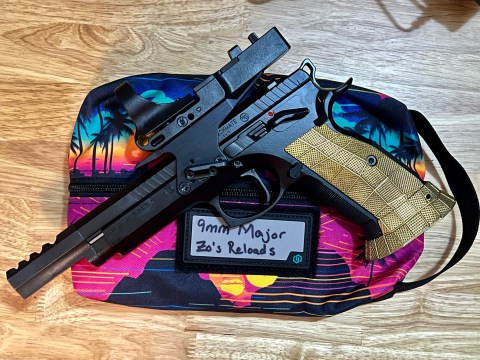
I guess I’m a day late and a dollar short with this first impressions review. How’s that? Well, the CZ 75 TS Czechmate Parrot has been a grail gun that I’ve wanted to add to the collection for a long time. (It’s a mouthful, so I will refer to it as the Parrot from here on out.) Over the past year my interest grew by leaps and bounds, since I got far more involved with USPSA than before. Especially since it could also let me dip my toes in Open division, something I’ve been wanting to do.
A few months ago, I finally got my grubby mitts on one. As I started preparing this review, I learned that CZ discontinued a few of their competition guns this year (2023). The Czechmate and the Parrot (there is a difference, which I will cover) are among them. So there you have it, a day late and a dollar short. Don’t despair, though. Discontinued or not, this review is happening.
Czechmate vs. Parrot
Let’s start with a little disambiguation. For all intents and purposes, the CZ 75 TS Czechmate and the CZ 75 TS Czechmate Parrot are the same gun. Call them the Czechmate and the Parrot. CZ designed and built them with IPSC Open and Standard division competition in mind. In other words, they are race guns. The Parrot is a limited edition variant of the Czechmate. How limited? I understand, though I may be wrong, that CZ USA imported about 10 Parrots into the United States each year. There are a few differences between the variants. I will cover them shortly as we tour the gun from muzzle to heel in the usual manner.
Regardless of the variant, both present a complete package. Add a compatible holster, and it’s ready to race in an IPSC or USPSA match right out of the box. Assuming one can find one in stock, a new in box Czechmate or Parrot runs right around $3,300. Yeah, okay. I get it. That’s not exactly budget friendly. However, consider that the other race-ready contenders are tuned and customized 2011s. The CZ price tag is a much lower point of entry. One can expect to spend two to three times that amount on a race-ready 2011. Also consider that serious competitors usually buy two, in order to have a standby backup for major matches.
What’s in the Parrot’s Case
So what can one expect to get for that cheddar? Well, it starts with a large briefcase-sized hard-sided foam-padded case. It can be configured to transport the handgun whether it is set up for Open or Limited division. The contents are as follows:
- The pistol itself (marketing material indicates it comes factory configured for Open division, but it may arrive in Limited configuration),
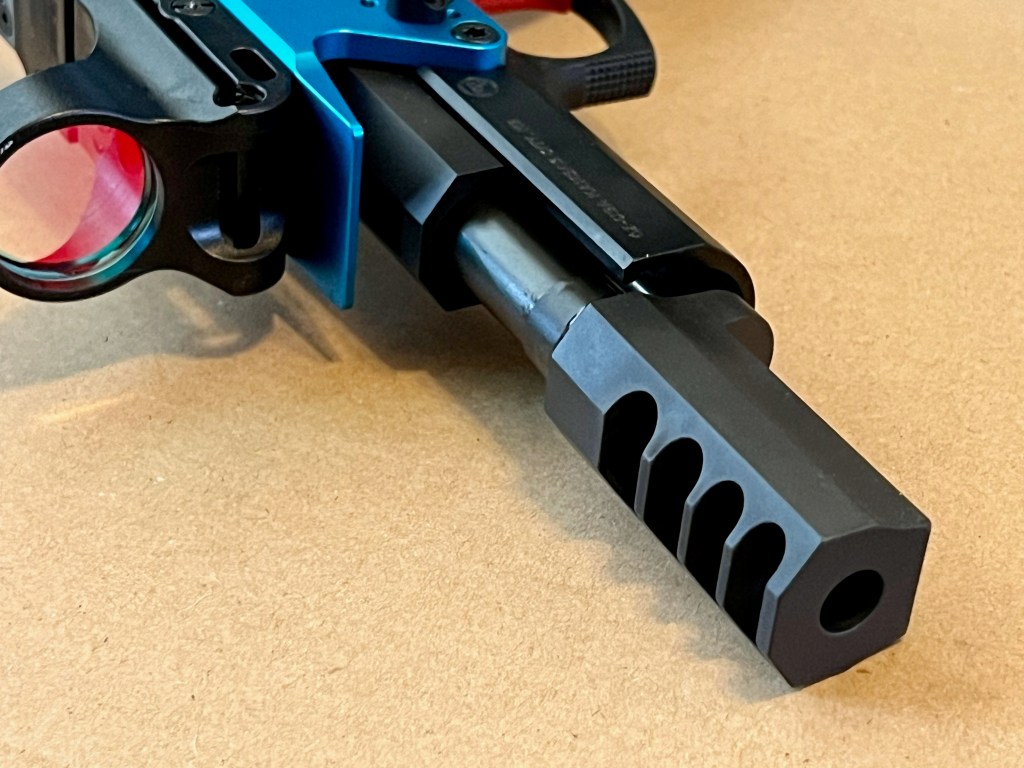
- A large four port compensator,
- A muzzle with a front sight,
- A slide racker,
- A rear sight,
- A frame mountable gas pedal (or thumb rest),
- A frame mounted optic mount,
- An optic mount mountable gas pedal,
- A C-More SlideRide 6 MOA red dot sight,
- A collection of hex and Torx wrenches necessary to reconfigure the pistol,
- A few non-locking slide stop pins,
- A spare slide stop,
- A low power recoil spring,
- Three 20-round magazines,
- One 26-round magazine,
- A cable lock,
- A pistol manual,
- And an optic manual.
The standard Czechmate variant also includes a spare 9mm barrel.
The Parrot from Muzzle to Heel
Compensator
We begin the muzzle to heel walk of the Parrot with either the compensator or the front sight integrated muzzle device. Both thread onto the barrel. The compensator, or comp, is big and heavy with four large ports. The weight makes the Parrot front heavy. I suspect that, along with the ports, helps minimize muzzle flip, and it makes for a very fast return. The flip side: it took extra effort to keep the muzzle from dipping below the point of aim on the return. Granted, a well timed follow up shot as the dot returns helps keep the muzzle from dipping too far. It also makes for some incredibly fast splits.
Another drawback of the front heavy configuration is that it doesn’t lend itself well to transitions. The inertia is noticeable and makes it more difficult to start and stop a transition. There may be additional benefits to the compensator that I’m not aware of yet. They may reveal themselves as I get more trigger time with it.
Front Sight Muzzle Device
The front sight integrated muzzle device is not nearly as heavy as the comp. However, it doesn’t do anything to reduce muzzle flip or speed up recoil recovery. The integrated front sight design minimizes front sight movement during recoil considerably, compared to front sights installed on the slide. With the front sight on the muzzle device, the sight only moves vertically during recoil. With the front sight on the slide, it moves vertically but also back and forth as the slide reciprocates. The difference gave me the impression that I could establish a front sight focus for precise follow up shots faster. That said, I’d take a high visibility fiber optic sight over the black serrated front sight on the muzzle device.
Slide, Rear Sight and Slide Racker
The traditional CZ 75 slide follows the attached muzzle device. As one can expect, it has the low profile that is characteristic of CZ pistols. It does feature front and rear slide serrations. Even so, the limited real estate makes it difficult to establish a working grip and manipulate it. This can make clearing malfunctions challenging. The flip side of the coin here is that the low profile design means less slide mass. Less reciprocating mass translates into less recoil and faster operation, which lends itself to competitive shooting where speed is important.
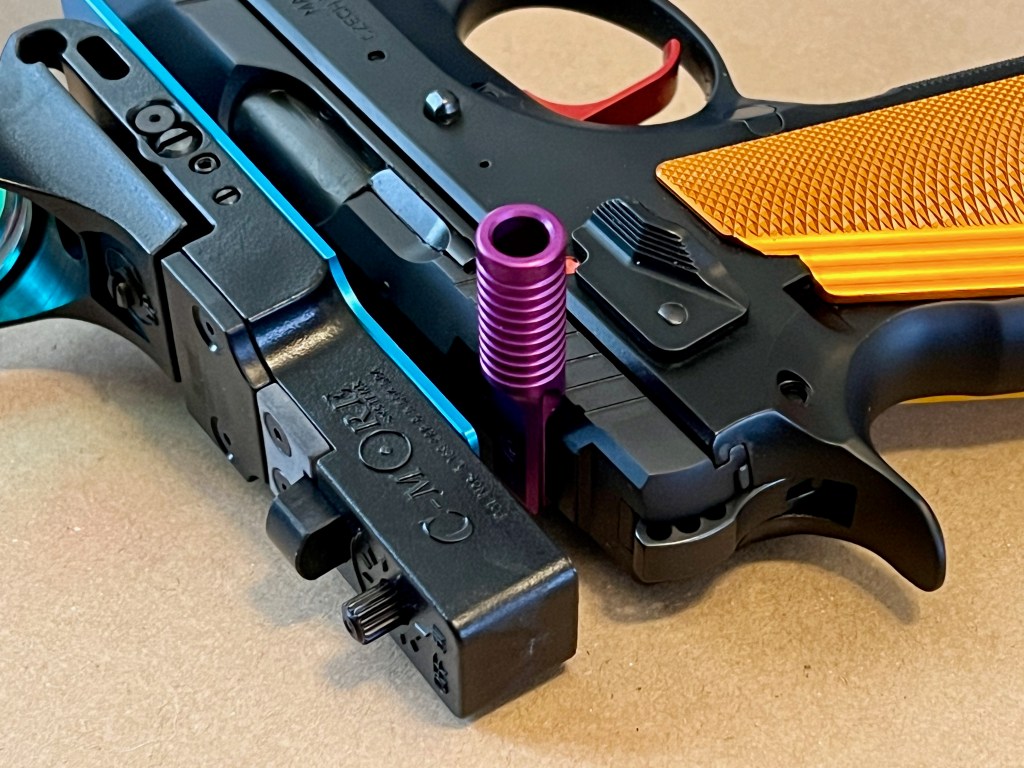
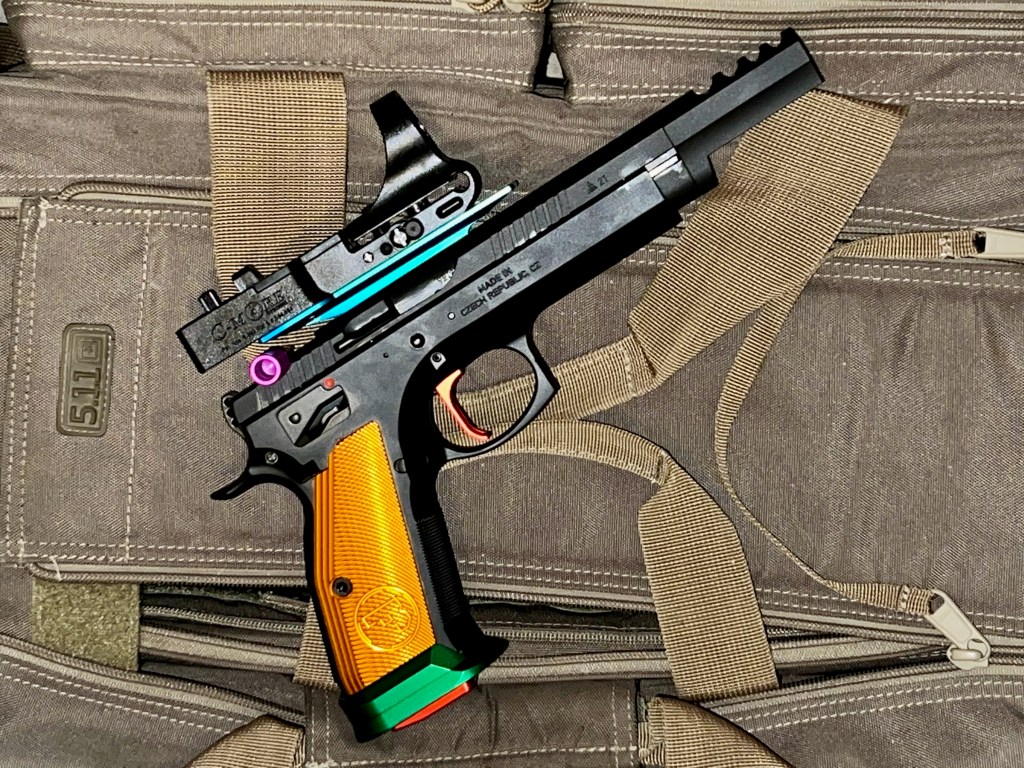
Continuing along the slide on the right side, we find the ejection port and the external extractor. A bit further back on top of the slide is a dovetail for the fixed rear sight or the slide racker. The fixed rear sight features a traditional square notch design that is black and serrated. The slide racker is a small, simple horizontal design that can be oriented on either side of the slide. Note that if it sits on the left side, the optic mount will interfere with removing the slide. One will need to remove the racker to take the slide off for cleaning. The Parrot’s slide racker is anodized purple, whereas the standard Czechmate’s slide racker is black.
Barrel and Frame
Within the slide we have the cold hammer forged 5.23 in threaded barrel, chambered for 9mm Luger. I should mention that the pistol is designed to withstand pressures from 9mm Major loads. Those loads are desirable in order to make major power factor in USPSA and IPSC competition. Many consider them required to be competitive in Open and Limited divisions at a high level. Under the barrel is a full length steel guide rod and the recoil spring.
Below the slide we have the steel CZ 75 large form factor frame. On the left side of the frame, we first encounter three pre-drilled holes. They hold either the Limited configuration gas pedal (or thumb rest, depending on the preferred nomenclature) or the optic mount. In the case of the Parrot, the optic mount happens to be anodized blue. The optic mount also includes several pre-drilled holes where a gas pedal may be affixed at different angles.

Slide Stop and Thumb Safety
We’ll cover the optic mount and the included optic in a bit more detail soon. For now, let’s continue along the frame to the slide stop, also found on the left side. As mentioned earlier, the included parts allow the user to swap the traditional slide stop for a non-slide-locking pin. This option shaves off an ever so tiny amount of weight. It may also be necessary in order to install some aftermarket gas pedals. And it leaves a smoother surface that could alleviate some hot spots on the support hand. Some competitive shooters may prefer that. Giving up slide lock is a fairly common practice. It usually begins with competitors using custom magazines, or a non-locking follower that allows stuffing in a bit more ammo.
Right after the slide stop, one will find the ambidextrous manual thumb safety. The thumb safety is one of the most contentious features of this pistol. At least it is among the aficionados that frequent the local matches I do. We all understand that it is absolutely necessary, given it is a single action pistol. However, everyone has an opinion about its placement and design. I found it very difficult to actuate with the firing hand thumb. I had a hard time reaching it, which also means I had a hard time “riding it” while shooting. Thankfully, there are several aftermarket options to alter its footprint and improve its usability.
Hammer and Grip
Just a bit further back, we arrive at the hammer. The Parrot features a “Stealth” hammer with a low profile design and a bit of material removed via three holes. It reminds me more of a lever than a hammer. The standard Czechmate features a skeletonized competition hammer, which is also found on several of CZ’s other competition pistols.
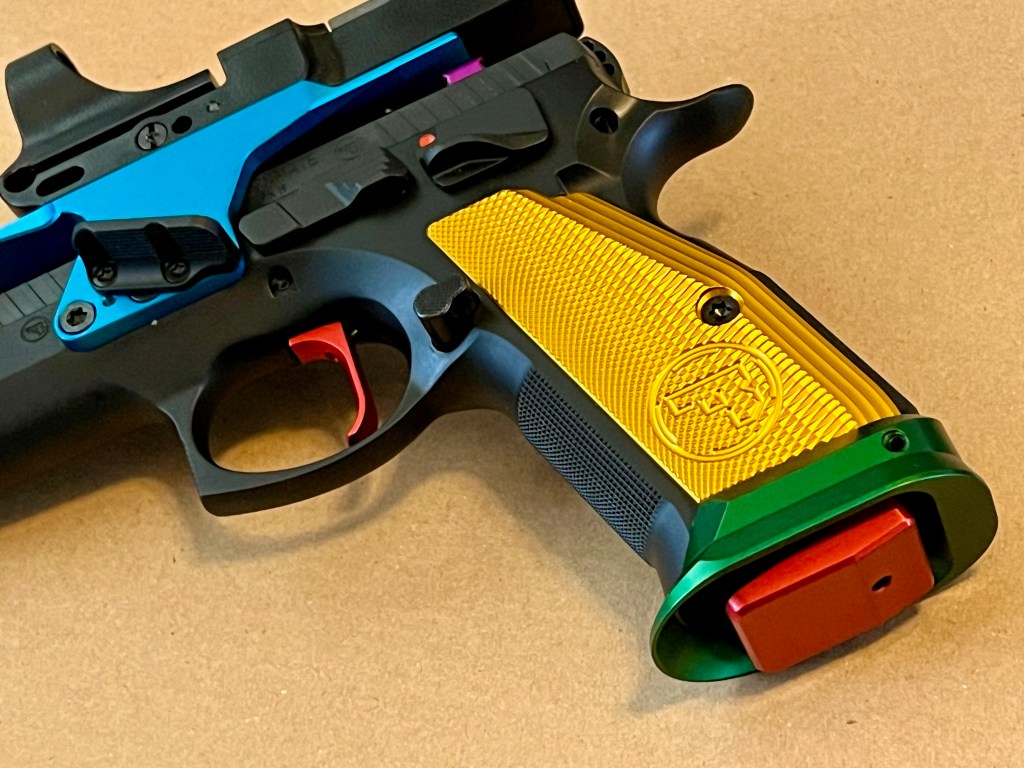
Heading down from the hammer, we come across the large beavertail. It is part of the wonderfully designed ergonomic grip CZ is known for. There are plenty of details here to appreciate. No sharp edges that can lead to discomfort and hot spots. Aggressive checkering along the back of the spine and the front of the grip. An undercut trigger guard with a checkered flat front.
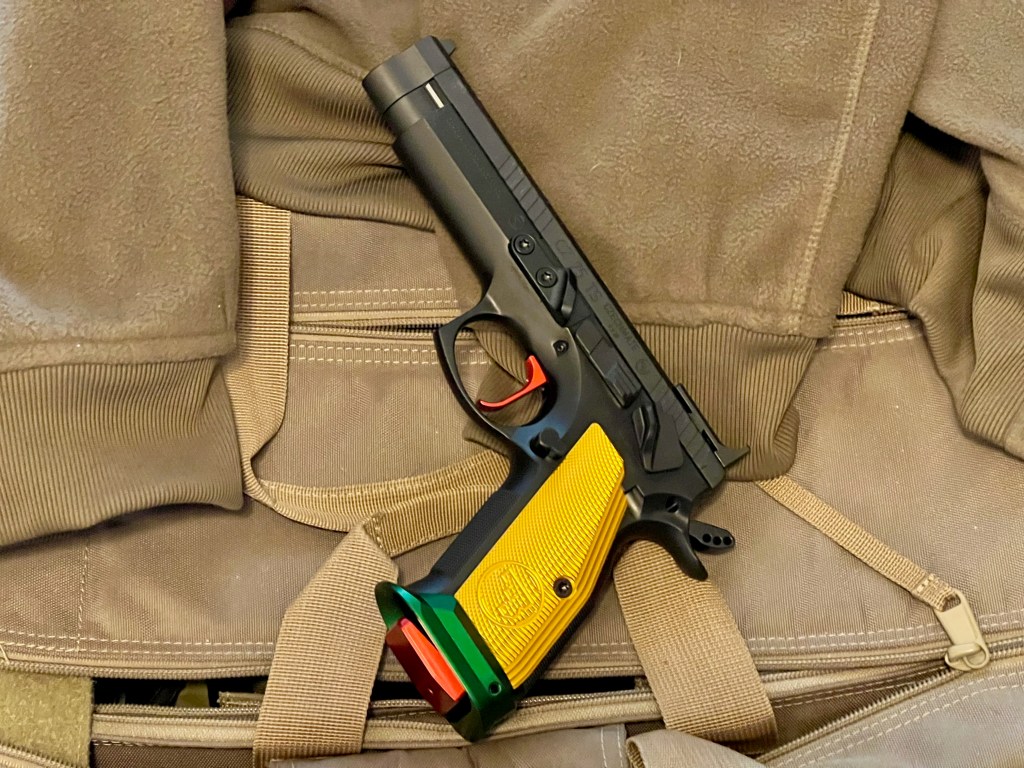
The pistol comes with thin aluminum grips with a fair amount of texturing, and they feel really good in hand. Granted, I would have preferred more aggressive texturing, but aftermarket grips can remedy that if so desired. Here the CZ Parrot adds another splash of bright color: yellow grip on the left, orange on the right.
Magwell and Trigger
The grips meet up flush with a flared magazine well at the bottom. It is functional and helps with those high speed magazine changes. The extended reversible magazine release button makes them easy to initiate. As one can expect by now, the Parrot gives us yet another splash of color with a green magazine well. It makes the red base plates that are exclusive to the Parrot magazines really pop. There really isn’t anything subtle about the Parrot. It is as vibrant as the name suggests.
The last thing left on the frame is the trigger, which happens to be anodized red on the CZ Parrot. The trigger is mostly flat with a slight curve at the bottom that provides an index for the trigger finger. The trigger pull is like butter. Given it is a hinged design, there is a tiny bit of pre-engagement travel, which a set screw can adjust. By my best estimate, the pre-engagement travel is about an eighth of an inch before we reach the wall. There is a microscopic amount of creep, which is difficult to detect. I estimate it at 1/32 to 1/16 of an inch. Then it breaks at just one ounce north of two pounds.
The entire pull is short and smooth, with a soft break that reminds me of a carrot snapping. The reset is short and tactile. It occurs when the trigger is let out about an eighth of an inch. Overall, it’s the smoothest and lightest trigger I’ve felt on a CZ that hasn’t been tuned by a gunsmith.

Optic Mount and C-More
Circling back to the optic mount and the optic. I may go into an in-depth review of the C-More optic in a future post. For the sake of brevity, I will attempt to be brief here. To the best of my knowledge, it is an older design. Even so, the optic is viable for competition given its large window and generous dot size. Even though it’s large, it is relatively light. There are a few things about it that I don’t care for. The one that pertains to this review is its size. With the racker on the right side of the slide, I work it with my support hand (my left hand). The optic gets in the way.
Optic aside, a frame mounted optic behaves differently than a slide mounted optic during recoil. The dot moves far less when mounted to the frame. It’s similar to the movement difference I described between a slide mounted front sight and a muzzle device mounted front sight. The difference in movement makes it considerably easier to call shots and track the dot.
How the Parrot Shoots
That’s pretty much the CZ 75 TS Czechmate Parrot from muzzle to heel. Let’s turn our attention to how it shoots. I’ll start with a little disclosure. I didn’t send a lot of lead down range while it was configured for Limited division. Most of my time with it so far has been in the Open configuration. That said, I found the Parrot to be incredibly accurate. It is also very easy to start shooting fast, given how little it moves during recoil. Yes, the big old compensator had a lot to do with that. So did the minimized movement of the dot (and the front sight). However, a lot of this also had to do with its weight. It tips the scale at 45.9 ounces in Limited configuration and 52.7 ounces in Open.
An undesired side effect is that sometimes it’s easy to go too fast. At least, faster than I am able to see and process information. That means getting more familiar with the pistol and improving practical marksmanship skills. It also means exercising a little more patience and restraint before attempting to go full throttle.

Mixed Feelings About the Parrot
Overall, I have mixed feelings about this pistol. Don’t get me wrong, I think it’s a fantastic pistol. My “mixed feelings” stem from its intended purpose now that it has been discontinued. On one hand, I see the pistol’s potential as a competitive platform for USPSA/IPSC Limited and Open divisions. It provides a solid foundation with a relatively low cost of entry. Still, it will likely need some customization to suit the individual and their shooting style. The list off the top of my head: grips, magazine well, slide racker, compensator, optic, optic mount, and manual safety.
Now, CZ has discontinued the Czechmate, and the Parrot is a relatively rare variant. It’s not out of the question to consider the Parrot’s future collector’s value. I suppose we could also consider the same for the Czechmate. Given its availability, though, I’d be far more inclined to customize it and put real competition wear on it.
Closing Thoughts
Now, I’m not going to tell folks what to do with their stuff. If they want a CZ Czechmate or a Parrot to be a safe queen, then go for it. If they want one or two to run in competitions, then go for it. My suggestion for either purpose? The Parrot for the safe queen and the Czechmate for competition, especially since it includes an extra barrel. Either way, those of you who have had one of these on your radar may want to make a move. New ones are still in stock at some retailers. It’s hard to say how long that will be the case. It’s also hard to predict how the second hand market will behave as new in box supply diminishes.