

Given how much I enjoyed KR Training’s Top 10 Drills class, I couldn’t help myself but sign up for it again as I saw it offered on the class schedule again. In my opinion, it’s one of those classes that is worth retaking over and over again for a number of reasons. The first reason, as I mentioned in the class’ previous after action report, is that the drills run in the class can be used to provide an objective assessment of one’s proficiency. Therefore a second run through it gives one a chance to see how much improvement (or deterioration) has taken place since the last time it was taken. Another reason is that it is a short fast paced class that doesn’t require a large ammunition or time commitment. Not to mention the “refresher” discount KR Training has in place makes repeating the class significantly more affordable. So yeah, signing up and taking the class was a no brainer for me.
Karl Rehn made a few changes to the class since the last time I took it, which was less than a year ago. The most notable change was that the drills weren’t the same. The class was also shortened from three to two hours. These changes were to fit this class into a two-hour live-fire block for the Rangemaster Tactical Conference, or Tac-Con. Making this particular instance of the course a test run or a beta test if you will since it took place prior to Tac-Con. By the time anyone reads this, Tac-Con will have already taken place. I made it a point to publish this after action report after the event to ensure this post wouldn’t be a spoiler for Tac-Con attendees.
The gear I used for this class was virtually identical to the gear I used the last time that I took this class. The exceptions were the gun belt and the ammo. This was completely unintentional and unplanned. Nevertheless, I’m glad it worked out this way since it made it easier to see what changed in terms of my proficiency since the comparisons between repeated drills will be essentially an apples to apples comparison. Here is the gear that I used:
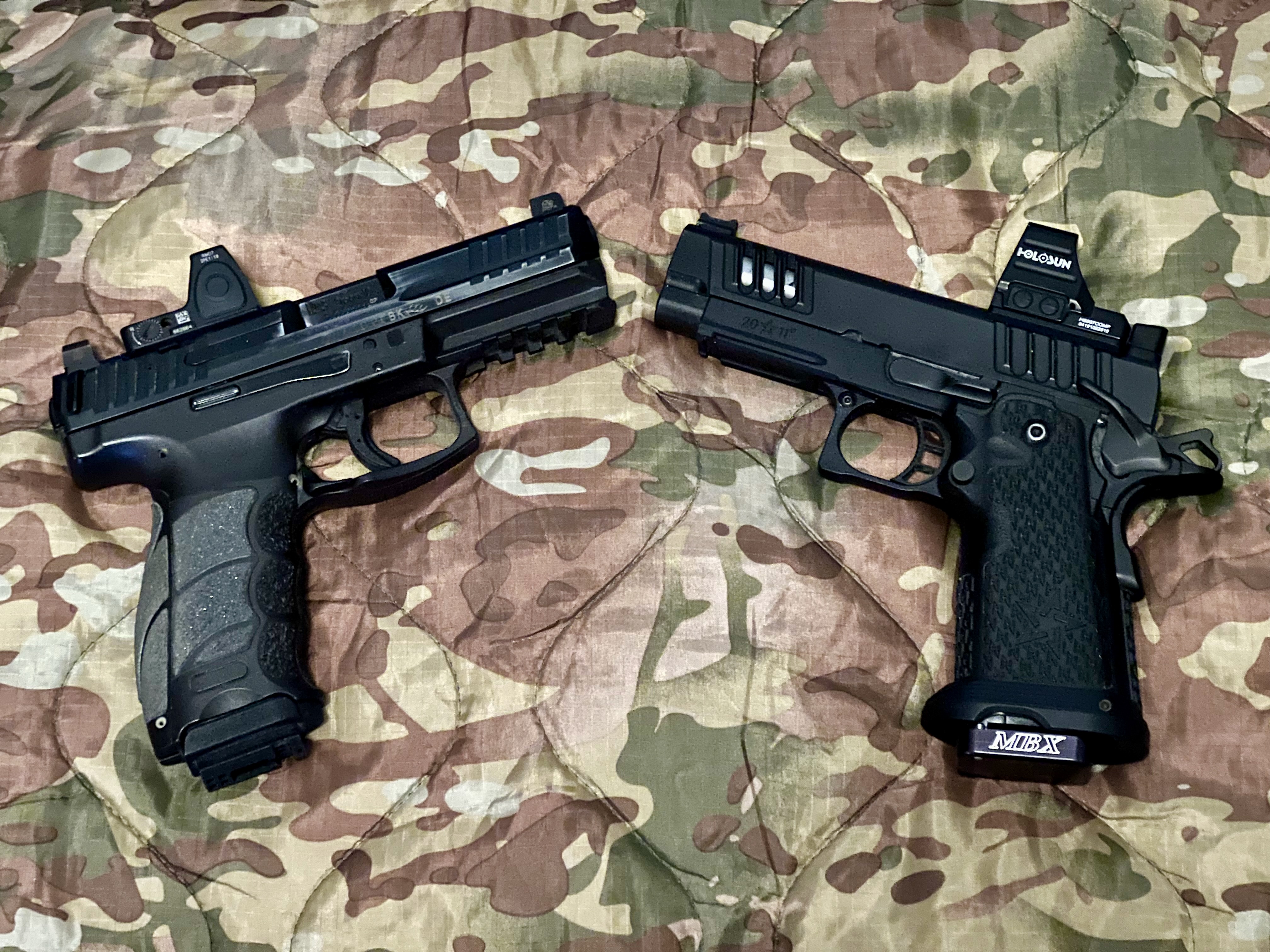
- Gun: Heckler & Koch VP9 with a Trijicon RMR outfitted with Jerkman Custom Grips
- Holster: G-Code Incog Eclipse IWB holster
- Mag pouches: Concealment Solutions Venom Single Magazine Carrier x2
- Belt: Nexbelt Titan EDC Belt
- Ammo: CCI Blazer Brass 9mm 147gr FMJ (round count for the course was roughly 200 rounds)

The first drill we shot was the NRA Basic Pistol Qualification. This was also the first drill the last time I took the class. The drill consists of shooting 5 shots into a 4″ circle at 5 yards with no time limit. We used a B-8 repair center target for this which was a slight deviation from the last time I took the class. The 10 ring is 3.36″ in diameter making it roughly 25% more difficult than the 4″ circle the drill calls for, but it works. We shot this drill twice. With the exception of 1 shot, I placed all the hits inside the 1.7″ X-ring. I could make the argument that the 10th shot was an X-ring hit since it broke the line, but just barely. Regardless, there was virtually no change in how I did on this drill this time around.
The next drill we ran was one that I hadn’t heard of prior. At least not by name nor do I recall shooting it before. The drill was called the 1-2-3-4-5 drill. It consisted of five strings all shot from 5 yards into the B-8, all shot from the ready position, and all having a par time of 5 seconds. The number of shots fired corresponded to the number of the string. So one shot in five seconds for the first string, two shots in five seconds for the second string, and so on for a total of 15 rounds. I don’t recall how it is scored, nor were there scoring notes in the one page handout we received which included the list of drills and their descriptions. I suspect it can be scored using the rings for a possible 150 points with no points awarded for shots after the time limit. If that is the case, I ended up with a score of 150 with 9 in the X-ring.
Next up was The Test, commonly known as the 10-10-10. The drill consists of firing 10 shots at 10 yards with a par time of 10 seconds, hence the moniker of “10-10-10”, from the ready into a B-8 target and is scored using the rings giving us a possible 100 points. Passing requires 80 points, 90 is considered good, and 95 is considered excellent. We ran this drill twice. I posted a 96 on my first attempt and a 99 on the second. Both of these were improvements over how I did on this drill the last time I took this class where I put up a 95.
At this point, the B-8 target was replaced by a KRT-2 target.

The fourth drill was The Wizard Junior. While this was a drill that was not included the last time I took this class, it was a drill that I attempted when I took KR Training’s Advanced Handgun class almost two years ago. Kind of, anyway. In the Advanced Handgun class we ran The Wizard. The junior version of this drill was the same drill with a decreased difficulty. It consisted of the same strings, but it used a par time of four seconds for each string rather than the standard 2.5 seconds. The strings, which all start from the holster, are as follows:
- From 3 yards, 1 head shot using strong hand only, two times
- From 5 yards, 1 head shot using strong hand only, two times
- From 7 yards, 1 head shot using both hands, two times
- From 10 yards, 2 shots to the body using both hands, two times
I didn’t shoot it clean as I managed to pick up a miss on one of the body shots. This was disappointing since I shot it clean when I took the Advanced Handgun class two years ago.
Next up was the Split Bill drill which Karl accredited to Gabe White as it is one of the four technical skill tests Gabe White uses in his Pistol Shooting Solutions class. The drill consists of drawing the pistol and delivering four hits to the body and then two to the head. The time limits used for this class were generous in the sense that they were significantly longer than the time requirements Gabe White would require for a student to earn one of his coveted pins. I made the class time limits and shot the drill clean both times we ran it. Unfortunately, the drill wasn’t run individually so I don’t know how well I did compared to the last time I attempted this drill under time pressure which was when I last took Gabe White’s class and met the 3.5 second time limit for a light pin.
The Four Aces drill was next in line. This drill is shot at seven yards and consists of drawing the pistol, two body shots, a reload, and two additional body shots. The par time we used in class was six seconds which was, once again, generous at least in the context of competitive shooting since a par time of 3.5 seconds is achievable by a practiced competitor using competitive equipment. We ran this drill several times. Many of which I recall shooting clean and meeting the time limit. Like the Split Bill drill, none of the attempts were individually timed.
The F.A.S.T. Drill was the seventh drill. This drill was run in both the previous time I took the Top 10 Drills class and the Advanced Handgun class. It consists of drawing the pistol, two headshots, a slide lock reload, and four shots to the body from seven yards. This drill was run twice as a class with a 10 second par time. The lack of individual student timing on this drill, like the previous two drills, made it difficult to objectively compare my performance in the other classes. Subjectively, I did about as good on this drill as I had done previously.
The eight drill was another new drill for me. It was the Wisconsin LEO Malfunction Combo which was run at a distance of seven yards. This was a four round drill that had a whole lot of things going on. The first complicated thing was the set up which called for an empty chamber, an empty magazine loaded specifically with a type 3 malfunction dummy round followed by two live rounds, and a second magazine with at least two rounds. The start condition is a holstered pistol with an empty chamber and the “special” magazine with the specialized type 3 malfunction dummy round inserted. On the signal, a verbal challenge is issued with a drawn pistol to a ready position. This is followed by a click fixed with a tap rack, two shots to the body, a type 3 malfunction clearance, and two more shots to the body without a time limit. The type 3 malfunction clearance procedure consisted of locking the slide back, striping the magazine, racking the slide 2-3 times, and inserting another magazine.
It was at this time that the KRT-2 target was replaced with a KRT-1 target.

The next to last drill was called Row by Row which consisted of three strings without a time limit that we ran twice and was a first encounter for me again. The first row was the top row which was made up by the two small colored circles on the target pictured above. Each colored target was shot with the number of shots corresponding to the label inside of the target. In the case of the top row, the red circle on the left labeled with a number one was shot one time and the yellow circle on the left labeled with a number 3 was shot three times. The second row was made up of the yellow square with a label of two and the blue diamond with a label of on2. The third and final row was made up of the red diamond with the number three and the blue square with the number two. Now that you have an idea of the target we working with, here are the details to each of the three strings:
- Top row – draw, shoot one, shoot three
- Middle row – draw, shoot two strong hand only, shoot one strong hand only
- Bottom row – from ready, shoot three weak hand only, shoot two week hand only
Even without a time limit, I managed to miss two hits on the first run and one in the second. All of my misses occurred in the final string where I was shooting weakhand only. I also managed to encounter one failure to feed malfunction working the first target on the third string both times. I suspect this was due to “limp wristing” when shooting weakhand only. Nevertheless, the misses and malfunctions are a clear sign to me that I need to put some time into getting better shooting weakhand only.
The last and final drill was the KR 16x16x16 drill which was also the last drill we ran the last time I attended the Top 10 Drills class. This drill consists of firing 16 rounds at 16 feet with a time limit of 16 seconds. Just like the last time I shot this drill, the drill wasn’t run with a 16 second time limit though. It was run as a class with a 24 second time limit first. Then we were given the choice to be individually timed or run it a second time as a group with a 24 second time limit. I opted for individual timing because I prefer individualized scoring as I find that provides me with more specific objective feedback. The set up for this drill calls for sixteen rounds to be randomly distributed between two magazines which randomizes the point at which one is forced to reload during the drill. The course of fire calls for shooting each shape in any order with the number of rounds indicated by the label on the shape. The large white triangle labeled with the letter A got three shots and the small upside down white triangle labeled with the letter B got one. The individually timed second run that I opted for resulted in a clean run in 12.3 seconds which was a new personal best compared to my previous best run of 18.29 (which included a 1 second penalty for one missed shot).
As is typical in every class debriefing, students are asked to share one thing they learned or found interesting. I mentioned what I found most interesting was the importance of mental focus as complexity increases. What I didn’t get to verbalize at the time, mostly because I wasn’t done processing and internalizing that thought at the time I shared it, was the importance of automaticity or unconscious competence, which is probably obvious to some readers. There is a lot to unpack here, but I’ll attempt to keep it brief. Our mind can really only focus on one thing at a time. To do well in more complex drills, we have to shift from one focus to another. The time required for focus shifts to take place seems to largely depend on when we are done with the previous focus. If that last sentence seems nebulous, then that’s because it is, but I’ll try to explain. The first drill required nothing more than putting a shot on target. As simple as that sounds, that required getting a good grip on the pistol, aligning it with the target, and getting a good trigger press. Those three things are three different things to focus on. However, when focusing on the trigger press, one can’t think about the grip or the target alignment. We have to rely on our ability to maintain grip pressure and target alignment as we focus on the trigger press. Without some level of automaticity, grip pressures change and alignment shifts resulting in a less than perfect impact. That’s why we don’t stack shots on top of each other every single time. Yet, we get closer to that as our proficiency increases. As drill complexity increases via the number of tasks, it becomes increasingly difficult to shift focus to the correct next thing and maintain focus on the current thing for sufficient time in order to do well with the current task before going on the next task. Adding time limits makes things even more difficult because we are now forced to discriminate between the things to focus on and limit the amount of time we can focus on them which means we have to increase our reliance on subconscious competence to complete the drill in time and in an acceptable manner.
That was a lot of words attempting to convey a concept that I haven’t found an easy way to convey, but think I understand. Or at least, I’m beginning to understand. So I will attempt to illustrate it with some examples. I think the reason I was able to get all X ring hits on the first drill, the NRA Basic Pistol Qualification, was because I was able to get a good grip, get a good alignment, and manage a good trigger press without thinking much about any of those tasks specifically. I was generally aware of those things and shifted my mental focus between them several times. The impact that almost fell out of the X-ring occurred because my focus got snagged on the alignment and I “yanked” the trigger. Meaning at that specific moment when I broke the shot my focus was on the wrong thing. Another example was my personal best on the 16x16x16, my mental focus started on the first shape, when the gun got there I focused on getting the right number of hits, then I moved to next target and repeated the process on each subsequent shape following a predetermined sequence of shape engagement, when the gun went empty, I shifted the focus to the reload and returned back to what it was working on, and finished out the remaining shapes. Everything else was on autopilot so to speak.
I focused a lot on how I performed on the drills in this post, but that wasn’t because I wanted to toot my own horn. Rather it was because I aimed to share how I’m evaluating my own skill development with the hope that it helps others with their own skill development. KR Training’s Top 10 Drills class continues to be one of my favorites. Even if the format changes and I get exposed to new drills, the value remains. I get objective measurements of my performance. It also helps me identify things that I can work on to improve in my own practice. Last but not least, it provides me courses of fire that I can use to help others improve when I coach them. While I would have liked to have seen a bit more individually timed drills in this class, the absence of individual measurement is understandable given the compressed time format this class had which still had plenty of meat to it that made it worthwhile and worth the investment. I can’t imagine not signing up for another class when it appears again on KR Training’s schedule of classes.
4 responses to “KR Training Top 10 Drills Again”
[…] I said in the previous KR Training Top 10 Drills after action report, I can’t help myself but sign up when a Top 10 Drills class shows up on […]
UZ- You make me feel like I was there watching you – and I like the way you try to explain the ‘only think on one thing at a time’ and ‘automaticity’ I am new to your site – but will be around a long time. I love training at KR – Karl is awesome – with any luck I will run into you there as well!
Thanks for the kind words! I’m glad you enjoyed my work and hope you found it useful or at least interesting. I’m one of Karl’s assistant instructors now so hopefully I’ll see you there soon enough.
[…] so minor that it doesn’t warrant detailing out the class flow and individual drills since the previous after action report post already does that. As such, this after action report will be brief – limited to my […]