
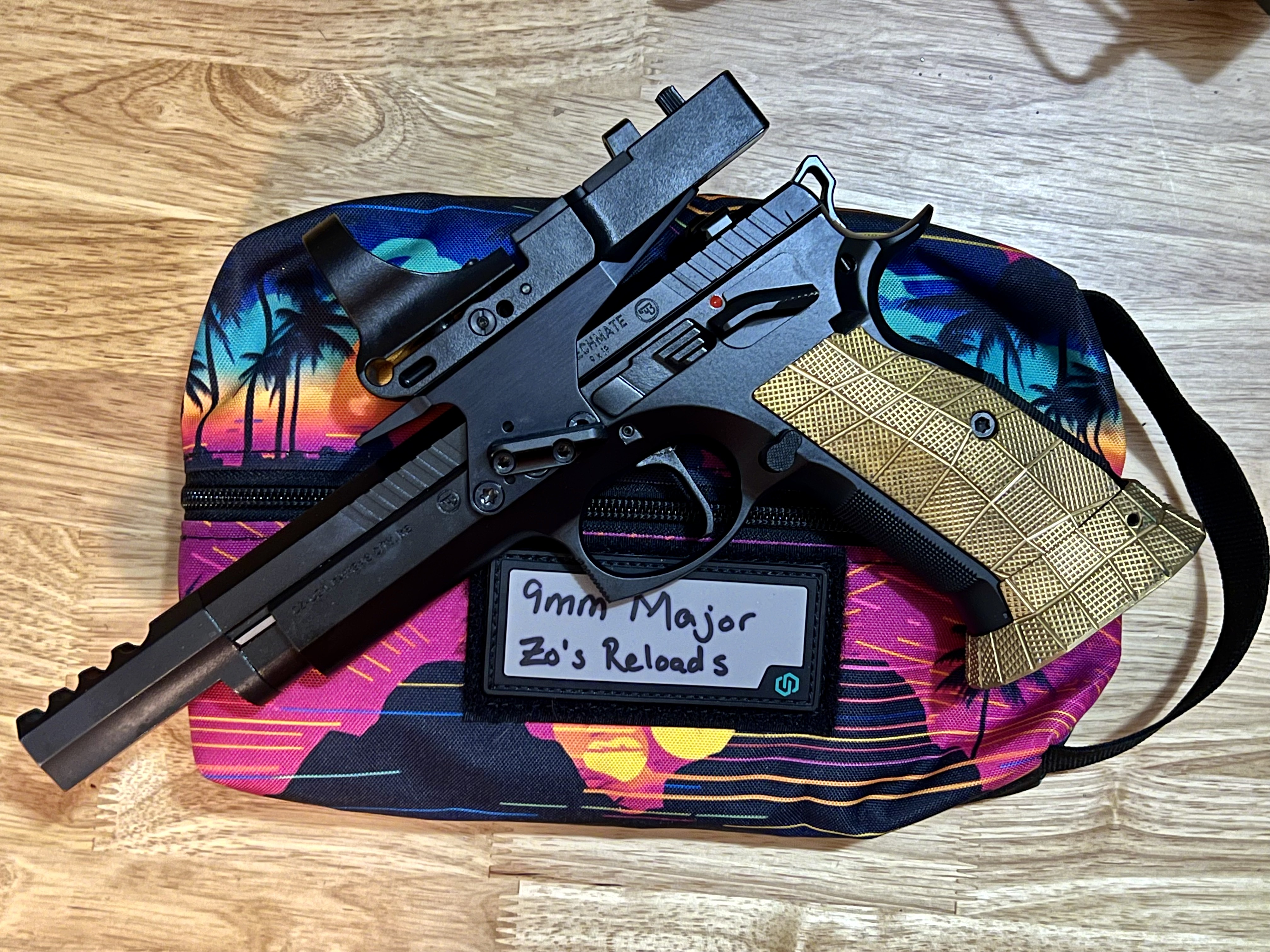
One of the things I looked forward to when I decided to start loading my own ammo was crafting 9 Major for USPSA’s Open division, hitting the major power factor requirements with my CZ Czechmate. The main reason I haven’t shot that division much is my focus on the 2011 platform over the past year and change. Another reason is that sourcing 9 Major from boutique ammo manufacturers has been a pain—they’re often sold out, and when they’re not, the cost per round is a tough pill to swallow. Loading my own solves the availability issue and makes the cost far more palatable.
With a Dillon XL750 already set up for 9mm Luger and a burning desire to shoot 9 Major, I figured, how hard could it be? Find load data, source components, and load. Easy, right? Not exactly. It came with some challenges.
What is 9 Major Ammo?
From what I’ve gathered, 9 Major, sometimes called 9mm Major, is a hot-rodded version of 9mm Luger. It’s a wildcat cartridge cooked up by IPSC and USPSA Open division shooters in the late 20th century to hit the “Major” power factor (165 minimum for USPSA) without the cost of .38 Super. It uses a standard 9x19mm case but packs slow-burning powder behind lightweight bullets—typically 115–124 grains—to push velocities past 1,400 fps. This high-pressure round isn’t for your average 9mm pistol; it’s built for raceguns with robust frames and compensators to handle the extra juice safely. Perfect for competition, it demands respect and the right gear to avoid turning your handgun into a hand grenade.

Two clues in that description hint at the challenges I faced. First, it’s a wildcat cartridge, meaning there’s no official SAAMI specification. Second, its specialized use limits demand to a niche group of IPSC and USPSA Open division shooters avoiding .38 Super’s cost. These factors make official published load data scarce—nonexistent, in my experience. What little I found was spotty, mostly forum posts from pistol shooters.
Component Selection
The sparse, questionable load data on forums didn’t inspire confidence, especially since I didn’t recognize the posters. My novice-level knowledge didn’t help, but a pattern emerged: light bullet, lots of slow-burning powder. I noted it and decided to ask the regulars at local matches—folks I’ve known for years who load 9 Major ammo for their CZ Czechmates. The group was small, but tight-knit, and their recipes were nearly identical, echoing the light bullet, slow-burning powder pattern. The go-to was 124 gr. JHP bullets from Precision Delta, seated to an overall length of 1.170″ with a hefty charge of Vihtavuori 3N38 powder.
I followed their lead with the same components but learned Hodgdon HS6 and Accurate No. 7 are viable powder alternatives, often used for high-pressure pistol cartridges like .38 Super and .40 S&W. I’ll keep those in mind if 3N38 runs short.
The locals also used previously fired 9mm brass and whatever small pistol primers they could find. This was a relief—new brass or specific primers would jack up costs and limit shooting volume.
Current component pricing breaks down like this:
- 124 gr. Precision Delta JHP: 10¢ per round
- Vihtavuori 3N38: 5¢ per round
- Processed 9mm brass from Fancy Brass: 6¢ per round
- Winchester #6-1/2 Small Pistol Primer: 5¢ per round
Total cost per round: ~26¢, within 10% of my 9mm Luger loads. That’s a steal compared to boutique 9 Major, which runs 45–50¢ per round when I can even find it.
Press Configuration
My Dillon XL750 was already set up for 9mm Luger, but I realized I’d likely switch between loading 9mm Luger and 9 Major often enough to consider a separate toolhead. The changes are minimal—adjust the seating die for overall length, clean the powder measure for a different powder, and tweak the powder drop. Cleaning the powder measure is tedious enough to justify a second one, but a whole new toolhead? The cost-to-benefit ratio feels iffy.

That said, I used this as an excuse to try new dies. Flawed logic, sure, but it didn’t stop me. After checking reviews, I went with:
- Mighty Armory full-length carbide sizing and decapping die
- Dillon Precision bullet feeder dropper die
- Redding Reloading competition seating die
- Mighty Armory full-length carbide taper crimp die
The Mighty Armory dies perform as expected—no complaints. The Redding die, however, had seating depth consistency issues with heavier, compressed powder charges. I suspect other micrometer-adjustable seating dies might struggle similarly, but I haven’t tested others to confirm, and I’m not curious enough to spend more to find out. This die will likely work better for my 9mm Luger loads, so I’ll move it to that toolhead. Since the Mighty Armory dies did well, I’m considering their seating die to see if it improves consistency.
On consistency: I learned some precision rifle reloaders add a thrust bearing between the shellplate and shellplate bolt on Dillon 650s and 750s for more consistent output. It’s a cheap mod, so I tried it, and it works as advertised—less variance in loaded cartridges.
Load Development
The locals used 8.9 grains of 3N38, which made me nervous—it’s nearly two grains over Vihtavuori’s max published charge (7.1 gr.) for 124 gr. JHP with 3N38. I knew 9 Major ammo would exceed published maxes, but I opted to work up from 8.0 gr. in 0.1 gr. increments, loading 10 rounds per charge. Here’s how it shook out:

- 8.0 gr.: 1,314.4 fps, 163 power factor—too low for Major.
- 8.1 gr.: 1,304.4 fps, 161.7 power factor—lower than 8.0gr, which surprised me. Likely my error.
- 8.2 gr.: 1,322.8 fps, 164 power factor—still too low.
- 8.3 gr.: 1,341.9 fps, 166.4 power factor—meets requirements but too close to the minimum for major matches.
- 8.4 gr.: 1,364.4 fps, 169.2 power factor—felt great in the Czechmate, meets requirements. I might stick here after testing in different conditions to check temperature stability, as data on that is scarce.
- 8.5 gr.: 1,372.5 fps, 170.2 power factor—good feel, not as nice as 8.4gr. I’ll likely use this for the 5 power factor buffer over the 165 minimum.
- 8.6 gr.: 1,383.3 fps, 171.5 power factor—getting stout, could work, but I’d need to shoot more to assess pistol stability.
- 8.7 gr.: 1,394.5 fps, 172.9 power factor—similar to 8.6gr, stout but shootable. More data needed on pressure benefits.
I ran out of range time before testing 8.8 gr. and 8.9 gr. loads. I’ll test them later but may not write about it unless the extra pressure proves beneficial, likely for compensator performance. Based on the velocity trend, I expect 8.8gr and 8.9gr to hit ~1,400+ fps, yielding power factors around 174–175. I’m curious why locals push this high—probably for better comp performance—but I wonder if it’s worth the wear and tear. Time will tell.
For those curious about future results, I’ll update my load data page and post details on AmmoFans.Net, my new project with reloading features still in its infancy. Check it out—it might help your reloading adventures.
Final Musings
I was shocked at how cost-effective 9 Major turned out to be—within 10% of 9mm Luger costs. That was the goal of this wildcat cartridge, but I didn’t expect it to be this close. Now I can shoot 9 Major ammo and USPSA Open more often, but I know these high-pressure rounds will beat up my gun. It’s not if, but when. I’m eyeing a 2011 in .38 Super Comp next, but I hope my Czechmate holds up until then, especially since parts for the discontinued CZ are getting scarce. It might be smart to ask the locals what parts they’ve replaced and stock up, just in case.

For now, it’s all fun and games with this cartridge—at least until something breaks.

Leave a Reply