

Back in 2020, I wrote about what it takes to purchase a silencer, or a can, as most owners call them. At the time, it took a $200 tax stamp per can, fingerprints, a passport photo, an NFA trust and, in my case, an 11-month wait. I’m still a little salty about that wait. That first can was a SilencerCo Omega 300, an earlier version of the Omega 300 DT that SilencerCo still sells.
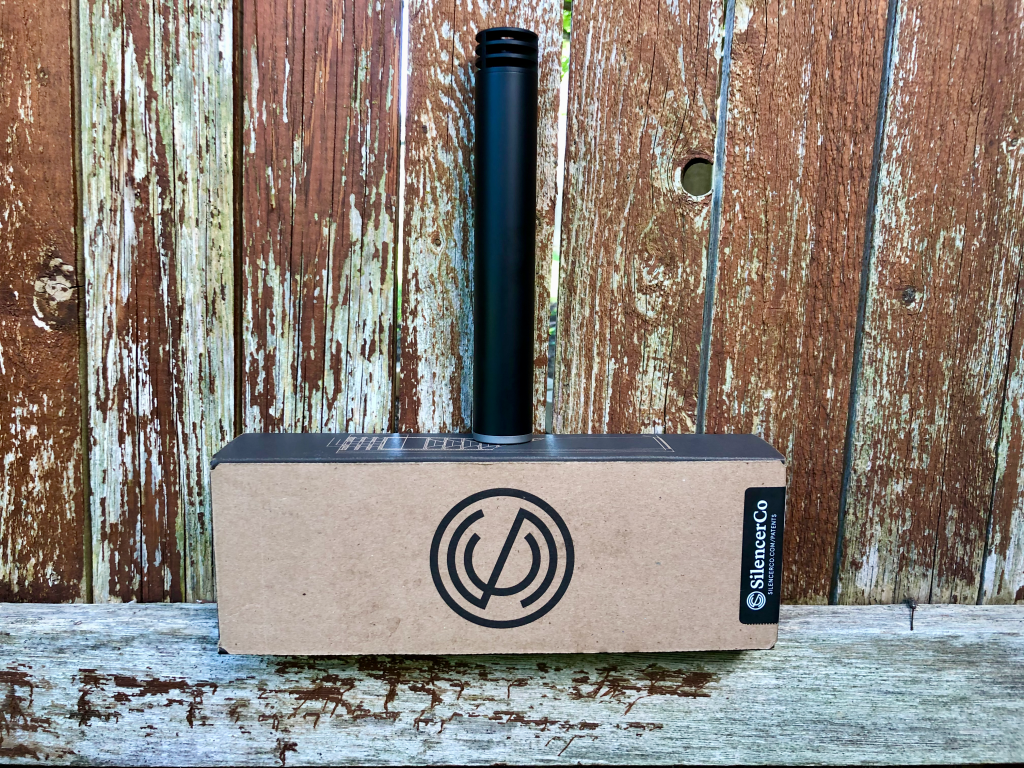
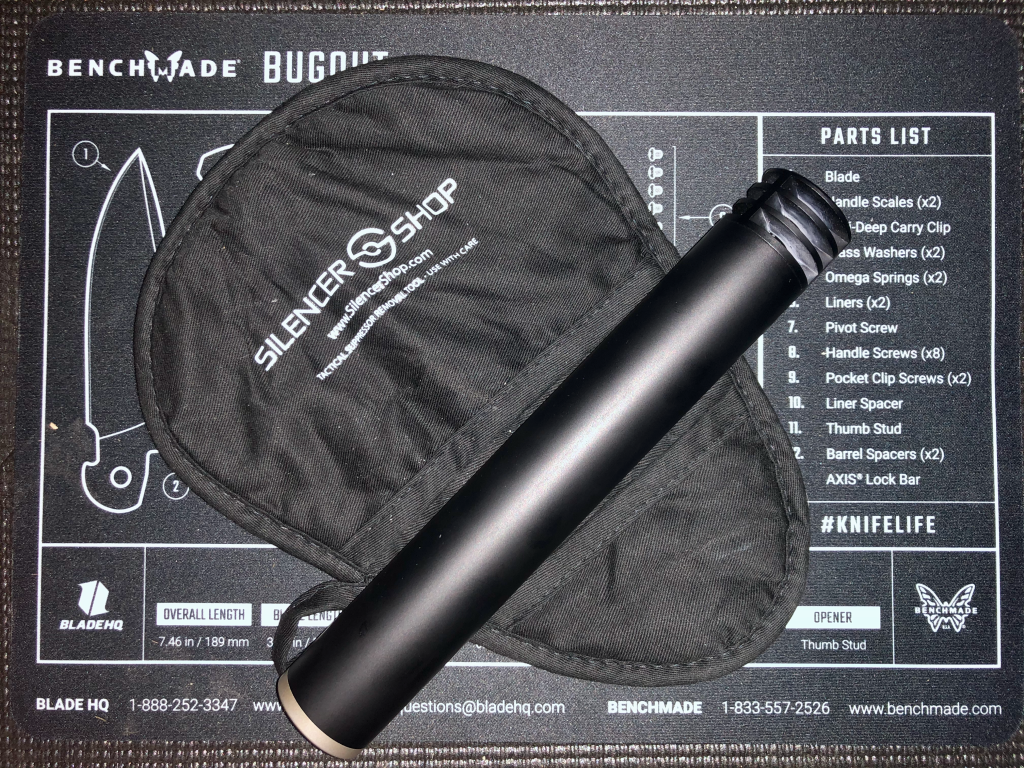
The second was a SilencerCo Harvester 300, which has since been discontinued, and so has its successor, the Harvester EVO. Both live in the same traditional NFA trust, and both have approved Form 4s. A Form 4 is the ATF’s application to transfer an NFA item, and an approved one comes back with the tax stamp.
Six Years Later
In 2026, the rules changed more in a few months than in the previous ninety years. The tax stamp is $0. A federal judge in Texas ruled that the registration requirement can’t stand on a $0 tax. Then, on October 9, 2026, the ATF announced it would stop enforcing NFA approval and registration for suppressors nationwide. Naturally, folks have been asking me what the NFA changes mean for owners like me. Others want to know if I’m buying cans by the armful.
Short answer: very little changes for the cans I already own, and no, I’m not. Full disclosure – I’m not a lawyer, and this isn’t legal advice. It’s one owner reading the ATF’s own words and deciding what to do with his own cans.
How the NFA Changed in 2026
The NFA changes came in pieces, so it helps to line them up.
| Date | What Happened |
|---|---|
| July 4, 2025 | The One Big Beautiful Bill Act cuts the NFA making and transfer tax on suppressors, short-barreled rifles (SBRs), short-barreled shotguns (SBSs) and “any other weapons” (AOWs) to $0, starting January 1, 2026. Machine guns and destructive devices stay at $200. |
| January 1, 2026 | The $0 stamp takes effect. You still file a Form 4 (to buy) or a Form 1 (to make your own) and wait for approval. |
| August 5, 2026 | In Silencer Shop Foundation v. ATF, Judge James Wesley Hendrix (Northern District of Texas) rules that the NFA’s making, registration and transfer rules for those items are no longer a valid use of Congress’s taxing power once the tax is $0. The court order (an injunction) covers only the plaintiffs, their members and their customers. |
| September 1, 2026 | The federal appeals court for the Third Circuit (Pennsylvania, New Jersey and Delaware), in United States v. Berger, upholds suppressor registration against a Second Amendment challenge. |
| September 24, 2026 | The Solicitor General tells the Senate Judiciary Committee that the Department of Justice won’t appeal the Texas ruling. The letter is filed with the court on October 1, and the appeal deadline passes on October 5. |
| October 9, 2026 | The ATF publishes an open letter and a page of frequently asked questions (FAQ): it won’t enforce NFA approval, registration or tax-stamp requirements for suppressors, SBRs, SBSs and AOWs, for anyone, nationwide. |
| October 16, 2026 | The ATF revises the FAQ. |
What the ATF Stopped Enforcing (and What It Didn’t)
Greg Ellifritz of Active Response Training rounded up a good batch of write-ups in his October 16 Weekend Knowledge Dump, if you want more than one take. Even so, I’d go straight to the source. The ATF’s FAQ is plain enough, and it’s the document that actually matters.
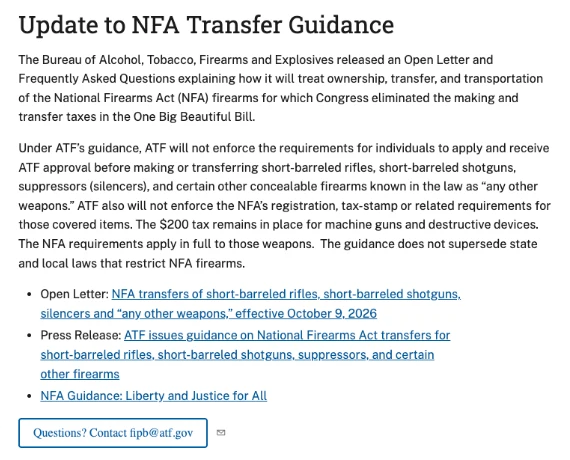
For suppressors, SBRs, SBSs and AOWs, the ATF says it won’t enforce:
- Prior approval to make one (Form 1) or transfer one (Form 4).
- Registration in the National Firearms Registration and Transfer Record (NFRTR), along with the rules against making, receiving, transferring or possessing an unregistered one.
- The ban on carrying an unregistered one across state lines.
- The NFA marking requirement.
What’s Still in Force
- The Gun Control Act of 1968. A suppressor is still a “firearm” under federal law. So buying one from a dealer still means a Form 4473, the same form every gun buyer fills out, plus a background check through the National Instant Criminal Background Check System (NICS). The dealer sells only to residents of its own state, and prohibited persons are still prohibited.
- State and local law. The ATF is blunt that its guidance doesn’t override them. It also “cannot opine” on whether a state will treat an unregistered can as lawfully held. Several states still ban suppressors outright, and others require a completed Form 4.
- SBRs and SBSs on the road. Before you take one across state lines, you still file a Form 20 (the ATF’s notice for interstate travel), even if it’s unregistered. Suppressors never needed one. If you rebuilt a braced pistol after the 2023 brace rule, read the SBR section of the FAQ before you put the stock back on.
- Machine guns and destructive devices. Nothing changed. Full NFA, $200 tax.
Enforcement Discretion, Not Repeal
Here’s the line that matters most: the ATF calls this enforcement discretion. In plain English, the agency chose not to enforce part of the law; the law itself didn’t change. Congress didn’t touch the registration requirement, and the Texas ruling binds only the parties in that case. The ATF also still maintains the registry. It approves Form 1s, Form 3s (dealer-to-dealer transfers) and Form 4s for anyone who files one voluntarily.
What It Means for an NFA Trust
This is the question I couldn’t find a straight answer to, because nobody official addresses it. The ATF’s letter and FAQ never mention trusts. Neither do the FAQs from Gun Owners of America or Silencer Shop, two of the plaintiffs. So here’s how I read the NFA changes for an NFA trust, working from what the documents do say.
The Cans Already in the NFA Trust Stay Registered
Nothing in the ruling or the ATF guidance touches an item that’s already registered. My Omega and Harvester are in the NFRTR under the trust, with approved Form 4s. That’s the strongest position anyone can hold, no matter what happens next. The injunction might hold, the policy might flip, or Congress might bring back a tax. Either way, a registered can is a registered can. So I’ll keep carrying copies of the approvals with them, same as always.
Don’t Deregister
The ATF will pull an item out of the registry if you ask in writing. However, it also says that once an item is removed, it “cannot be re-registered unless the Attorney General declares an amnesty.” That’s a one-way door with nothing on the other side worth having. I see no upside to walking through it with a can that’s already legal under every scenario. Nothing in the 2026 NFA changes makes deregistering a smart move.
My GOA Membership Probably Doesn’t Reach the NFA Trust
I’m a Gun Owners of America (GOA) life member, and GOA is a plaintiff, so the injunction covers me. My cans don’t belong to me personally, though. They belong to the trust, and the trust is the registrant. A trust isn’t a GOA member, and no trust or limited liability company (LLC) appears in any of the groups the order covers. Nobody has said whether a member’s trust rides along.
While the nationwide policy stands, that mostly doesn’t matter. It applies to “any person,” and under the tax code a trust is a person. But suppose the policy is rescinded and only the injunction is left. Then a trust-held can bought without a Form 4 sits in a gray area I wouldn’t want to test.
One more thing on that front: don’t move cans out of the trust and into your own name to chase injunction coverage. That’s a transfer, and it accomplishes nothing for an item that’s already registered. It also throws away the reasons you set up the trust in the first place.
The Trust Still Does Its Old Job
Getting through the Form 4 was never the trust’s job. It lets more than one person lawfully possess the cans. It also lets the cans pass cleanly to my heirs when I’m gone. Neither of those reasons went away on October 9. If enforcement comes back, I want the cans already in a structure that handles shared possession and succession without new paperwork. So the trust stays, and I’ll keep paying the fee to update it when the people on it change.
Buying Through a Trust After October 9
A trust can file a $0 eForm 4 (the ATF’s online Form 4), and the ATF keeps approving them. You’ll need a Responsible Person Questionnaire, fingerprints and photos for each responsible person, meaning each trustee who can control the items. With online filing, the wait is nothing like mine in 2020. In August 2026, trust eForm 4s averaged about 20 days and individual ones about 6, per Capitol Armory’s tracker of ATF data.
Since October 9, some dealers will also sell you a can on a 4473 alone, with no Form 4 at all. That gets you an unregistered can, and that’s the part I want to talk about.
Why the NFA Changes Don’t Have Me Buying Another Can
Technically, the NFA changes cover me twice. The injunction covers me personally as a GOA life member, and the ATF’s nationwide policy covers everybody. Texas took suppressors off its prohibited weapons list in 2021 with House Bill 957, so state law doesn’t stand in the way. I could walk into a shop here and fill out a 4473. I’d walk out with a can the same day. I’m not going to, for two reasons.
I’d Rather Not Register More NFA Items
The $0 Form 4 path is cheap and quick. Even so, it puts another serial number, my fingerprints and the trust’s responsible persons on a federal registry. Two cans on that list is plenty for me.
The NFA Is Still Law
The ATF says so itself. Its FAQ lists exactly how enforcement could come back: Congress could impose a new tax, the injunction could be dissolved or overturned, or the Department of Justice could rescind the guidelines. None of those is far-fetched. After all, a new administration can rescind a policy memo on its first day, and we get a shot at a new one every four years. On top of that, the Third Circuit upheld suppressor registration in Berger on September 1, 2026. That case turned on the Second Amendment, not the $0 tax, but it’s a reminder that not every court is hostile to registration.
And if enforcement does come back, the ATF is clear about what an unregistered can becomes. The NFA treats it as contraband, with felony penalties and forfeiture. There’s no automatic grandfathering, and federal law generally doesn’t let you register it after the fact. The Attorney General may hold an amnesty of up to 90 days, but nothing requires one. Possession is an ongoing act. So the day enforcement resumes is the day a can bought on a 4473 becomes a problem.
Put those two reasons side by side and they box me in. The registered path means more on the registry, which I don’t want. The unregistered path means betting a felony on the next election, which I really don’t want. So until the law itself changes, the right number of new cans is zero.
What I’d Tell a Friend Who Wants a Suppressor
Not everyone shares my first reason, and that’s fine. Suppressors are hearing protection, and I’d still rather see more people shooting with one than without. If a buddy asked me, here’s what I’d say:
- Check your state first. The ATF won’t answer that for you. Some states ban suppressors outright, and others require a completed Form 4 no matter what the ATF enforces.
- If you buy, file the $0 Form 4. It costs nothing, and as of 2026 it takes days, not months. A registered can stays legal no matter which way the courts or the next administration go. As the law stands in 2026, it’s also the path I’d take for any NFA item, if I ever bought another.
- Decide trust or individual on the old merits. Will more than one person in the house use it? Do you care where it goes when you’re gone? Then a trust still earns its keep. Otherwise, an individual Form 4 is faster.
- If you go the 4473-only route, go in with eyes open. You’re relying on a policy, not a law. Keep your receipts and keep up with the news. Also know there may be no way to register the can later.
Finally, talk to the attorney who drafted your trust before you change anything about it. Mine came through U.S. LawShield’s NFA program, and that’s the first call I’d make. If you carry a self-defense legal service, call them too. I use U.S. LawShield only for the trust and carry CCW Safe for self-defense. Either kind of service may answer your questions, or at least point you to a lawyer who can.
Closing Thoughts
In 2020 I wasn’t sure the expense, time and legal gymnastics would be worth it. Six years on, the Omega and the Harvester have earned their place. And these NFA changes are the biggest shift in suppressor law since 1934. It’s genuinely good news. It just isn’t permanent yet.
So my cans stay registered, the trust stays put, and my wallet stays closed until Congress takes suppressors out of the NFA for good. Honestly, I’d rather see the NFA struck down altogether, and the Gun Control Act with it. That’s a topic for another post, though, and I’m not promising one. Either way, when that day comes, I’ll be first in line. Until then, I’m happy shooting the two I’ve got.


Comments