

The Holosun 507 series red dot sights have been around for a good while now. They have a reputation as a stellar exposed emitter red dot sight that rivals the Trijicon RMR, the gold standard for quite some time. Several instructors I trust and other authoritative experts consider them well suited for pistol use. Even so, my own experience with them was a handful of shots fired when friends let me check out theirs. That is, until now.
More readers than I can count ask me what my thoughts are about the Holosun 507 series red dot sights. I’ve parroted what I’ve heard from reputable sources, with the caveat of not personally having any experience with them. A healthy number of those inquiries have been specific to the Holosun 507C equipped with the ACSS Vulcan reticle. I gave those the same answer, with the additional caveat of knowing absolutely nothing about the reticle. Then a little over a month ago, I reached out to Primary Arms, one of my affiliates. I asked if they would mind sending me one to test and review. I figured the worst case scenario would be hearing a no. Much to my surprise, Primary Arms obliged.
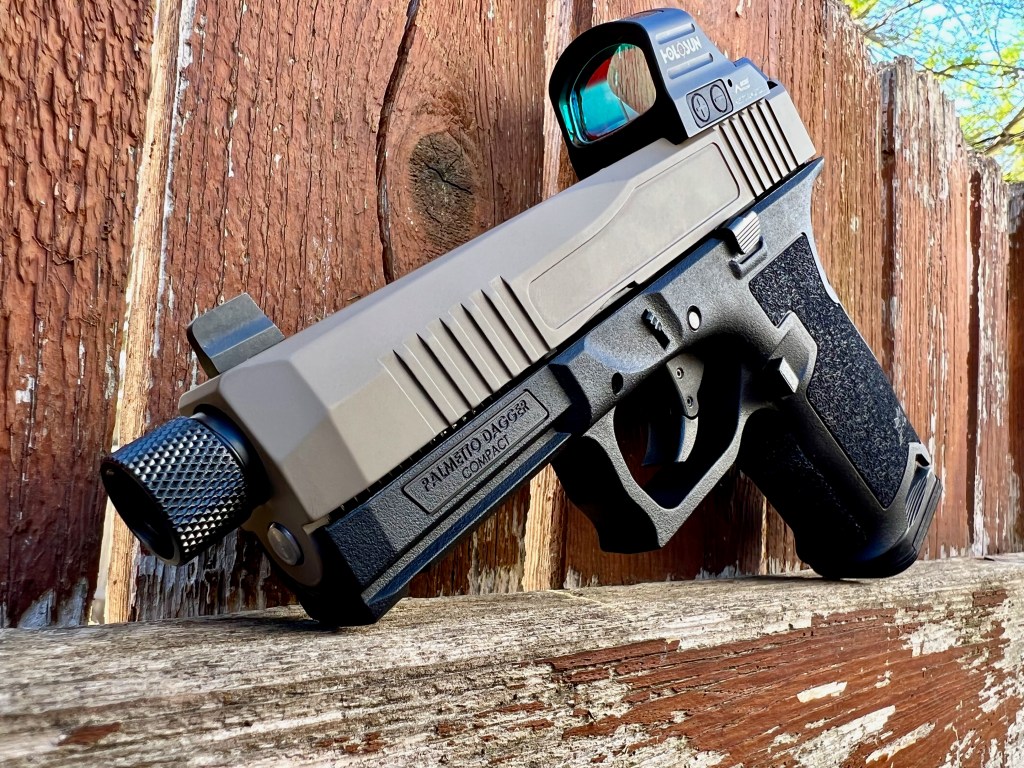
As soon as the dot arrived, I slapped it on the PSA Dagger. Then I headed over to Bentley’s Firearms and Indoor Range to sight it in and send a few hundred rounds down range with it.

Dot and Reticle in One Review
I considered splitting this review up into two posts. One focused on the Holosun 507 series optic and another focused on the reticle. This is similar to what I have done in the past, but I’ve decided against it, at least for this initial “first impressions” review. I may do things differently in follow up reviews. For now I think it’s best to keep them together, as my initial impressions on the hardware echo everything I’ve heard from trusted sources. As such, this should keep the dot portion of the review relatively brief.
What’s in the Box
So what do you get after spending roughly $320 on the ACSS Vulcan equipped Holosun 507C X2 red dot sight?
- A pretty basic plastic foam-lined box wrapped in a four sided paper-based sleeve,
- a manual for the ACSS Vulcan reticle,
- a manual for the Holosun 507C X2 red dot sight,
- a warranty registration card,
- a lens cloth,
- a pair of long Torx mounting screws,
- a pair of short Torx mounting screws,
- an installation and adjustment tool,
- the red dot sight with a preinstalled CR1632 battery.
That’s pretty much everything you need, short of an RMR footprint adapter plate, to mount this dot to a pistol and get started with it.

The Optic, Front to Rear
Housing and Window
The housing is 7075-T6 aluminum. It holds the objective lens, which measures roughly 0.63″ in height and 0.91″ in width. The window is a good size. It isn’t the biggest window, but it’s not the smallest. It feels comparable in size to the Trijicon RMR window. Like most other exposed emitter red dot sights, the lens has multiple coatings. Light transmission is great, and edge to edge clarity is surprisingly clear and parallax free given the price point.
Solar Panel
Right behind the lens, on the top side of the housing, is a voltaic cell solar panel. It powers the emitter when sufficient ambient lighting is available and helps deliver the spectacular 50,000 hour advertised battery life. The solar power feature seems to be particularly important to many of the folks I’ve spoken to who have purchased this red dot. The common theme is a stronger peace of mind about battery induced red dot sight failures. While I find this feature interesting, I’ve witnessed one Holosun sight experience an electronic component failure. Neither the solar panel nor a fresh battery resolved it. I’m not saying the solar panel isn’t valuable. I am concerned that it may downplay the importance of replacing the battery regularly for some folks.
Battery Tray and Controls
On the right side of the housing (looking at the sight from the rear) is the battery tray. It lets you change the CR1632 battery without dismounting the sight, with a little assistance from a small flat head screwdriver.
Opposite the battery tray, on the left side of the housing, are the brightness and operation control buttons. The buttons cycle through twelve (12) different brightness settings, the lowest two (2) of which are night vision compatible. They also switch between operation modes. The default is “auto-mode”, which uses both solar and battery power to run the emitter. When the ambient light is sufficient, the reticle runs on solar power and the brightness adjusts automatically based on the solar power available. When the ambient light is low, the sight reverts to battery power, where you adjust the brightness with the “+” and “-” buttons.
Pressing the “-” button for 3 seconds puts the dot in “manual-mode”. That forces the optic to use only battery power and stops it from adjusting the brightness on its own. In this mode, you also adjust the brightness with the “+” or “-” buttons.
Pressing the “-” button for 3 seconds again puts the dot in “lockout-mode”, which prevents brightness adjustments with the “+” or “-” buttons. Another 3 second press of the “-” button cycles back to “auto-mode”.

Sleep Mode and Shake Awake
Regardless of the operation mode, the 507C goes into sleep-mode after a certain period without movement, unless you disable sleep-mode. You set that period with the brightness and operation controls. By default, the sight sleeps after 10 minutes of no movement. Pressing and holding the “+” button for 10 seconds changes the sleep time from 10 minutes to 1 hour. Doing it again changes it from 1 hour to 12 hours. Once more disables it. One more time and we are back to a 10 minute delay.
The dot’s “shake-awake” sensor brings the sight out of sleep-mode the instant it detects movement. I suspect this feature is one of the reasons the marketed battery life for this dot is 50,000 hours. As of writing this, I don’t know what the battery life is with sleep-mode off and the brightness locked at its highest setting. I see that configuration as atypical. Still, it is something to be aware of if the dot is going through batteries like a new-born goes through diapers.
Emitter and Adjustments
Toward the rear is the exposed reticle emitter, which projects the ACSS reticle onto the objective lens. I don’t have much more to say about the emitter itself, and I cover the reticle below.
Behind the emitter, back on the right side of the optic, is the windage adjustment dial. A bit further back, on the top side, is the elevation adjustment dial. Both dials adjust with a small flat head screwdriver and provide exceptional tactile feedback, where each click represents a one (1) minute of angle adjustment. After zeroing, the dot held zero without any problem while I sent a few hundred rounds downrange.

Durability and Value
Before getting into the ACSS Vulcan reticle, which I’m now thinking might deserve its own blog post, I want to add one thing. The durability of the Holosun given its price range is exceptional. I don’t say this lightly. I am basing it on trusted feedback and the findings Sage Dynamics documents in their MRDS white paper.
Combining hearsay and research with my own first hand experience, I find the Holosun 507C series red dot sights to be a great choice. That goes for folks who want a value-priced pistol-mounted red dot sight for recreational, defensive carry, or competitive use. Are there better for each of those use cases? Yes, absolutely. Are there more affordable options? Yes, but none that I can think of that would be better at the same price point or lower. This opinion holds true even when the Holosun sight doesn’t have the ACSS Vulcan reticle.
The ACSS Vulcan Reticle
I promise, I’ll do my best to keep this brief, which is a tall order and will likely result in a follow up post that dives deeper into it. But alas, let’s give it a try.
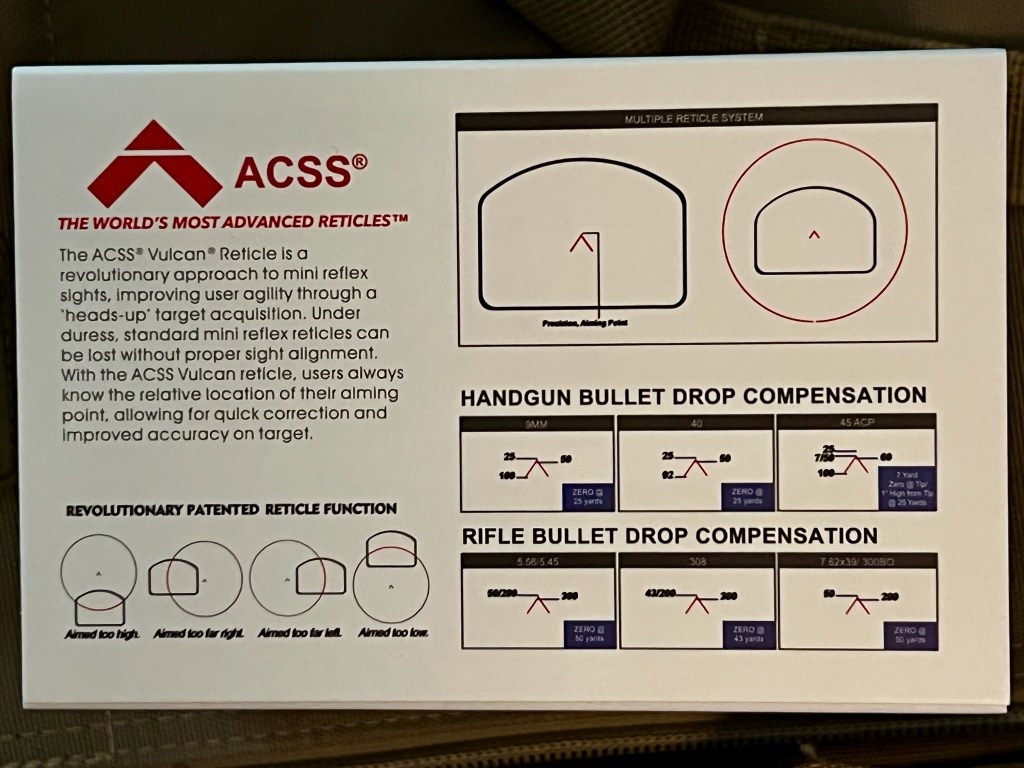
The reticle consists of two parts. The first is a 10 MOA tall chevron at the center which is, in the most elementary sense, what you aim with. A 250 MOA circle encloses the chevron. The chevron works with several different handgun and rifle cartridges. It provides bullet drop compensation at various distances, assuming you zero it with those cartridges as intended. To be completely transparent, I’ve only worked with this reticle using 9mm handgun cartridges and didn’t follow the zero specifications set forth in the manual. As such, I will not provide any opinions regarding the chevron’s bullet drop compensation features.
Why a 10 Yard Zero
I suspect several readers are curious as to why I didn’t follow the zero instructions, and some might feel short changed after reading this far into the review. The truth is that I tend to stick with 10 yard zeros for pistol mounted dots, based on my ability to zero them. Additionally, I don’t do much with pistols beyond 25 yards. I rarely exceed those distances in pistol competitions, and distances beyond that are anomalous to self defense situations. I’m not saying there is no value in shooting pistols beyond 25 yards. Rather, my skill level limits my ability to zero a pistol mounted red dot effectively beyond 10 yards and affects what I can effectively test beyond 25 yards.
Shooting the Chevron
That said, I zeroed the tip of the chevron to 10 yards with the 9mm Dagger. When shooting static targets without time pressure, I found the chevron easy to pick up and exceptionally easy to aim with. That held while applying hold overs between 3 to 25 yards to make slow precise hits. Under time pressure, I found the easy to pick up 10 MOA chevron to be fantastic for making good enough hits quickly at close distances. I also found it trivial to see a much finer grained aiming reference for precise shooting under the same pressure. As I did my testing, the question that kept creeping into my mind was “am I doing anything here with the chevron that I can’t do with a traditional dot?” The answer to that has continued to be “not really” so far.
“Not really” isn’t as definitive as a hard no. Let me explain. I did find the 10 MOA tall chevron significantly faster to pick up. Under time pressure, I was able to use the large chevron to make very fast hits using a coarse sight picture. I don’t have split time data to back up that subjective perception. Still, the feeling of making coarse grained hits faster than I normally do with the 2.5 to 3.25 MOA dots I’m most familiar with was very prevalent.
Staying Target Focused
At the same time, I found myself getting “sucked into the chevron” much more often than I find myself getting “sucked into the dot” with other pistol mounted optics. Again, I don’t have empirical data to support this subjective feeling. Nevertheless, I had to make a more concerted effort to remain target focused while using the Vulcan reticle than I typically do with a traditional dot. Lowering the brightness on the chevron helped with this, just like it seems to with traditional dots. Even so, I still seemed to struggle more with remaining target focused when using the ACSS Vulcan.
The Enclosing Circle
I found the enclosing 250 MOA circle to be immensely helpful in finding the chevron when it wasn’t immediately visible after I fumbled a draw or a grip. This was a rare occurrence for me during my testing. However, finding the dot is something that I see a lot of folks new to pistol mounted red dot sights struggle with, and it was something I struggled with myself. As such, I found this feature to be a remarkably useful training aid.
On the other hand, I suspect newer dot users might misuse it as a crutch, which may curtail the presentation development that would minimize their dependence on this feature. In my honest opinion, the usage of the enclosing circle should be the exception rather than the rule. Thankfully, you can disable the enclosing circle by pressing and holding the “-” brightness control button for ten (10) seconds, which can help force better presentation development while training and practicing.
Overall, I see the reticle as a double edged sword. On one hand, the large chevron can be strikingly useful for fast coarse grained shooting, and the enclosing circle can be extraordinarily handy for aiming and presentation corrections. On the other hand, the large chevron can hinder a shooter’s ability to remain target focused. The enclosing circle may hamper the development of presenting a pistol with a mounted red dot sight. When you exploit the reticle for its benefits, it is absolutely amazing.
Final Thoughts
So what is my verdict?
In summary, the Holosun 507C series red dot sight is a go for pistol mounted use. While I see some potential drawbacks to the ACSS Vulcan reticle, I think the good outweighs the bad by a long shot and I like it a lot. As such, I’m going to say it’s a go. Sure, it may require more deliberate effort to remain target focused and might be misused as a crutch. However, the large aiming reference for dynamic shooting under pressure and the training aid the enclosing circle provides make it an extremely attractive and valuable proposition.
Your pistol, your call.


what heights sights did you have on the dagger?
I’m not really sure. They are the sights that came installed with the Dagger (https://alnk.to/eDMyPSq) which PSA describes as “Ameriglo Lower 1/3 Co-Witness Sights”. My best guess is that they are the GL-526 Ameriglo sights (https://ameriglo.com/products/details/gl-526).