

Here we go again. Another Toor Knives post, because y’all keep asking and I keep buying them. So far I’ve covered the Serpent, the Field 3.0, the Field 2.0 Ebony, the Mullet T and the Tanto. This time it’s the Toor Specter, the dagger Toor introduced on October 19, 2023, and the Toor blade I have used the least. Which, if you read the Tanto post, is saying something.
Full disclosure, same as always: Toor Knives and this blog have an affiliate relationship, so if you buy through a link here I may get a cut at no extra cost to you. Nobody sent me this one. I ordered my Specter the day it launched, $350 of my own money, back before the Specter R existed, because I saw the Ultem scales and that was that.
What the Toor Specter Is
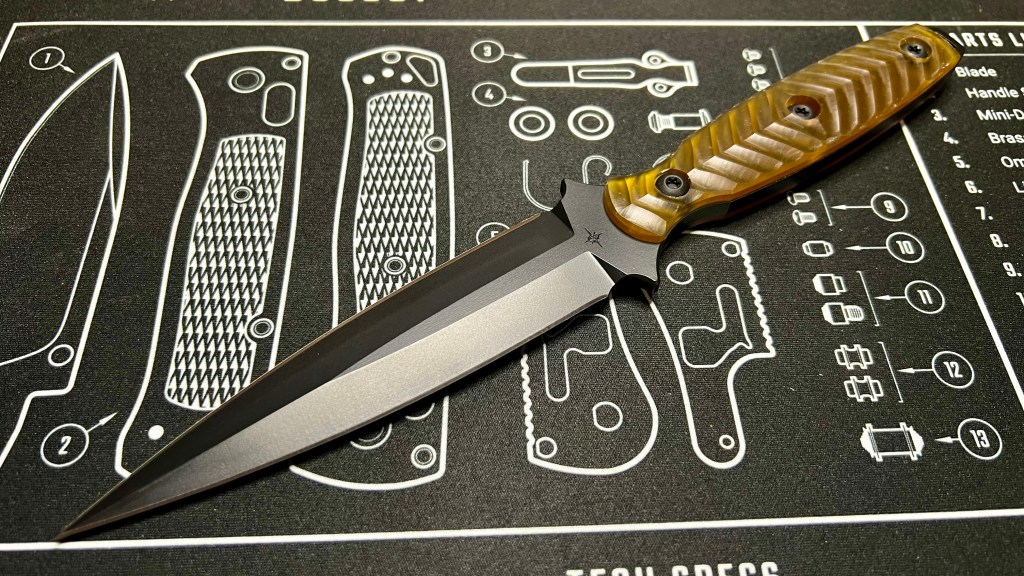
The Specter is a dagger. Not a tanto with ambitions, not a drop point with a sharpened swedge. A symmetrical double-edged blade that tapers to a fine point, a short guard and a handle that’s the same shape no matter which way you hold it. Toor describes it as a tactical, covert, self-defense blade, and that is exactly what it looks like. The symmetry also means the Kydex sheath takes it either way around, which sounds like a gimmick until you sheath a knife in the dark and don’t have to think about it.
Now the numbers, for the nerds. Mine runs 9.625″ overall with a 4.75″ blade ground from 3/16″ stock, and it weighs 6.5 oz. That’s the first-batch Specter: a black KG Gunkote finish over the steel, translucent Ultem scales, and a Kydex sheath with adjustable retention. Toor makes it in San Diego, California, like everything else they make.
The Steel
A confession about the steel. I’d have bet money mine was CPM M4, because that’s what Toor puts in the Specter R today and what the Mullet T is made of. Then I dug up the launch email. The copy says CPM-3V. The spec table under it says CPM 154, next to an 8.5″ overall length, a 4″ blade, Tracer Red G10 scales and 7.5 oz, none of which describe the knife in the picture above it. Somebody pasted the spec block from another product.
The blade isn’t stamped, so the email is the best record there is, and 3V matches every retailer listing for the first batch. M4 only showed up when Toor brought the Specter back in SOF Series colors with G10 scales. So mine is the same steel as my Serpent: one of the toughest blade steels going, with edge retention that’s fine rather than great, and a chromium content low enough that you want the coating to stay intact. For a knife whose whole job is a hard thrust, tough is the right trade.
| Spec | Specter (first batch, 2023) | Specter R (2026) |
|---|---|---|
| Overall length | 9.625″ | 9.25″ |
| Blade length | 4.75″ | 4.25″ |
| Handle length | 4.875″ | 5″ with the ring |
| Blade thickness | 0.1875″ | 0.1875″ |
| Steel | CPM-3V | CPM M4, 59–61 HRC |
| Finish | Black KG Gunkote | KG Gunkote |
| Scales | Ultem (also Granadillo, Shadow Black) | G10 |
| Ring | No | Yes, at the pommel |
| Sheath | FlexTech Kydex | DuoTone Kydex |
| Weight | 6.5 oz | 6.5 oz |
| Price | $350 | $350 |
A Fairbairn-Sykes in Its Bones
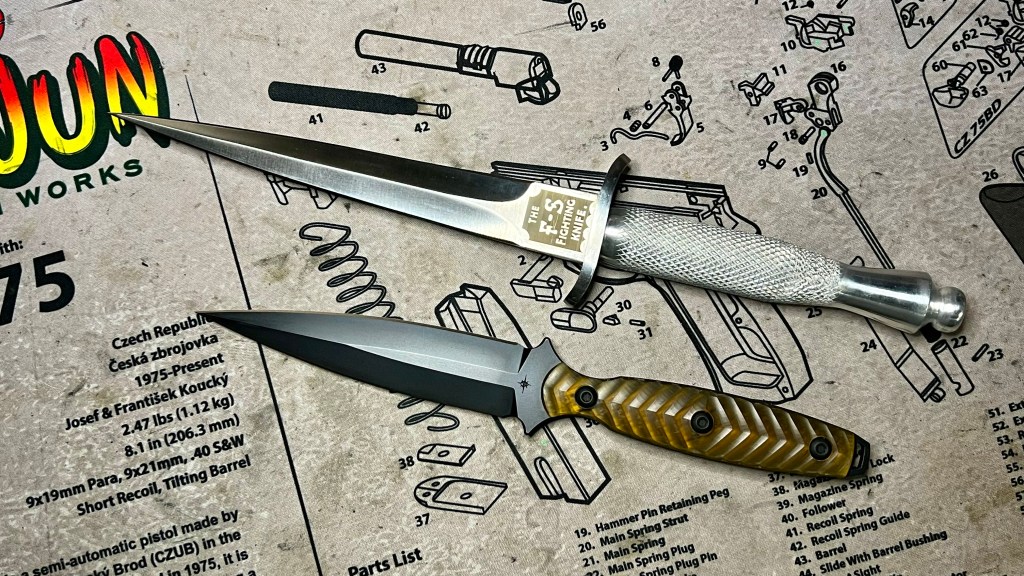
Put the Specter next to the Fairbairn-Sykes fighting knife a friend gave me and the family resemblance is there. The symmetrical double-edged blade with a ridge down the middle, the acute point, the guard on both sides, the handle that doesn’t care which way is up. It isn’t a copy. The Specter’s blade is shorter and broader for its length, the guard is cut into the tang instead of being a separate piece, and the grip is flat where the original is round. To my eye it’s a grandchild of the Fairbairn-Sykes, built from materials that didn’t exist in 1941. Toor doesn’t say that anywhere I can find, so take it as my reading and not theirs.
The original dates to January 1941. William Fairbairn and Eric Sykes designed it after years with the Shanghai Municipal Police, and Wilkinson Sword built the first run for the British Commandos. The blade is about 7″ long and the whole knife is 11.5″, a stiletto meant to go in between ribs and nothing else. Fairbairn’s argument for a sharp point and keen edges was blunt: a torn artery tends to contract and stop bleeding, and a cleanly cut one doesn’t. The design got copied everywhere. The OSS stiletto, the Marine Raider stiletto and the V-42 all trace back to it, and so does just about every double-edged boot knife since.
Where the Old Design Fell Short
It also had problems, and Fairbairn knew it. The round knurled grip gave the hand no way to feel which way the edges were pointing in the dark, it got slippery when wet, and the needle tip broke when people used the knife as anything other than a stabbing tool. Fairbairn’s later work with Rex Applegate went after exactly those complaints, with a wider, sturdier blade and a reworked handle.
The Specter follows that branch of the family. It keeps the point and the symmetry and fixes the parts that aged badly. Flat, sculpted scales tell your hand where the edges are without looking. With 3/16″ of steel behind the point, the tip isn’t the liability it was on a 1941 blade. And it’s about two inches shorter overall, which matters when the plan is a knife that disappears on a belt or a plate carrier instead of hanging off a Commando’s thigh.
Those Ultem Scales
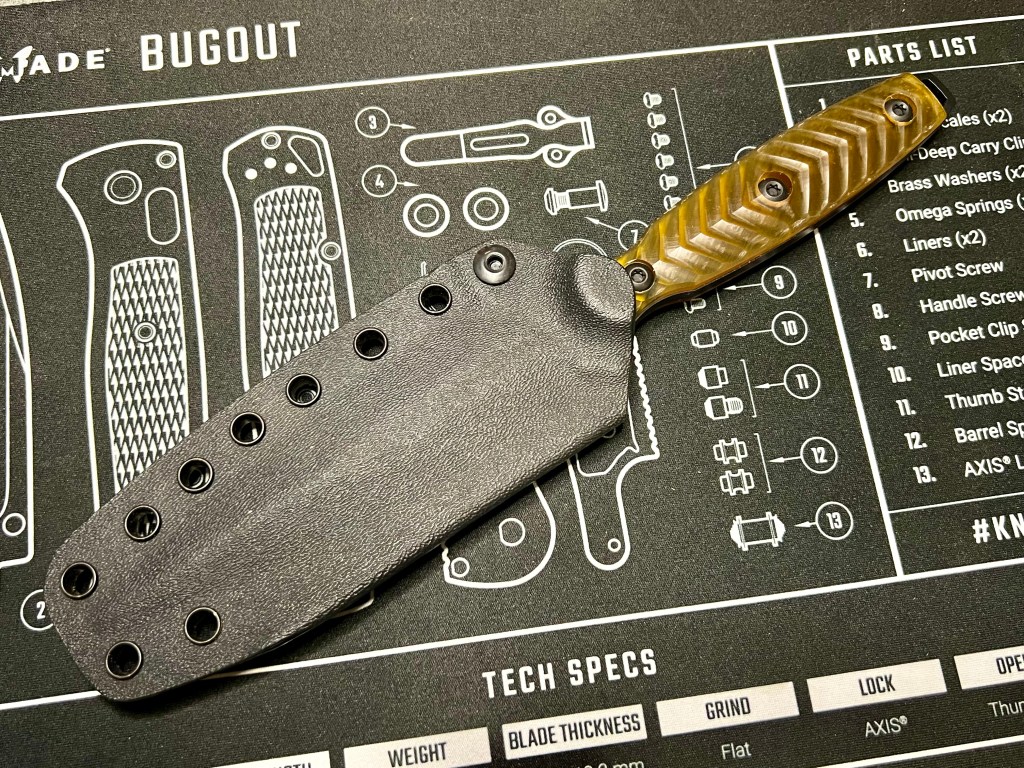
The first batch came three ways, Granadillo wood, Shadow Black G10 and Ultem, and the Ultem is the thing that sold me and the thing you can’t get anymore. Ultem is a translucent amber thermoplastic, a polyetherimide the aerospace and medical folks use because it shrugs off heat and chemicals. Knife makers use it because it looks like smoked honey with a light behind it. On the Specter it’s cut with Toor’s sculpted texture, so the scales bite into the hand and the light catches every facet. Grippy is one word for it. Spectacular is the other.
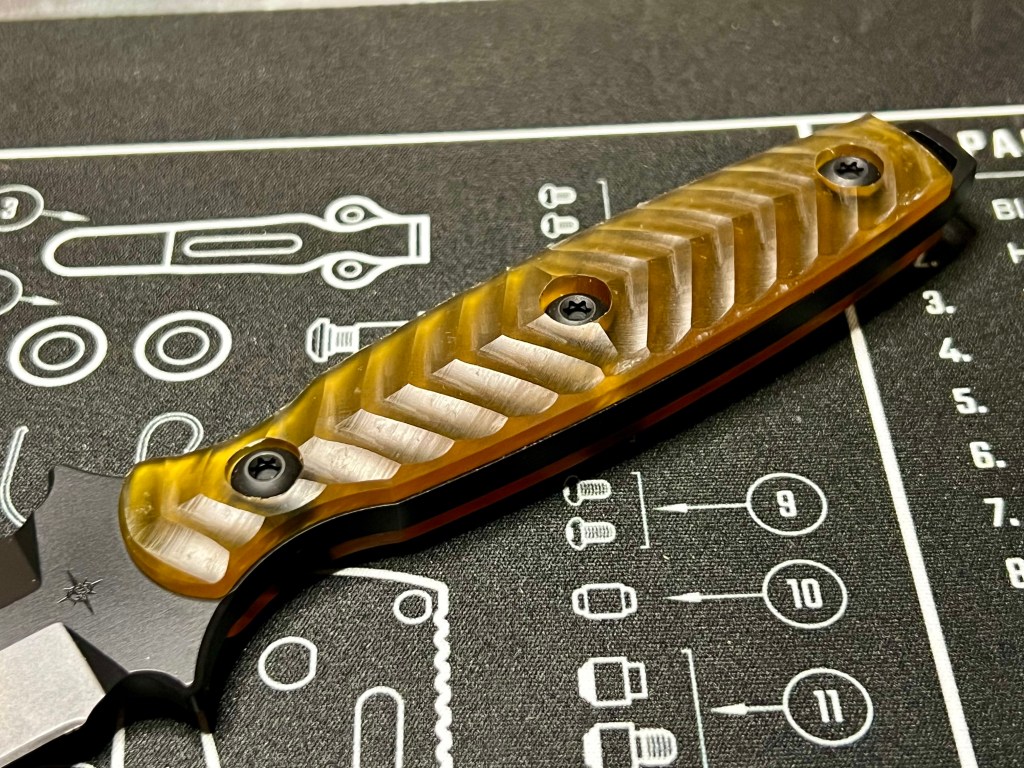
I’ve griped in nearly every Toor review that their scales run thin for my hands and raise hot spots over a long session. The Specter does a little better. I didn’t put calipers on them, but side by side and in the hand the Ultem is thicker than the scales on my Field knives and my Serpent. Not by much, and it’s still too thin for an hour of real work. What would fix it? A bit more thickness on each scale and a softer contour where the scale meets the tang, since that edge is where the hand bears down. There’s a limit to that, though. Rounder is more comfortable, but a fully round handle is the Fairbairn-Sykes problem all over again: the flats are how your hand finds the edges.
All of that matters less here than on the Field knives, because nobody is whittling tent stakes with a dagger. You hold a Specter in a fist for a few violent seconds, and for that the handle is enough. It’s still my standing complaint with Toor, and it still stands.
The Specter R Is the One You Can Buy
As of late November 2026, the Specter I have isn’t on Toor’s site. The Ultem run was limited and it’s gone, and so is the plain Specter in SOF Series colors that followed it. What’s there is the Specter R. Toor introduces it as a dagger “with a RING!” so I take the R to stand for the big change.
The ring isn’t the only difference. The blade dropped half an inch to 4.25″, the handle grew to 5″ to make room for the ring, and the whole thing comes in three-eighths of an inch shorter at 9.25″. The steel is CPM M4 at 59 to 61 HRC, the scales are G10 and it still weighs 6.5 oz. It’s $350 in SOCOM Black, FDE and Ranger Green. Phantom Grey and the $360 Tombstone finish come and go.
The Specter R’s Ring
The ring sits at the pommel, right where the Serpent’s does. In a forward grip your pinky goes through it. Flip to a reverse grip, point down, and it’s your index finger. Toor’s pitch is that the ring “allows for a secure and quick deployment,” which is marketing-speak for two real things. You can hook a finger and draw the knife without a full grip on it, and once it’s in your hand it is not coming out of it.
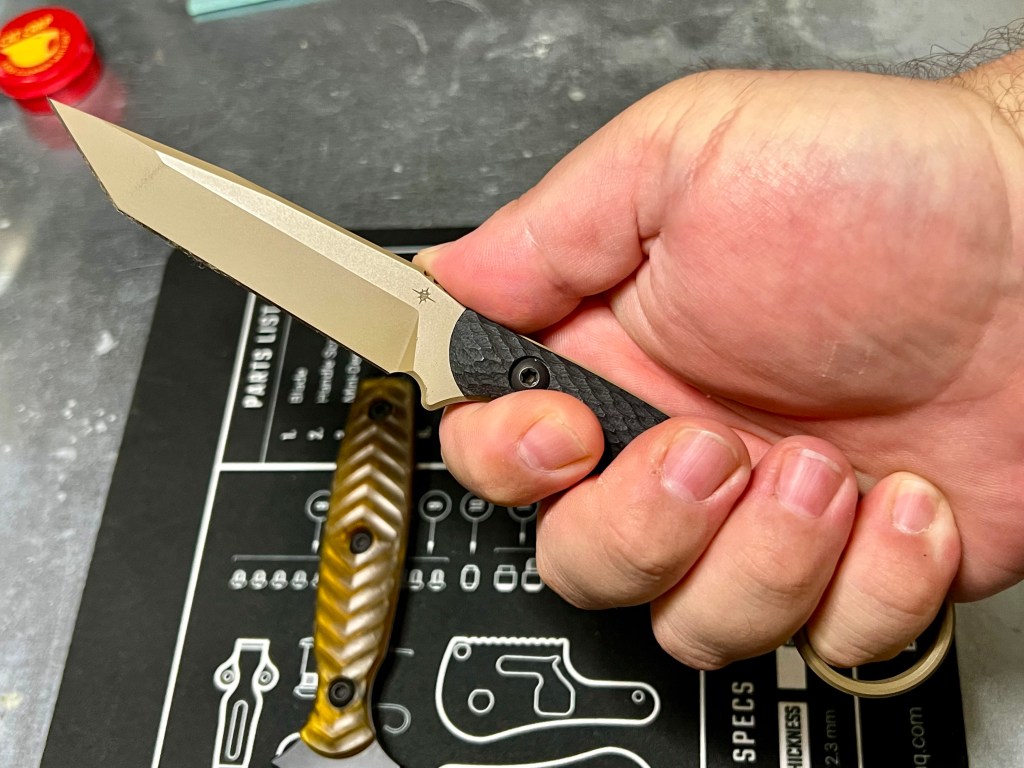
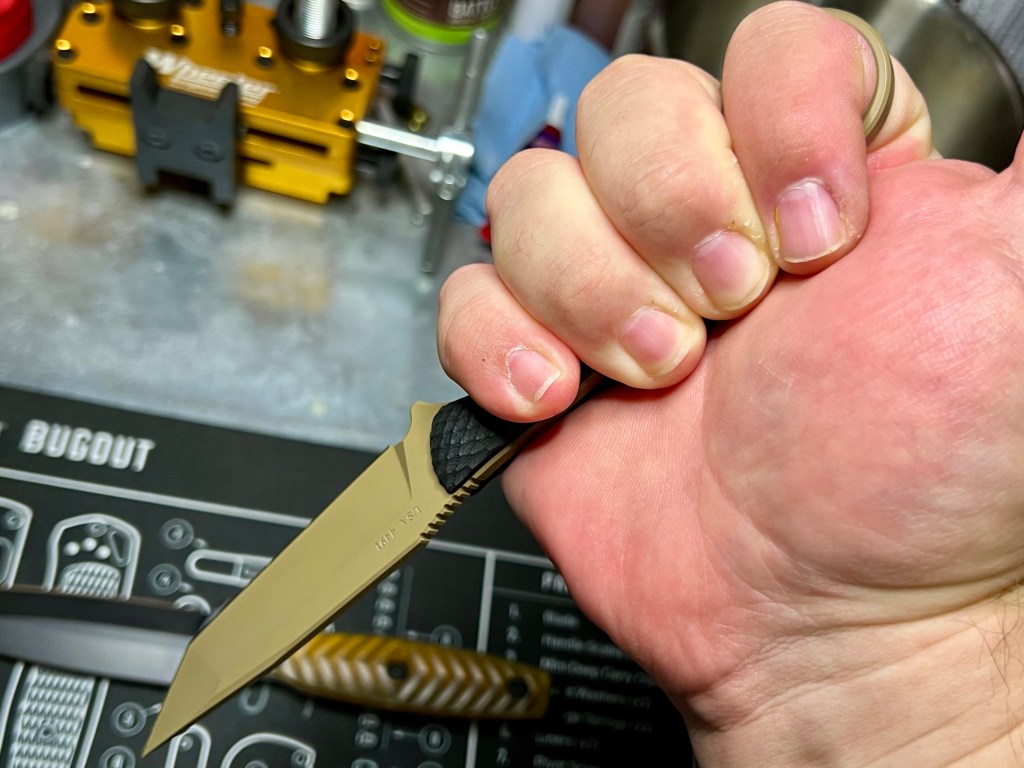
This is where I’ll give an opinion I can’t back up with a fight, because I’ve never been in one with a knife and plan to keep it that way. The ring is the better design for a knife like this, and it’s an improvement on the Fairbairn-Sykes idea the Specter grew out of. The old knife’s known weakness was the grip. A ring solves retention and orientation with one piece of steel, the same way the ring on my Serpent made drawing it a breeze. Buying a Specter today? I’d want the R, and I wouldn’t miss the half inch of blade. The Ultem looks better. The ring works better.
What I Use the Toor Specter For
Nothing. I want to be plain about that, because a review of a knife I don’t use is a review of how it looks and what it’s for, not how it holds up.
I don’t carry the Specter for defense. My defensive tool is a pistol, I train with the pistol, and a dagger on my belt would be a second weapon I have no training with. It would also be a legal question in some places. Texas scrapped its “illegal knife” list in 2017, so a dagger like this is fine to carry here, open or concealed, and only blades over 5.5″ face location limits. Some states still restrict double-edged blades, so check your state’s knife laws before this becomes your boot knife.
Chores? A dagger is terrible at chores. There’s no spine to put a thumb on, and none to hit, so batoning is out. You can’t choke up on it. A fine point is the last thing you want to pry with, since the tip is the first thing to go. You can’t strike a firesteel off a coated double edge either. The one thing it does better than any knife I own is open mail, and $350 is a lot of letter opener. It makes a fantastic one, though.
So it sits in its sheath on the shelf next to the Tanto, never once pressed into steak duty, which the Tanto and the Mullet T both managed, and comes out when somebody wants to see the pretty one. That’s a strange thing to say about a fighting knife, and it’s the truth.
Verdict
The Good
4
- A fine point with 3/16″ of CPM-3V behind it
- Translucent Ultem scales that grip as well as they look
- Sheaths either way around, no thinking required
- Made in San Diego, and $350 hasn’t gone up since 2023
The Bad
4
- The Ultem version is gone. It’s the Specter R or the secondary market.
- A double edge rules out nearly every knife chore
- 3V and M4 both rust where the coating gets scratched
- Scales still run thin, like every Toor I’ve reviewed
The Ugly
1
- I’ve owned it since 2023 and used it for exactly nothing
Closing Thoughts
The Toor Specter is the knife I’d show somebody who wanted to understand why I like Toor, and the last one I’d hand them to cut a rope. It’s a well-made modern take on the Fairbairn-Sykes idea, in a material that glows, from a shop in San Diego that keeps getting better. I’d buy it again and still never use it, and I’ve made peace with both of those.
If you’re shopping, buy the Specter R. The ring makes it a better fighting knife than mine, and a fighting knife is the only thing a Specter is for. If you just want the pretty one, watch the secondary market and be quick on the draw.


Comments