

When I assist on the line at KR Training, it’s usually in Basic Pistol or Defensive Pistol Skills 1, where the folks who bought a gun for personal protection show up first. A lot of pistols come through those two classes, and plenty of them aren’t a great fit for concealed carry. So the question I hear more than any other, usually at the first break, is some version of “what pistol should I buy?”
Which Pistol, by Hand and Budget
The short version, which is what the search engine sent you for. Each pick links to its section; the hand-size test and the full table are further down.
- Medium pistols, if the Glock 19 doesn’t fit you: the Sig P365-XL or P365-XMACRO, the Glock G43X or G48, the Hellcat Pro, the Shield X, or the Walther PDP F-Series.
- Large pistols, if the Glock 19 fits you: the G19 Gen6, the M&P 2.0 Compact, the Walther PDP Compact, the CZ P-10 C, or the H&K VP9 if the budget stretches.
- About $400 or less: the Dagger, the Micro Dagger, the RXM, or the TX9.
- Your first concealed carry pistol, period: whichever of the above passes the hand-size test, has no manual safety, and costs little enough to leave money for a holster, ammunition and a class.
Where This List Comes From
The list is on a whiteboard in the classroom, and every gun on it is one we know to be reliable, from what we see run in class and what’s on the market in late 2026. Fit is how we narrow it from there. What makes a gun worth carrying at all is in Qualities of a Defensive Handgun, and this is what to buy once you’ve agreed to that.
Full disclosure. I own two of the twelve guns below and owned a third until I sold it to a friend. Most of the rest I know from the class line and the match bay, where I’ve watched dozens of them run. KR Training as a whole sees roughly a thousand guns a year come through its classes, most of them pistols. None of the guns on this list was sent to me. The retailer links are affiliate links.
The Glock 19 Problem
The Glock 19 is the quintessential concealed carry pistol, the bar every other one gets measured against, and it earned that. It runs, it’s everywhere, every holster maker supports it, and you can find magazines at a gas station. Is that the problem? No. The problem is what that reputation does to the buying decision. People buy a reliable Glock 19-sized gun because that’s the answer everyone gives, and they never ask whether it fits their hand. I’ve recommended it that way. So have plenty of instructors I respect.
What Karl Sees From the Back of the Line
Karl Rehn, who owns KR Training, says it plainly: many students, not most but many, are shooting a gun that’s too big for their hands. It’s in his Handgun Ergonomics notes from April 2026. Gun fit, he wrote, is widely misunderstood or neglected when people buy, and a lot of students arrive with a Glock 19-sized gun when they need a medium one.
It shows up the same way every time. The trigger finger reaches with the tip instead of the pad. The gun rotates in the hand under recoil, and the support hand spends the string chasing the grip. For a right-hander, the group drifts low and left, and no amount of “press straight back” fixes it, because the hand can’t press straight back from where it’s sitting.
I Was One of Them
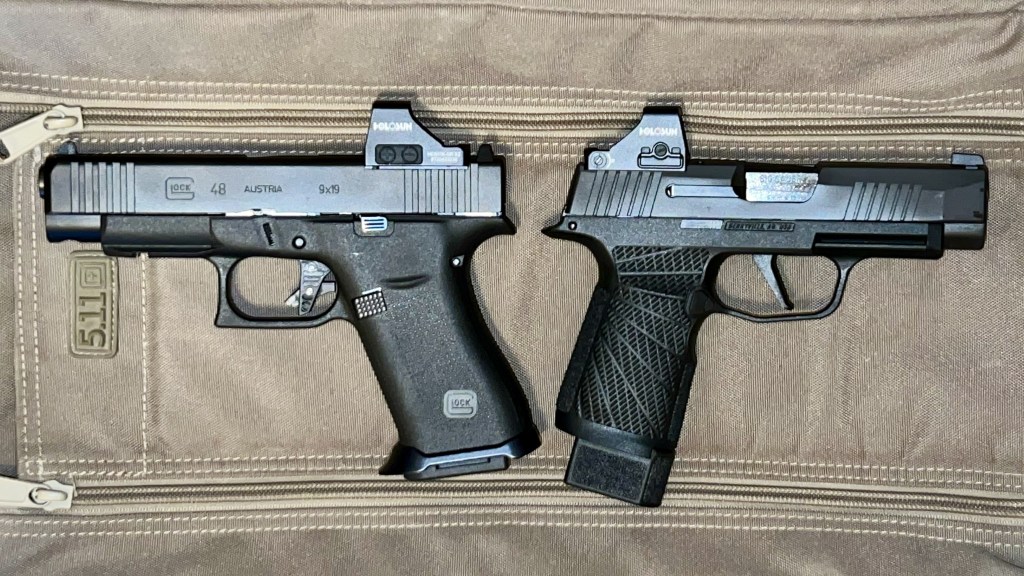
I started my training journey with a Sig Sauer P229 that was way too large for my hands. The late Sean Hoffman, who was on staff at KR Training, spotted it in his Texas Tactical Pistol/Rifle class. I switched to a VP9 that fit much better and thought the problem was solved, until Karl found a fit issue in Handgun Beyond Basics in early 2022 and handed me his Glock 48. I trained through the problem. Most people won’t, and that’s why I point a student who fails the hand-size test at a medium pistol before anything else.

The Hand-Size Test
Do this in the store, with the gun cleared and the clerk watching. Take a full firing grip, the web of your hand high under the tang and the barrel in line with the bones of your forearm, then lay your trigger finger on the trigger. The center of your fingerprint should rest on the face of the trigger without your hand shifting on the grip and without the finger rubbing along the frame. If you have to rotate the gun in your palm to get there, it’s too big for you.
The makers list the medium pistols on this list at 0.9 to 1.1 in wide and the Glock 19 at 1.35. A quarter of an inch sounds like nothing, and it can be the difference between the pad and the tip.
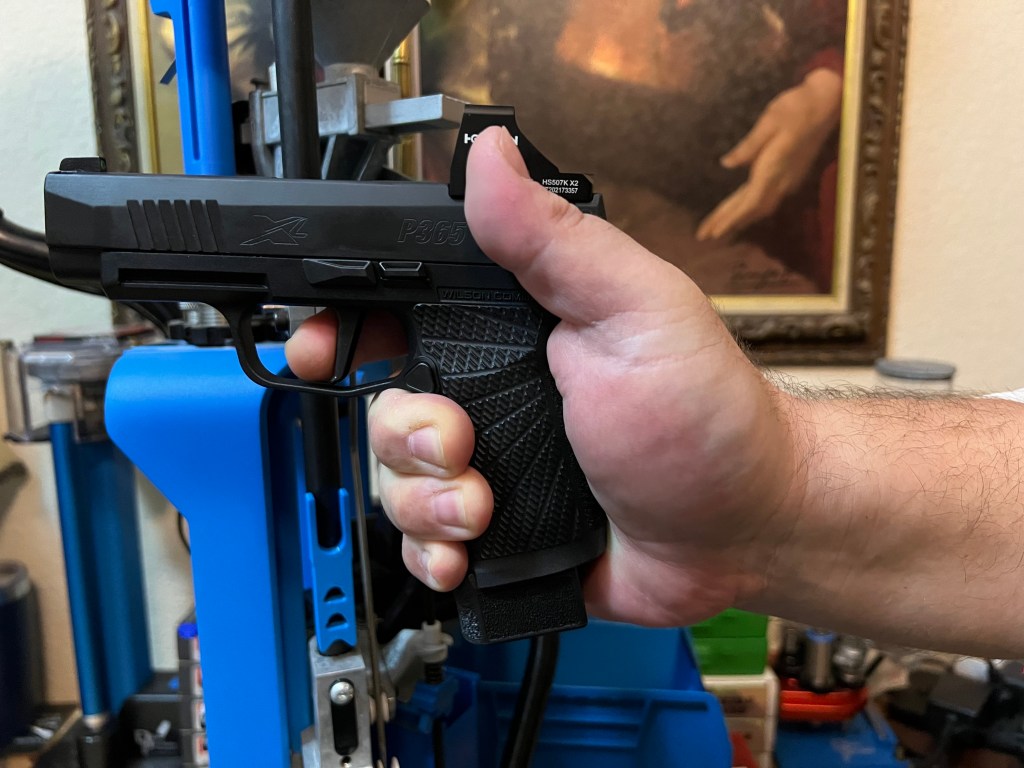

Measure Your Trigger Finger
If you’d rather have a number before you go to the store, Karl’s version uses a tape measure. Measure your trigger finger from where it meets the palm to the tip, then find your band.
| Trigger finger | Band | What fits |
|---|---|---|
| 3.50 in and up | XL | Any gun on this list |
| 3.25 to 3.50 in | L | The large pistols and everything smaller |
| 3.00 to 3.25 in | M | The medium pistols: Glock 48, Hellcat Pro, Shield X, P365-XL |
| Under 3.00 in | S | Mostly single-stack 380s, which this list doesn’t cover |
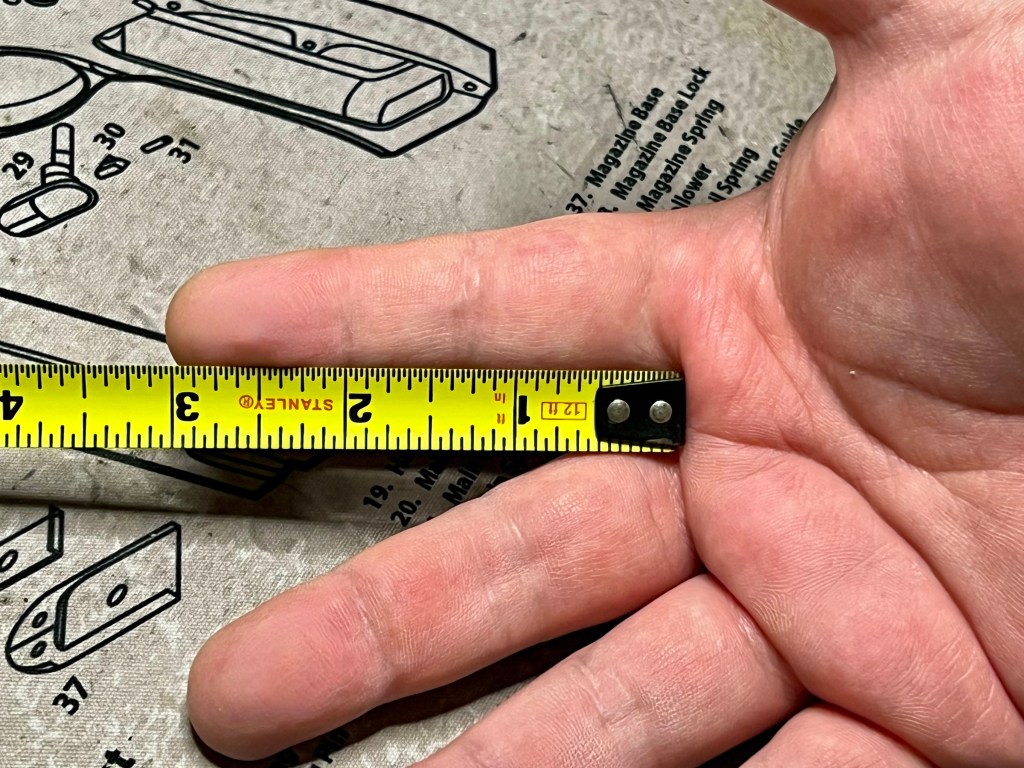
The bands are Karl’s. We don’t see the S band often, and when we do, the P365-XL or the G43X is usually close enough. The alternatives cost you something: pricier ammunition for a 380, a single-action manual of arms for a 1911.
The hand-size test tells you which group to shop: the seven medium pistols if the Glock 19 fails in your hand, all twelve if it passes. Grip and reach vary inside each group, so hold several.
The List at a Glance
Twelve pistols, the medium ones first. All are sold optics-ready (the slim Glocks as the MOS, the Dagger with the cut slide) and all have a rail. Width and height are the makers’ numbers where they publish one, and makers don’t all measure the same way. Weights are unloaded and capacity is the flush magazine. “Safety versions” says whether the maker also sells a thumb-safety version; the one on this list is the one without. Prices are the typical range UncleZo.deals has recorded, not the best deal of the day, and they’ll move with the holiday sales.
| Pistol | Width | Height | Weight | Capacity | Grip adjustment | Safety versions | Street price |
|---|---|---|---|---|---|---|---|
| Sig Sauer P365-XL | 1.1 in | 4.8 in | 20.7 oz | 12+1 | Grip modules | Thumb safety optional | $596–$639 |
| Sig Sauer P365-XMACRO | 1.1 in | 5.2 in | 21.5 oz | 17+1 | Grip modules | Thumb safety optional | $712–$769 |
| Glock G43X MOS | 1.1 in | 5.04 in | 18.6 oz | 10+1 | None | None | $509 |
| Glock G48 MOS | 1.1 in | 5.04 in | 20.6 oz | 10+1 | None | None | $480–$505 |
| Springfield Hellcat Pro OSP | 1.0 in grip | 4.8 in | 21 oz | 15+1 | None | Thumb safety optional | $547–$580 |
| Smith & Wesson Shield X | 0.9 in | 4.9 in | 20.8 oz | 13+1 | None | Thumb safety optional | $473–$510 |
| PSA Micro Dagger | 1.1 in | 4.7 in | 15.9 oz | 15+1 | None | None | $340–$360 at PSA |
| Glock G19 Gen6 | 1.35 in | 5.04 in | 22.6 oz | 15+1 | Backstraps | None | $620–$655 |
| Smith & Wesson M&P 2.0 Compact | 1.3 in | 5.0 in | 25.8 oz | 15+1 | Backstraps | Thumb safety optional | $582–$641 |
| PSA Dagger Compact | 1.28 in | 4.78 in | 22.4 oz | 15+1 | None | None | $300–$380 at PSA |
| Ruger RXM | Glock 19 size | 5.31 in | 23.2 oz | 15+1 | Grip frames | None | $368–$414 |
| Taurus TX9 Compact | 1.28 in | 4.8 in | 23.7 oz | 15+1 | Backstraps and modules | None | $386–$406 |
The Medium Pistols: Seven Slimlines
These are the guns Karl steers people toward when the Glock 19 fails the hand-size test. They give up a little weight, which means a little more recoil, and most of them give up a few rounds. In exchange you get a gun you can actually grip with a trigger you can reach, and that’s worth more than the rounds you gave up.
Sig Sauer P365-XL and P365-XMACRO
For a short reach, start here. My P365-XL fits my hands better than anything else I’ve owned at this size, and the P365-XL versus G48 comparison is still the most-read thing I’ve written about either gun. The serialized part is the fire control unit, and it drops into whichever grip module you want, so a Wilson Combat module or Sig’s own changes the grip without buying another gun. The P365-XMACRO, which most people just call the Macro, is the same width with a longer grip, a 17-round magazine and a factory compensator. Both are sold with or without a thumb safety. Buy them without.
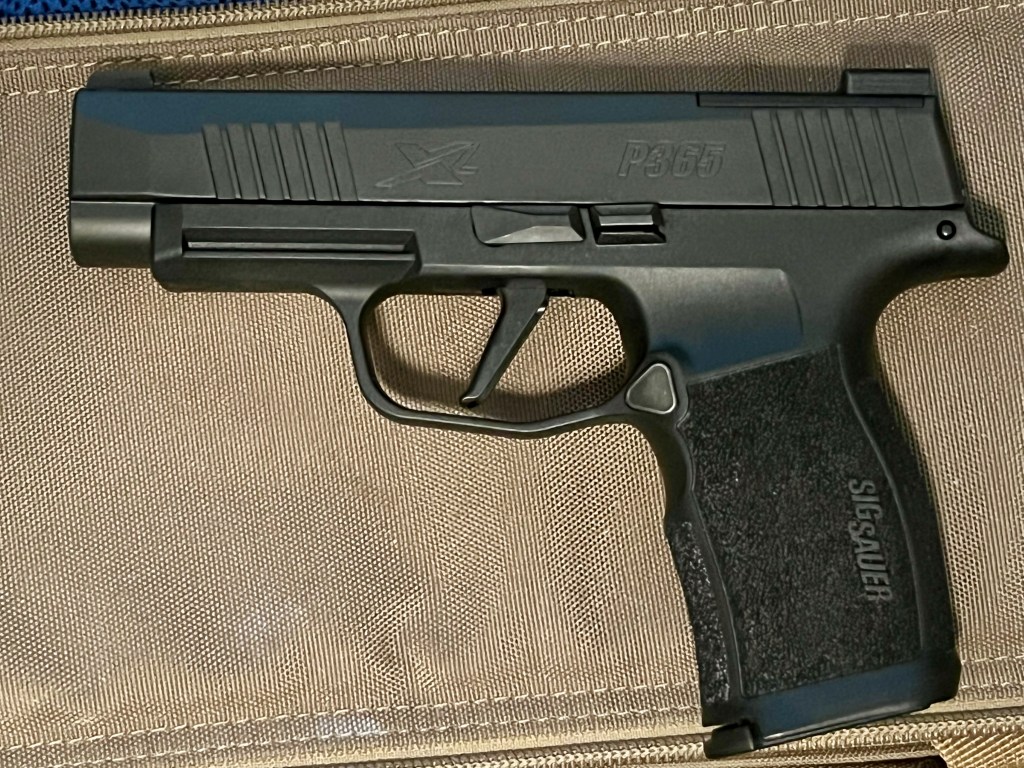
Glock G43X and G48
Same slim frame, two slide lengths: a 3.41 in barrel on the G43X and 4.17 in on the G48, which is why I called the G48 the offspring of a G43X and a G19 in my review. Glock lists the trigger reach at 2.64 in against the G19’s 2.76. That eighth of an inch, plus the slim frame, is the whole story. The grip is fixed, with no backstraps or modules. The factory magazines hold ten, and Shield Arms S15 magazines take that to fifteen, though Karl’s advice is to load them to fourteen so they seat reliably.
Mine is gone. I liked the P365-XL better, so the G48 MOS sat in the safe until a friend went looking for a slimline and I sold it to him, and I wouldn’t let a friend carry a gun I wouldn’t carry myself. Everything I did to that gun is in Project Glock 48, and most of it was optional.
Springfield Armory Hellcat Pro
The Hellcat Pro is Springfield’s slimline in the P365-XL’s size class: a 3.7 in barrel, 4.8 in tall, fifteen rounds in the flush magazine and seventeen in the extended one that ships with it. We see some come through class, though it’s one of the less common ones. The grip is fixed. Skip the one with the thumb safety.
Smith & Wesson Shield X
The Shield X followed the Shield Plus in 2025, and it’s a bigger change than the name suggests: a 3.6 in barrel instead of 3.1, thirteen rounds flush and fifteen in the extended magazine that ships with it, a light rail, and an optic cut on every model. At 0.9 in wide it’s the narrowest gun on this list, and the grip is fixed. It’s also the gun Karl moved to from his G48. He switches between two of them, a compensated one with an enclosed-emitter optic and a plain one with an open-emitter optic, and both wear a compact weapon light. Avoid the version with the manual safety.
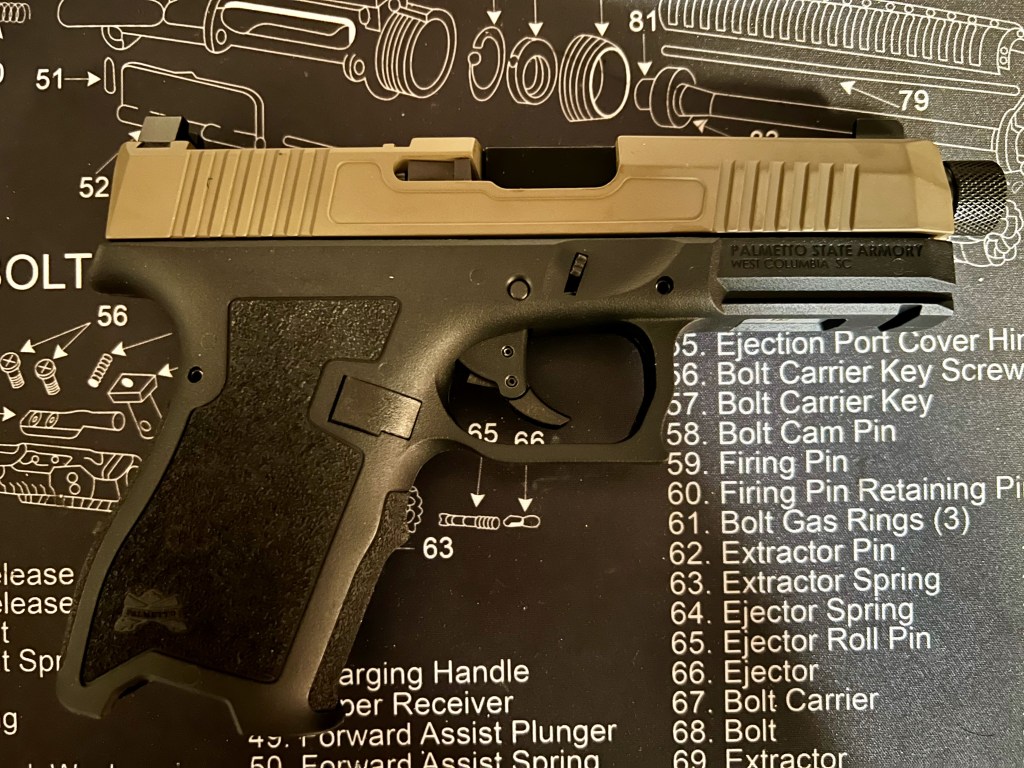
PSA Micro Dagger
The Micro Dagger is Palmetto State Armory’s slimline, built around Glock 43X and 48 magazines, so its grip is the Glock slimline’s size with fifteen rounds in the box. At 15.9 oz it’s the lightest gun on the list. The grip is fixed, there’s no thumb-safety version, and it ships with the optic cut. It’s also one of two guns here I haven’t held myself, the TX9 being the other, so on this one I’m leaning on Karl. PSA sells it direct.
The Large Pistols: If the Glock 19 Fits Your Hand
These five weigh more and shoot softer, which makes them the easier first pistol to learn on. Unless they’re too big for your hand.
Glock G19
The benchmark, and still the first pistol I’d name for a hand that fits it: fifteen rounds, a 4.02 in barrel, a backstrap set in the box, and more holsters, magazines, sights and parts made for it than for anything else here. The others on this list have proven reliable too, or they wouldn’t be on it. What the Glock has that they don’t is volume and pedigree.
Glocks used to dominate these classes. When I started training as a student in 2019, more than half the line was Glocks. That’s rare now. They’re still usually the most common brand in class, but not always. On a class weekend in October 2026, I counted sixteen pistols and five were Glocks, three of them 19s, next to three P365-XLs, three M&Ps and two Shield Xs, which put Smith & Wesson level with Glock.
If it fits, buy the Gen6. It’s optic-ready out of the box, the Gen5 MOS it replaced is discontinued and hard to find, and we’ve already seen Gen6s run in class.
Smith & Wesson M&P 2.0 Compact
The M&P 2.0 Compact is a Glock 19-sized gun with a 4 in barrel, fifteen rounds and four backstraps in the box. Karl carried M&Ps for years because the standard Glock frame was too big for his hands, until the Glock 48 came along, so if the G19 is a near miss for you, try the M&P on its smallest backstrap before you give up on a large pistol. Smith & Wesson sells it with or without a thumb safety, and a California version with a magazine disconnect. The one on this list has neither.
PSA Dagger
The Dagger is a Glock 19 pattern gun, and it takes Glock 19 magazines and most Glock 19 holsters. A 3.9 in barrel, fifteen rounds, a fixed grip, no thumb-safety version, and the optic cut only on the cut-slide versions, so buy one of those. I reviewed the Dagger Compact in 2022, and it has run fine since, which isn’t saying much, because it doesn’t get much trigger time next to the guns I compete with. Daggers are on the list because they run in class. What they don’t do is fit any better than the G19 they copy. PSA sells this one direct too.
Ruger RXM
The RXM is Ruger and Magpul’s lower-cost Glock 19: Glock magazines, Glock holsters, a 4 in barrel, fifteen rounds, and optic cuts from the factory. The serialized part is the fire control insert, and it sits in a Magpul grip frame you can swap, so you get the grip modularity of a P365. We’ve seen a number of them come through class, and they run. It’s the same size as the original, though, so if that didn’t fit you, start with the slimlines.
Taurus TX9
The TX9 is the newest addition to the list: a three-size family for 2026 on a serialized steel chassis with swappable grip modules and four backstraps. The compact is the one for carry: a 4 in barrel and fifteen rounds. It’s 1.28 in wide, which puts it next to the Dagger, not the Shield. I haven’t held one or seen one in class yet, but I’m not at every class. Karl is at most of them, and the TX9 wouldn’t be on his list if it didn’t belong there.
It’s on the list as another frugal option, because students don’t all have the same budget. Could you spend less? Sure. Lower-priced pistols come through class, and they almost never make it to the end without stoppages and other problems. The damage is twofold: the student gets frustrated, and a gun that won’t run gets in the way of learning. What almost always follows is the sale of the failing gun and the purchase of the lowest-priced one that works, and that costs more than starting there.
The Ones I Add When Karl Asks
When I’m assisting, Karl sometimes asks whether there’s anything I’d add. There is, and none of it changes the test. The Walther PDP Compact is a Glock 19-sized gun with a 4 in barrel, fifteen rounds, backstraps, and no thumb-safety version. The PDP F-Series is a different gun where it counts. The slide is as wide as the standard PDP’s, but the frame is new, with a smaller grip and a shorter trigger reach. I’ve held both, and the difference is noticeable. It fits a medium hand. It just doesn’t carry as slim as the slimlines.
The CZ P-10 C and the Heckler & Koch VP9 are Glock 19-sized too, with fifteen rounds, backstraps and no thumb-safety version. The VP9 is the gun I learned to shoot fast and well with, and it’s in my own top five for 2025. Its interchangeable side panels make it the most adjustable grip of the bunch. It also costs more than anything on the list, and the card below shows the VP9A1 K, the newer compact version. All four run.
A Nod to Canik
I see Caniks in matches every month and in classes at every level. I don’t know the lineup well enough to tell you which model to buy, so take that as a nod and do your own homework. If one passes the hand-size test and ticks the boxes below, I wouldn’t talk you out of it.
Triggers and Recoil
People ask about triggers almost as often as they ask which gun. The VP9 has the best trigger of the bunch, in my opinion, but most of these guns have really good triggers at about the same pull weight. Glock has a reputation for a bad one. Deserved? Not really. A pistol that fits your hand matters more than its trigger, and after fit it’s preference.
Recoil is mostly preference too, and it’s the hardest thing on this page to check, because you have to shoot the gun. Rent or borrow one if you can. Even then, let fit make the first cut and let recoil pick between the ones that passed.
What the List Leaves Out
Every gun above, in the version on this list, is a striker-fired 9mm with no manual safety, no grip safety, no magazine disconnect, and a grip long enough for your whole hand. That’s deliberate. The learning curve for a new shooter is steep to begin with, and everything on this list is there to keep it as flat as it can be: a gun that fits, a simple manual of arms, and a maintenance schedule that forgives neglect.
Four Rules, One Reason
- No manual safety. It’s one more thing to learn and to do under stress.
- No passive grip safety. Hand shape and grip strength vary, and a grip safety that doesn’t fully depress in a small or weak hand leaves you with a gun that doesn’t fire.
- No magazine disconnect. A gun that won’t fire without a magazine needs specialized equipment before you can dry fire it the way it’s carried. Getting a new shooter to dry fire at all is hard enough without adding a purchase and a step. None of the twelve has one in the versions listed.
- A full-length grip. Long enough for a full firing grip with every finger on it, and ideally long enough that the heel of your hand doesn’t get pinched between magazine and frame on a reload. A dangling pinky makes recoil far harder to manage, and a pinched palm makes practice no fun. That’s why the P365-XL is on the list and the shorter P365 isn’t, and why Karl has written for years that the smallest gun possible is the wrong goal.
Why My Own Carry Gun Isn’t on It
That’s also why the gun on my own hip isn’t on the list. I carry a Staccato C2, a Glock 19-sized 2011 with a thumb safety, a grip safety and a single-action trigger. It’s a fantastic gun, and I wouldn’t recommend it as anyone’s first concealed carry pistol.
Nobody, Karl included, says a fit problem or a thumb safety can’t be trained past. The trouble is that most people never do. In Strategies and Standards for Defensive Handgun Training, the book he wrote with John Daub, Karl puts the share of Texas gun owners who take a class beyond the license course or shoot a match at about one percent in a given year. More training may never follow the purchase, so the list assumes it won’t.
What About Compensators?
The Hellcat Pro, the Shield X, the M&P 2.0 and both Daggers now come with a factory compensator as an option, and the Macro ships with one as standard. Less muzzle rise is real, and it helps most on small, light guns. The trade is noise and hot gas close to your face if you ever have to shoot from retention. That’s a topic for another post. The plain versions are the ones in the table.
Before You Buy Your First Concealed Carry Pistol
Check your state’s laws first. A few states require a manual safety or a magazine disconnect, or cap magazine capacity, and that can strike guns off this list, because not every one of them comes in a compliant version. There are too many state variants to list, and they come and go more often than the standard models do. Buy the version your state allows.
Then budget the whole kit, not just the gun: a holster that covers the trigger and holds the gun where you put it, two spare magazines, 500 rounds of practice ammunition, and a class. A sales pitch? No. The class is what turns the gun into protection, and I wrote about why in The Reality of the First Handgun. The sales at the end of November are a fine time to buy a first pistol and a terrible reason to buy the wrong one. Go to a shop that will let you hold several, bring the hand-size test with you, and buy the one that passes.
Closing Thoughts
My own road went the long way around: a P229 that was too big, a VP9 that still wasn’t quite right, and a Staccato C2 on my hip. That’s a $2,300 answer, with a manual of arms to match, to a question most new shooters should answer for $500. You don’t have to take that road. Start with a gun that runs, and see where your finger lands before you pay for it.


Comments