

On November 7 I told you to take inventory before you panic buy, and I said I’d worry about 2028 in 2028. I’m keeping that promise. This isn’t a 2028 post. It’s a 2027 post, because the chatter since the midterms has shifted from “buy ammo” to something that bothers me more: lawyers and legal-service influencers telling gun owners that a Democratic president in 2029 is a near certainty, that the NFA tax is coming back at $5,000, and that the only rational move is to buy everything with a serial number before it’s too late. Some of you sent me those videos. So let’s talk about what the data says, where the real fight is, and where your next gun dollar does the most good. Hint: it isn’t the gun counter.
Same disclaimer as the midterms post. I don’t write about politics, and this isn’t a politics post. It’s a post about gun rights organizations, which is a different thing. This blog exists to grow the gun community and make it more competent. None of that survives without the right to own, carry, train and compete. Defending that right isn’t politics. It’s the foundation the rest of this site sits on.
What the Influencers Are Selling
Here’s the pitch making the rounds. Studies show a Democrat wins in 2028. Two terms is likely. The $0 NFA tax goes back up, and not to $200, with numbers from $2,000 to $10,000 floating around and $5,000 the popular guess. The NFA list grows to include AR-15s, semi-automatic pistols and standard-capacity magazines. The Supreme Court won’t save you, because the justices are getting older and the next appointments won’t be friendly. Therefore, buy now.
Some of that is plausible. Some of it is damn near invented. Before I sort it, consider the source. The loudest voices sell trusts, legal plans and suppressors, and panic is good for business. The industry’s own trade group reports suppressor sales are booming.
I’m not calling anybody a liar. I’m saying incentives are incentives, and I’d want you to apply the same skepticism to me if I sold NFA trusts for a living. I don’t. One disclosure, because the readership deserves it: Gun Owners of America is an affiliate of this blog, so a GOA membership started from one of my links sends a few dollars back here. I’ve never pushed it, and to date it has paid me exactly $0. Nobody else I’m about to name pays me a dime.
What the Markets Say About 2028
I went looking for the studies. I didn’t find any. What I found were prediction markets, and they say something more modest. Kalshi prices a Democratic win in 2028 at 67% as I write this, and Polymarket sits about the same. That’s a favorite, not a lock. One in three is the kind of chance that comes in all the time, in politics and at the range. Nobody trades a “two full terms” market, so that half of the claim rests on nothing at all.
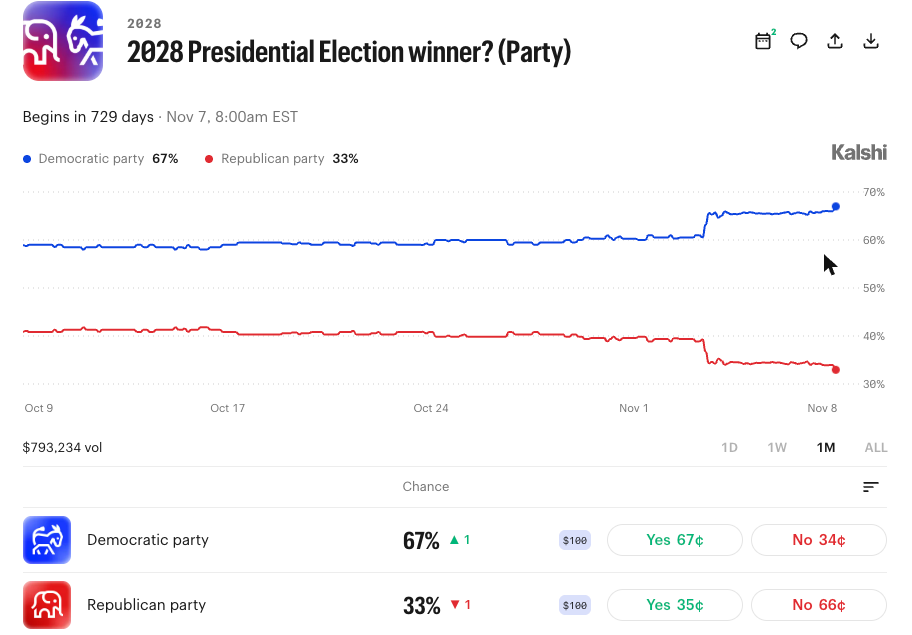
Those prices also move. In September, JD Vance was near even money for the Republican nomination. The week after the midterms, the whole field was led by Jon Ossoff, who says he isn’t running. Two years is forever in this business. The closest thing to a “study” is a base rate: since 1952, the party holding the White House has won a third straight term exactly once, in 1988. That cuts against Republicans in 2028, sure. It also cuts against anyone claiming certainty, because the same history says the midterms don’t predict the next presidential. Reagan, Clinton and Obama all lost a midterm and won two years later. So, is 2028 decided? No. Is it leaning one way? Yes. Plan for the lean. Don’t bet the household budget on the certainty.
Where the $5,000 Stamp Came From
The $5,000 number has a paper trail, and it’s shorter than the videos suggest. In July 2025, Senator Chris Murphy filed an amendment to a military construction spending bill that would have set the NFA transfer tax at $4,709 per item. It went nowhere. That’s it. That’s the whole source. The $2,000 and $10,000 figures? I traced the most-shared post-election article on the topic, and the numbers appear only in the reader comments. The article itself names no figure and never mentions 2028.
What that article does say is worth hearing, and it’s the same risk I laid out in the October 28 NFA post. The court ruling behind the ATF’s decision to stop enforcing registration, won by the Silencer Shop Foundation and Gun Owners of America, rests on the tax being $0. Congress could restore a tax of one dollar through budget reconciliation, which can’t be filibustered, and a one-dollar tax undercuts the ruling. The president can veto a bill. He can’t veto a line out of a bill he wants. That’s the near-term risk, it exists in 2027, and it has nothing to do with 2028.
As for adding AR-15s and magazines to the NFA, that isn’t a rumor either. It was in the Biden campaign’s 2020 plan: sell them to the government or register them under the NFA. It’s a known ask, and it’s also an ask that went nowhere with a Democratic House, Senate and president in 2021 and 2022.
The Slow Version of the Threat
The Supreme Court point is the one the influencers have most right. Justice Thomas is 78 and Justice Alito is 76. A Democratic president from 2029 on plausibly replaces one or both, and the majority that gave us Bruen gets thinner. That’s the slow version of the threat, and it’s real. It is also years out, and no amount of buying in November 2026 changes who sits on that bench.
The Bills Are Already Coming to the States
Now the part that should actually move you. While everyone argues about 2028, the gun control groups are already working on 2027, and they’re not hiding it. Before the election, Everytown put $3 million into legislative races in exactly five states: Arizona, Michigan, Minnesota, Pennsylvania and Wisconsin. It put another $3 million into governor’s races with the Democratic Governors Association. Every one of those five states elected a Democratic trifecta. Everytown’s president put the goal in one sentence: “Every gun safety bill must reach a governor’s desk.” Three days after the vote, the group was already calling Minnesota a “gun safety trifecta.” In Arizona, the ads named the agenda outright: universal background checks, an assault weapons ban and a red flag law.
Flip, File, Sign
How fast does that go? Look at three states where Democrats hold the pen. Virginia went Democratic in November 2025 and had a ban on assault weapons and magazines over 15 rounds signed by May 14, 2026, effective July 1. Colorado’s permit-to-purchase law for most semi-automatic rifles took effect August 1, 2026, and a federal judge declined to block it on November 4. New Mexico got a seven-day waiting period in 2024. Flip, file, sign. The pattern runs about six months, and the gun rights organizations in those states fought every bill with the members and money they had. Some bills died. Still, the ones that didn’t are now law, and the lawsuits against them run on donations.
One more thing the influencers get right, for the wrong reason. A state ban on suppressors, short-barreled rifles or standard-capacity magazines doesn’t wait for 2029. It takes effect the summer after it passes, and the run on the shelves starts the week the bill moves. If you live in one of the flipped states, your needs-and-wants list runs past the ammo cabinet and into the safe, same rules as the midterms post: no debt, fill the real gaps first, and decide calmly now instead of in a panic in April.
The Texas Wrinkle
Here at home, I wrote on November 7 that most gun bills would die in the Texas Senate. I still think that’s the likeliest outcome, but I owe you the wrinkle. Democrats won the governor’s office and the attorney general’s office. Governor-elect Gina Hinojosa hasn’t named guns as a priority, but in 2017 she wrote that Texas should pass universal background checks and require a license to carry a long gun. Democrats took the Texas House too, with a handful of races still too close to call as of this writing. The Senate stays Republican, 19 to 12.
But the next lieutenant governor, the one who presides over that Senate, is a Democrat, Vikki Goodwin. As a House member in 2025 she filed bills to raise the purchase age for semi-automatic rifles to 21, require background checks on private sales, create a red flag law, add gun show offenses, and have dealers report multiple rifle sales to the state. None got a hearing. Her stated priorities since the election are schools, hemp and data centers. Guns didn’t make the list. Even so, Everytown endorsed her for this office in April, as one of its own Moms Demand Action volunteers.
Under the current Senate rules, her new office names the committees and decides where bills go. Those rules are the Senate’s to write, though. It takes 16 senators to write them, and Republicans have 19. The outgoing lieutenant governor, Dan Patrick, has already urged them to rewrite those rules before she arrives. Then there’s a habit gun owners here know well: the Texas Senate listens to the police lobby.
Who the Texas Senate Listens To
Don’t take my word for it. Take the record. Back in 2015, the Texas Police Chiefs Association polled its members, and three quarters opposed open carry. The chiefs, CLEAT, the Sheriffs’ Association and the Dallas and Houston unions fought the bill, and it passed only after the provision they hated most came out. Two years later, Patrick said the Senate didn’t have the votes for constitutional carry and cited law enforcement concerns.
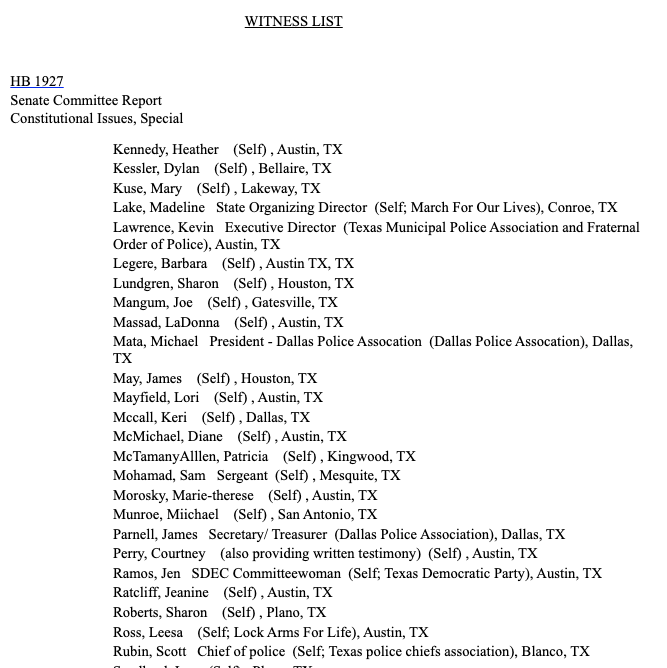
In 2021, he said the votes weren’t there again and went to meet the police groups, and the Senate witness list shows who he meant: the Texas Municipal Police Association, the Texas Police Chiefs Association and the Dallas Police Association, all registered against, while the Texas State Rifle Association and Gun Owners of America registered for. Permitless carry passed only after the amendments the police groups wanted. The pattern isn’t “the cops say no and the bill dies.” Instead, the cops set the terms.
The Bills With a Badge
Now flip it around. Since Uvalde, the Texas Police Chiefs Association has recommended raising the purchase age to 21 for AR-15-style rifles and expanding background checks. The Legislature ignored them in 2023, when a raise-the-age bill cleared a House committee with two Republican votes and died in the House Calendars Committee. No police group registered on that bill either way, so the chiefs’ 2022 recommendation is the whole of the record. A Democratic House won’t let it die there in 2027.
Twenty Bills in Two Days
A raise-the-age bill has plenty of company this time. Filing for the 2027 session opened on November 9, and within two days about twenty bills restricting guns were in. Five would raise the purchase age for semi-automatic rifles to 21, and one would bar anyone under 21 from possessing any firearm at all. The list also has background checks on private sales, a red flag bill that repeals the 2025 Anti-Red Flag Act, and a requirement that dealers report anyone who buys two guns in a week.
The Fine Print
Two of those bills reward a closer read. The background check bill says a person may not “sell or otherwise transfer” a firearm without a dealer-run check, and it never defines “transfer.” It has no exception for family, gifts or loans. Does handing your brother-in-law a rifle at deer camp count? The bill doesn’t say. The dealer can charge a fee, and skipping the check is a Class A misdemeanor.
The red flag bill starts with a judge finding reasonable cause that someone’s serious mental illness makes that person a danger. The judge can then issue a temporary order without notice and order the guns surrendered within 24 hours. A hearing is due within 14 days. Still, the bill puts no expiration on the temporary order, and it doesn’t say what happens if the hearing runs late.
Texas already has a law for that same person, and it moves faster. Under emergency detention, a doctor examines the person within 12 hours, and the hold ends at 48 hours unless a court extends it. An officer can take a firearm found on that person, with a set process for getting it back. If the case goes on to commitment, the court appoints a lawyer within 24 hours of the filing and holds a probable cause hearing within 72 hours of ordering custody. The red flag bill requires no doctor’s opinion up front and appoints no lawyer. In short, it takes the guns and leaves the person where they were.
Keep all twenty in perspective, though. The Texas State Rifle Association counted 107 bills like these in 2025, and three got a hearing. Filing is cheap. What changed is who decides which bills get a hearing in the House.
Where the Votes Are
Which ones do you watch? Not the scariest ones. The red flag bill has no Texas law enforcement association behind it, and the last Legislature voted the other way. The bills with a real shot are the ones that can wear an officer-safety badge: the raise-the-age bills, the background check bill, and a permitless carry rollback if one gets filed. That’s my read of the record, not a forecast. Passing any of them takes four Republican senators, and under the current rule it takes six just to bring one to the floor. The rules fight in January settles both questions: how much of the office Goodwin keeps, and where the floor threshold lands. It has moved from 21 votes to 19 to 18 since 2015. Watch that fight.
Join Your State Gun Rights Organization First
Which brings me to the ask, and it’s the same one I made in September 2019, when Democrats had just taken the U.S. House and I was tired of watching gun owners outsource the fight. If you’re going to spend money because of this election, spend the first of it on the people who will be in the capitol in January, and start at the state level.
Three Steps, in Order
- Your state gun rights organization. This is the membership that matters most, because state bills are the ones that pass. In Texas that’s the Texas State Rifle Association, which has had a lobbyist in the building for every one of the fights above, and some readers prefer the no-compromise approach of Texas Gun Rights or Lone Star Gun Rights. Pick one. In the flipped states, your state group is about to have the busiest six months of its existence, and it needs to show up in Lansing, Madison, St. Paul, Harrisburg and Phoenix with a membership number that makes a committee chair blink.
- Then the national gun rights organizations. Gun Owners of America, the Firearms Policy Coalition and the Second Amendment Foundation are the ones filing the lawsuits. GOA is a plaintiff in the case that stopped the ATF from enforcing NFA registration. SAF won McDonald. FPC, in turn, has filed post-Bruen suits by the dozen. If your interest is cans and short-barreled rifles specifically, add the American Suppressor Association, which did the state-level work that made suppressors legal to hunt with in most of the country.
- Then a monthly commitment, state first. Memberships are the floor. Lobbyists and lawyers cost money every month, and the other side’s biggest donor is a billionaire. Pick an amount that doesn’t change your household math, ten or twenty dollars, and set it to recur, starting with the state group. The sooner it starts, the more of the 2027 session it funds.
What Gun Rights Groups Cost
Most memberships run $15 to $35 a year. Call it a box of defensive ammo apiece. That’s the cheapest insurance you can buy on a constitutionally protected right, and unlike the ammo, it works whether or not you ever need it. How many of the coming bills get fended off before they become law is the open question of 2027, and the answer depends almost entirely on whether gun owners put skin in the game before January or after the bill passes.
Then, and Only Then, the Safe
I’m an advocate for preparedness. I am not a doomsday prepper, and I spent sixteen posts on building a survival kit on a budget to make that distinction. The pragmatic version of preparedness improves your life and reduces your most likely risks. Your most likely risks are not an apocalypse. They’re a layoff, a medical bill and a transmission, and a panic buy on a credit card makes every one of those worse. I said it in October 2024 and on November 7, and I’ll keep saying it: don’t take on debt to prepare for a maybe.
So once the memberships are paid and the monthly line is set, then look at the safe. Same inventory, same order as the midterms post: defensive tools, defensive ammo, magazines, practice ammo. Then the wants. If a suppressor or an SBR has been a real gap for years, the $0 stamp and a Democratic statehouse are two good reasons to stop putting it off. If it’s a want that showed up last week because a guy in a video said so, it’s the video talking. Fill the holes you can afford, in the order they matter, and let the price of a thing tell you when.
What I’m Doing: Gun Rights Groups Before Guns
Memberships first. I’m a Texas State Rifle Association member, a Firearms Policy Coalition member and a Gun Owners of America life member, and all three are current. Then the wish list, and it’s the same one I had before the election.
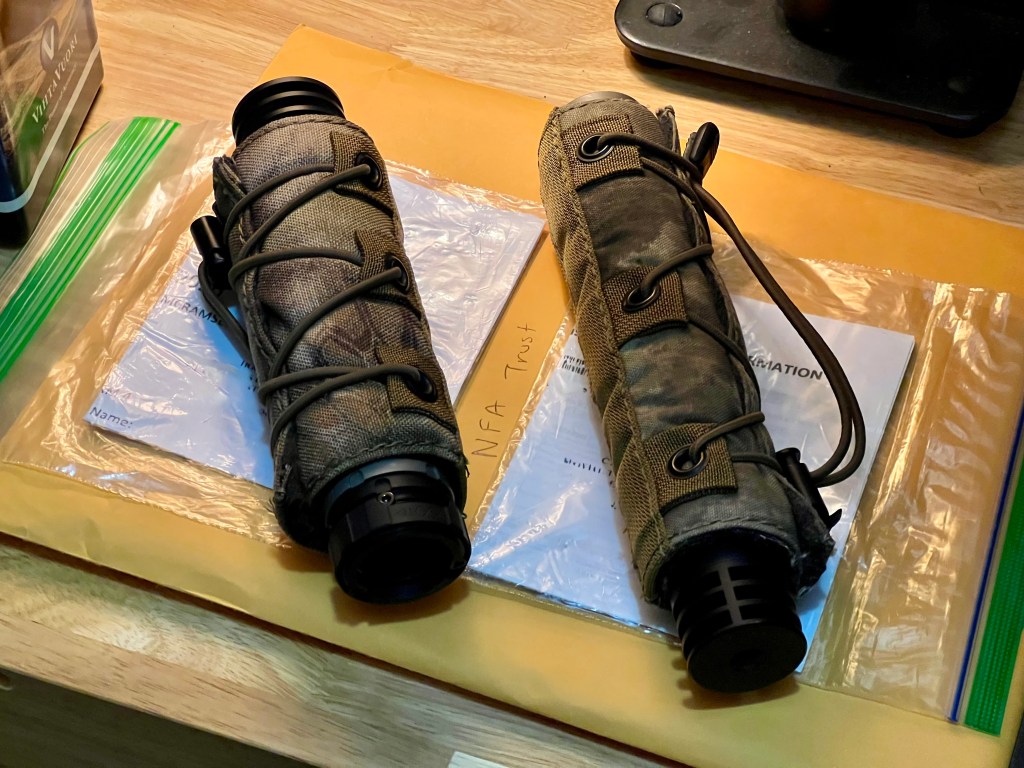
The most likely addition to the trust is a short-barreled rifle in 300 Blackout, suppressed, for home defense. I described that gun in 2021 as the ideal home-defense firearm, a suppressed, short, lightweight AR with a dot and a light. I said 5.56 then. I’d pick 300 Blackout today for the way it runs subsonic through a can, and that gun is still the best suburban home-defense long gun I can think of. Is it a gap today? No. It’s a want, and it happens if and when the wallet allows.
Short-barreled shotguns don’t register in my brain as either a need or a want, so that’s a no before 2029 and probably after. Cans, I’m reconsidering: a 22 rimfire can and a 9mm can are the top contenders, and maybe a 338. Wallet permitting, again. This uncle once bought a Desert Eagle, so take my wants-versus-needs sermon with the grain of salt it deserves.
Closing Thoughts
Is a Democratic president in 2029 likely? The markets say more likely than not. Is it certain? No, and anyone telling you it is wants something from you. Are the bills coming? In Austin they’re already filed, and the other statehouses open in January. The people who will stand in the committee room against them are funded by memberships and monthly donations, not by panic buys. Join your state gun rights organization this week. Add a national one. Set the monthly amount you won’t miss. Then, and only then, open the safe and fill the real gaps within your means. Your state, your dollar, your call.


Comments