

On October 31, 2026, I took Advanced Handgun at KR Training for the third time. Between the course description and my write-ups of the first time in May 2022 and the second in October 2024, the format won’t be a surprise to y’all. What made this one different was me. It was the first class I’d taken in 2026. An arthritis flare-up in August 2025 took me off the range for about three months. Coming back too soon cost me more time, and then life kept me away until August 2026.
So the question going in was different too. In 2022 and 2024 I went to see how much I had improved. This time I went to find out how much I had lost, and where. A day of scored drills under Karl Rehn’s eye is about the most honest way I know to answer that question.
Why Advanced Handgun, and Why Now
Two reasons. The first is the calendar. KR Training all but shuts down during deer season, under an agreement with the range’s neighbors to keep things quiet, so the October 31 Advanced Handgun was the last class on the 2026 calendar. If I wanted a class before the new year, it was this one or nothing.
The second reason is the class itself. Of everything in the Defensive Pistol Skills Program, this is the one I’d pick for a tune-up. Karl has a knack for watching me shoot for an hour and finding the one thing I can tweak that pays off right away. Then there are the scored drills. A sheet full of times and hits against known standards is an objective measurement, and I wanted one. I had a rough number already. Two USPSA matches, on August 1 and October 17, 2026, had put my classifier runs somewhere around 10% behind where they sat before the break, by eyeball rather than careful math. What a classifier can’t tell me, though, is where that 10% went. Five hours of scored drills with Karl watching can.
The Loadout
Advanced Handgun ◆ 2026
Gun
Optic
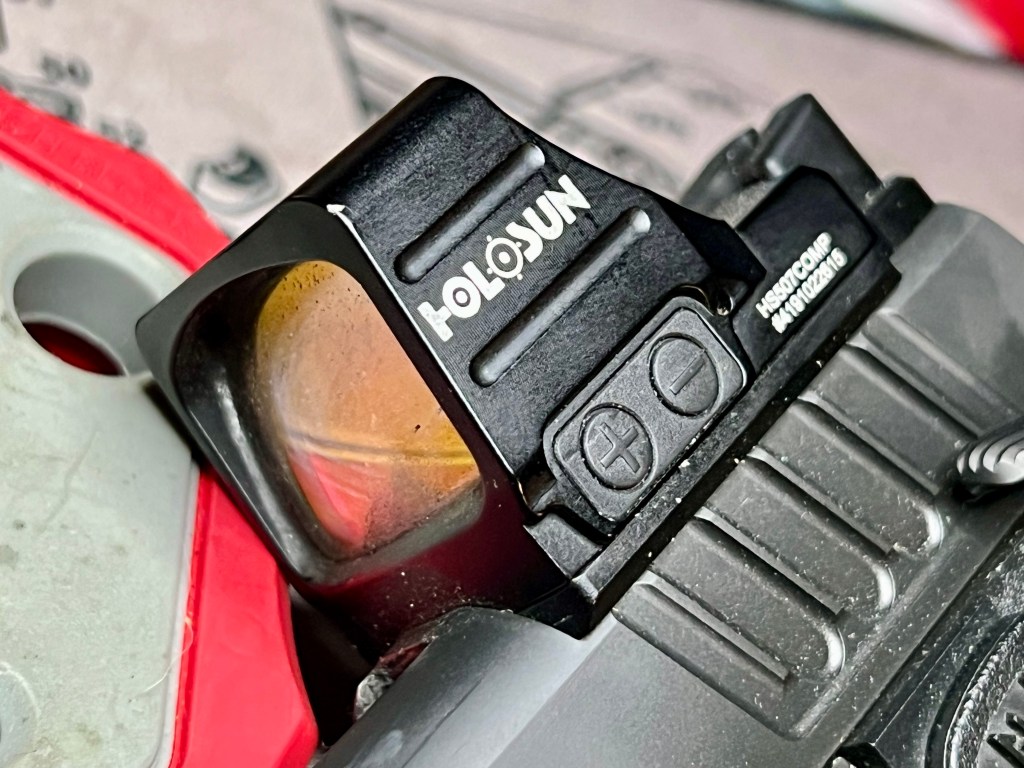
Holosun 507COMP
Holster
JM Custom Kydex IWB 3, strong side
Belt
Concealment Solutions Python Gun Belt
Round count 300 to 350
Same as 2024, except the belt and the ammo

This is my everyday concealed carry setup, which is the point. Advanced Handgun works fine with competition gear, but I’d rather measure the gun I actually carry. The C2 is sitting at about 8,100 rounds now, still wearing the same 507COMP. Two things changed from the October 2024 class, one by choice and one not. The 147 gr handloads were the choice, and the reason was fatigue. There are still a few cases of Blazer Brass in the ammo cabinet, but five hours of shooting after a year away was going to be tiring enough on its own. My competition load runs softer than the bulk stuff, so I brought it and saved my hands for the drills.
The belt wasn’t a choice. The old Concealment Solutions Python Gun Belt came out of retirement because the buckle on the Nexbelt Titan EDC belt I’d worn for two years broke. That’s a topic for another post. The Python did what a stiff belt is supposed to do and didn’t give me a second thought all day.
How the KR Training Advanced Handgun Class Runs
The class was scheduled for five hours, 10 to 3, with a 400-round minimum. It ran the full five, though I’d put the actual round count a bit over 300, maybe 350. Karl led it with two assistant instructors, Eric Victorin on the line and Ed Vinyard, who spent much of the day running a side experiment I’ll get to further down.
Same Method, New Order
If you’ve read the earlier write-ups, the shape of the day will be familiar, even though the order wasn’t. Karl reworks the flow of this class year after year for efficiency and effect, and now and then the curriculum itself changes, usually on the heels of a successful experiment or a change in the industry: a training method, published research, new gear. This time we went from the safety brief and range medical plan straight into the Bill Drills. Karl then talked through 25-yard zeros from a rest, but we shot our groups at 15 yards standing, with no barrels or rests. My guess is that was a time call on Karl’s part, though I can’t say for certain. Everything after that followed the order on the score sheet.


What didn’t change is the part that matters. Each scored drill is preceded by a short block of coaching and one or two supporting drills that isolate the skill the scored drill is about to test. The supporting drills are the part that separates this five-hour class from the two-hour Top 10 Drills, and they’re where the tune-up lives. The scored drills tell you what; the supporting drills and Karl’s eye tell you why.

Every student leaves with a score sheet. Mine from 2022 and 2024 are the reason I could walk in on October 31 knowing exactly what I was comparing against. A classifier percentage tells you how far off you are. A sheet from the same drills, on the same range, two years apart tells you drill by drill.
The Advanced Handgun Score Sheet
The sheet is the same family of well-known drills as the past two times. A few of them have their own posts here, which I’ve linked, and all of them are documented in John Daub’s free Drills, Qualifications, Standards, & Tests eBook. Two gaps in the table are on purpose. I was off the line for Farnam and The Wizard, and I’m fine with that, for reasons that get their own section below. The headline numbers first, with the October 2024 result where that post recorded one.
The Test, 10 yd
97/100
99 in October 2024
16x16x16
13.60s
Clean ◆ 13.56 s in October 2024
Three Seconds or Less
20/20
Clean


Drill by Drill
And the whole sheet, as Eric wrote it down on the line.
| Drill | Standard | October 31, 2026 |
|---|---|---|
| Bill Drill, 7 yd | 6 hits, fast as you can | 1.74 s draw, 2.58 s total, 1 down |
| Bill Drill, 7 yd, strong hand only | Same | 2.06 s draw, 4.18 s total |
| Bill Drill, 7 yd, support hand only | Same, from the ready | 1.40 s to the first shot, 4.54 s total |
| Bill Drill, 15 yd | Same | 2.20 s draw, 4.67 s total |
| Group, 15 yd, standing | Group size | 1 in, one called flyer excluded |
| Four Aces | 6 s par, then a timed run | Par made; 4.69 s |
| Farnam | 15 s par | Skipped for NURO |
| The Wizard | Pass/fail | Skipped for NURO |
| Three Seconds or Less | 20 hits | 20/20 |
| IDPA 5×5 Classifier | 5, 8, 11 and 6 s pars | Pars made, 4 points down |
| F.A.S.T. | 10 s par, then a timed run | Par made, clean; 6.21 s with 1 miss |
| 5-Yard Round Up | 100 points | 95/100 |
| The Test, 5 yd (10-5-5) | 100 points | 100/100 |
| The Test, 10 yd (10-10-10) | 100 points | 97/100 |
| 16x16x16 | 16 s | Par run clean; 13.60 s individual run, clean |
Reading the Sheet
Here’s the honest summary. Did I do well? Yes. As well as October 2024? No, but respectable, and nothing on the sheet was a disaster. The standards that reward careful shooting came in close to the 2024 sheet: 97 on the 10-yard Test against 99, a clean 16x16x16 within a few hundredths of the 2024 run, a clean Three Seconds or Less. Where the break shows is in the dropped points: a point down on the 7-yard Bill Drill, four down on the IDPA 5×5, a miss on the timed F.A.S.T. run, five off on the Round Up.
All in all, the sheet squared with the number I walked in with: about 10% off where I was before the break, give or take, and nothing worse. Most of a year without matches, without regular range trips, and without the dry fire that holds everything together between them could easily have cost more. That it didn’t says something about how durable well-practiced fundamentals are.
Where the 10% Went
A 10% drop could come from a lot of places. A slower draw. Lost speed on the trigger. Rusty reloads. The useful thing about shooting a few hundred rounds under supervision is that the pattern shows itself. Mine didn’t come from any one skill falling off a cliff. Instead, it came from consistency. Things I used to do the same way every time, I now did the right way most of the time, and the misses on the sheet lined up with the times I didn’t. A few fundamentals leaked more than others.
The Draw From Concealment
A couple of times, establishing the master grip in the holster, I caught a bit of shirt material along with the gun. The draw still happened, but it wasn’t the clean, repeatable movement it was before the break.
On one draw I failed to finish forming the two-handed grip. The support hand got there late and landed in the wrong place. Instead of all four fingers wrapped over the strong hand with the thumb forward along the frame, the index finger ended up wrapped around the trigger guard and the other three sat on the strong hand doing a whole lot of nothing. The hand might as well not have been there, and the shots of that string paid for it. Neither of those happened in October 2024. Both of them are dry fire problems, and dry fire is the thing I did the least of over the year.
Grip and Trigger on Long Strings
More frequent than the draw problems were inconsistent trigger manipulations, which is a polite way of saying too much input on the trigger, combined with a grip that started to degrade on longer strings of five or six consecutive shots. The first two or three shots looked like they always have. Somewhere after that, though, the grip pressure drifted, the trigger press got heavier handed, and the hits spread.
A strength problem? I don’t think so. A skill problem? Maybe, but I’m not convinced. It looks a lot like the visual problem below. The grip starts out right and then wanders. Staying locked in used to happen on its own, below the level of thought. Right now it takes conscious effort to hold, and I noticed the grip and the eyes never fell apart on the same string, which makes sense. A normal human can consciously hold onto one thing at a time.
Visual Discipline
The biggest culprit, by a wide margin, was visual discipline. A string would start the way it’s supposed to, with a precise target focus on the spot I wanted to hit. Then, somewhere in the string, that precise focus would morph into a broad, general focus on the target. From there it was a short trip to the dot, and I got sucked into dot focus more times than I care to admit.
Here’s why that matters. Shots tend to go where you’re looking. With the eyes locked on a precise spot on the target, that’s exactly where you want them. With the eyes on the dot, by contrast, the spot you’re looking at on the target isn’t stationary anymore. The eyes wander relative to the place they should be locked, so the impacts wander with them, often up the target. Calling the shot suffers too, because reading precisely where the dot lifted from relative to the target becomes next to impossible. Nearly every ugly string on my sheet had a visual story behind it.
That’s the thing that would have taken me the longest to find on my own. It doesn’t show up in a single drill, and it doesn’t show up with a timer and a target at a quiet range. It showed up because Advanced Handgun put enough reps, variety and pressure in front of me that the pattern had nowhere to hide.
A Side Quest With the NURO Shooting System
Back to the two skipped drills. While the line worked through the drill sequence, Ed Vinyard was set up off to the side with the NURO Shooting System from Building Shooters, running a few experimental drills to gather data for the system’s possible inclusion in the KR Training curriculum. Students who wanted to take part left the firing line one at a time to run them. Of course I volunteered. That cost me Farnam and The Wizard. Worth it? I’d make the trade again.
Not because the device was new to me. I first shot with NURO at the 2024 Rangemaster Tactical Conference, in John Holschen’s two-hour block on the perception, cognition and decision cycle. What drew me this time was the experiment itself. I’m on staff at KR Training as an assistant instructor, so how a change gets tested before it reaches a class is something I have a stake in.
Visual Signals Instead of a Buzzer
If you haven’t seen one, NURO is a small, programmable, weather-resistant device that projects shapes onto a target with lasers, listens for your shots, and records what happened. Building Shooters describes it as “a networkable, programmable set of sensory stimulation and performance measurement tools.” For me, the part that matters is what it replaces. Nearly all firearms training and practice runs on an auditory stimulus. The buzzer goes off, you shoot, the timer tells you how you did. Real-world deadly force encounters don’t work that way. They start and stop on what you see. NURO gives the instructor visual start and stop signals, and working against those is a very different exercise from working against a beep. Ed kept our drills simple and used only the green dot, as the active-threat signal.

Testing Before Teaching
Experiments like this aren’t the norm at KR Training, but they do happen from time to time, and they happen for a reason. Changes to the curriculum get pressure tested, and the data gets collected, before the change goes live for paying students. I think that’s exactly the right way to do it, and I was glad to be a data point.
Whether NURO ends up in the KR Training curriculum is Karl’s call. If you want to try it before then, you’ll have to find it somewhere else, because Karl doesn’t travel much. A few traveling trainers run it in their classes. Dustin Salomon, the Building Shooters founder and the primary inventor of NURO, is one of them, and he has carried more of that load since John Holschen’s unexpected death in September 2025.
What excites me is the prospect of more students getting to work against visual stimuli. Situational awareness, including what’s around and behind the target, comes up in nearly every class, but it rarely gets practiced hands-on in a controlled setting. As far as I know, only two kinds of training connect the concept to the practice: visual stimuli on the firing line, whether that’s NURO or the way John Hearne runs his Cognitive Pistol class, and force-on-force training. In my opinion there isn’t enough of the former, and a lot of students shy away from the latter.
What Goes Into Dry Practice
Side quest over. The nice thing about a diagnosis is that it tells you what to practice. I walked out of Advanced Handgun knowing specifically what to work on, instead of “shoot more,” and that’s the best outcome a tune-up can have. How I’m going to work on it is a plan I haven’t written yet, but the shape of it is clear.
Most of it will be draw-to-first-shot work, because the garment and the support hand both live there. Dry Fire Part 2: The Draw lays out three ways to drill it, and I’ll most likely lean on the structured approach to the draw I wrote up in January 2023, which starts at a five-second cadence so there’s time to be aware of every piece of the sequence, the concealment garment and the support hand included.
For grip consistency and vision, it’ll be a lot of Bill Drills in dry fire. Six shots is long enough for a grip to wander and for the eyes to drift to the dot, which makes it an excellent drill for both. I’ll probably also put in a fair bit of time on the Criss Cross Drill, which strings a draw, transitions between targets of alternating difficulty and a reload together, so the eyes have to find a new precise spot before every pair of shots.
Of course, none of that is new. It’s the same work I’d hand a student who showed me the same sheet. The difference is that I now have evidence, in Eric Victorin’s handwriting on a score sheet, that these are the places my consistency went, so these are the places the work goes.
Closing Thoughts
I went back to Advanced Handgun looking for a tune-up and an honest measurement, and I got both. The measurement turned out to be the part I needed most: a clear picture of what a year away costs and where it comes from. For me the number was about 10%, nearly all of it consistency, and the single biggest piece was my eyes. That’s a far more useful thing to know than a vague sense of being rusty.
If you’ve been away from the range, for whatever reason, I’d recommend exactly this. Don’t ease back in by plinking. Instead, find a class with scored drills and an instructor who will watch you shoot, and let the numbers tell you where to start. For folks in Central Texas, the KR Training schedule picks back up after deer season, and Advanced Handgun is the one I’d point an already competent shooter to. The class is built as a road course too, so ask KR Training when it’s next traveling if you’re not local. Which class, and with whom, is your call. Mine’s made. I’ll be back in it the next time it’s offered, either as a student or as an assistant. Hopefully with a sheet that says I got the 10% back.


Comments