

Not every gun has to be practical. Sometimes fun is reason enough to purchase a gun. On rare occasions, fun and practical intersect. I doubt that the Ruger Mark IV 22/45 Lite is at that intersection, but it sure is fun.
Target pistols get designed for competition or recreation, and the intent matters because not all competitive applications are equal. What did Ruger have in mind with the Mark IV? Honestly, I’m not sure. I see plenty of them at local Steel Challenge matches, and folks report using them on small game and varmints.
Why am I interested in the Mark IV? That’s easy. I compete in Steel Challenge, and a 22 Long Rifle pistol to compete with has a strong appeal. However, I’m not ready to drop serious money on a top shelf competition pistol. At least, not yet. Given those parameters, the Mark IV seems like an option to satisfy my curiosity without breaking the bank. Or at least without breaking the bank to the same degree a competition pistol would.
What’s in the Box
Manufacturer suggested retail price on the Mark IV 22/45 Lite ranges from $699 to $749 as of writing depending on the variant. However, street price was just under $500. The purchase yields a fairly standard package that includes:
- The pistol itself,
- a hard foam-padded case,
- a manual,
- a cable lock,
- and two 10-round magazines.
Muzzle to Butt
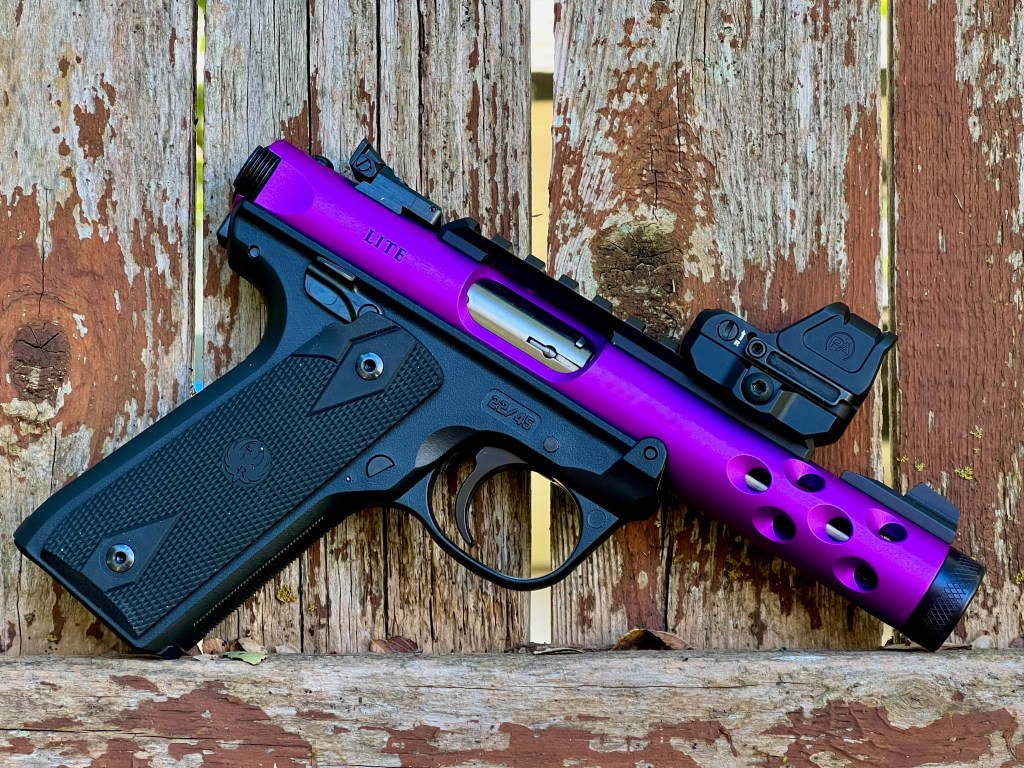
Walking this pistol from muzzle to butt we start with the threaded muzzle and muzzle thread protector. I will note that some variants do not come with a threaded barrel. I suspect that’s for legal compliance in some markets, since the non-threaded barrel is the exception rather than the rule.
Behind the muzzle is the anodized aluminum receiver. It comes in several colors, with different ventilation cut patterns around the front half or so of the 4.4 in barrel. The fixed black serrated front sight sits at the top front of the receiver. A Picatinny rail section runs essentially the full length of the receiver, from the front sight back to the black serrated adjustable rear sight. Under the rear of the rail on the right side is the ejection port, which exposes the internal cylindrical bolt with the action closed. At the very back of the receiver is the charging handle.
The charging handle, while very easy to use, is a bit of a pain. Literally. Return it slowly while still gripping it, and it tends to pinch finger tips as it meets the receiver.
Frame and Trigger Guard
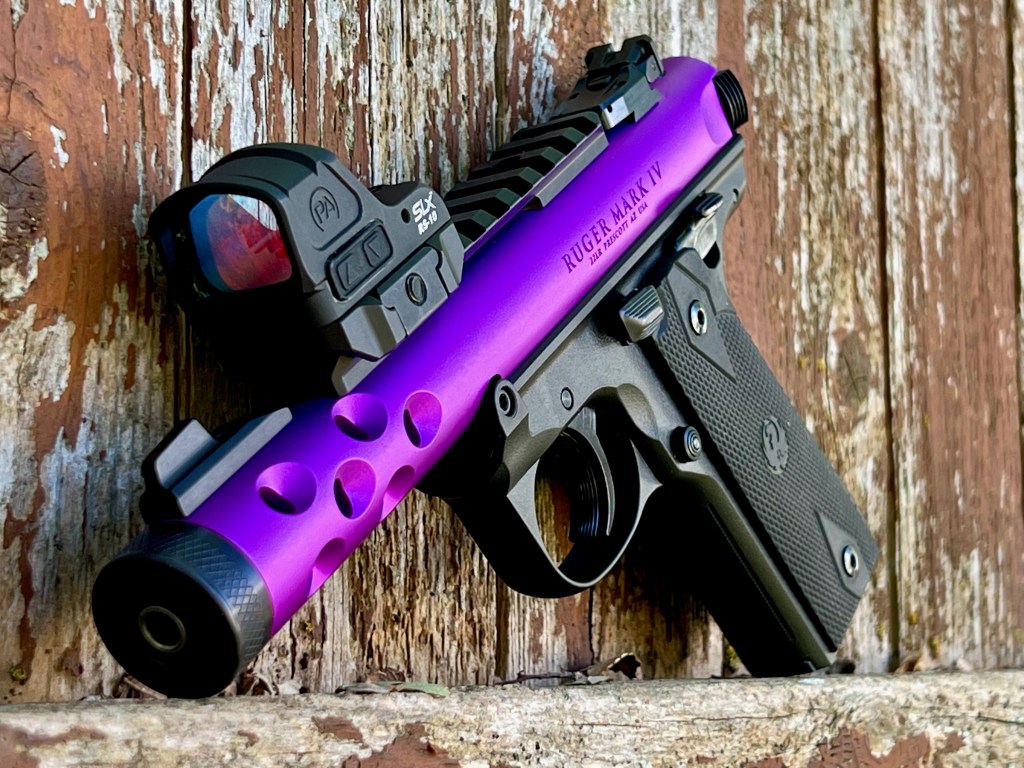
Under the receiver is the polymer frame, which begins with a trigger guard that is rounded and smooth, with no texture or ledge to park a support-hand index finger on. Not a big deal for me, but if you wrap that finger around the guard, keeping it there may take some effort even with .22 LR’s minimal muzzle rise.
The Trigger
The hinged single-action trigger sits close to the grip, which leaves plenty of room ahead of it for big hands or gloves while keeping the reach short for smaller hands. The serrated face helps keep your finger pad in the same spot when you’re shooting fast.
The trigger pull begins with about a quarter inch of pre-travel before it reaches a very noticeable wall. It breaks crisply with about 5 lbs of pressure. The reset is tactile, but subtle and not particularly short, but not crazy long either. It’s a decent factory trigger, but leaves a lot to be desired for a target or competition pistol. Thankfully there are a handful of fantastic aftermarket trigger options which can reduce the pre-travel and lighten the break. Note that the pistol includes a magazine disconnect safety. It prevents firing without a magazine inserted.
Controls, Grips and Takedown
Just behind the trigger is the magazine release button which to the best of my knowledge is not reversible. Above that is the bolt stop. It’s easy to use but sits a bit too far forward for one handed operation by folks with smaller hands or a short firing hand thumb reach (assuming right handed operation). Following the magazine release and bolt stop controls we have the 1911-style rubber grip panels. The diamond shape texture and material of the grips provide a reasonable amount of grip for this pistol. That’s especially true combined with the checkering on the front and back of the frame’s grip. Above the rear most part of the grip we have an ambidextrous manual thumb safety.
On the very back of the frame right above the beaver tail of the grip is the takedown button. Pushing it in allows the barrel receiver assembly to tilt forward and come completely off the frame. This design allows for easy removal of the bolt and traditional chamber-to-muzzle cleaning of the barrel.
Closing Thoughts
That’s the 25 oz, 8.4 in pistol in a nutshell. Ruger built it as a target pistol, and on good ammo it is remarkably precise and a lot of fun. It’s a fantastic recreational target gun, maybe a small-game handgun, and a good foundation for rimfire divisions like Steel Challenge, which is what I’m using it for. The mild recoil also makes it a great first pistol and a good one for grinding fundamentals.

Ready for Steel Challenge? Not Quite
Others interested in this pistol for Steel Challenge competition should note one thing. It’s not quite ready for a match out of the box. The first thing you’ll need to do is pick up at least three more magazines. The good news is that additional magazines run right around $20 each, which I think is reasonably affordable. They are readily available at several locations such as GunMag Warehouse, who graciously sent me a handful of them to help with this review. Beyond that, some optional upgrades will likely follow: an optic, a high visibility front sight, and a trigger upgrade. For those upgrades and others, I suggest taking a look at what the folks at Tandemkross are offering.
Will it win Steel Challenge for you? No. Will it get you to your first rimfire match without breaking the bank? Yes. Your wallet, your call.



The Ruger Mk IV Lite is, along with the KelTec P50, a gun I had absolutely *no* need to purchase, but did so without a moment’s hesitation. It is simply fun to shoot. I’m now trying to find a second for … reasons.